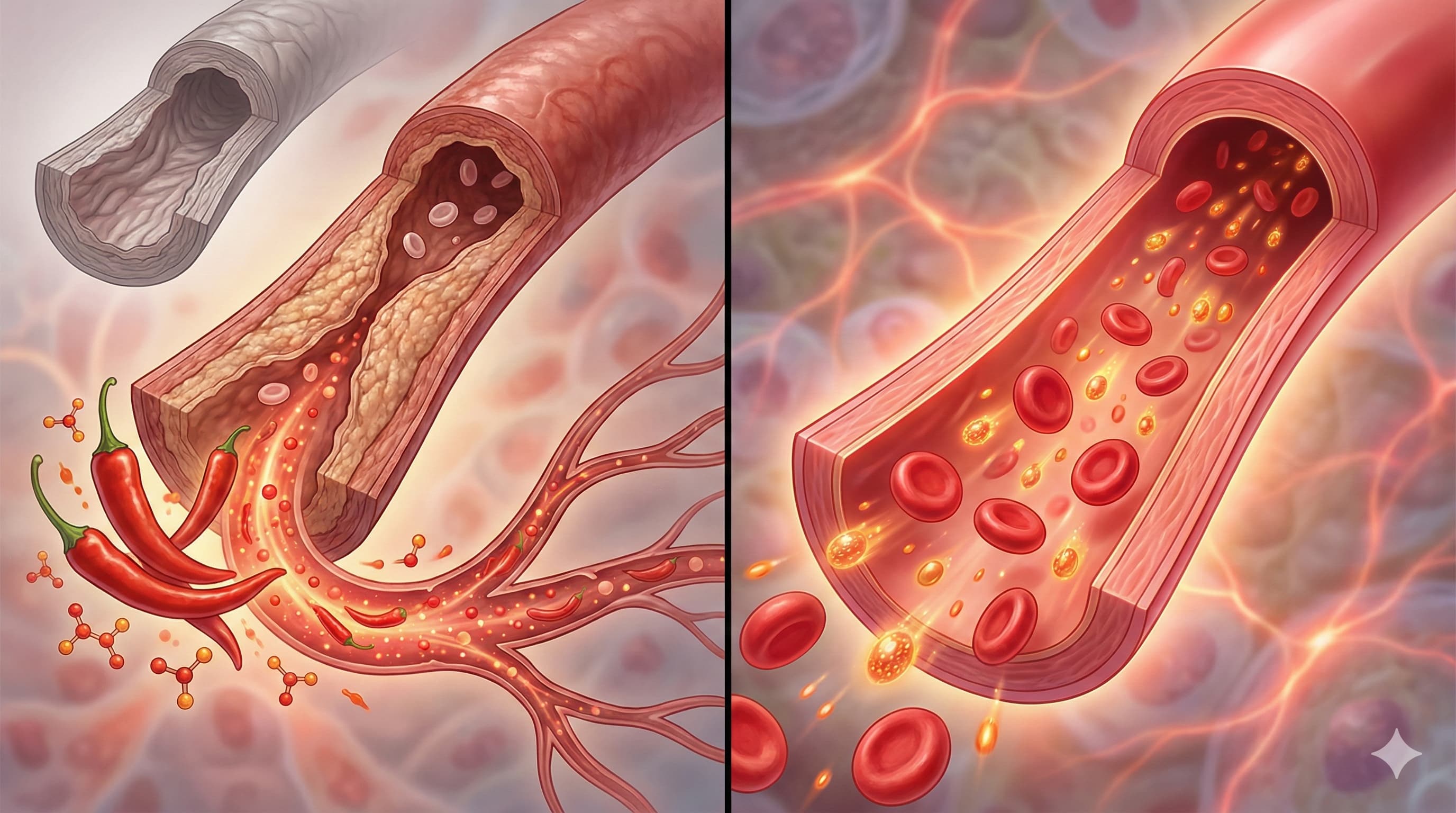
The Fire Within: How Dietary Chili Recharges the Aging Vasculature

Recent research increasingly positions the “Western diet” as a primary accelerant of biological aging, yet a specific component of global cuisines—the pungent alkaloid capsaicin—may offer a potent counter-measure. This comprehensive review, spearheaded by researchers at Central South University, China, and published in the journal Aging and Disease, synthesizes a decade of evidence suggesting that capsaicin does more than just trigger a “heat” response; it serves as a master key for the Transient Receptor Potential Vanilloid 1 (TRPV1) channel, a critical regulator of vascular health.

The “Big Idea” is the transition of capsaicin from a culinary curiosity to a legitimate geroprotective agent. As we age, our blood vessels undergo a transformation: endothelial cells (the inner lining) become senescent and stop producing nitric oxide (NO), while vascular smooth muscle cells (the outer layer) begin to calcify and stiffen. This “vascular aging” is a precursor to nearly all cardiovascular diseases. The review highlights that chronic TRPV1 activation by capsaicin triggers a calcium-dependent signaling cascade that increases the phosphorylation of endothelial Nitric Oxide Synthase (eNOS). This results in sustained vasorelaxation and a reduction in systemic blood pressure. Beyond simple mechanics, the paper details how capsaicin suppresses the Senescence-Associated Secretory Phenotype (SASP), effectively “silencing” the pro-inflammatory signals that aged cells broadcast to their neighbors. While dietary pepper consumption has long been linked to reduced all-cause mortality in large-scale human cohorts, this paper provides the mechanistic roadmap required to move toward standardized clinical protocols for vascular rejuvenation.

Paper and Journal:
Open Access Paper: Capsaicin and TRPV1: A Novel Therapeutic Approach to Mitigate Vascular Aging
Journal: Aging and disease
The impact score of this journal is 7.0 (2023 JIF), evaluated against a typical high-end range of 0–60+ for top general science (e.g., Nature, Cell), therefore this is a High impact journal. It ranks in the top Q1 for Geriatrics & Gerontology.


Part 2: The Biohacker Analysis

Study Design Specifications:

  • Type: Comprehensive Literature Review (synthesizing in vivo, in vitro, and epidemiological data).
  • Primary Models Discussed: C57BL/6 mice, ApoE-/- (atherosclerosis models), and Sprague-Dawley rats.
  • Lifespan Data: Not tested
  • Mechanistic Deep Dive:
    • Vascular Health: Activates eNOS/NO pathway via Ca2+ influx.
    • Mitochondrial Dynamics: Upregulates the PKA/UCP2 pathway, reducing oxidative stress in coronary endothelial cells. [Confidence: High]
    • Autophagy/mTOR: Capsaicin is shown to activate AMPK, which indirectly inhibits mTORC1, promoting cellular “cleanup” or autophagy. [Confidence: Medium-High]
    • Immune Microenvironment: Modulates macrophage polarization from M1 (pro-inflammatory) to M2 (anti-inflammatory), particularly in the context of atherosclerosis.

Novelty:

The paper consolidates the evidence that capsaicin acts as a senomorphic (suppressing senescent cell signaling) rather than just a senolytic. It specifically identifies the TRPV1-eNOS-NO axis as the primary target for reversing arterial stiffness.

Critical Limitations:

  1. Desensitization Paradox: Chronic high-dose exposure to TRPV1 agonists can lead to receptor desensitization (loss of function), potentially nullifying the vascular benefit.
  2. GI Erosion: High oral doses required for systemic vascular effects can cause gastric mucosal damage (but capsules and patented “microencapsulation” technology avoids these problems).
  3. Translational Gap: Human data relies heavily on epidemiological associations; rigorous Phase II clinical trials for vascular aging specifically are absent.

Part 3: Actionable Intelligence

The Translational Protocol:

  • Human Equivalent Dose (HED):
    • Math: Based on an effective mouse dose of 10 mg/kg (commonly used in exercise/metabolic studies):
    • 10 mg/kg (mouse)×(3/37)=0.81 mg/kg (human).
    • For a 70kg adult, this is ~56 mg of pure capsaicin daily.
  • Pharmacokinetics (PK/PD): Oral capsaicin has a short half-life of 1–2 hours due to rapid hepatic first-pass metabolism by CYP2C9, 2C19, and 3A4. Sustained-release formulations may be necessary for steady-state vascular protection.
  • Safety & Toxicity:
    • NOAEL: 100 mg/kg/day in rats (~8.1 mg/kg in humans).
    • LD50: ~148 mg/kg (oral rat).
    • Signals: Watch for hepatotoxicity at extremely high supplemental doses (>500mg/day).

Biomarker Verification Panel:

  • Efficacy Markers: Plasma Nitric Oxide (NO) metabolites, eNOS phosphorylation in PBMCs, and Pulse Wave Velocity (PWV) for arterial stiffness.
  • Safety Monitoring: ALT/AST (liver), Creatinine/Cystatin C (kidney), and Endoscopy if persistent GI discomfort occurs.

Feasibility & ROI:

  • Sourcing: Widely available as “Cayenne Fruit” extracts. Standardized extracts using microencapsulation (e.g., 2%–5% capsaicinoids) are preferred over raw powder for dose accuracy, and gastro-intestinal side effect risks.
  • Cost: Moderate to high (~$6:50–$12/day) at the lower pricing options.
  • ROI: High potential for blood pressure regulation and metabolic health with Moderate to High financial risk.
1 Like

Part 4: The Strategic FAQ

  1. Does chronic capsaicin cause TRPV1 “burnout”? Yes, “defunctionalization” occurs at very high doses. To maintain vascular sensitivity, intermittent dosing (5 days on, 2 days off) is hypothetically superior. [Confidence: Medium]
  2. Can I take this with Rapamycin? Yes. There is no known direct contraindication. Both activate autophagy (Rapa via mTOR, Capsaicin via AMPK). They may be synergistic.
  3. Interaction with SGLT2 inhibitors (e.g., Empagliflozin)? Both lower blood pressure. Monitor for orthostatic hypotension. [Probability of interaction: High]
  4. Interaction with PDE5 inhibitors (e.g., Tadalafil)? Caution. Both increase Nitric Oxide. Concurrent use may lead to a significant drop in blood pressure.
  5. Is “non-pungent” capsiate as effective? Preliminary data suggests capsiate activates TRPV1 in the gut but has lower systemic bioavailability than capsaicin.
  6. Does it affect the gut microbiome? Yes, it increases Akkermansia muciniphila, mimicking some of the benefits of metformin. [Source: ResearchGate]
  7. Is it a senolytic? No, it is a senomorphic. It makes senescent cells “behave” better rather than killing them.
  8. Will it help with lung aging? The mechanism (vascular regeneration) is systemic; thus, it may improve pulmonary hemodynamics.
  9. What is the best time to dose? With meals, to reduce gastric irritation and take advantage of its effect on postprandial glucose.
  10. Contraindications? Avoid if you have active peptic ulcers, GERD, or are on potent CYP3A4 inhibitors, which could spike systemic levels dangerously.

Data Gaps: We lack human longitudinal data on whether supplemental capsaicin (vs. dietary) reduces arterial calcification over 5+ years. Additional data on the “desensitization threshold” in humans is required for optimal protocol design.

The following analysis identifies the most cost-effective procurement options for standardized Cayenne Fruit extract capsules (2%–5% capsaicinoids) available for shipment within the United States. Cost efficiency is measured by the price per 60 mg of capsaicinoids, a dosage frequently employed in clinical literature to achieve significant AMPK activation and metabolic upregulation.

Gastrointestinal and Taste Side Effects

The consumption of high-concentration capsaicinoids presents distinct physiological challenges due to the activation of TRPV1 receptors throughout the alimentary canal.

Mitigation via Beadlet Technology

Raw or non-encapsulated form, capsaicinoids act as severe irritants to the mucosal lining of the esophagus and stomach. Standardized products like Capsimax® utilize OmniBead™ technology (microencapsulation) to address these issues.

  • Controlled Release: These beadlets are designed to remain intact through the stomach’s acidic environment, releasing the capsaicinoids only in the higher-pH environment of the lower intestine.
  • Tolerability: Clinical trials have demonstrated that this delivery system allows for dosages of up to 10 mg/day with minimal to no reports of gastric distress compared to raw powder.

Delivery Technologies: Solving the Gastric Limiter

The constraint of “2% standardization” inherently necessitates advanced delivery systems. Pure 2% capsaicinoid powder is a potent irritant. To sell this legally and safely as a dietary supplement, manufacturers utilize one of two patented technologies:

  1. OmniBead™ (Capsimax®): This technology, developed by OmniActive Health Technologies, utilizes a melt-spray encapsulation process. The concentrated capsaicinoid extract is encased in a controlled-release coating (often sucrose and cellulose gum) that is pH-sensitive. It remains intact in the low pH of the stomach and dissolves in the higher pH of the intestines, preventing gastric burning. This is the dominant form found in sports nutrition.
  2. FenuMat™ (Capsifen®): Developed by Akay Bioactives, this technology utilizes “green chemistry” to encapsulate the extract within a galactomannan hydrogel derived from Fenugreek fiber. This matrix is mucoadhesive and allows for sustained release. It is the form utilized by Life Extension.

Cost Analysis of Standardized Cayenne Extracts (2%–5% Capsaicinoids)

Standard commercial cayenne (40,000 SHU) typically contains only ~0.25% capsaicinoids. To reach the requested 2%–5% range, specialized delivery systems like Capsimax® (2% capsaicinoids) or high-potency standardized extracts are required.

Key Findings and Strategic Recommendations

The market analysis reveals a bifurcation in the cayenne supplement sector. The vast majority of retail products (estimated at >90% of SKUs) are standardized to 40,000 SHU, yielding a negligible capsaicinoid content of approximately 0.25%. These products fail to meet the 2% threshold and have been systematically excluded.

The compliant market segment is dominated by two patented delivery technologies: Capsimax®(OmniActive Health Technologies) and Capsifen® (Akay Natural Ingredients). These technologies utilize encapsulation (beadlets or fenugreek fiber matrices) to bypass gastric irritation, enabling the delivery of the required 2% concentration.

Procurement Winner: The analysis identifies Life Extension Thermo Weight Control as the undisputed leader in cost efficiency. Utilizing the Capsifen® ingredient at a clinical dose of 100mg per capsule, it delivers the target active compound at a cost of $6.75 per 60mg. This represents a cost variance of -59% compared to the second-ranked option and -96% compared to the most expensive option on the list.

Top 3 Recommended Sources:

  1. Life Extension Thermo Weight Control: Best overall value; utilizes Capsifen® technology; high reliability via Walmart/Life Extension logistics.
  2. MST Nutrition Capsimax: Highest value for the specific Capsimax® branded ingredient; pure formulation without stimulants.

Quantitative Sourcing Data: Top 10 Lowest-Cost Sources (USA pricing)

The following table presents the verified top 10 sources, ranked by their cost efficiency in delivering the active capsaicinoid compound.

Table 1: Top 10 Sources for Standardized Cayenne Extract (2%–5% Capsaicinoids)

Rank Product/Brand Name Vendor Total Weight (Capsules) Total Price (USD) Extract Dosage (per Cap) Active Capsaicinoids (per Cap) Cost Per 60mg Active (USD) Capsules Needed for 60mg URL
1 Life Extension Thermo Weight Control Walmart / Life Extension 60 Veg Caps $13.50 100 mg (Capsifen®) 2.00 mg $6.75 30 Link1
2 MST Nutrition Capsimax Supplement eBay (Official MST) 60 Veg Caps $32.99 100 mg (Capsimax®) 2.00 mg $16.50 30 Link2
3 Old School Labs Vintage Burn eBay / Old School Labs 120 Veg Caps $49.95 50 mg (Capsimax®) 1.00 mg $24.97 60 Link4
4 Kaged Clean Burn Capsules Amazon / Kaged 180 Veg Caps $24.99 16.5 mg (Capsimax®) 0.33 mg $25.24 182 Link6
5 Jacked Factory Burn-XT Walmart 60 Veg Caps $19.98 25 mg (Capsimax®) 0.50 mg $39.96 120 Link8
6 Inno Supps Inno Shred Gosupps / Inno Supps 60 Veg Caps $49.99 50 mg (Capsimax®) 1.00 mg $49.99 60 Link10
7 RSP QuadraLean Thermo iHerb 180 Caps $29.97 8.33 mg (Capsimax®) 0.17 mg $59.94 353 Link12
8 Jacked Factory Burn-XT Stim Free Walmart 60 Veg Caps $29.99 25 mg (Capsimax®) 0.50 mg $59.98 120 Link9
9 Force Factor LeanFire iHerb 30 Veg Caps $10.32 12.5 mg (Capsimax®) 0.25 mg $82.56 240 Link14
10 The Genius Brand Genius Burn iHerb 60 Veg Caps $49.99 12.5 mg (Capsimax®) 0.25 mg $199.96 240 Link16

Logistics & Shipping Summary:

  • Walmart (Rank 1, 5, 8): Offers robust domestic logistics with 2-day shipping options. Free shipping is typically available on orders exceeding $35.
  • eBay (Rank 2, 3): Shipping times vary by seller. Rank 2 (MST) is sold by an official reseller; verify current lead times before bulk purchase.
  • iHerb (Rank 7, 9, 10): Excellent for consolidated shipping. Offers flat-rate domestic shipping (often free over $30) and reliable tracking.
  • Amazon (Rank 4): Standard Prime logistics apply. High reliability for stock and delivery speed.
  • Gosupps (Rank 6): Fixed rate delivery of $19.99 is noted in some snippets, which may affect the final landed cost for small orders.18

Impact on Microbiota and SCFA Production

Emerging evidence suggests that capsaicinoids modulate the gut-brain-metabolic axis through the microbiome.

  • Akkermansia Upregulation: Murine studies indicate that capsaicin increases the relative abundance of Akkermansia muciniphila, a bacterium strongly associated with improved metabolic health and intestinal barrier integrity.
  • Short-Chain Fatty Acids (SCFAs): Capsaicin has been shown to shift microbial populations toward SCFA producers, specifically increasing concentrations of acetate and propionate.
  • The Butyrate Link: While butyrate production is primarily driven by fiber/resistant starch (e.g., Green Banana Flour), capsaicinoids may synergistically support colonic health by reducing local inflammation, though human data on the specific 5% standardization impact on butyrate remains a knowledge gap.

Scholarly Gaps: * Human Longitudinal Data: Most microbiota/SCFA data is derived from animal models; the dose-dependent response in the human colonic environment requires further RCTs.

  • Synergy with Prebiotics: The potential for synergistic effects when combining capsaicinoids with resistant starch (Type 2) to optimize butyrate synthesis is a promising but under-researched area of longevity science.

Full Gemini Procurement Analysis: https://gemini.google.com/share/f8a191bb5811

See my post here, if you want the AI prompt to recreate the pricing analysis for your country: Using AI for Health and Longevity and Research - Your Favorite Prompts - #69 by RapAdmin

1 Like