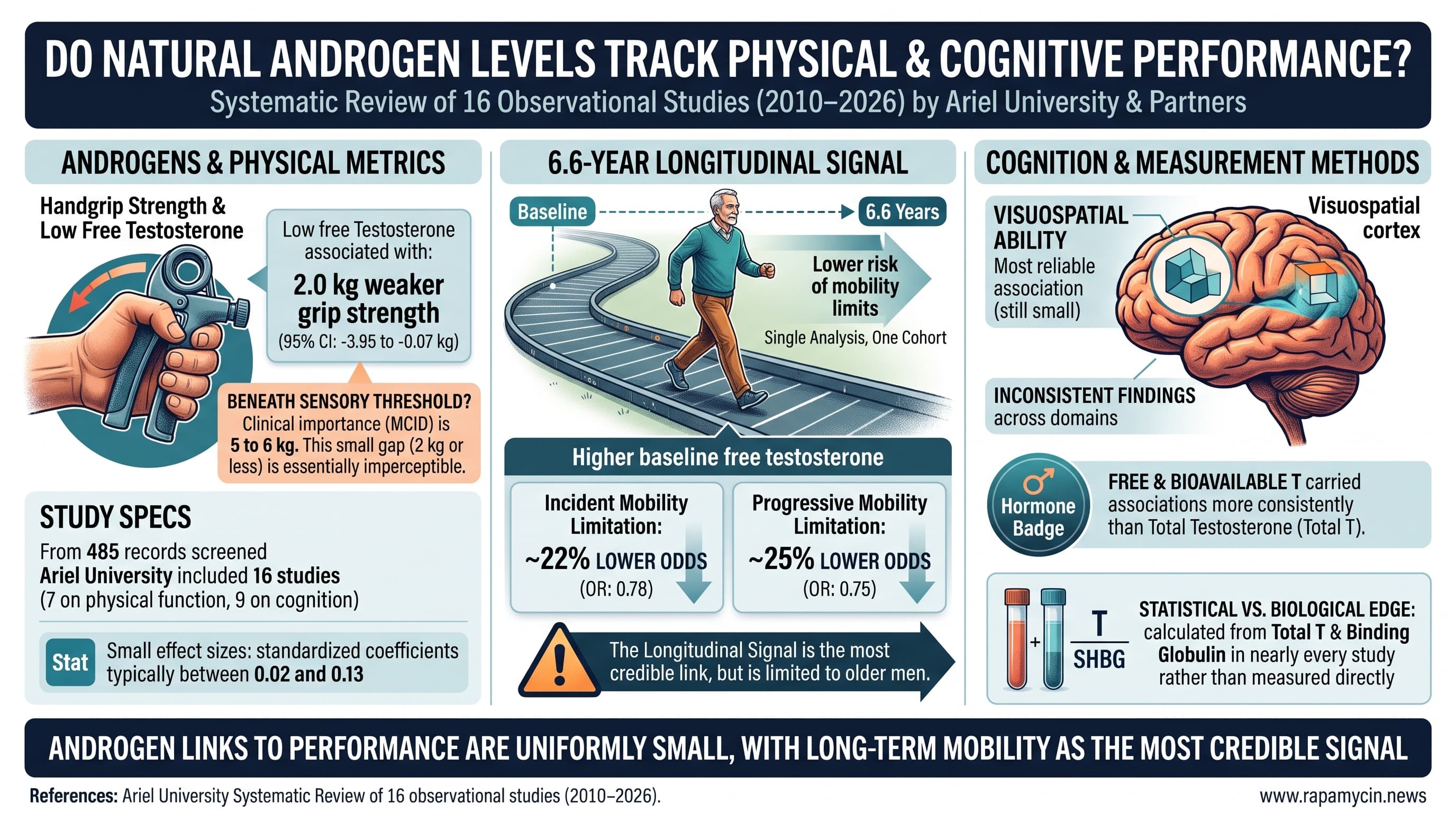
This systematic review from Ariel University and collaborating Israeli centers asked whether naturally occurring androgen levels track physical and cognitive performance in healthy middle-aged men. Following PRISMA guidelines with prospective PROSPERO registration, the authors searched three databases for observational studies published between 2010 and 2026, screened 485 records and included 16: seven on physical function and nine on cognition. Free and bioavailable testosterone showed small positive associations with grip strength more consistently than total testosterone, and one longitudinal analysis found higher baseline free testosterone predicted lower risk of mobility limitation over 6.6 years. Cognitive findings were inconsistent across domains, with visuospatial ability showing the most reliable association. Effect sizes were uniformly small, standardized coefficients typically between 0.02 and 0.13.
Testosterone falls by roughly one to three percent per year from a man’s fourth decade onward. Around forty percent of middle-aged men eventually meet a laboratory definition of low testosterone. What that means for how they function has never been clear, because symptoms correlate poorly with the number on the lab report.
A team led by Dan Keren at Ariel University narrowed the question. Rather than asking whether giving men testosterone helps, which has been studied extensively in older and sick populations, they asked whether a man’s own hormone levels in midlife predict how well his body and mind work. They restricted the search to healthy men and to objective measurements: grip strength, walking speed, chair rises, memory tests, processing speed.
Sixteen studies qualified. Seven examined physical performance, nine examined cognition.
The physical side produced the more coherent picture. Across six studies measuring grip strength, free and bioavailable testosterone were associated with stronger grip more consistently than total testosterone. The distinction matters mechanically: most testosterone circulates bound to a carrier protein and is unavailable to tissue, so the free fraction should track biological effect better.
The single longitudinal result is the most useful finding in the review. In the Framingham Offspring cohort, men with higher free testosterone at baseline had a lower risk of developing mobility limitation over the following 6.6 years, with roughly a quarter lower odds. Total testosterone predicted nothing.
The cognitive side was messier. Nine studies, almost no agreement. Visuospatial ability showed the most consistent link to testosterone. Verbal and episodic memory produced contradictory results: one study found higher urinary testosterone predicted better word recall, another found free testosterone predicted worse recall, and a third found the direction depended entirely on a man’s cortisol level.
The size of all of this is the part that gets lost. Standardized coefficients for grip strength clustered between 0.09 and 0.13, meaning testosterone accounted for roughly one to two percent of the differences between men. One walking speed association had a coefficient of 0.02, which is indistinguishable from nothing. The grip strength difference between men with low and normal free testosterone was 2 kilograms, with a confidence interval reaching down to 0.07 kilograms. Typical male grip strength is 40 to 50 kilograms, and the smallest difference people can perceive is usually put at 5 to 6 kilograms.
The authors also report, in their discussion rather than their abstract, the finding that should anchor interpretation. Large randomized trials of testosterone treatment in men with hypogonadism have produced gains in muscle mass and strength but modest and inconsistent effects on actual physical performance, and no cognitive benefit at all.
That gap between observation and intervention is the familiar shape of a confounded association. Men who are more active, leaner and healthier have higher testosterone and also walk faster and grip harder. Fourteen of the sixteen studies measured everything at a single moment, which cannot separate those possibilities.
Actionable Insights
- The measurable associations are too small to act on individually. Standardized coefficients for testosterone and grip strength ran from 0.09 to 0.13, accounting for roughly 0.8% to 1.7% of between-person variation. For context, a coefficient of 0.2 is conventionally the floor for a meaningful effect.
- The one concrete clinical number is below the threshold people can feel. Men with low free testosterone had grip strength 2.0 kg weaker (95% confidence interval -3.95 to -0.07 kg). The minimal clinically important difference for grip strength is usually cited at 5 to 6 kg, and the upper bound of this interval is essentially zero.
- If you are tracking hormones, free or bioavailable testosterone carried the associations more consistently than total testosterone. Note that free testosterone was calculated from total testosterone and binding globulin in nearly every study rather than measured directly, so part of its apparent advantage may be statistical rather than biological.
- The longitudinal signal is the most credible: higher baseline free testosterone predicted about 22% lower odds of incident mobility limitation and 25% lower odds of progressive limitation over 6.6 years (odds ratios 0.78 and 0.75). This is one analysis in one cohort of older men.
- Treatment does not reproduce the observation. The review cites 2025 evidence that testosterone therapy in hypogonadal men increases muscle mass and strength but has modest, inconsistent effects on physical performance and no cognitive benefit.
Context and Source
- Paywalled Paper: Endogenous androgens, physical and cognitive function in healthy midlife men: A systematic review
- Institutions: Faculty of Health Sciences, Department of Physical Therapy, Neuromuscular and Human Performance Laboratory, Ariel University; Division of Maternal Fetal Medicine, Helen Schneider Women’s Hospital, Rabin Medical Center, Petah Tikva; Sheba Longevity Center, Sheba Medical Center, Ramat Gan; Gray Faculty of Medical and Health Sciences, Tel Aviv University; Department of Management, Health Management Program, Bar-Ilan University
- Country: Israel
- Journal: Mechanisms of Ageing and Development, volume 234 (2026), article 112257
- Impact evaluation: The impact score of this journal is 4.9, evaluated against a typical high-end range of 0 to 60+ for top general science, therefore this is a Low impact journal.