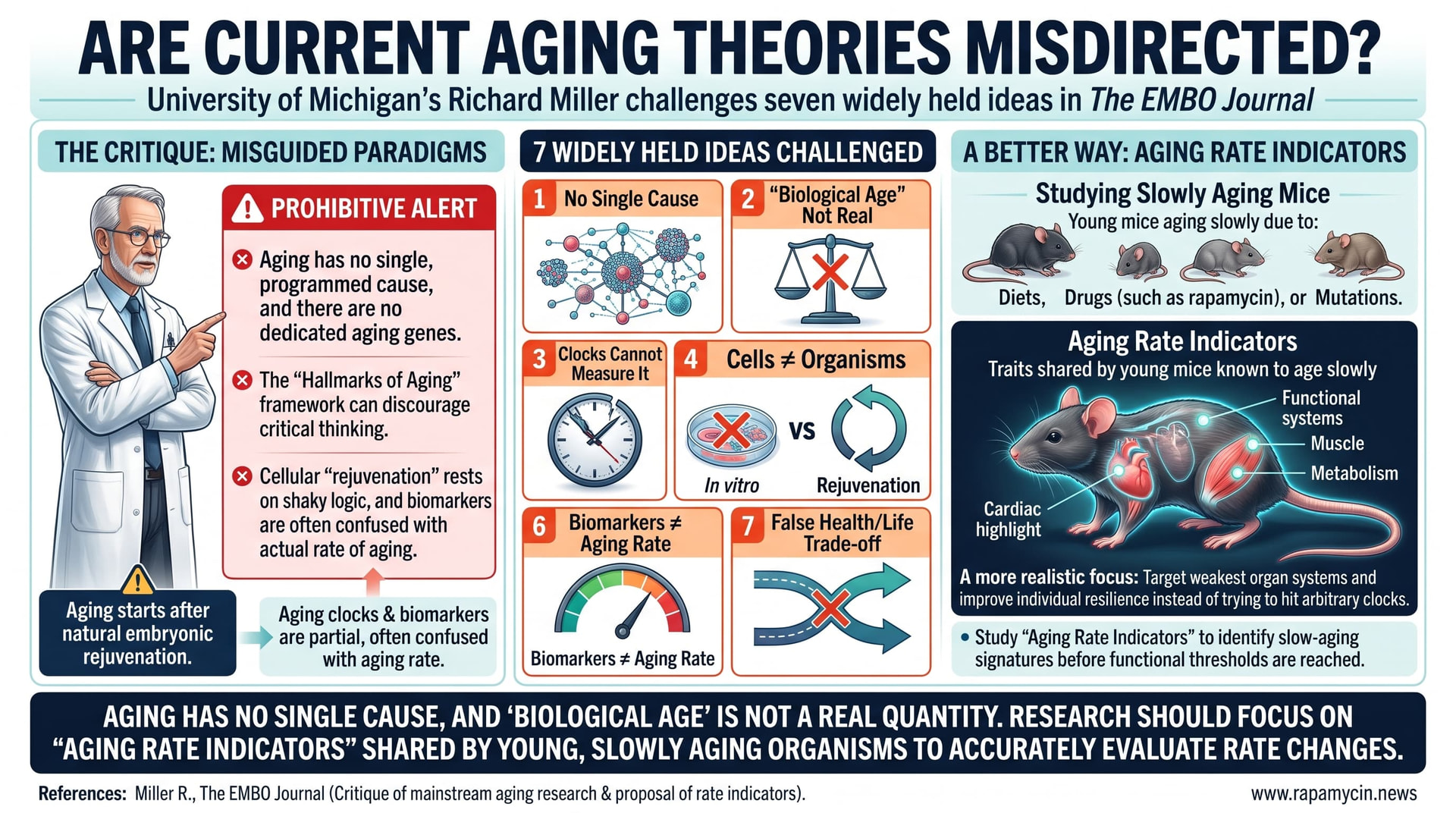
In an opinion piece in The EMBO Journal, University of Michigan biogerontologist Richard Miller argues that seven widely held ideas are misdirecting aging research. In his view, aging has no single cause, “biological age” is not a real quantity, aging clocks cannot measure it, cultured cells do not age the way organisms do, cellular “rejuvenation” rests on shaky logic, biomarkers of age are being confused with measures of aging rate, the healthspan-versus-lifespan split is a false trade-off, and the Hallmarks of Aging framework discourages critical thinking. He proposes studying “aging rate indicators”: traits shared by young mice that are known to be aging slowly because of drugs, diets or mutations.
Few people have shaped mouse longevity research more than Richard Miller. As one of the lead investigators of the US National Institute on Aging’s Interventions Testing Program, he has spent two decades feeding candidate drugs to thousands of genetically diverse mice and recording when they die. In a new commentary in The EMBO Journal, he turns his attention from the mice to the scientists, arguing that much of the field is chasing ideas that collapse under careful thought.
His starting point is a definition. Aging, he insists, happens to a whole organism: it is the process that turns a healthy college sophomore into a 75-year-old with weaker muscles, worse hearing and a steadily rising risk of death. Cells in a dish do not age in that sense, and using one word for both has, in his view, sent researchers down blind alleys.
The first casualty is the hunt for a single cause of aging. Cancer, muscle loss, cognitive decline and weakened immunity each arise from tangled webs of contributing factors. Expecting one master cause behind all of them ignores what is already known.
Next is “biological age”, the idea that each person carries a hidden number that can be higher or lower than their birthday count. Miller compares this to merging someone’s talents for dancing, wine tasting and car sales into one “skilledness” score. Squashing many independent traits into one number throws away information.
Commercial aging clocks fare worse. Miller cites a 2023 study in which a transcription-based clock showed pregnant women aging rapidly and then growing younger after delivery, with similar reversible swings after emergency surgery and severe COVID-19. The authors read this as stress raising biological age. Miller’s reading: a watch that speeds up on a pregnant woman’s wrist and runs backward after the birth is simply a bad watch.
Cellular senescence, a hot commercial area, also takes a hit. Mouse telomeres are long and mouse cells do not senesce in culture the way human cells do, yet mice develop cancer, cataracts, deafness and cognitive decline much as people do. Apart from one unreplicated 2016 study, he says, no good evidence shows that clearing senescent cells extends lifespan, and the largest mouse trial of the senolytic fisetin found neither longer life nor fewer senescent cells.
He also rejects the fashionable stance that researchers should pursue healthspan but not lifespan. In mice, dogs and horses, longer-lived animals tend to stay healthier for longer. Health and longevity move like an elevator, not a seesaw.
His alternative is to stop comparing young and old animals and instead compare young animals that are known to be aging at different speeds, such as mice on rapamycin or restricted diets, or long-lived mutant strains. Traits shared across these unrelated slow-aging models could serve as a speedometer for aging rather than an odometer. They might also rescue human trials, which by his own calculation would need more than 1,100 volunteers to detect a drug that halves the yearly decline of a typical biomarker within one year.
This is an opinion essay, not a study, and many of its targets will push back. But its central warning, that a sophisticated-looking number is not a measured biological truth, applies to anyone paying for an aging test.
Actionable insights
- Be wary of judging a supplement with a clock. Miller’s worked example assumes a biomarker whose person-to-person spread (30 units) is three times larger than one year of aging change (10 units). A drug that halves the aging rate shifts the result by just 5 units in a year, an effect size of about 0.17 standard deviations. That is very small: you would need about 567 people per group to detect it reliably. With 50 per group, the chance of detecting a real effect is only 13% after one year. A single person’s before-and-after test cannot separate that signal from noise.
- Time any clock test away from illness, surgery or pregnancy. These events produced large, temporary swings in one published clock.
- Track function directly. Grip strength, lung function, contrast vision and hearing may be as informative as costly molecular tests, and you can repeat them cheaply.
- Discount senolytic claims for now. Fisetin did not extend lifespan in the most rigorous mouse test.
- Keep perspective on the mouse winners. Astaxanthin lengthened median male mouse lifespan by 12% and meclizine by 8%, with no significant benefit in females. There are no human lifespan data for either.
Context and source
- Open Access Paper: Seven ways not to think carefully about aging, Published: 27 October 2026.
- Author and institution: Richard A Miller, Department of Pathology and Paul Glenn Center for Biology of Aging, University of Michigan, Ann Arbor
- Country: United States
- Journal: The EMBO Journal (EMBO Press), published online 27 October 2026
- Impact evaluation: The impact score of this journal is 8.7 (2025 JIF), evaluated against a typical high-end range of 0-60+ for top general science, therefore this is a High impact journal. It is a flagship society journal in molecular biology