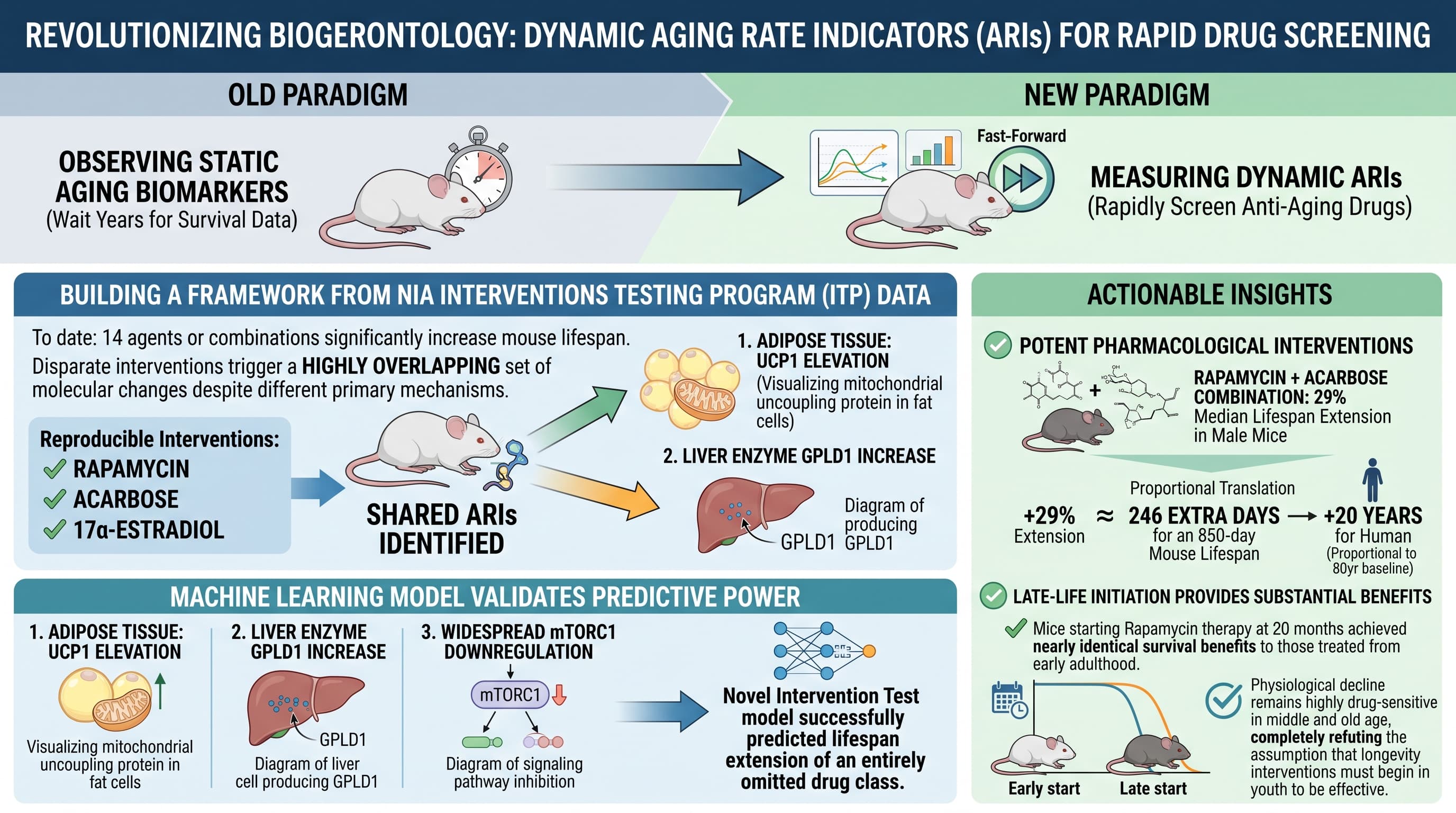
This new paper by Steven N. Austad, Matt Kaeberlein and Richard A. Miller outlines a conceptual shift in biogerontology from observing static aging biomarkers to measuring dynamic Aging Rate Indicators (ARIs). By identifying physiological and molecular changes shared across multiple lifespan-extending interventions in mice, the authors propose a framework to rapidly screen anti-aging drugs without waiting years for survival data. Preliminary machine learning models using these ARIs have successfully predicted drug efficacy in novel test cohorts, suggesting a practical roadmap for accelerating both preclinical discovery and human clinical trials.
The central thesis of this research is that traditional aging biomarkers function like biological odometers, whereas true ARIs function like biological speedometers. Biomarkers accumulate over time and require longitudinal tracking across many years to detect whether an intervention has slowed the aging process. In contrast, ARIs transition rapidly from a normal state to a “slow-aging” state shortly after an effective intervention begins. This rapid physiological pivot allows researchers to assess the efficacy of a candidate longevity drug in a matter of months rather than decades.
The authors build this framework on data from the National Institute on Aging Interventions Testing Program. To date, the program has identified 14 agents or combinations that significantly increase mouse lifespan. Among these, rapamycin, acarbose, and 17a-estradiol extend lifespan reproducibly. Crucially, the researchers discovered that these disparate interventions trigger a highly overlapping set of molecular changes despite their different primary mechanisms of action. Shared ARIs include the elevation of uncoupling protein 1 (UCP1) in adipose tissue, increased production of the liver enzyme GPLD1, and widespread downregulation of the mTORC1 pathway.
To validate the predictive power of these indicators, the researchers utilized an extreme gradient boosting machine learning model applied to plasma metabolomic data from 12-month-old mice. The model was trained on a subset of the effective interventions and then successfully predicted the lifespan extension properties of an entirely omitted drug class. This “novel intervention test” proves that shared metabolomic signatures can accurately forecast long-term survival outcomes.
Translating these findings from murine models to human clinical trials remains the ultimate objective. Validated plasma ARIs could bypass the need for multi-decade human longevity trials, which are financially and logistically prohibitive. Instead, healthy middle-aged adults could undergo a short-term intervention protocol to see if their plasma metabolites shift into a recognized slow-aging profile. This approach directly answers the economic and regulatory bottlenecks that currently suppress the development of preventative geroprotectives.
Insights
The data highlights several practical takeaways for optimizing healthspan. Rapamycin and acarbose remain the most potent pharmacological interventions for mammalian longevity. The combination of rapamycin and acarbose yields a 29 percent median lifespan extension in male mice. In absolute terms, a 29 percent extension applied to an 850-day mouse lifespan equals roughly 246 additional days of healthy life. If translated proportionally to a human baseline expectancy of 80 years, the standardized effect size mimics an absolute gain of over 20 years.
Furthermore, the research confirms that late-life initiation of geroprotectives provides substantial benefits. Mice starting rapamycin therapy at 20 months of age achieved nearly identical survival benefits to those treated from early adulthood. This indicates that physiological decline remains highly drug-sensitive in middle and old age, completely refuting the assumption that longevity interventions must begin in youth to be effective.
Finally, the study highlights a severe sex-specific disparity in drug efficacy. Nine of the 14 successful interventions worked exclusively in male subjects, and agents like canagliflozin actually proved toxic to older female subjects at standard dosages. Precision dosing must account for sex-specific pharmacodynamics to maximize efficacy and limit toxicity.
Context/Source
- Open Access Paper: Aging rate indicators and the search for anti-aging drugs
- Institution: University of Alabama at Birmingham, Optispan Inc., University of Michigan
- Country: United States
- Journal: Frontiers in Science
- Impact Evaluation: The impact score of this journal is 5.0, evaluated against a typical high-end range of 0 to 60+ for top general science, therefore this is a Medium impact journal.