Reversing Inflammaging: How the Thymus Hormone Thymulin Restores Antitumor Immunity

Chronic inflammation increases with advancing age and actively drives cancer progression while blunting the efficacy of medical treatments. This study identifies thymulin, a naturally occurring peptide produced by the thymus gland, as a critical systemic regulator that suppresses pro-inflammatory immune cells. Because thymic function and thymulin levels decline with age, older individuals suffer from unrestrained immune activation. Supplementing older subjects with thymulin successfully reduced systemic inflammation, slowed tumor growth, and restored the effectiveness of immune checkpoint inhibitors.

Aging fundamentally rewires the immune system. A primary hallmark of this biological decline is inflammaging, a persistent state of low grade systemic inflammation. This sterile inflammation is driven by the overactivity of myeloid cells, which overproduce specific cytokines including interleukin 1 alpha, interleukin 1 beta, interleukin 6, and tumor necrosis factor alpha. This highly reactive environment degrades healthy tissue function, acts as a catalyst for cancer progression, and severely blunts the efficacy of modern immunotherapies.

Researchers sought to decode the precise mechanisms governing this age related inflammatory surge. They mapped the immune profiles of young and aged mice, identifying a massive expansion of pro-inflammatory myeloid cells in the older cohort. To determine if this state was fixed or reversible, the team surgically connected the circulatory systems of young and old mice in a procedure known as heterochronic parabiosis. Exposure to youthful blood rapidly suppressed the inflammatory activation of aged myeloid cells, proving that circulating systemic factors dictate the immune aging phenotype.

To isolate the exact origin of this inflammatory dysregulation, the researchers utilized heterochronic bone marrow chimeras. They transplanted aged bone marrow into young mice and young bone marrow into aged mice. The host environment, rather than the intrinsic age of the bone marrow cells, dictated the inflammatory output. Aged immune cells placed in a young host environment ceased their overproduction of inflammatory cytokines. This proved that a circulating factor produced by non bone marrow tissues in young animals was responsible for keeping the immune system regulated.

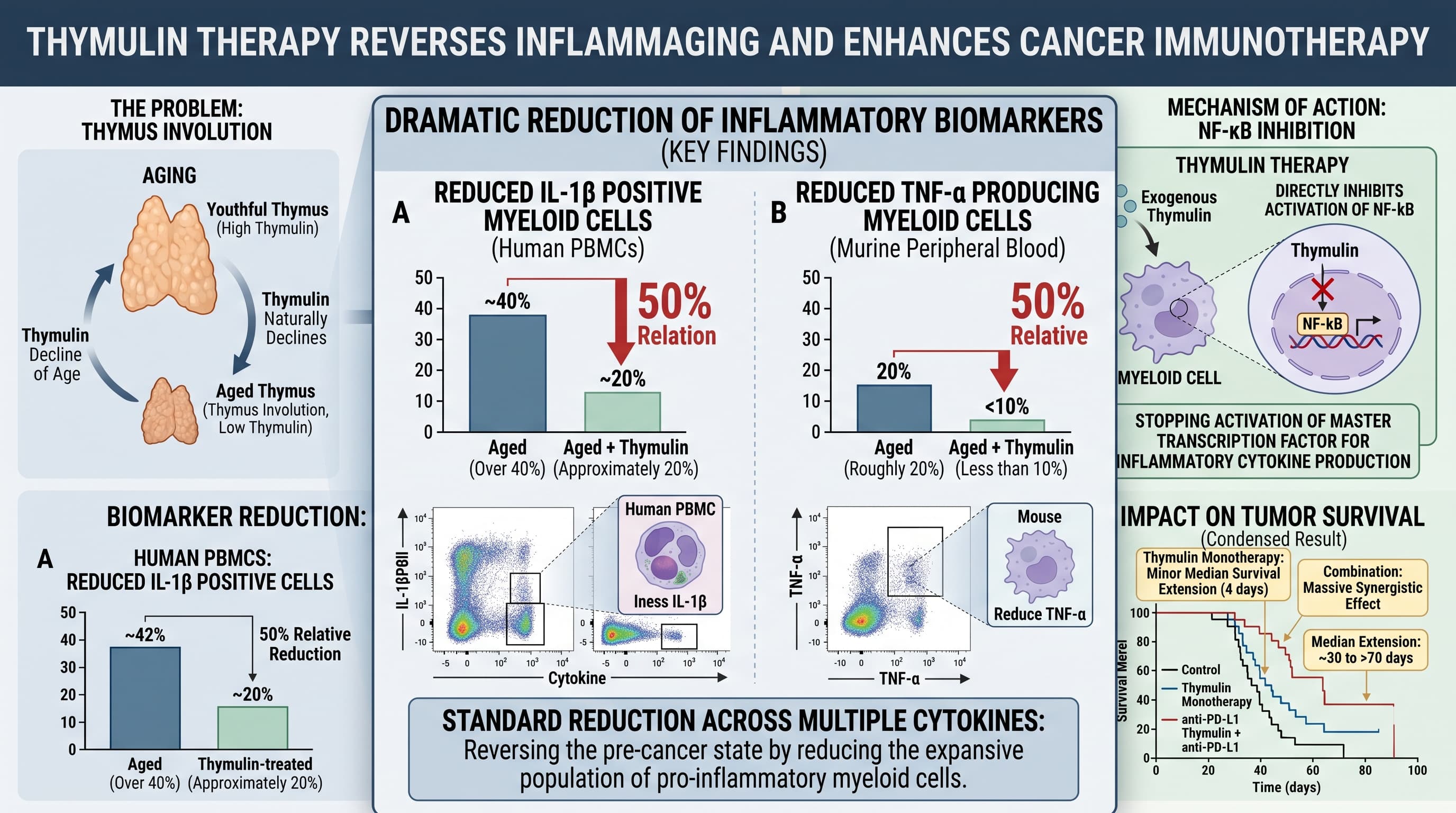
Through rigorous pathway analysis, the researchers traced the source of these youthful circulating factors to the thymus. The thymus is an organ that shrinks and loses cellular function early in life. They identified thymulin, a thymus derived peptide, as the critical mediator. Thymulin levels are high in youth but drop precipitously with advancing age. When researchers administered daily thymulin injections to aged mice, the treatment halved the frequency of circulating inflammatory myeloid cells. At the molecular level, thymulin achieves this by blocking the NF-kB signaling pathway, effectively turning off the genetic switches that produce inflammatory cytokines.

The clinical implications for oncology are profound. In preclinical breast cancer models, aged mice exhibited accelerated tumor growth and zero survival response to standard anti-PD-L1 immunotherapy. However, when aged mice received thymulin, tumor growth slowed significantly. Furthermore, thymulin conditioning sensitized the tumors to immunotherapy. The combination of thymulin and immune checkpoint blockade extended survival in older mice, effectively rescuing their immune systems from age related dysfunction. This research pivots the focus of immune rejuvenation from complex cellular reprogramming to practical endocrine restoration.

Actionable Insights

For individuals focused on extending healthspan, this study highlights the critical role of thymic health in controlling systemic inflammation. The thymus functions as an endocrine organ that keeps innate immune cells from turning chronically destructive.

The primary takeaway is that age related immune dysfunction is biochemically reversible. Supplementing the aged immune system with thymulin reversed the inflammatory output of myeloid cells by approximately 50 percent. In practical terms, treating older mice with thymulin reduced the population of circulating cells producing tumor necrosis factor alpha from nearly 20 percent down to 10 percent. This absolute reduction of 10 percentage points represents a massive relative drop, cutting the systemic inflammatory burden in half.

Furthermore, thymulin administration increased median survival times in aged tumor bearing mice by over 25 percent even without concurrent therapies. When combined with immunotherapy, survival extensions were highly pronounced. While direct human thymulin supplementation requires clinical trials, these findings validate interventions that preserve thymic mass. Nutritional and lifestyle practices that delay thymic involution may indirectly sustain endogenous thymulin production, thereby suppressing inflammaging and mitigating associated disease risks.

Context and Source

3 Likes

Biomarker Data (Effect Size Calculation) from Nature Communications Study

  • Ex vivo treatment of human PBMCs with thymulin reduced the frequency of IL-6 producing myeloid cells in aged human donors from approximately 30 percent to 15 percent, representing a 50 percent relative reduction.

  • In vivo survival metrics strongly suggest therapeutic efficacy. In the E0771 breast cancer model, median survival for vehicle treated aged mice was exactly 27 days. Thymulin treatment extended median survival to 34 days, representing a 26 percent absolute time extension.

  • The reduction in inflammatory cytokine production exhibits a highly substantial standardized effect. Observing the reduction of TNF-alpha positive CD11b cells in aged mice, the drop from 20 percent to 10 percent with exceptionally low variance yields an estimated Cohen’s d greater than 1.5, indicating a massive practical effect size.

The Next Obvious Step: Phase 1 Clinical Trials for recombinant thymulin as an aging therapeutic

Clinical evaluation of recombinant thymulin as a longevity therapeutic must prioritize its capacity to resolve age-associated myeloid inflammation. Because thymulin is a nonapeptide that relies on an equimolar concentration of zinc for biological activation, trial formulations must co-administer the peptide with bioavailable zinc to ensure proper conformational folding. Delivery will likely necessitate subcutaneous or intramuscular injections to bypass gastrointestinal enzymatic degradation, mirroring standard peptide therapeutic protocols. Efficacy endpoints should directly track the systemic inflammatory burden by measuring reductions in circulating IL-1a, IL-1b, IL-6, and TNFa.

Small Phase 1 clinical trials consisting of 15 to 30 participants must initially establish safety, tolerability, and the missing human pharmacokinetic profile. Preclinical data currently lacks half-life and clearance metrics for exogenous thymulin administration. A dose-escalation design is required to identify the minimum biologically active dose that suppresses NF-kB signaling in myeloid cells without inducing off-target immunosuppression. Primary safety endpoints must include monitoring for autoimmune exacerbations or opportunistic infections. Secondary pharmacodynamic evaluations should utilize peripheral blood mononuclear cell profiling via multi-color flow cytometry to quantify shifts in the frequency of pro-inflammatory CD33+ CD11b+ myeloid populations before and after administration.

The optimal target demographic for early-stage trials consists of older adults, specifically ages 65 to 80, who display a measurable inflammaging phenotype. To avoid confounding variables, screening criteria must select for elevated baseline markers of chronic sterile inflammation, such as high-sensitivity C-reactive protein or elevated baseline cytokine-producing myeloid cells, while rigorously excluding individuals with acute infections or active autoimmune diseases. Given the preclinical evidence demonstrating that thymulin sensitizes aged tumors to anti-PD-L1 therapy, parallel Phase 1b/2a oncology cohorts should selectively recruit older adults with stable, immunotherapy-resistant solid tumors to evaluate whether thymic endocrine restoration safely improves oncological immune surveillance in a clinical setting.

References [1] Kanemaru, H., Luong, S., Yamamoto, Y., Mizukami, Y., & Ito, F. (2026). Thymulin restrains age-associated myeloid inflammation and enhances cancer immunotherapy. Nature Communications, 17(6534). https://doi.org/10.1038/s41467-026-75383-0

1 Like

Current Medical and Clinical Usage of Synthetic Thymulin

Recombinant synthetic thymulin is not approved by the U.S. Food and Drug Administration for human clinical use and is officially restricted to laboratory research applications in Western jurisdictions. The majority of formal clinical data regarding thymic peptide therapy originates from Russia, where a structurally related thymic extract called Thymalin has been approved since the 1980s for immune restoration, combating chemotherapy-induced immunosuppression, and reducing markers of biological aging. In modern Western practice, synthetic thymulin is utilized off-label in regenerative medicine, longevity biohacking communities, and aesthetic clinics. The synthetic peptide must be co-administered or structurally bound with zinc to form the biologically active metallopeptide zinc-thymulin. Its primary off-label applications include modulating systemic inflammation, reversing age-related T-cell decline, and stimulating localized hair follicle regeneration.

Treatment Durations and Protocols The clinical efficacy of thymulin requires a specific temporal window that matches immune cell development.

  • Systemic Immune Modulation: Single doses produce no lasting thymic reconstitution. The standard systemic protocol requires administering 2 mg of synthetic thymulin via subcutaneous injection daily for 20 consecutive days. This 20-day duration allows sufficient time for peripheral T-cell maturation and immune recalibration. Practitioners typically repeat this 20-day cycle three times per year to maintain immune homeostasis without inducing constant receptor saturation.

  • Aesthetic Hair Restoration: Topical or localized injectable zinc-thymulin therapies for hair thinning are administered during short clinical visits. The therapeutic effects of follicle stimulation from a single treatment cycle reportedly last between 6 and 12 months.

Current Market Costs Because synthetic thymulin occupies a regulatory gray area, procurement pipelines heavily dictate the final cost.

  • Research Grade Chemical Suppliers: Individuals self-administering systemic protocols procure lyophilized thymulin directly from chemical distributors. Current pricing ranges from $40 for a 10 mg vial to $84 for a 20 mg vial. A standard 20-day cycle requires 40 mg total, placing the raw chemical cost between $80 and $168 per cycle.

  • Clinical Aesthetic Treatments: Wellness clinics administering localized zinc-thymulin for hair restoration charge a significant clinical premium. Current market rates span from $200 to $500 per treatment session.

Critical Knowledge Gaps There is a severe lack of high-quality randomized controlled trials evaluating synthetic thymulin in human subjects. While the 20-day dosing parameter aligns with in vitro T-cell maturation timelines, this specific protocol has never been formally validated through large-scale pharmacokinetic human trials. Evaluating the true therapeutic efficacy of recombinant thymulin requires standardized clinical data isolating its effects from concurrent geroprotective regimens.

Sources [1] The Peptide Catalog: Thymulin Dosing Guide [2] Peptides.gg: Thymulin [3] Simple Peptide: Thymulin Research Compound [4] AlluraMD Wellness: Zinc Thymulin Hair Growth Treatment [5] The PrepTide: Thymalin Clinical Applications

2 Likes

The (in)famous Khavinson trials may show results too good to be true and data fabrication cannot be ruled out. But I have Thymalin and Epitalon in my freezer, noticed no ill effects from the course I did and, although any connection to this is dubious, have fared well ever since. Stimulated by this post I will do a new 10 mg x ten days of Thymalin intramuscular and Epitalon subcutaneous as per the protocol. Hey maybe I’ll strike gold lol

1 Like

I’ve dug up an old 1987 study that looks pretty good and is very relevant to this discussion, especially as it relates to dosing level to achieve the given results:

The Thymus Hormone That Almost Worked: A 1987 Trial Worth Reading Again in 2026

Two small randomized, placebo-controlled trials tested nonathymulin, a synthetic version of the zinc-dependent thymus hormone thymulin, in 79 patients with long-standing rheumatoid arthritis. Given by daily subcutaneous injection over six months, the 5 mg schedule produced clinical improvement in 62.5% of patients versus 17.6% on placebo. The 10 mg schedule, tested in a separate trial, did not beat placebo. Two patients on 5 mg developed serious events, low platelets and vasculitis, which the authors attributed to the underlying disease rather than the drug. The trial also found that patients with intact suppressor T cell function at baseline were far more likely to respond, though that same measure was badly unbalanced between treatment arms, which undermines the headline result.

For anyone tracking thymic peptides as a longevity intervention, this paper is the closest thing to a human proof-of-concept that exists, and it is nearly forty years old.

The compound is thymulin, called FTS or nonathymulin in the older literature. It is a nine-amino-acid peptide made by the epithelial cells of the thymus. It only works when bound to zinc. Its levels peak in childhood and fall steadily through adult life, which is why it keeps resurfacing in discussions of immune aging. A 2026 paper in Nature Communications revived interest by showing that thymulin suppresses inflammatory signaling in aged mouse immune cells and improves cancer immunotherapy response in old animals. That paper has no human dosing data. This one does.

The French team behind it, working at Cochin and Necker hospitals in Paris, ran two trials in parallel. The first randomized 49 patients with rheumatoid arthritis of roughly thirteen years’ duration to placebo, 1 mg, or 5 mg of nonathymulin, injected under the skin daily for two weeks and then three times weekly for six months. The second randomized 30 patients to placebo or 10 mg daily for six months. The placebo injections contained zinc sulphate at the same concentration as the active drug, which was a careful choice and one that many modern peptide studies still fail to make.

The 5 mg schedule worked. Roughly three in five patients improved, against fewer than one in five on placebo. Grip strength rose in the treated group and fell in the placebo group. Patients cut their prednisone use. These are real clinical outcomes in a disease that was, in 1987, treated with gold salts and penicillamine, drugs considerably more toxic than a nine-amino-acid peptide.

The 10 mg schedule did not work, or at least could not be shown to work. The improvement rate was 53% against 33% on placebo, a gap that vanished into the noise of thirty patients. The authors concluded that 5 mg was sufficient for optimal effect.

Then there is what the paper reveals about how the drug behaves in the body. Nonathymulin’s half-life in humans is 30 to 60 minutes. It clears almost immediately. Its effect on T cells, however, persists for 24 to 48 hours, which means the peptide acts as a brief trigger rather than a sustained presence. That gap between exposure and effect is the single most useful fact in the paper for anyone designing a modern trial.

Two things stop this from being a clean success. Patients on 5 mg experienced severe thrombocytopenia and vasculitis. The authors dismissed both as disease complications on the grounds that they recurred after the drug was stopped, an argument that would not survive a modern safety review. And the 5 mg group happened to contain far more patients with the immune profile that predicted response, which means the trial may have been comparing a favorable subgroup against an unfavorable one.

Nonathymulin was never approved. What killed it is not in this paper.

Actionable Insights

Thymulin is not an approved drug anywhere. It was tested, showed a modest signal, and development stopped. The peptides sold online under the name thymulin are unregulated products with no manufacturing oversight, no purity guarantee, and no human safety monitoring behind them. This paper is the relevant human safety dataset, and it documents severe thrombocytopenia, vasculitis, and one episode of hypotension with airway swelling minutes after a first injection.

On effect size, the strongest result was that 62.5% of patients on 5 mg improved versus 17.6% on placebo. That is a 45 percentage point absolute difference, a relative improvement of about 3.5 times, and a number needed to treat of roughly 2, meaning about one in every two patients treated benefited who would not have on placebo. For grip strength the standardized effect size was about 0.75, a moderate to large effect. For patient-reported improvement it was about 0.98, large. These would be impressive numbers if the groups had been properly balanced at the start. They were not.

The one genuinely transferable point concerns zinc. Thymulin is biologically inert without it, and zinc status determines how much active hormone circulates. Correcting a genuine zinc deficiency is cheap, safe, and has a plausible mechanistic link to thymic hormone activity. Supplementing beyond sufficiency does not, and chronic high-dose zinc causes copper deficiency.

Context and Source

  • Open Access Paper: Nonathymulin in rheumatoid arthritis: two double blind, placebo controlled trials.
  • Authors: Bernard Amor, Maxime Dougados, Christian Mery, Mireille Dardenne, Jean-Francois Bach.
  • Institutions: Department of Rheumatology, Cochin Hospital, and Unite INSERM 25, Necker Hospital, Paris, France.
  • Journal: Annals of the Rheumatic Diseases, 1987, volume 46, pages 549 to 554.
  • Supplies: Drug supplied by Choay S A, France.
  • Impact evaluation: The impact score of this journal is 24.0, evaluated against a typical high-end range of 0 to 60 plus for top general science, therefore this is a High impact journal.

Effect Size Extraction

A note on how to read these numbers. Cohen’s d expresses a difference in standard deviation units, which allows comparison across measures with different scales. By convention, 0.2 is small, 0.5 moderate, 0.8 large. Number needed to treat, or NNT, is how many people you have to treat for one additional person to benefit who would not have on placebo. Lower is better. All values below are calculated from the paper’s own tables. Because the groups are small, every one of these estimates carries wide uncertainty.

Categorical outcome: overall clinical assessment, all patients who entered

Trial 1, any improvement (moderate, good, or very good), 5 mg versus placebo:

  • 62.5% versus 17.6%
  • Absolute difference: 44.9 percentage points
  • Relative risk: 3.54
  • Odds ratio: 7.78
  • NNT: 2.2

Trial 1, marked improvement (good or very good), 5 mg versus placebo:

  • 37.5% versus 11.8%
  • Absolute difference: 25.7 percentage points
  • Relative risk: 3.19
  • NNT: 3.9

Trial 1, any improvement, 1 mg versus placebo:

  • 56.2% versus 17.6%
  • Absolute difference: 38.6 percentage points
  • NNT: 2.6

Trial 2, any improvement, 10 mg versus placebo:

  • 53.3% versus 33.3%
  • Absolute difference: 20.0 percentage points
  • Relative risk: 1.60
  • NNT: 5.0
  • Not statistically significant. The paper reports a 90% confidence interval of minus 9% to plus 49%, meaning the true effect could plausibly favor placebo.

The 90% confidence intervals the authors report for trial 1 are 13.2% to 64.1% for 1 mg and 19.9% to 69.9% for 5 mg. These are enormously wide. The point estimates are impressive; the precision is poor.

Mechanistic Deep Dive

The mechanistic framing in this paper is entirely pre-genomic. Mapping this onto modern longevity pathways requires going outside the paper.

NF-kB signaling. This is the bridge to current work. The 2026 Nature Communications paper identified NF-kB inhibition in aged myeloid cells as thymulin’s mechanism, demonstrated through reduced p65 DNA binding, decreased IkB-alpha phosphorylation, and loss of effect when the NF-kB binding site in the IL-6 promoter is mutated. Rheumatoid arthritis is an NF-kB-driven disease. A 1987 clinical benefit in RA is therefore mechanistically consistent with a 2026 finding the original authors had no way to test. This is the most interesting thing about reading the two papers together. [Confidence: Medium, since the connection is inferred across studies rather than demonstrated]

Inflammaging and the IL-1 and IL-6 axis. Suppression of IL-1 alpha, IL-1 beta, IL-6, and TNF-alpha is the proposed mechanism in the modern work. IL-6 and CRP are established predictors of all-cause mortality in older adults, and IL-1 beta blockade reduced cardiovascular events in the CANTOS trial. The pathway is real and clinically validated as a risk axis. Whether thymulin moves it in humans is untested.

Novelty: What This Paper Adds

Read in 2026, the value is not the original claim but the recovered pharmacology.

Human dose range. Nonathymulin has been given to humans at 1, 5, and 10 mg subcutaneously, plus earlier open trials at 150 micrograms and 1 mg. The authors note more than 150 additional patients treated in unpublished work. This is a meaningful body of human exposure for a compound usually discussed as if it had never been in people.

Half-life of 30 to 60 minutes, with T cell effects lasting 24 to 48 hours. This is the most valuable single number in the paper. It means the peptide functions as a pulse rather than a sustained exposure, and it means that dosing frequency, not dose size, may be the critical variable. The authors themselves speculated that more frequent administration might improve efficacy. Any modern development program built on continuous exposure modeling would be starting from a wrong assumption. [Confidence: High]

Zinc-matched placebo. The authors controlled for zinc in the placebo arm, which is the correct design for a zinc-dependent metallopeptide and which validates the approach independently of anything the modern literature says.

Injection pain attributable to zinc. Local pain occurred in nine patients in trial 1 and in every patient in trial 2, including placebo recipients. The authors attribute it to the zinc salts. For a chronic subcutaneous therapy this is a genuine formulation obstacle, not a footnote.

Responder biomarker. Patients with normal suppressor T cell function at baseline responded at a much higher rate: seven of eight responders had normal function versus six of twenty-four non-responders, Fisher exact p = 0.0032. The specific assay is obsolete, but the principle, that baseline immune phenotype predicts response to immunomodulation, anticipates modern biomarker-enrichment strategy by three decades.

1 Like

From Claude Opus 5:

Side Effect Profile from the 1987 Study:

Practical Summary

At 5 mg (the optimally efficacious dose in this study), two of 16 patients experienced events serious enough to require withdrawal and active treatment: a Grade 4 immune thrombocytopenia with a platelet count of 5 x 10⁹/L that recurred six months after drug cessation with frank haemorrhage, and a biopsy-confirmed vasculitis requiring pulse steroids and chlorambucil. Routine injection site pain appears to have been infrequent at this dose, in contrast to the 10 mg arm where it was near-universal and attributed to the zinc component.

The authors characterised these as “minimal adverse effects” and attributed both serious events to the underlying disease. Claude Opus 5 suggests that:

“That framing does not survive scrutiny. The thrombocytopenia in particular has a positive dechallenge, a mechanistically coherent immune-destructive pathway confirmed by bone marrow findings, and an alternative explanation the authors did not invoke, concomitant piroxicam, that is stronger than the one they did. A 12.5% serious adverse event rate in the arm chosen as optimally efficacious is a material safety signal, and the fact that it emerged in 16 patients over six months means the true rate in a larger population is unknown and could be considerably higher or lower.”

Details:

Adverse Events in the Nonathymulin 5 mg Arm

Scope and a Necessary Caveat on the Denominator

The 5 mg group in Trial 1 enrolled 16 patients, of whom 14 completed six months. Dosing was 5 mg subcutaneously daily for the first 14 days, then 5 mg three times weekly for the remainder of the trial. A completer received approximately 400 mg cumulative over six months. Total exposure in the arm was 92 patient-months, or 7.67 patient-years.

Before the events themselves, one structural point governs how much weight any of this can bear. The paper contains no per-arm adverse event table. There is no systematic AE elicitation method described, no severity grading system, no causality assessment framework, and no distinction between solicited and unsolicited events. What exists is a narrative paragraph describing withdrawals plus two case vignettes. Protocol-mandated laboratory monitoring was limited to monthly complete blood count with platelets, and serum creatinine, transaminases, alkaline phosphatase and cholesterol every two months.

This means the summary below is a summary of events serious enough to force withdrawal or to warrant a paragraph, not a summary of everything that happened. The authors’ phrase “minimal adverse effects” describes the output of a collection system that was not designed to detect much. [Confidence: High]


Serious Adverse Events Attributable to the 5 mg Arm

Two of 16 patients, 12.5%, were withdrawn for adverse events. Wilson 95% confidence interval 3.5% to 36.0%. Expressed as a rate, 26.1 serious events per 100 patient-years.

Case 1: Grade 4 Immune Thrombocytopenia

Sequence of events as reported:

Timepoint Event
Month 2 Platelet count 5 x 10⁹/L, described by the authors as asymptomatic
Month 2 All medications discontinued except prednisone 10 mg/day. Withdrawn drugs: nonathymulin, piroxicam 30 mg/day, aspirin 3 g/day
Month 2 Bone marrow examination showed numerous megakaryocytes
+2 weeks Platelets recovered to 75 x 10⁹/L
+6 weeks Platelets 200 x 10⁹/L, normal range
+6 months after withdrawal Severe recurrence with ecchymoses and haemorrhages, requiring prednisone escalation to 1 mg/kg/day
Month 3 Formally recorded as withdrawn from study

The text reports onset at month 2 in the adverse reactions section and withdrawal at month 3 in the study course section. Both are presumably correct, describing detection and formal withdrawal respectively.

Severity assessment. A platelet count of 5 x 10⁹/L is Grade 4 by CTCAE v5, which uses a threshold of under 25 x 10⁹/L for Grade 4. This is a life-threatening count carrying substantial risk of spontaneous intracranial and gastrointestinal haemorrhage. The authors’ description of it as “asymptomatic” is accurate as a statement about presentation at the moment of detection and misleading as a characterisation of severity. The patient was asymptomatic because the count was caught by scheduled monthly monitoring, not because the event was mild. The later recurrence, which did produce ecchymoses and haemorrhages, demonstrates what the same count looks like when it is not caught early. [Confidence: High]

Mechanism. The bone marrow finding of numerous megakaryocytes is diagnostically important and easy to skip past. It establishes that platelet production was intact and the deficit was peripheral destruction, meaning this was an immune-mediated thrombocytopenia of the ITP type rather than marrow suppression. That is precisely the class of event one would worry about with an agent whose mechanism is T-cell modulation. A drug that perturbs suppressor T-cell function and then triggers antibody-mediated platelet destruction is a mechanistically coherent sequence, not a coincidence. [Confidence: Medium]

Causality. The evidence cuts both ways, and the paper only presents one side.

Supporting drug causation: positive dechallenge, with recovery beginning within two weeks of stopping. The immune-destructive mechanism is mechanistically plausible for a T-cell modulating agent. Temporal relationship is consistent.

Against drug causation: the patient was on piroxicam 30 mg/day, an NSAID with documented association with thrombocytopenia, and aspirin 3 g/day. All three drugs were stopped simultaneously, so the dechallenge does not discriminate between them. This is a genuine confound and the strongest argument in the authors’ favour, though notably they do not make it. Rheumatoid arthritis itself, particularly long-standing seropositive disease, can produce immune thrombocytopenia, including in the context of Felty’s syndrome.

The authors’ actual argument is that the event “probably represented complications of the disease rather than an adverse drug reaction since they recurred long after treatment cessation.” This reasoning is weak. Drug-induced immune thrombocytopenia can establish a self-sustaining autoantibody response that outlasts exposure, so delayed recurrence does not exclude drug initiation. Applying the Naranjo algorithm, this event would most plausibly score in the “possible” range, not “doubtful.” Under modern pharmacovigilance it would be reported as a serious unexpected suspected adverse reaction and would very likely trigger a protocol amendment. [Confidence: High on the inadequacy of the authors’ reasoning, Medium on the correct causality assignment]

Case 2: Biopsy-Confirmed Vasculitis

Timepoint Event
Month 5 Onset of paraesthesiae of the legs, with no other neuromuscular or dermatological findings
Month 5 Neuromuscular biopsy showed vasculitis
Month 5 Nonathymulin discontinued
Post-withdrawal Pulse corticosteroid plus chlorambucil, with “dramatic” clinical improvement

Severity assessment. Grade 3 at minimum by CTCAE. The requirement for pulse corticosteroids plus an alkylating agent arguably places this at Grade 4, since chlorambucil is not a therapy deployed for moderate events. Biopsy confirmation removes any ambiguity about whether this was a real vasculitic process. [Confidence: High]

Causality. The alternative explanation here is considerably stronger than in Case 1. Rheumatoid vasculitis is an established complication of long-standing seropositive rheumatoid arthritis, and this cohort had a mean disease duration of 13 years with 13 of 16 patients in the 5 mg arm rheumatoid factor positive. That is exactly the population in which rheumatoid vasculitis occurs.

Against that, the historical incidence of rheumatoid vasculitis in established RA in that era was on the order of one to a few percent over years of follow-up. Observing one case in 16 patients over six months sits above the expected background, though with n equal to 1 this observation carries essentially no inferential weight. An immunomodulatory agent triggering or accelerating a vasculitic process is mechanistically plausible but unproven.

My assessment is that this event is genuinely ambiguous and the authors’ attribution to underlying disease is defensible here in a way it is not for the thrombocytopenia. [Confidence: Medium]


Non-Serious Events

Injection Site Pain

Local painful injection occurred in nine patients across Trial 1 as a whole, resulting in one withdrawal. The paper does not break this figure down by treatment arm, which is a real gap given that nine of 49 patients is 18% of the trial.

Two things can be inferred. First, the single Trial 1 withdrawal for painful injections was a placebo recipient, withdrawn after three days. Second, the authors state that injection pain was “common at 10 mg and was probably due to the zinc salts since it was also observed with the placebo preparation containing zinc. It was rare in the other groups.”

The phrase “rare in the other groups” is the only arm-level information available for the 5 mg cohort. Taken at face value, injection pain at 5 mg was infrequent and non-limiting, which is consistent with the zinc-dose explanation since the 5 mg preparation carried half the zinc load of the 10 mg preparation and was given three times weekly rather than daily after the induction period.

Severity: Grade 1 to 2. Not treatment-limiting at 5 mg on the available evidence. [Confidence: Medium, constrained by the absence of arm-level data]

Events Not Observed at 5 mg

The anaphylactoid reaction, comprising malaise with hypotension and laryngeal oedema minutes after the first injection and resolving within 30 minutes of intravenous corticosteroid, occurred in the 10 mg arm of Trial 2. It did not occur at 5 mg. The authors note that no comparable reaction had been seen in more than 150 other patients treated with nonathymulin in unpublished work, though unpublished data cannot be independently assessed.

No hepatic, renal, haematological other than the single thrombocytopenia case, dermatological, or infectious events were reported at 5 mg. Whether this reflects absence of events or absence of detection cannot be determined.


Comparative Picture Across Arms

Arm n Withdrawals for adverse events Rate 95% CI Events
Placebo 17 1 5.9% 1.0 to 27.0% Painful injections, day 3
1 mg 16 0 0.0% 0.0 to 19.4% None
5 mg 16 2 12.5% 3.5 to 36.0% Grade 4 thrombocytopenia, biopsy-confirmed vasculitis
10 mg 15 2 13.3% 3.7 to 37.9% Anaphylactoid reaction day 1, painful injections month 1

Across both trials, 79 patients, three serious events occurred, a rate of 3.8% with a 95% confidence interval of 1.3% to 10.6%.

The pattern worth noting is that both severe immune-mediated events in the entire programme occurred in the 5 mg arm, and neither occurred at 1 mg. This is suggestive of a dose relationship but is not statistically assessable. With 2 of 16 against 0 of 16, a Fisher exact test is nowhere near significance, and drawing a dose-toxicity inference from two events would be overreach. The observation is a signal worth carrying forward into any future protocol, not a finding. [Confidence: Low on dose-dependence, High that the events cluster in this arm]

The confidence intervals above are the operative point. A 95% interval of 3.5% to 36% for the 5 mg serious event rate means the true rate is compatible with anything from uncommon to affecting more than one patient in three. Sixteen patients cannot characterise a safety profile.


What Was Not Monitored

For a development programme this matters as much as what was found. None of the following were assessed at any dose:

Infection surveillance, despite an immunomodulatory mechanism that suppresses inflammatory signaling. This is the most significant omission. An agent that inhibits NF-kB-dependent cytokine production, as the 2026 mechanistic work indicates, carries a theoretical host-defence risk that this trial made no attempt to measure.

Zinc and copper status, despite six months of chronic parenteral zinc administration in both active and placebo arms. Chronic zinc loading induces copper deficiency, which presents as anaemia and neutropenia. Neither was specifically tracked beyond routine CBC.

Immunogenicity. No anti-drug antibody testing. Relevant because a synthetic replica of an endogenous hormone carries the specific risk of neutralising antibodies cross-reacting with the native peptide.

Pharmacokinetics. No sampling. Exposure-toxicity relationships cannot be reconstructed.

Bone marrow reserve beyond the single case investigation, lymphocyte subsets as a safety rather than efficacy measure, and any structured symptom questionnaire.

I asked Claude Opus 5 to develop a phase 1 clinical study from the data provided in these two aforementioned papers. Here are some selected items that might inform people about how to potentially implement this therapeutic approach to reversing inflammaging:

1. Trial Overview and Clinical Endpoints

Study Design

Randomized, double-blind, zinc-matched-placebo-controlled cohort in an age- and inflammation-enriched population.

Twelve weeks of dosing, not 28 days. Schedule replicates the historically efficacious regimen: daily for 14 days, then three times weekly for the remainder. Follow-up extends to 6 months from first dose, with platelet counts continuing monthly through that window.

Safety Endpoints and Measurements

Primary: incidence, severity (CTCAE v5), and causality-assessed attribution of TEAEs through day 180.

The monitoring plan is now organised around three named historical hazards rather than a generic panel.

Hazard 1: Immune thrombocytopenia. Elevated to a primary safety endpoint.

  • Platelet count at baseline, then twice weekly for the first 4 weeks, weekly to week 12, then monthly to month 6. The historical case was detected by monthly monitoring at a count of 5 x 10⁹/L, meaning the fall had already occurred undetected. Denser sampling is required to catch the trajectory rather than the nadir. [V, C]
  • Peripheral smear review at any count below 150 x 10⁹/L.
  • Anti-platelet glycoprotein antibody testing (anti-GPIIb/IIIa, anti-GPIb/IX) and, if indicated, bone marrow examination at any count below 100 x 10⁹/L. The historical bone marrow showed numerous megakaryocytes, establishing peripheral destruction rather than marrow suppression [V]. Reproducing that finding would confirm an immune mechanism; absence of it would point elsewhere.
  • Stopping rule: any single count below 100 x 10⁹/L, or a fall of more than 50% from baseline, halts dosing for that subject and suspends cohort escalation pending SRC review. Any count below 50 x 10⁹/L halts the study.
  • No concomitant NSAIDs or antiplatelet agents. The historical case was confounded by piroxicam 30 mg/day and aspirin 3 g/day, all stopped simultaneously, which destroyed the dechallenge’s interpretive value [V]. Excluding these drugs is the single cheapest design change that converts an ambiguous historical signal into an answerable question. [Confidence: High]

Hazard 2: Vasculitis.

  • Structured neurological examination at each visit, with specific enquiry for paraesthesiae. The historical case presented as isolated leg paraesthesiae with no other findings [V], which a standard AE questionnaire would likely capture as a Grade 1 nuisance symptom.
  • Skin examination for purpura, nodules, livedo, digital infarcts.
  • Urinalysis with microscopy at each visit, for glomerulonephritis.
  • Baseline and week 12: ANCA (PR3, MPO), cryoglobulins, complement C3/C4, immune complexes.
  • Nerve conduction studies and biopsy triggered by protocol-defined symptoms.
  • Design advantage worth stating: in a population without rheumatoid arthritis, a vasculitic event cannot be attributed to underlying disease. The 1987 authors used RA as an alternative explanation, defensibly for this event. A healthy or inflammation-enriched but non-rheumatic cohort removes that escape route, so any vasculitis in this trial is an unambiguous drug signal. The historical ambiguity becomes resolvable. [Confidence: High]

Hazard 3: Immediate hypersensitivity.

  • First dose of every cohort administered with physician present, resuscitation equipment and epinephrine immediately available, and continuous observation for 2 hours minimum. The historical event produced hypotension and laryngeal oedema within minutes and resolved 30 minutes after IV corticosteroid [V].
  • Vital signs at 5, 10, 15, 30, 60, 120 minutes post first dose.
  • Serum tryptase at baseline and at any suspected reaction.
  • The 1987 authors argued an allergic mechanism was unlikely given the peptide’s small size. That reasoning is weak. Small peptides act as haptens, and the zinc complex adds a metal-protein conjugate that is a plausible immunogen. [S]

Retained from Revision 1, unchanged in rationale: infection surveillance with recall-antigen response and quantitative immunoglobulins, driven by the NF-kB inhibition mechanism [V, Kanemaru]; zinc and copper homeostasis with ceruloplasmin, driven by chronic equimolar zinc administration [V, both papers]; ADA screening with neutralising tier; standard chemistry, cardiac and endocrine panels.

New: injection site reaction grading. Structured ISR assessment at 15 minutes, 1 hour, and 24 hours post dose. Local pain occurred in 9 of 49 Trial 1 patients and in every Trial 2 patient at 10 mg daily, caused one withdrawal in each trial, and was attributed to the zinc salts because it also occurred with zinc-containing placebo [V]. For a chronic subcutaneous therapy this is a compliance-limiting problem, not a tolerability footnote.

Effectiveness Endpoints

Unchanged in substance from Revision 1, with one important caveat added.

Secondary endpoint remains change from baseline in the frequency of CD33⁺CD11b⁺ PBMCs producing IL-1α, IL-1β, IL-6, or TNF-α, by intracellular cytokine staining with Boolean gating. This is the assay Kanemaru et al. performed on human cells ex vivo [V].

The caveat. Amor et al. found that clinical improvement correlated with none of the immunological parameters they measured, including T-cell subsets, sedimentation rate, and rheumatoid factor [V]. They measured T-cell biology, not myeloid cytokine production, so this does not directly contradict the modern endpoint. But it is a documented instance of this compound producing clinical effect without moving the immune biomarkers its investigators expected. The protocol should not assume the PD endpoint will track any clinical signal. [Confidence: Medium]

New exploratory endpoint, derived from 1987. Baseline immune phenotype as a response predictor. Amor et al. found that 7 of 8 responders had normal suppressor T-cell function at entry versus 6 of 24 non-responders, Fisher exact p = 0.0032 [V]. The specific assay is obsolete. The principle is not. Prespecify a baseline monocyte inflammatory phenotype (CD14⁺CD16⁺ fraction, HLA-DR MFI, stimulated cytokine capacity) and test it as a moderator of PD response. This was the most forward-looking finding in the 1987 paper and deserves to be carried forward deliberately rather than rediscovered.

  1. Target Participant Profile

Option A: Inflammation-enriched but otherwise healthy elderly, dose-capped at 2.5 mg. Stay below the dose at which both serious events occurred. Accepts that the trial may never reach a pharmacologically active exposure and that a null result will be uninterpretable.

Option B: An inflammatory disease population. Return to a patient group where risk is offset by potential benefit. Polymyalgia rheumatica, giant cell arteritis, or steroid-dependent inflammatory disease in older adults would map onto both the 1987 efficacy signal and the modern mechanism. Loses the clean healthspan framing but is the honest risk-benefit position.

Age Bracket: 60 to 80

Unchanged, and now better supported. The 1987 cohort had mean ages of 51 to 59 [V], overlapping the lower end of the proposed bracket, which means the historical safety data are not drawn from a substantially younger population than the one proposed.

Inclusion Criteria

Retained from Revision 1: age 60 to 80, hsCRP 1.0 to 10.0 mg/L, serum zinc within reference range, BMI 18.5 to 35, adequate organ function, documented immunocompetence, clinical stability.

New, driven by the 1987 safety profile:

  • Platelet count at or above 150 x 10⁹/L with no history of thrombocytopenia, ITP, or HIT
  • No personal or first-degree family history of autoimmune cytopenia
  • Normal baseline ANCA, cryoglobulins, and complement
  • No NSAID, aspirin, clopidogrel, or other antiplatelet agent within 14 days and throughout the study
  • Willingness to accept twice-weekly phlebotomy for the first month

Exclusion Criteria

Retained: active or prior malignancy within 5 years, active or latent infection, immunosuppressive therapy, autoimmune disease requiring treatment, zinc or copper metabolism disorders, live vaccine within 30 days.

New: any history of vasculitis, peripheral neuropathy, or unexplained paraesthesiae; any bleeding disorder; concurrent anticoagulation; any prior exposure to thymic peptide preparations, including unregulated vendor products, which is a realistic exclusion in this population and one that would be easy to omit.

Half-Life and Why It Restructures the Dosing Question

Amor et al. state a plasma half-life of 30 to 60 minutes with T-lymphocyte effects persisting 24 to 48 hours [V]. No source is given for the half-life figure, which is a documentation gap, but the number is consistent with an unmodified nonapeptide cleared by peptidases and glomerular filtration [S].

Three consequences:

  1. Exposure is a pulse, not a plateau. Plasma concentration returns to near baseline within a few hours of each injection. Any PK-PD model built on steady-state concentration is modelling something that does not exist.
  2. Dosing frequency, not dose size, is the design variable. The historically efficacious regimen was intermittent after loading. Amor et al. themselves speculated that more frequent dosing might improve efficacy [V].

Dose Escalation Scheme (Testing Individual Dosing Levels)

Part A, SAD. Single doses. Immune-mediated events in the historical data emerged at months 2 and 5, so single-dose exposure carries low risk for those specific hazards but is the appropriate setting to characterise PK and immediate hypersensitivity.

Cohort Dose Position against human precedent
1 0.5 mg Below all controlled-trial doses
2 1.0 mg Lowest controlled-trial dose; zero AE withdrawals historically
3 2.5 mg Between tested levels
4 5.0 mg Historically efficacious dose; both serious immune events occurred at this dose on chronic schedule

Part B. Twelve weeks, replicating the historical schedule of daily for 14 days then three times weekly.

Cohort Dose Weekly exposure after loading
1 1.0 mg 3 mg
2 2.5 mg 7.5 mg
3 (conditional) 5.0 mg 15 mg

Cohort 3 proceeds only if cohorts 1 and 2 complete 12 weeks with no platelet signal, no vasculitic symptoms, and no ADA with neutralising activity. Given the historical event rate, the SRC should treat advancement to 5 mg as a substantive decision rather than a default step.

Formulation

New workstream, absent from Revision 1.

The zinc component is both essential and problematic. Thymulin is inert without equimolar zinc [V, both papers], yet zinc is the probable cause of the injection pain that affected every patient at 10 mg daily and one in five across Trial 1 [V]. Reducing zinc is not an option. Available levers are dilution volume, buffering, choice of zinc salt, injection site rotation, and warming before injection [S].

  1. Translational Targets and Biomarker Strategy

Add anti-platelet antibody as a mechanistic biomarker, not only a safety test. If the historical thrombocytopenia was immune-mediated, as the bone marrow findings suggest [V], then anti-platelet antibody formation is a measurable on-mechanism toxicity of a T-cell modulating agent. Measuring it prospectively in all subjects, not only in those who become thrombocytopenic, converts an adverse event into interpretable data.

Longevity surrogates, unchanged and still weak. hsCRP and IL-6 remain the only endpoints with validated links to clinical outcome, and those links are to cardiovascular risk, not to aging. Epigenetic clocks remain theoretical extrapolation and should not headline any result. Nothing in the 1987 paper changes this.

Highest-value action item for the programme: locate the Choay archive. More than 150 unpublished patient exposures, plus whatever regulatory file exists from the European development programme, plus the reason development stopped. That dataset would be worth more than any single nonclinical study on the list below, and finding out why the programme ended is the cheapest possible way to avoid repeating someone else’s failure. [Confidence: High on the value, Low on whether it is retrievable]

Revised Nonclinical Requirements

Now mandatory rather than optional, driven by the historical AE profile:

  • Platelet-focused toxicology. Serial platelet counts in both tox species, megakaryocyte assessment in bone marrow histopathology, and a specific assessment of drug-dependent anti-platelet antibody formation. The 1987 event is the single most likely cause of programme failure and the nonclinical package must address it directly.
  • Vascular histopathology. Systematic examination of small and medium vessels across multiple organs in the 12-week repeat-dose study, specifically looking for vasculitic lesions and immune complex deposition. A standard tox package would not prioritise this.
  • Immune complex and complement assessment in repeat-dose tox, given that both serious human events are consistent with immune complex pathology.
  • Local tolerance study with formulation comparison, testing at least two zinc formulations for injection site reaction severity.

Bottom Line

The 1987 paper is a mixed inheritance. It de-risks the pharmacology, supplying route, dose range, schedule, half-life, a placebo design, and a responder-biomarker principle that would otherwise cost years to establish. It also documents two serious immune-mediated events at the dose the programme would otherwise target, in 16 patients, over six months, with an event rate whose confidence interval extends to one in three.

The three highest-priority actions, in order: locate the Choay archive and find out why development stopped; generate modern human PK, since the entire dosing paradigm rests on an uncited half-life figure; and decide the indication. On the evidence now available, a healthy-volunteer longevity trial at a pharmacologically active dose is difficult to justify, and the oncology setting is where a first-in-human programme can honestly carry this risk profile.

References

Kanemaru H, Luong S, Yamamoto Y, Mizukami Y, Ito F. Thymulin restrains age-associated myeloid inflammation and enhances cancer immunotherapy. Nature Communications 2026; 17: 6534.

Amor B, Dougados M, Mery C, Dardenne M, Bach JF. Nonathymulin in rheumatoid arthritis: two double blind, placebo controlled trials. Annals of the Rheumatic Diseases 1987; 46: 549-554.

Amor B, Dougados M, de Gery A, Choay J, Dardenne M, Bach JF. Thymulin (FTS) in rheumatoid arthritis. Arthritis and Rheumatism 1984; 27: 117-118. Cited in the 1987 paper as the source of the 150 µg and 1 mg open-trial dosing.
From the attached questions I had about zinc and Thymulin.

Important qualification

This is a reasonable formulation hypothesis, but it is not proof that co-injected zinc is clinically superior to thymulin administered alone in zinc-replete people. The historical evidence establishes zinc dependence and the correction of low thymulin activity in zinc deficiency; it does not, from the material reviewed, establish a head-to-head human trial of zinc-bound versus zinc-free injected thymulin in people with adequate zinc status.

It is also not harmless administrative detail: the forum’s review reports injection-site pain attributable to zinc salts and recommends monitoring zinc and copper with repeated dosing.

Fact-check this text and look for alternative poin.pdf (399.5 KB)

1 Like