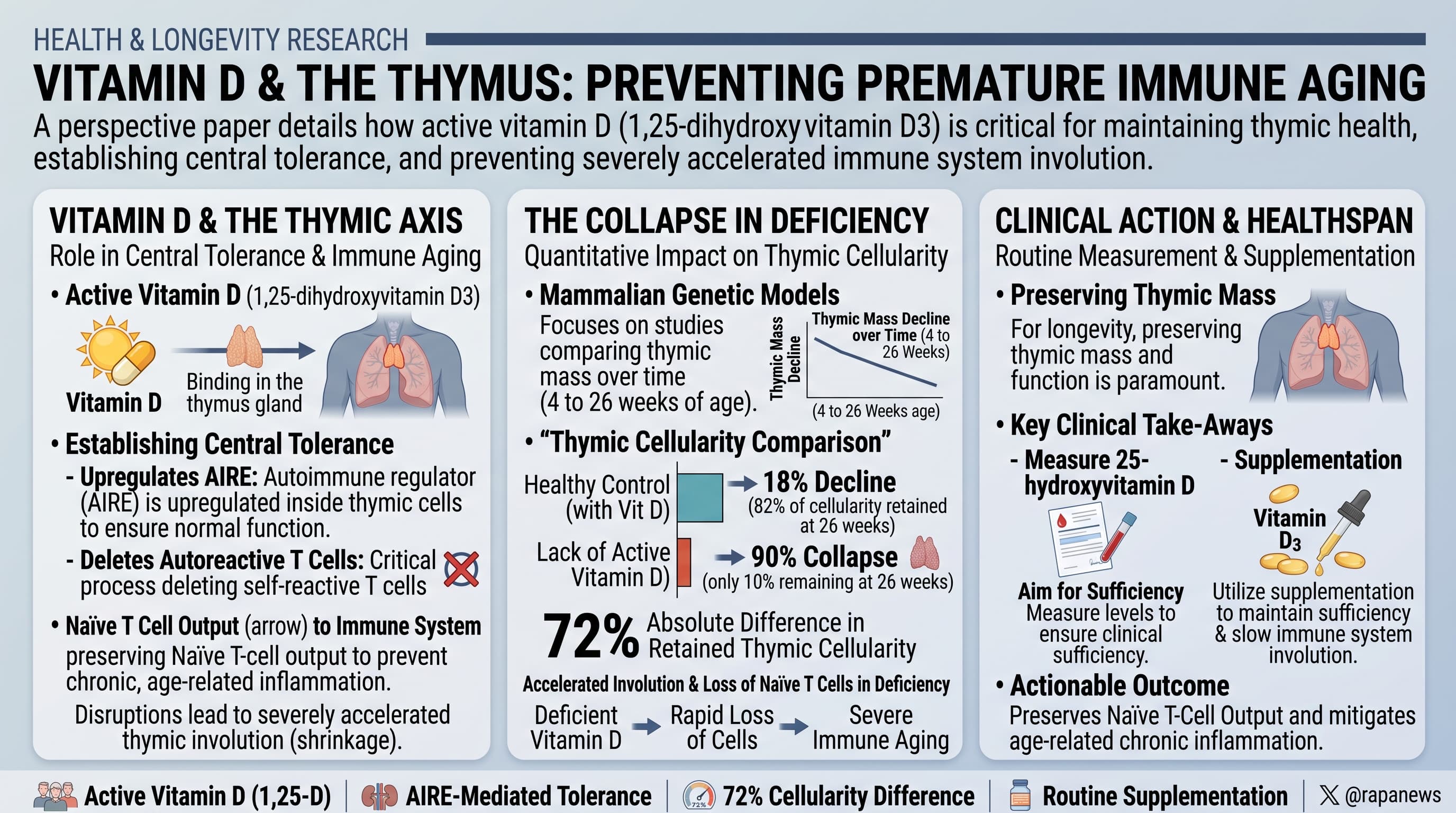
This perspective paper details the critical role of active vitamin D (1,25-dihydroxyvitamin D3) in maintaining thymic health, preventing premature immune aging, and establishing central tolerance. The authors synthesize recent findings showing that vitamin D signaling upregulates the autoimmune regulator (AIRE) in the thymus, which is necessary for the deletion of autoreactive T cells. Furthermore, disruptions in vitamin D signaling in murine genetic models lead to severely accelerated thymic involution, highlighting a potentially crucial mechanism for extending human healthspan by preserving naïve T cell output and mitigating age-related chronic inflammation.
The thymus is the biological clock of the immune system. It is uniquely responsible for the development and maturation of T cells, which are central to adaptive immunity. T cells undergo a rigorous selection process in the thymus to ensure they can recognize foreign pathogens without attacking the host tissues. This process of central tolerance relies on the presentation of tissue-restricted antigens by medullary thymic epithelial cells. If a developing T cell binds too strongly to a self-antigen, it is triggered to undergo apoptosis. The transcription factor AIRE drives this expression of self-antigens. Without functional AIRE, organisms develop devastating multiorgan autoimmunity.
Recent investigations reveal that vitamin D is not simply a bystander in this process but an essential coactivator. The biologically active form of vitamin D binds to the vitamin D receptor within thymic epithelial cells. This agonist-bound receptor then physically interacts with AIRE, recruiting it to chromatin to initiate the transcription of tissue-restricted antigens. Consequently, a deficiency in vitamin D signaling impairs this critical negative selection process, allowing highly self-reactive T cells to escape into the periphery and increasing the risk of autoimmune conditions.
Beyond establishing tolerance early in life, the thymus is notorious for being the first human organ to undergo aging-associated involution, beginning rapidly after adolescence. This involution involves tissue atrophy, declining cell counts, and adipocyte infiltration, leading to a marked drop in naïve T cell output. The resulting collapse in T cell receptor diversity weakens responses to new infections and cancer while contributing to the systemic chronic inflammation known as inflammaging.
Experimental models demonstrate that eliminating vitamin D signaling accelerates this thymic aging process drastically. Murine thymi lacking the enzyme necessary to synthesize active vitamin D exhibit disorganized tissue architecture, reduced expression of thymic longevity factors, and profound cellular depletion by early adulthood. Observational human data echo these principles, linking higher thymic health scores to reduced risks of cancer, metabolic disorders, and all-cause mortality. Ultimately, maintaining adequate vitamin D signaling emerges as a targeted strategy to support immune tolerance in youth and delay the immunological decline associated with aging.
Actionable Insights
For individuals seeking to optimize longevity and immune function, this research underscores the necessity of avoiding vitamin D deficiency, particularly during developmental windows. The epidemiological evidence strongly suggests that early-life vitamin D supplementation dramatically reduces the risk of autoimmunity. In a massive cohort study of over 10,000 children, regular vitamin D supplementation in infancy yielded a Relative Risk (RR) of 0.12 for developing Type 1 Diabetes compared to no supplementation. This constitutes an 88% relative risk reduction. Furthermore, dosing magnitude matters; infants receiving 2,000 IU/day exhibited an RR of 0.22 compared to those receiving lower doses, whereas infants presenting with clinical rickets faced a 3.0-fold increased relative risk of disease onset.
For adults focused on longevity, preserving thymic mass is paramount. The absolute effect size of vitamin D signaling on thymic aging in mammalian models is exceptionally large. By 26 weeks of age, mice lacking the ability to produce active vitamin D experienced a 90% collapse in thymic cell counts relative to their baseline at 4 weeks. In contrast, healthy control mice experienced only an 18% decline over the same period. This represents a 72% absolute difference in retained thymic cellularity. The practical take-home message is to routinely measure 25-hydroxyvitamin D levels and utilize supplementation to maintain clinical sufficiency to potentially slow immune system involution.
Context and Source
- Title: Vitamin D signaling in thymic development and longevity., 14 September 2026.
- Institution: McGill University.
- Country: Canada.
- Journal: Frontiers in Nutrition.
- Impact Evaluation: The impact score of this journal is 4.0, evaluated against a typical high-end range of 0–60+ for top general science, therefore this is a Medium impact journal.