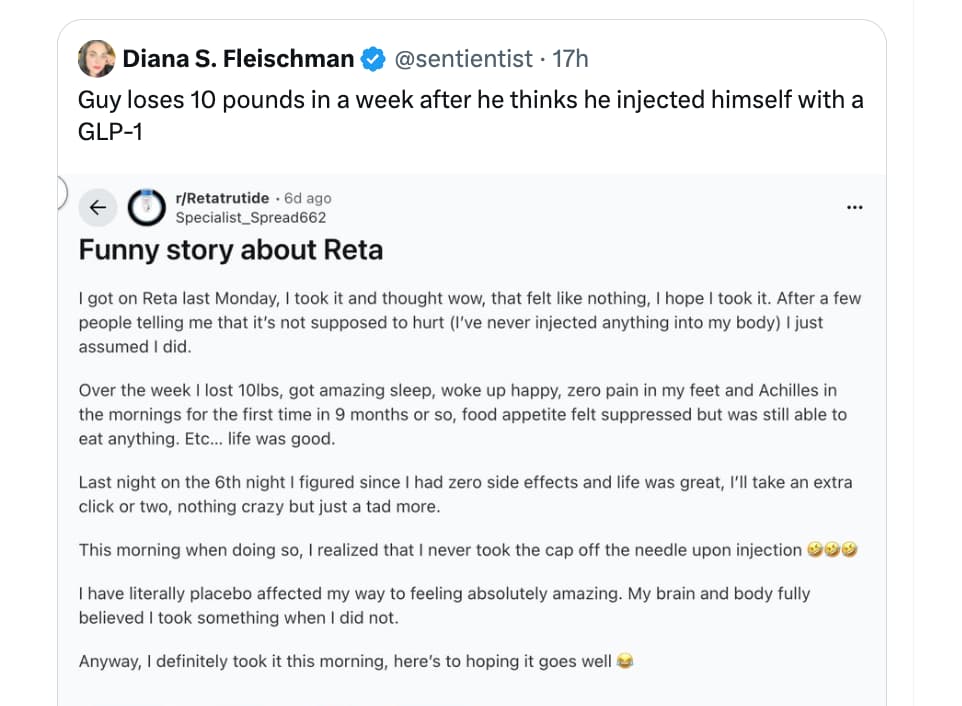
This doesn’t make any sense. If he drew up the medication successfully from the vial, there’s no reason to put the needle cap back on. Even if he did put the needle cap back on and forgot to take it off, he wouldn’t be able to even push down on the plunger if the needle cap is on because it blocks outflow from the syringe.
Never underestimate the sheer incompetence of your average redditor.
Or maybe just some random Reddiot trying to get attention by making up a story about the placebo effect.
If he was using an injector pen, there are 2 caps, the outer large cap and a small inner cap.
I’ve had several people do this exact thing, One did it 2 consecutive weeks.
I’ve done it once when I was in a hurry but I noticed it right away and re-did the shot.
Not sure if anyone has seen this report on GLP1’s and inflammaging.
Same. I had extremely unpleasant, almost (not almost, but exactly) psychiatric episodes of grieving sorrow, using 4-5mg of terzipatide. Not just “emotionally flatness”, but strong chemical depression. Without bad thought of selfharm,or self-blaming, just a feeling of extrem sadness whithout any reason. I almost quit because of it. Lowered my dosage to 3mg, went on plateu. Now slowly titrating, on 6mg. But a bit scared if it will return.
What about reta? Any similar adverse effects?
I’m interested as well. I had to quit semaglutide due to intense depressive and suicidal thoughts.
N=1, but didn’t experience any of this on retatrutide after 1 year of use.
was 1,5 years on Semaglutid. No problem at all. And several months on Terza too. But later it started… Maybe its a mix with my other numerous interventions, touching some guts and stomach axis, and it became too much? Who knows.
So it may be 1)Class effect, 2)Depends on molecule but on a person too, 3)Depends on condition.
Btw, started to take several mild modulators. L-teanine, Lithium Orotate, Iron (was low-normal, which could lead to “absence of energy” which may feel like “overall depression”). Now so far so good. Maybe a slight one-minute shadows of those feelings per day, maybe its just self-scaring as a psychological echo of them…
Too low calories + too low blood pressure + low hormones + low iron and connected things like erithrocytes followed by low oxygenation and brain support + low glucose…pick your cards)
I know more than a few people taking either Tirz or Reta and none have reported any seriously concerning psychological issues. Most people do not experience psychological effects out side the “flatness” in how they feel about food and other things that drive impulsive behavior. I guess that could be classed as an anhedonia response but it doesn’t seem to bother any of the people I know. In fact most are quite happy not having uncorralled urges.
Personally I still have my urges 
But I have seen a few issues that are atypical, one was insomnia. A rare side effect. Was resolved with timing related to food and alcohol consumption, nothing to eat after 6:00pm and no alcohol after 6:00pm. That resolved this side effect in a week. 2 months later the individual was able to eat and drink as was their previous normal lifestyle without experiencing insomnia.
It seems most side effects from GLP1 resolve over time but a few do not.
Bowel movements are one that seems to vary for many, often switching back and forth from constipation to diarrhea. This side effect is probably related to an inconsistent diet.
Some experience transient nausea every time they increase the dose for the few days and later in the week it goes away. This sometimes happens for the first 2 week with a dose increase and then resolves completely, until the next dose increase.
And then there is the vast majority who sail through with minimal sides that all go away and never return.
I think coaching from an experienced person is one of the keys to successful use of GLP1’s and I don’t mean following the pharma guide lines on dosing. Low and slow, like good BBQ, is the best way to handle this for non-T2D healthy adults. Patience and consistency, not changing dose willy nilly and letting the scale be your best source of data.
Checking the latest papers on the topic:
- Association of Glucagon-Like Peptide-1 Receptor Agonists and Suicidality: A Systematic Review 2026: “Our findings indicate liraglutide (reported odds ratio [ROR] = 3.26, 95% CI = 2.53, 4.22) and semaglutide (ROR = 1.73; 95% CI = 0.30, 0.80) are significantly associated with a greater odds ratio of reported suicidal ideation. Similarly, tirzepatide was associated with greater odds of reported suicidal ideation; however, this was nonsignificant (ROR = 1.49; 95% CI = −0.41, 1.21). Similarly, semaglutide (ROR = 8.81; 95% CI = 3.69, 21.04) and liraglutide (ROR = 3.74; 95% CI = 1.23, 11.38) are also associated with a greater odds ratio of reported suicidal depression. No significant association between other GLP-1 RAs and suicidality was observed.”
- Association of Glucagon-Like Peptide-1 Receptor Agonist Use With Risk of Psychiatric Disorders: A Systematic Review and Meta-Analysis of Randomised Controlled Trials 2026: “GLP-1 RAs use was not associated with the risk of psychiatric disorders, including depression, suicide or anxiety.”
- Association of glucagon-like peptide-1 receptor agonist use with anxiety disorders, depression, self-harm, and suicidality: a large cohort study 2026: “GLP-1 RAs were associated with a higher risk of anxiety disorders and depression, but no difference in suicidality or self-harm in comparison to SGLT2i, DPP4i, and lower suicidality risk compared to SU.”
- The effect of glucagon-like Peptide-1 receptor agonists on measures of suicidality: A systematic review 2025: “suicide ideation (SI) […] Pharmacovigilance studies indicate that semaglutide and liraglutide are associated with disproportionate reporting of SI. Results from cohort studies indicate that GLP-1 RAs are not consistently associated with an increase in any aspect of suicidality; instead, some agents are associated with decreased SI and SA.”
So the suicide ideation risk exists but might be limited to semaglutide (and potentially tirzepatide). Hopefully retatrutide is better.
How are you taking such a low dose? I had assumed that Reta like Tirzepatide would be in a dose controlled injector and dose would not be adjustable. I have been looking for a way to try a micro dose of tirzepatide because some doctors have reported success using it to reduce long covid food sensitivities. But they only had easy access to microdoses when there was a tirzeptide shortage and compounders were then allowed to fill prescriptions. Reta when it becomes generally available might be another option for me to try if I could microdose.
Vials of all the GLPs are available online from both Chinese and domestic sources. Chinese vendors are cheaper by an order of magnitude. You’ll need to do a lot of reading, a lot of independent research, to get yourself safely up to speed. This site is a good place to start, but there are several others that are equally informative.
You can dose-split with the pens. See this video on how that is done:

Is anyone pairing imeglimin with retatrutide? Curious to hear about experiences.
(pls excuse the duplicate posting in the imeglimin thread)
Claude seems to think these would be synergestic, and in my opinion, Reta + SGLT-2 + imeglimin is probably a much more beneficial stack than whatever crazy & expensive things other biohackers are carrying out (e.g. reta + tesamorelin — which is probably the safest among the other crazy stuff going on in that space).
Excerpt of chat with Claude:
" Here’s the reasoning for why imeglimin (the “glimin” class oral antidiabetic, approved in Japan) could complement retatrutide (Lilly’s GIP/GLP-1/glucagon triple agonist):
Complementary mechanisms
Retatrutide acts at the receptor level — it agonizes GLP-1R, GIPR, and GcgR to drive weight loss, improve incretin signaling, and increase energy expenditure. Imeglimin works at the cellular/mitochondrial level, amplifying glucose-stimulated insulin secretion and preserving β-cell mass, while also enhancing insulin action in the liver and skeletal muscle PubMed Central. These are largely non-overlapping targets.
Countering retatrutide’s glucagon-driven hepatic glucose output
This is arguably the most compelling rationale. Retatrutide’s glucagon receptor agonism is intended to increase energy expenditure and lipolysis, but glucagon also stimulates hepatic gluconeogenesis — a potential glycemic liability. Imeglimin directly targets excess hepatic gluconeogenesis as one of its three core mechanisms PubMed Central, which could offset this side effect of glucagon agonism.
β-cell protection
Retatrutide drives sustained metabolic stress (weight loss, altered fuel partitioning). Imeglimin’s mitochondrial mechanism — rebalancing respiratory chain activity and reducing reactive oxygen species — preserves β-cell mass and function PubMed Central, which could support long-term durability of glycemic benefit.
Additive glucose-dependent insulin secretion with low hypoglycemia risk
Like GLP-1 receptor agonists, imeglimin enhances insulin secretion in an exclusively glucose-dependent manner, but their mechanism of action at the cellular level diverges PubMed — imeglimin works through NAD⁺/ATP amplification rather than receptor signaling. So combining them adds two independent glucose-dependent insulin-secretion pathways without substantially increasing hypoglycemia risk.
Residual insulin resistance
Retatrutide’s primary benefit is weight-mediated metabolic improvement. But imeglimin targets multiple mechanisms — increasing insulin sensitivity, decreasing gluconeogenesis, increasing β-cell function, and improving mitochondrial function PubMed Central — potentially addressing insulin resistance that persists beyond what weight loss alone corrects."
YEAH but HOW DO YOU KNOW THEY AREN’T CONTAMINATED
Well people seem to be getting fantastic results and nobody is dropping dead so there’s that
Grey peptides are amazing when you know where to order. Cheaper than pharma and effective.
(WWB)China Price list 12-23.pdf (200.2 KB)
When it says “WWB”, is that World Well-Being ?