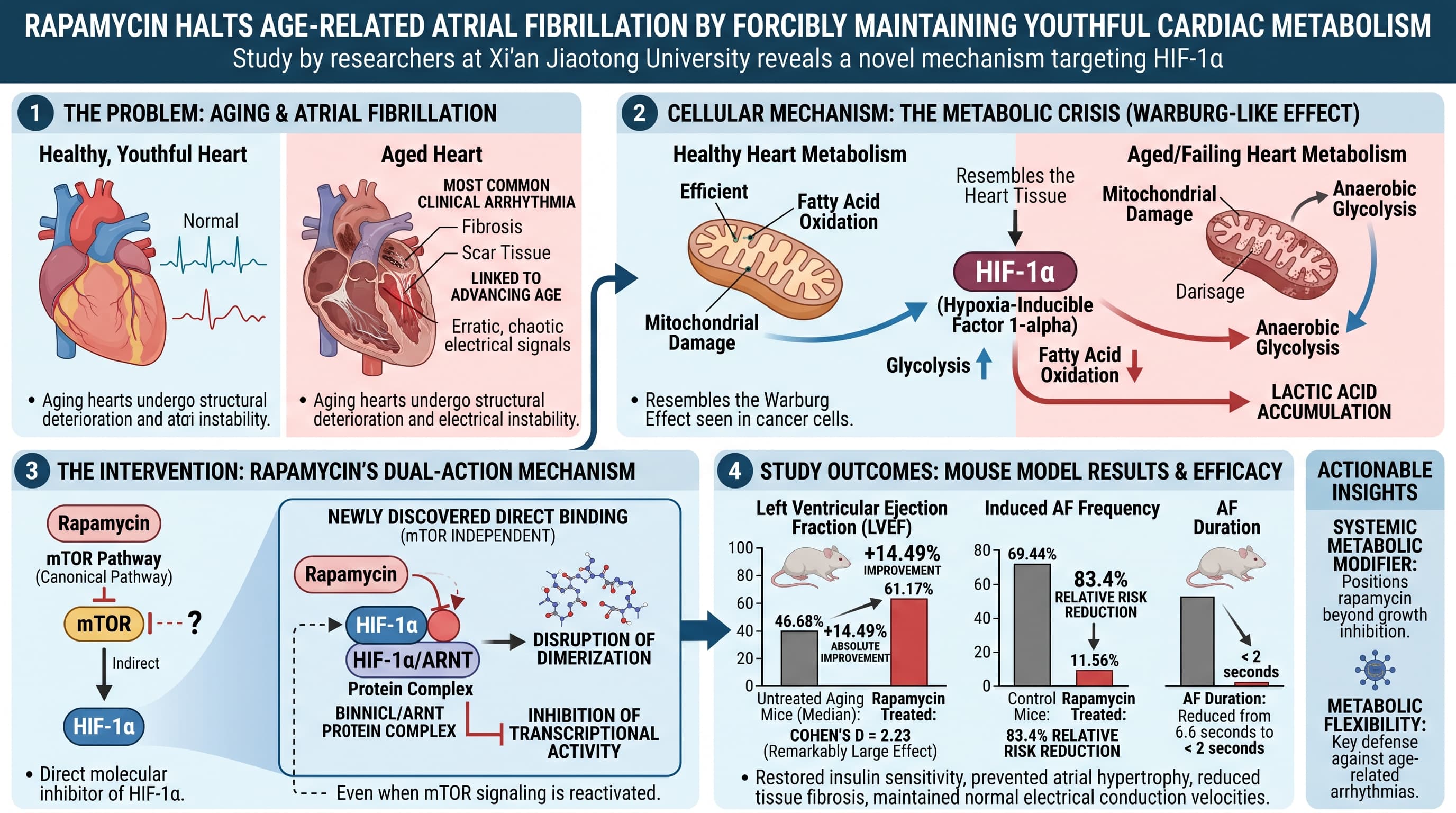
Rapamycin significantly reduces the susceptibility to age-related atrial fibrillation by reversing pathological metabolic shifts in the heart. Researchers demonstrated that rapamycin administration in an accelerated aging mouse model preserved heart structure and electrical conductivity. This protective effect is driven by the suppression of hypoxia-inducible factor 1-alpha, which prevents the heart from switching to an inefficient, glycolysis-dependent metabolic state.
Atrial fibrillation represents the most common clinical arrhythmia and is tightly linked to advancing age. Aging hearts undergo structural deterioration and electrical instability that create an environment ripe for arrhythmias. Underlying these physical changes is a fundamental metabolic crisis. Healthy hearts rely on the efficient burning of fatty acids in the mitochondria. In contrast, aged and failing hearts experience mitochondrial damage and shift their energy production toward anaerobic glycolysis, a phenomenon resembling the Warburg effect seen in cancer cells.
Researchers at Xi’an Jiaotong University investigated whether rapamycin could halt this arrhythmogenic decline. Using a mouse model where accelerated aging was induced via continuous D-galactose injections, the team evaluated the electrical and structural health of the atria. The chemically aged mice developed severe metabolic dysfunction, systemic insulin resistance, and highly inducible atrial fibrillation. Following a twelve-week dietary regimen of rapamycin, the treated mice exhibited profound improvements. The rapamycin intervention restored insulin sensitivity, prevented atrial hypertrophy, reduced tissue fibrosis, and maintained normal electrical conduction velocities.
The primary mechanism centers on hypoxia-inducible factor 1-alpha (HIF-1α). HIF-1α is a transcription factor that drives the pathological shift toward glycolysis and impairs fatty acid oxidation. The aging mice showed marked elevations in HIF-1α activity and subsequent lactic acid accumulation in the heart tissue. Rapamycin treatment successfully suppressed HIF-1α expression, thereby preserving mitochondrial integrity and normal fatty acid metabolism.
The study revealed an unexpected molecular interaction. Rapamycin is universally known to operate by inhibiting the mechanistic target of rapamycin (mTOR) pathway. While the canonical mTOR pathway does regulate HIF-1α, the researchers utilized molecular docking and isothermal titration calorimetry to show that rapamycin also binds directly to the HIF-1α/ARNT protein complex. This direct binding disrupts the dimerization of the complex and inhibits its transcriptional activity independently of mTOR. Pharmacological experiments forcing the reactivation of mTOR signaling confirmed that rapamycin still suppressed HIF-1α nuclear accumulation. This identifies a dual-action mechanism where rapamycin acts as a direct molecular inhibitor of HIF-1α.
Actionable Insights
For individuals focused on healthspan extension, this research positions rapamycin as a systemic metabolic modifier rather than just a cellular growth inhibitor. The data indicates that maintaining metabolic flexibility in cardiac tissue is a primary defense against age-related arrhythmias.
The intervention demonstrated massive real-world efficacy in preserving cardiac output. In the accelerated aging model, untreated mice saw their left ventricular ejection fraction degrade to a median of 46.68%. The rapamycin cohort maintained an ejection fraction of 61.17%, generating an absolute improvement of 14.49%. Statistical extraction yields a Cohen’s d of 2.23, representing a remarkably large standardized effect size.
Regarding arrhythmia prevention, the absolute risk reduction was dramatic. The control aging mice experienced a 69.44% frequency of induced atrial fibrillation. Rapamycin treatment suppressed this frequency to 11.56%, translating to an 83.4% relative risk reduction. The absolute duration of fibrillations dropped from 6.6 seconds to under 2 seconds. These calculations strongly suggest that rapamycin protocols could offer substantial protection against physical and electrical cardiac decline by forcibly maintaining youthful mitochondrial substrate utilization.
Context/Source
- Paywalled Paper: Rapamycin attenuates age-related atrial remodeling and fibrillation by targeting HIF-1α-mediated metabolic dysregulation.
- Institution: The Second Affiliated Hospital of Xi’an Jiaotong University.
- Country: China.
- Journal Name: BBA Molecular Basis of Disease.
- Impact Evaluation: The impact score of this journal is 3.8, evaluated against a typical high-end range of 0-60 for top general science, therefore this is a Medium impact journal.