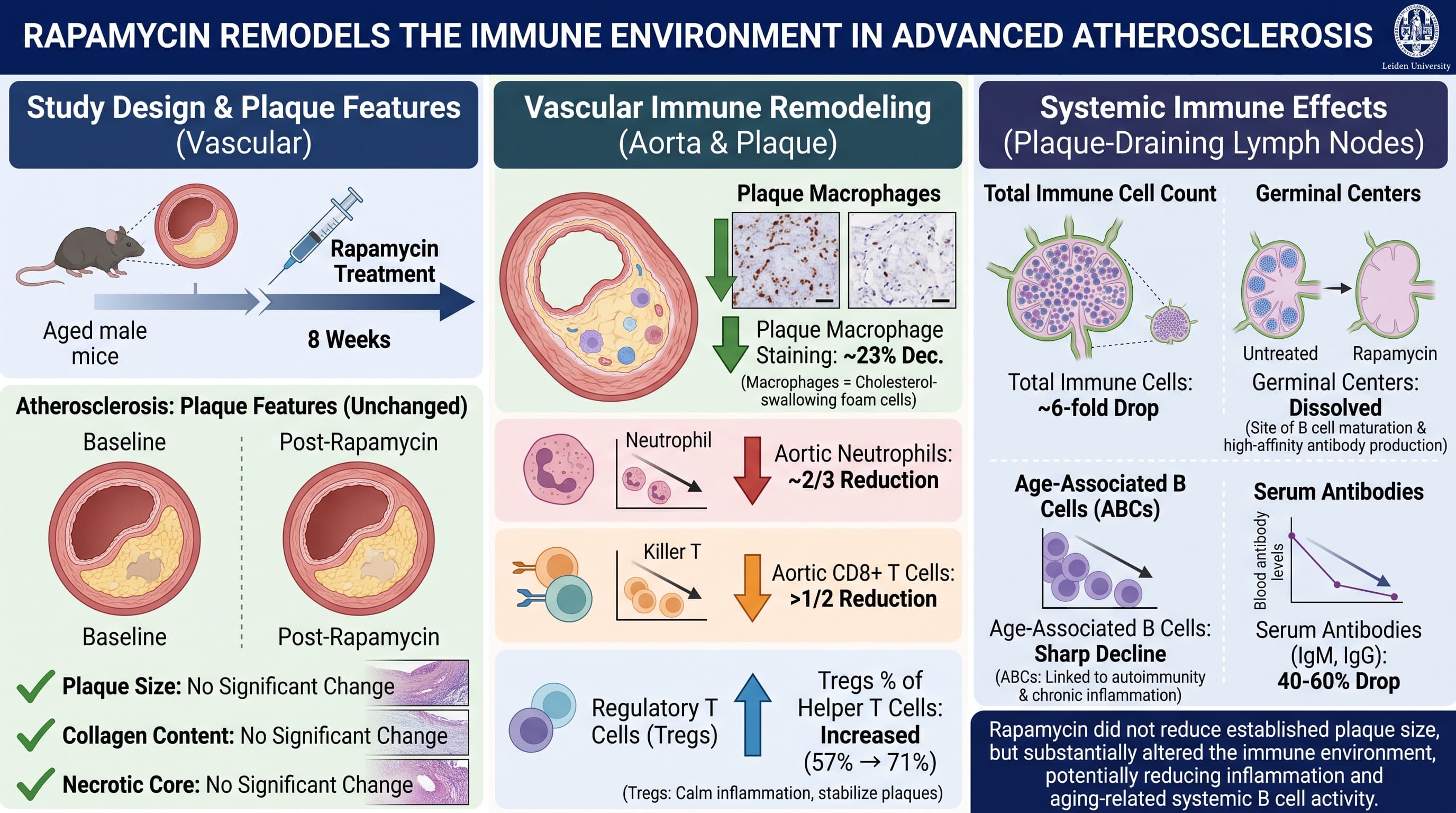
Researchers at Leiden University gave rapamycin to naturally aged male mice that already had advanced atherosclerosis. After eight weeks, plaque size, collagen and necrotic core were unchanged. The immune environment was substantially remodeled. Plaque macrophage staining fell about 23 percent. Aortic neutrophils and CD8 T cells dropped. Regulatory T cells rose as a share of helper T cells. Germinal center B cells, antibody levels and age-associated B cells fell sharply in plaque-draining lymph nodes. Some senescence markers declined. The costs were a 25 percent rise in blood cholesterol and broad suppression of antibody-producing immunity.
Rapamycin has spent two decades as the most reliable lifespan-extending drug in mice, and a growing number of people take it off-label hoping to slow their own aging. A new study from Leiden University asks a narrower, clinically pointed question: what does the drug do to the immune system of an old animal that already has advanced arterial disease?
The answer is that it reshapes that immune system substantially, but it does not shrink the plaques.
The team used male mice lacking the LDL receptor, a standard model for human-like cholesterol problems. The mice aged on ordinary chow until they were 80 to 90 weeks old, roughly comparable to people in their late fifties to mid-sixties. By then the animals carried arterial plaques built up slowly over a lifetime rather than forced by a high-fat diet. Half then received rapamycin injections three times a week for eight weeks. The others received a placebo solution.
Plaque size did not change. Neither did collagen content or the necrotic core, the dead, debris-filled center that makes human plaques prone to rupture. What changed was the cellular makeup. Rapamycin-treated plaques held about 23 percent less macrophage staining. Macrophages are the immune cells that swallow cholesterol and become foam cells. In the aortic wall, neutrophils dropped by roughly two-thirds and killer CD8 T cells by more than half. Meanwhile, the share of regulatory T cells, which calm inflammation and are thought to help stabilize plaques, rose from about 57 to 71 percent of helper T cells.
The effects were much larger in the lymph nodes that drain the heart and aorta. There, total immune cell counts fell almost six-fold. Germinal centers are the lymph node sites where B cells learn to make high-affinity antibodies, and they all but disappeared. Blood levels of IgM and several IgG subclasses fell by 40 to 60 percent. Age-associated B cells also declined. These cells accumulate with age and are linked to autoimmunity and chronic inflammation.
Gene expression hinted at a partial rollback of immune aging. Senescence scores fell in several aortic immune cell types. Spleen cells expressed less p16 and Btg2, two hallmarks of aging cells. Two other senescence markers, p21 and p53, did not change.
The trade-offs are real. Blood cholesterol rose 25 percent, a side effect already well documented in transplant patients on mTOR inhibitors. The same suppression of germinal centers and antibodies that looks anti-inflammatory inside an artery could weaken responses to vaccines and infections in an older person. The spleen also showed more interferon-gamma-producing helper T cells, and more helper T cells that had lost CD27, a marker of heavily used, late-stage cells.
The authors present the work as a case for “immune rejuvenation” in older cardiovascular patients, possibly combined with statins to offset the cholesterol rise. The study shows a quieter, more regulated immune landscape around established plaques. It does not show that plaques grew less, or that the mice had fewer cardiac events or lived longer. Those are the outcomes that ultimately matter.
Actionable Insights
This is a short mouse study with no clinical endpoints. It supports hypotheses, not prescriptions. With that caveat, four practical points emerge.
First, do not expect rapamycin alone to shrink existing plaque. What improved was plaque inflammation. Macrophage content fell about 23 percent, a moderate-to-large effect (a treated mouse had roughly a 71 percent chance of scoring better than a control).
Second, monitor lipids. Total cholesterol rose 25 percent, from about 258 to 323 mg/dL. That is a large effect (roughly an 83 percent chance a treated mouse ran higher than a control), and it matches human transplant data. Anyone using rapamycin who has cardiovascular concerns should track an ApoB or lipid panel. Pairing with lipid-lowering therapy deserves a conversation with a clinician.
Third, consider vaccine timing. Germinal center B cells in the draining lymph nodes fell about 97 percent, and IgM fell about 61 percent. This used a fairly intense regimen, and low-dose human trials have shown better vaccine responses, so dose and schedule likely matter.
Fourth, the regulatory T cell shift (up about 13 percentage points) is the most plausible benefit mechanism, but it remains unproven in humans.
Context and Source
- Open Access Paper: Therapeutic Immune Reprogramming by Rapamycin Attenuates Plaque Inflammation and Lymphoid Immune Responses in Aged Atherosclerotic Mice, Published Sept. 2026.
- Institutions: Division of BioTherapeutics, Leiden Academic Centre for Drug Research, Leiden University (lead); Department of Laboratory Medicine, Medical University of Vienna (collaborating)
- Countries: The Netherlands; Austria
- Journal: Aging Cell (Wiley, on behalf of the Anatomical Society), 2026
- Impact evaluation: Aging Cell; The impact score of this journal is 7.7, evaluated against a typical high-end range of 0 to 60+ for top general science, therefore this is a High impact journal.