Thanks, but I don’t understand why we need a clinical trial where the control group has LDL of <70 mg/dl and an active group <50 mg/dl. Why can’t you just compare achieved LDL levels and see the risk on events, etc?
See this study:
There is a consistent relative risk reduction in major vascular events per change in LDL-C in patient populations starting as low as a median of 1.6 mmol/L (63 mg/dL) and achieving levels as low as a median of 0.5 mmol/L (21 mg/dL), with no observed offsetting adverse effects.
If you combine it with median achieved LDL below 50 studies, the post-hoc regression of plaques studies, it suggest to me we do have enough data. The linear relationship between achieved LDL and RR reduction continues to even lower levels.
I think we know have heard each other and for my part I’m content in agreeing they there still is some agreement and some disagreement and just see what new data comes out in the months and years ahead of us.
Just to be clear that I’m not just following Attia, rather a “lower is better” view that seems to be something that more and more experts are believing in - even if I agree that the slow moving guidelines are not there (yet?).
For instance, top Prof at a very conservative institution:
“The lower the LDL, the better,” says Professor Eugene Braunwald, MD, distinguished Hersey Professor of Medicine at Harvard Medical School, faculty dean for academic programs at Mass General Brigham and cardiovascular medicine specialist at Brigham and Women’s Hospital. “You can’t have too low an LDL." (quote from recent feature in MIT Technology Review)
We need an RCT because that’s the only way to have a definite answer. I guess that’s why the national guidelines haven’t been lowered yet, contrary to hypertension.
Because if we look at the achieved LDL levels then in the alirocumab trial it’s 66 mg/dL vs 103 mg/dL. And of course 66 is better than 103. We want the same trial but with at the end let’s say 50 vs 66. And see whether people on 50 do better, including on side effects, not only the primary end point of MACE.
Because otherwise in all meta analyses the people who have higher LDL are those who have higher risk, so no wonder they do worse! You do a trial where you give the same dose to everyone, let’s say 5 mg rosuvastatin, yes of course the guy who ends up at 50 mg/dL does better than the guy at 70 mg/dL post treatment (the AUC of the first one over the course of their life before the trial must be so smaller as well). And they both do better than the guy who stops the treatment because of side effects and is at 100 mg/dL. But what if you give ezetimibe to the guy at 70 mg/dL to bring him to 50? And what if you switch the statin intolerant one to PCSK9i and/or something else to bring them to 50? That’s what we want to see.
I assume that “lower is better” is probably the good conclusion, but in the absence of an RCT between the two strategies, I’m not sure clinical practice will change.
For me the main goal is mark risks of stroke and hear attach in 3-6 decades from now…
… for that I don’t think we’ll ever get a RCT
So we have to use the whole Medicine 3.0 and triangulate between what data and what mechanistic data we have in totally and just make the best calls we can and then be ready to adapt along the way as new data comes out (even if that data will never be perfect).
The difference for me when it comes to (a) cardiovascular disease and to some extent (b) metabolic disease vs eg (c) cancer, (d) neurodegenerative disease, and (e) longevity is that we understand the mechanisms in (a) (and to some extent in (b)) much better than in (c) to (e).
By the way, the latest European guidelines (from 2019) have the following targets: “<1.4 mmol/L (55 mg/dL) in very high-risk groups, <1.8 mmol/L (<70 mg/dL) in high-risk groups, a goal of <2.6 mmol/L (<100 mg/dL) in moderate-risk groups and a goal of <3.0 mmol/L (<116 mg/dL) in low-risk groups”. They’ll update them next year. Will be interesting to see if they lower the thresholds for all groups. (Or they could change the definition of "low-risk group?) I don’t know when the 2018 American guidelines will be updated.
I’m surprised that at the end (9:08), he says about bempedoic acid: “it’s possible that this type of therapy will eventually replace statins”. Indeed, it seems that it reduces apoB and LDL by only 20–25% and that it might not have effect on MACE and mortality:
“BA showed a significant reduction in LDL-C [LSM difference in %: -25.24; 95 % CI: -30.79 to -19.69; p < 0.00001], total cholesterol [LSM difference in %:-21.28; 95 % CI:-30.58 to-11.98; p < 0.00001], non-HDL-C [LSM difference in %: -23.27; 95 % Cl: -29.80 to -16.73 p < 0.00001], and HDL-C [LSM difference in %:-3.37, 95 % CI:-3.73 to-3.01, p < 0.00001] compared to placebo. In terms of clinical efficacy, BA was associated with a lower risk of coronary revascularization [RR:0.81; 95 % CI:0.66 to 0.99; p = 0.04], hospitalization for unstable angina [RR:0.67; 95 % CI:0.50 to 0.88; p = 0.005], and myocardial infarction [RR:0.76; 95 % CI:0.66 to 0.88;p = 0.0004]. No significant difference was observed in MACE [RR:0.81; p = 0.15], ACM [RR:0.86; p = 0.46], cardiovascular-related mortality [RR:0.79; p = 0.44], and stroke [RR:0.83; p = 0.08] between the two groups.” (Efficacy and outcomes of Bempedoic acid versus placebo in patients with statin-intolerance: A pilot systematic review and meta-analysis of randomized controlled trials 2023)
“BA was associated with a reduced risk of MACE (OR 0.86, 95% CI 0.79–0.95), myocardial infarction (OR 0.76, 95% CI 0.64–0.88) and unstable angina (OR 0.69, 95% CI 0.54–0.88) compared to control, over a median follow up of 87 (15–162) weeks. BA was associated with a reduction of LDL-Cholesterol (mean difference [MD]–22.42,95% CI − 24.02% to − 20.82%), total cholesterol (− 16.50%,95% − 19.21% to − 13.79%), Apo-B lipoprotein (− 19.55%, − 22.68% to − 16.42%) and high-sensitivity CRP (− 27.83%, − 31.71% to − 23.96%) at 12 weeks.” (Safety and efficacy of bempedoic acid: a systematic review and meta-analysis of randomised controlled trials 2023)
Probably because BA is a targeted drug that reduces LDL and does not cause myopathy. For those that are statin intolerant, like myself, it’s the only real choice that doesn’t break the bank. So, I pair it with Ezetemibe for better effect.
That’s as would be expected: we only have a limited number of very short-term trials on BA, some of them not powered for hard outcomes and none of them powered for total mortality. Their formal Phase 3 CVD outcomes trial demonstrated that MACE risk was "significantly lower with bempedoic acid than with placebo (819 patients [11.7%] vs. 927 [13.3%]; hazard ratio, 0.87; 95% confidence interval [CI], 0.79 to 0.96; P = 0.004), as were the incidences of a composite of death from cardiovascular causes, nonfatal stroke, or nonfatal myocardial infarction (575 [8.2%] vs. 663 [9.5%]; hazard ratio, 0.85; 95% CI, 0.76 to 0.96; P = 0.006); fatal or nonfatal myocardial infarction (261 [3.7%] vs. 334 [4.8%]; hazard ratio, 0.77; 95% CI, 0.66 to 0.91; P = 0.002); and coronary revascularization (435 [6.2%] vs. 529 [7.6%]; hazard ratio, 0.81; 95% CI, 0.72 to 0.92; P = 0.001). "
Some of the metas you cite don’t even include their Phase 3 hard outcome trial, so unsurprisingly they don’t find an effect on hard outcomes. In others it’s diluted. It’s not clear how many patient-years are reflected in the umbrella systematic review on statins you cited, but e.g. the Cholesterol Treatment Trialists’ (CTT) Collaborators meta-analysis of statins in low-risk patients had 134,537 people in it with a median follow-up of 4·8 years, versus a “total of 3956 patients and follow-ups of four to 52 weeks” in the 2022 BA meta you cite.
This is the nature of diseases of aging: it takes a long time and a lot of people to demonstrate reductions in total mortality, in substantial part because of competing risks. As Attia often emphasizes (and others in this thread have done), you are never going to get the kind of trial we want to prove the use of these drugs for their best potential (true primary prevention people not at high 10-year risk): you have to go from the data we have and the understanding of the causal relationship between exposure AUC and the pathogenesis of the disease.
Attia’s specific enthusiasm is because of the lack of myopathy and lack or dramatically lower risk of diabetes compared to statins.
@adssx have you seen the paper(s) that @A_User has shared in the past on how all cause mortality is not often part of the design of trials and why it generally should not be - because they would need to be orders of magnitudes larger and longer.
The math is counter intuitive so you have to give it some reading and reflection to internalize it.
(it’s not Attia but Brad Stanfield) So you think that bempedoic acid could replace statins as the first line treatment for mild high LDL because of the lower side effects, despite the lower efficiency vs statins? But why bempedoic acid specifically and not PCSK9i?
Haven’t seen them. Would love to read them. But besides all cause mortality, bempedoic acid is not impressive just in terms of LDL reduction so again, I don’t get why Brad Stanfield seems so excited about it (unless he meant all non-statin therapies?).
I’m not sure what Brad is saying, I hardly ever find it valuable to watch his stuff. And def would not expect him to be deep and provide new perspective on cardiovascular disease.
PCSK9i is injectable so it’s a different in a significant way imo.
Since you care about hepatoselectivity I think, I think a similar reason is why bempedoic acid might be seen as a replacement. The selectivity for action in liver should minimize possible side effects like on brain cholesterol levels. If you add ezetimibe which is similar as in Nexlizet, it isn’t that large of a difference between it and a statin. Combined with PCSK9 inhibitor like Attia does and apoB is most likely in optimal levels.
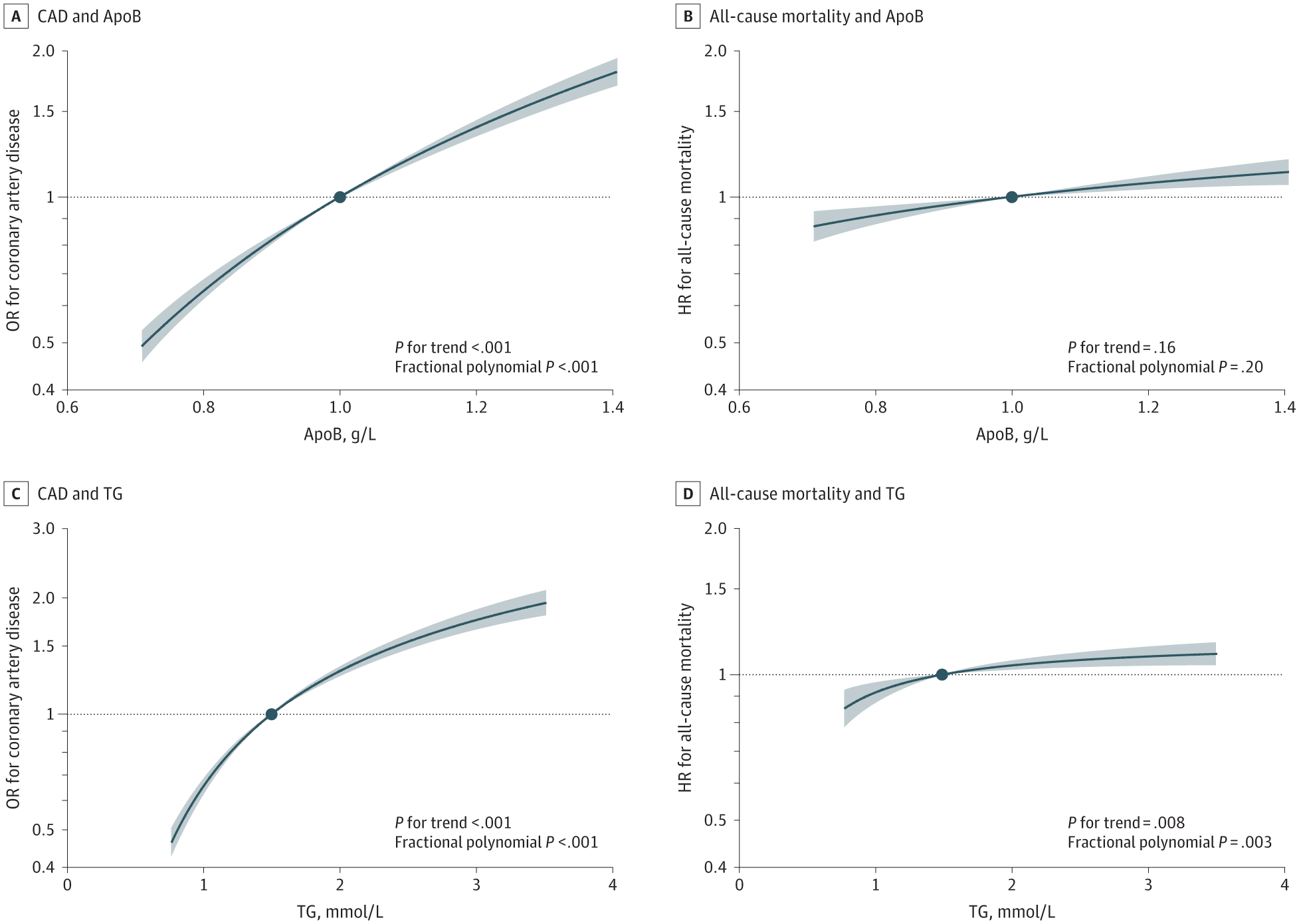
Our findings provide genetic evidence suggesting no threshold of lowering apoB or, equivalently, LDL-C (ie, the main apoB-containing lipoprotein) for reducing risk of CAD, all-cause mortality, and CVD mortality, further supporting the concept of the lower the better.
Our findings are consistent with a recent MR study showing no threshold in the association of LDL-C with CAD, although that study used a different approach for instrument selection and lacked power to detect a significant association of LDL-C with all-cause mortality.
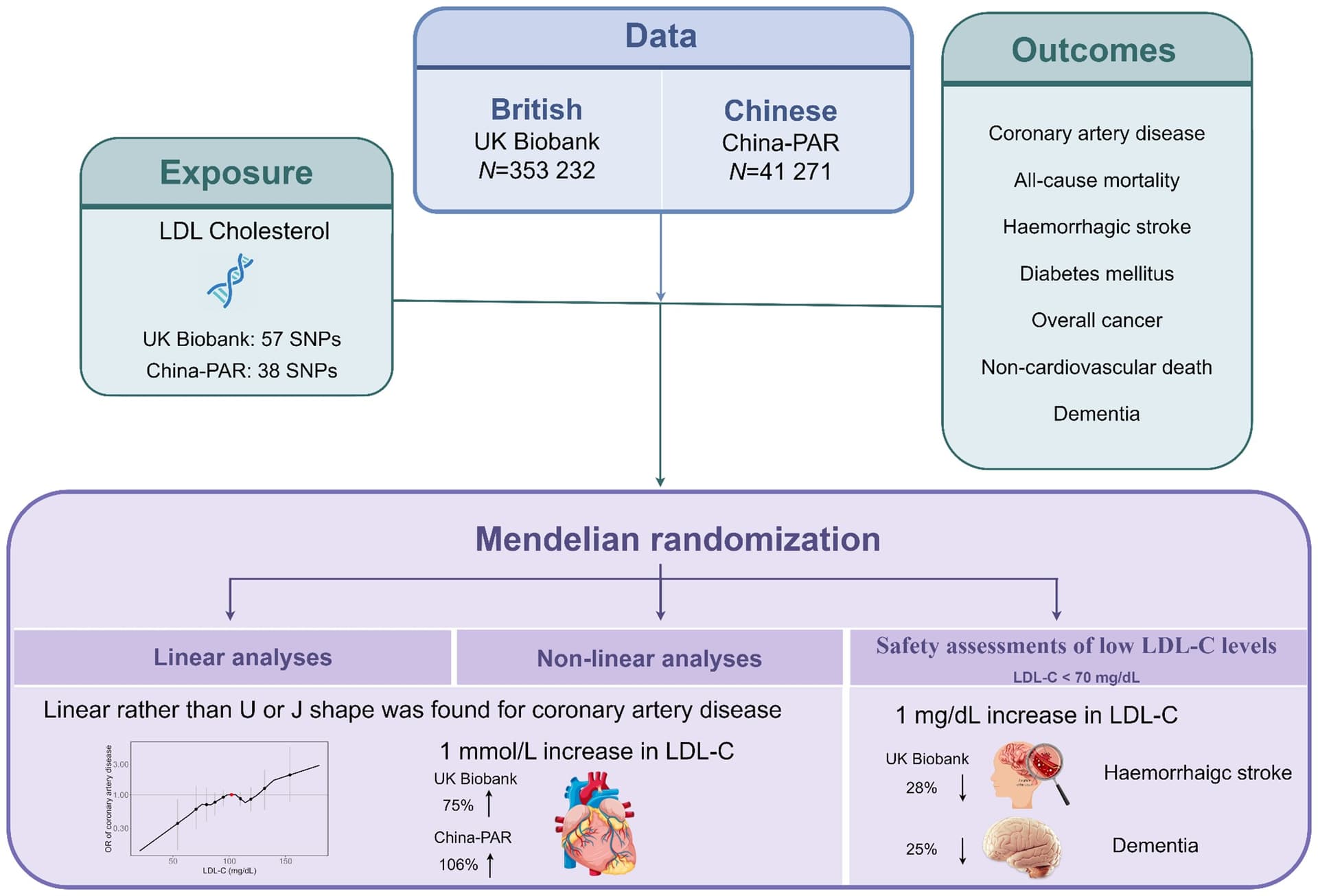
I haven’t access to the full study yet, but interested to understand more from it re:
“There are potential safety concerns (including haemorrhagic stroke and dementia) for people who have low LDL-C levels.”
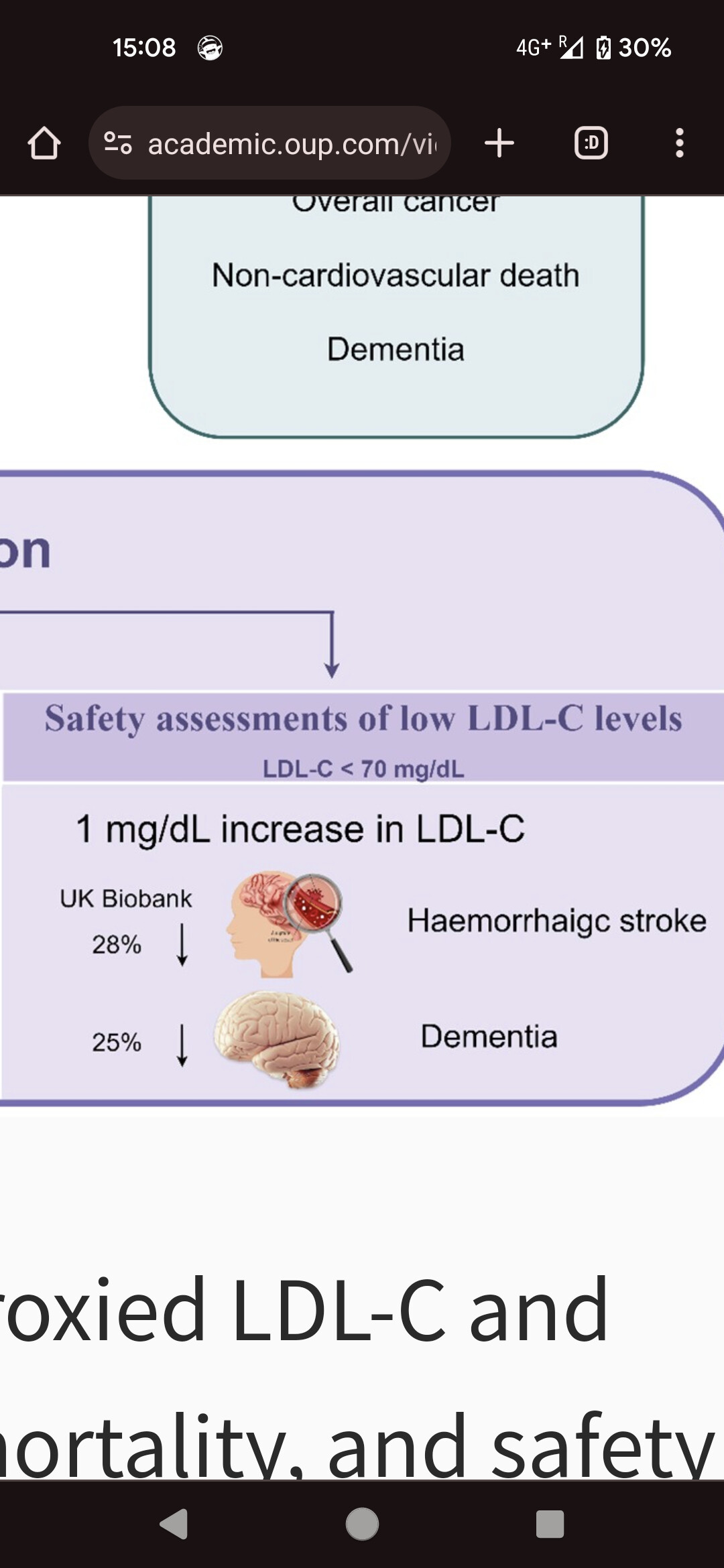
In the UK Biobank, when restricted to individuals with low concentrations of below 70 mg/dL, LACE estimates demonstrated that genetically proxied lower LDL-C levels were significantly associated with an increased risk of haemorrhagic stroke [OR, 0.72 (95% CI, 0.54–0.96); P = 0.03] and dementia [OR, 0.75 (95% CI, 0.59–0.97); P = 0.03].
In contrast, a non-significant inverse association with dementia was found in Chinese. This non-significant result may be due to the use of the Mini-Mental State Examination (MMSE) to define dementia outcome, which differs from the definition in the UK Biobank.
Finally, the statistical powers of some outcomes (e.g. haemorrhagic stroke and dementia) are relatively low in the UK Biobank and the China-PAR project, which may raise the concern of false negatives in the linear and non-linear MR and less robust evidence of significant associations in the stratified analyses. Further studies with a larger number of participants are needed to validate our results.
However, low genetically proxied LDL-C is inversely associated with diabetes incidence and marginally statistically related to two other outcomes, dementia and haemorrhagic stroke. The authors contend that their findings should raise concern about dementia and haemorrhagic stroke as serious adverse effects when extreme lowering of LDL-C is undertaken.
The Mendelian randomization approach is probably valid but still involves some extrapolation to measured LDL-C and its lowering by medication. The authors excluded the lowest extremes in their LDL-C distributions (<50 mg/dL in the British and <20 mg/dL in the Chinese), which might be the most informative group for detecting adverse effects with extreme lowering of LDL-C. The diabetes finding is opposite to the clinical trial findings for statin use. The haemorrhagic stroke finding was based on only six events regressed across the LDL-C range 50–70 mg/dL in about 800 people among the British; though there were higher case counts in the Chinese, there was no excess risk across the LDL-C range 20–69 mg/dL. Dementia was based on a weak diagnostic tool, low Mini-Mental State Examination score, without additional neurological investigation. Many comparisons were made, weakening statistical inference and yet still finding mostly marginally statistically significant results. These issues further weaken the Mendelian randomization approach. Therefore, we accept their caution about possible adverse effects, but pending further investigation, tend to accept the lack of adverse effects of PCSK9 inhibitors and the known, largely controllable adverse effects of statins as indicated in the individually randomized studies of measured LDL-C.
@A_User@Neo: Can we conclude based on this that, not taking into account the financial aspect, and assuming you can achieve the same LDL target, PCSK9 inhibitors (and maybe ezetimibe) are better than statins for lifespan extension?