The normal action of statins is to inhibit HMC-CoA. I am not inclined to do this.
There’s 8 ml of liquid which contains 6 grams hydroxypropyl-beta-cyclodextrin. On the package it says you can absorb 1 gram in 30 minutes retention. It doesn’t say how much you absorb if you retain it forever. I would expect some of it to be turned into short chain fatty acids by the bacteria. It’s a starch and that is food for them.
No side effects except for the obvious. If you can ignore that it’s a miracle.
1 Like
@L_H can I ask you the same question back - which of my responses to the 9 items do you agree with, and in the cases where you don’t agree, why?
This is further information on one strand of this conversation.
I have long been of the opinion that inflammation plays a causal role in cardiovascular disease. At times, I thought it might have been a necessary condition. The following does not rule this interpretation out but the consensus on proportions (20-25%) you see in the following suggests that there might be better explanations of the full causal chain.
-
In the JUPITER trial, approximately 25% (1,013 out of 4,060) of major cardiovascular events occurred in individuals who had baseline hsCRP levels < 0.5 mg/L.
-
In the Pravastatin Inflammation/CRP Evaluation (PRINCE) study, about 21% (195 out of 919) of the cardiovascular events were in those with hsCRP < 0.5 mg/L at enrollment.
-
A post-hoc analysis of the Air Force/Texas Coronary Atherosclerosis Prevention Study (AFCAPS/TexCAPS) found that nearly 20% of major coronary events happened in those with baseline hsCRP < 0.5 mg/L.
These studies indicate that a substantial proportion of cardiovascular events can still occur even with very low CRP levels, thereby reducing the test’s value as a lone risk predictor. I was unable to secure comparable data on other common measures of inflammation.
7 Likes
CRP and hsCRP are always identical if checked at the same time. CRP increases with any inflammation, infection, exercise and many other factors. I agree that it is “not a valuable lone predictor” of cardiovascular events.
2 Likes
C Reactive Protein is driven by two things.
a) infection
b) the background level of SASP
hence you need multiple measurements so that an upswing from infection can be excluded.
4 Likes
The apoB increase was transient and self resolving. There was no need to address this as it was an expected side effect and if it would persist I would certainly address it although apoB of 84 without any confounding risk factors does not need any radical decisions.
I had my ASCVD health assessed in clinic and their conclusion was that ATM my lifetime risk is low and even aggressive 40% lowering of apoB would reduce it marginally per know data we have from studies. Assessment included ultrasound assessment of carotid and peripheral arteries and ambulatory BP, heart stress test among other tests and there is no sign atherosclerotic plaques or arterial wall thickening. I am almost 50.
Yes I have been reading a lot and listening to PA and co. and was tempted to try to lower my apoB especially when I hit 84 mg/dl 3 months into rapamycin regimen. But as ASCVD can not be generalized and recommendations are really more case to case I discussed it with few doctors and reading a lot of literature and possible risks involved I identified two possible drugs that I could potentially use, ezetimibe and fibrates, but since my lipid composition favors apoA1, I have really low TG and lp(a) I did not decide to try fibrates, ezetimibe is still there as an option. At this moment I do try to optimize lifestyle interventions, I have low BP (median 24h is 106/65) my apoB is 58, my HbA1c is 4.8-4.9%, I don’t smoke, I exercise daily, eat mostly home cooked Mediterranean diet, trying to lower saturated fats and sodium and I don’t see much benefit in going lower with medicines. I think every medicine has unwanted side effects and risk assessment of potential side effects vs. benefits should be taken into consideration very carefully in wanting to prevent something that you are low risk to begin with. I know that Attia uses argument that 30% of all first MI are fatal and that starting with lipid lowering when you already have ASCVD is far worse than preventing it. If I were in my thirties my position would probably be different but entering into fifth decade without any sign of ASCVD and no close family members dying of ASCVD or having advanced ASCVD gives me a bit more confidence that maybe my genotype and phenotype is protective against it, but if any of risk factors changes I will reconsider. I am also open to arguments that don’t generalize ASCVD and don’t use catchy one liners or fear mongering.
4 Likes
Yes, really interesting replies thank you. You make a good point that we need only commit short term to any intervention at any one point in time. My counterthought to it would be that to work, blood lipid interventions need to be long term, so I’m more drawn to experimenting with food and lifestyle rather pharma because I know that if they work I’ll find it easy and risk and worry free to continue with them indefinitely.
I think the areas of disagreement are mainly:
A. The scale of the benefit from moving to v.low from low (say apob 55 to 30). The mendelian randomization studies suggest a lifetime impact of 20-25%. That’s obviously great but it may not be generalizable to psk9 inhibitors, and it equates to whole of life apob not middle age+ intervention. And it comes from population typical lifestyles, and I assume the % doesn’t hold for people hyperfocussed on minimizing inflammation and oxidation. And the absolute benefit will be small for those people too, even at age 90+
The risk of atherosclerosis seems fairly linear with age (not exponential), and being in the best 2% for apob (apob <55) and low inflammation/oxidation would seem to give you extremely good odds of avoiding atherosclerosis given the population level incidence.
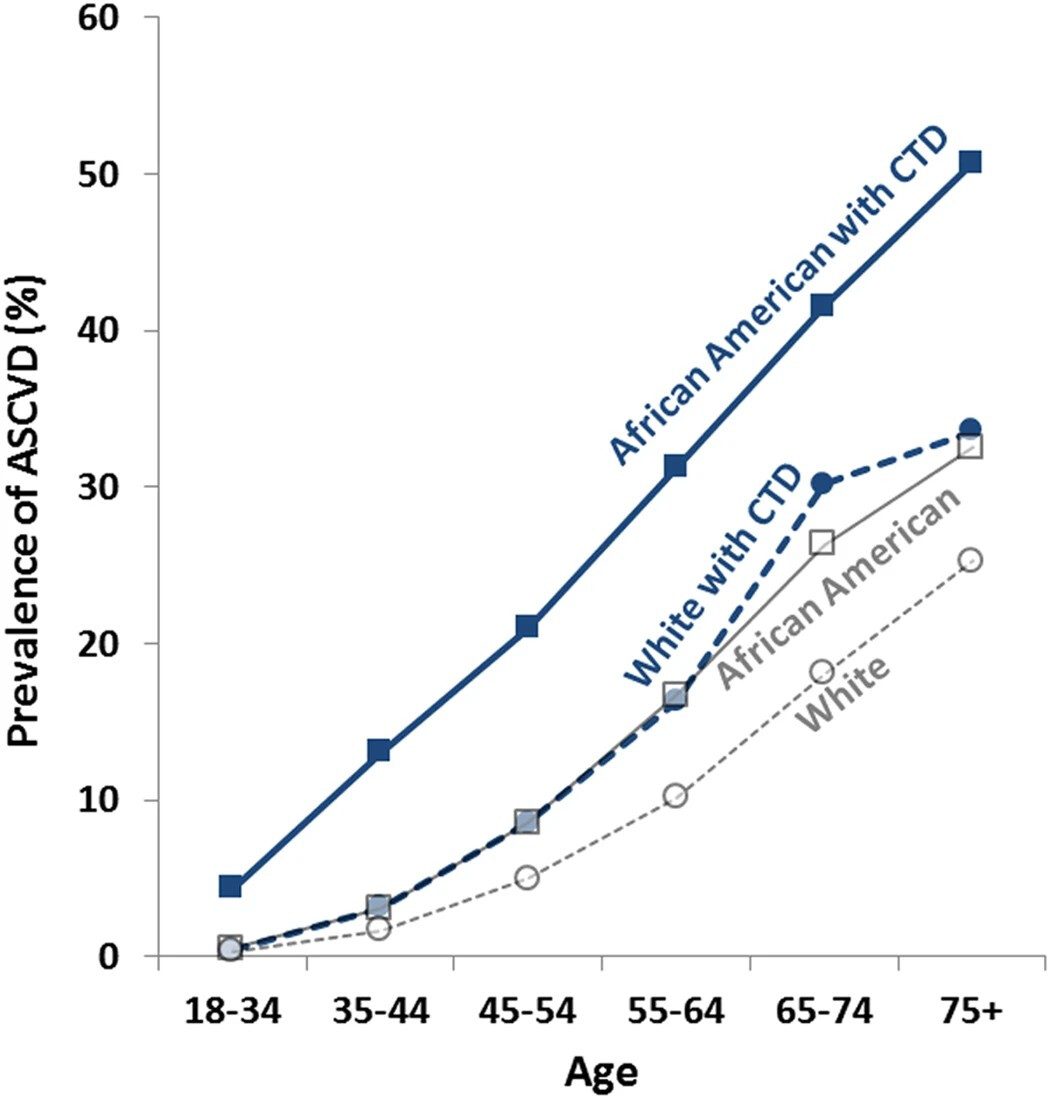
B. Whether we should worry more about a. missing out on the potential benefit of hitting extremely low Apob or b. the potential side effects of pharma to get us there. I suspect this is highly unknowable. But I veer towards ‘first do no harm’. And I’m also sure that I would eat less well if i were on say, a psk9i, so that is an added side effect.
C. Whether we can avoid atherosclerosis risk factors into old age. I think we can, as long as we remain metabolically healthy
D. Our theoretical models for atherosclerosis probably differ too. I believe oxidation and inflammation are also necessary but not sufficient. I appreciate they can’t be targeted as well as apo b. But i think there’s a danger focussing too heavily on the things we can measure because it typically is at the detriment of the things we can’t target easily. In most multi-factoral diseases it’s better to focus broadly on all risk factors rather than trying to solve the problem by targeting a single risk factor to extremes.
I suspect the main difference between us is one of biases. I have no family history of heart disease, grandparents all reached 90s or 100+, I’ve grown up on a high fibre med diet etc. So I believe my atherosclerosis risk is very small compared to other hallmarks of aging. So I feel confident in my future arterial health, less in my future kidneys, mitochondria, brain, cancer risk etc.
Some back of envelope calculations: let’s assume 25% is the baseline risk of ascvd at age 75. An apo b of 55 would already put me below 5%. Plus family history, low inflammation, low oxidation and I’m well into low single digit% - reducing that risk by a further say, 10-15% with a psk9i (used only middle age +) doesn’t seem large to me - we’re talking well under 0.5% absolute benefit. Even at 90 years+ the risk reduction benefit is likely to be under 0.5%. Whereas my mitochondria and brain are more likely than not to be compromised at 90 years+ So any potential side effects which impact those, I’d love to avoid!
3 Likes
Masterjohn here links a study showing that MK-4 is localized in the membranes of liver cells especially to the mitochondrial inner membrane, and jumps to the conclusion that MK-4 taken as an oral supplement will go there (and not just in the liver). He has presented no evidence that such is the case, and I could find one. He also assumes that oral supplemental CoQ will be delivered to mitochondria, and this is not at all clear after years of investigation, and seems unlikely granted that it fails to do anything about statin-induced myopathy.
1 Like
We certainly have much better long-term intervention study data for hard outcomes and side effects for lowering apo B to very low levels with current pharmaceuticals than we have for K2, exercise, or fiber to do it — since we have none for the latter three. The studies you link or could point to are all epidemiology, not intervention trials. Indeed, most trials of K2 for CVD indications have failed, and were only looking at surrogate outcomes to begin with.
3 Likes
You may have misunderstood. I’m not trying to lower my apo b to extreme levels with food and exercise etc.
I’m saying that food and exercise will both lower my apob moderately and reduce my inflammation and ldl oxidation.
I hold food and exercise to a lower standard compared to a drug. Partly because it doesn’t lower apob to extreme levels. But also because i only opt for non-extreme diet and exercise. Med diet and 250 mins of moderate exercise with a little high intensity and body weight resistance.
Admittedly, Vitamin k2 is in supplement form now, but originally i ate natto. It noticeably improved the texture of my teeth and so i switched to a supplement when my easy supply of natto disappeared during covid.
I am very interested in any RCTs for lowering apob to extreme levels if there are any that haven’t been posted.
1 Like
Indeed, are there ongoing or planned trials about intensive apoB reduction? (similar to the trials for intensive BP reduction that led the ACA/AHA to lower its hypertension threshold)

All of the PCSK9 inhibitor trials have lowered from already low LDL, around 70 mg/dl (already on max dose statins etc) iirc.
Of course there is regression in plaques etc from it and decrease in heart attacks, following the linear relationship as expected.
Yes, but this is not the same thing as doing a trial where you ask doctors to put ALL patients under, let’s say, 50 mg/dL using whatever drugs they want and then see the outcome.
Do you mean adjusting the dosage so everyone gets below 50 mg/dl? Why not just stratify based on achieved LDL reduction and see what happens to those with lower LDL (which they have in both statin and PCSK9 trials I think)?
Example of a post-hoc analysis on plaque regression:
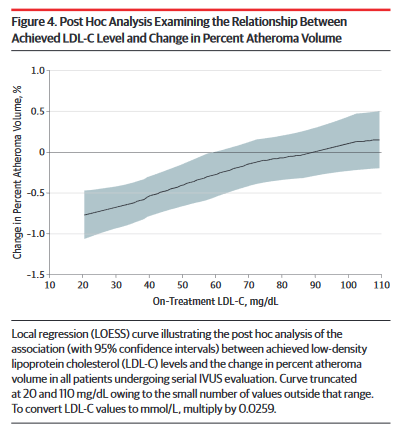
The PCSK9 trials tend to lower from around 90 mg/dl-70 mg/dl to 30 mg/dl and have a reduction in events. There are statins studies stratifying on achieved LDL as well.
1 Like
Yes. That’s what they did in the landmark Systolic Blood Pressure Intervention Trial (SPRINT) to show that intensive blood pressure control reduces cardiovascular morbidity and mortality. You want to see if there’s a tradeoff between intensive control (whether BP or LDL) and other adverse events. Actually, there are ongoing or planned trials doing just that:
- Intensive Blood Pressure and LDL Lowering in Diabetic Patients With Coronary Artery Disease: “use any medication to achieve systolic blood pressure less than 120mmHg and LDL cholesterol within 70-85mg/dl” vs “use any medication to achieve systolic blood pressure less than 130mmHg and LDL cholesterol less than 100mg/dl”
- Effect of Intensive LDL-cholesterol Targeting for Elderly Patients With Cardiovascular Disease: I-OLD Trial: “Intensive lipid lowering therapy with LDL-cholesterol goal of <55mg/dL” vs “Conventional therapy group” (1,200 patients, ending in 2027)
- Intensive Lipid-lowering for Plaque and Major Adverse Cardiovascular Events in Low to Intermediate 10-year ASCVD Risk Population (ILLUMINATION): “Goal for LDL-C <1.8 mmol/L or ≥50% reduction from baseline” vs “Goal for LDL-C <2.6 mmol/L or 30%-50% reduction from baseline” (that’s 70 mg/dL vs 100 mg/dL)
- Effects of Ezetimibe Combination Therapy for Patients With Atherosclerotic Cardiovascular Disease; Randomized Comparison of LDL-cholesterol Targeting <70 Versus <55mg/dL; Ez-PAVE Trial:
- The Effect of InTensive Statin in Ischemic Stroke With inTracranial Atherosclerotic Plaques (INSIST-HRMRI): “Routine-dose statin group” vs “high-dose statin or PCSK9 inhibitor group”
We’ll only get the results in a few years, unfortunately. So I guess it’s up to anyone to decide whether they want to choose the intensive control now (and potentially re-evaluate their choice later if the trials conclude that intensive control is detrimental) or choose the “conventional control” and similarly re-evaluate their decision later as we gather more data on intensive control.
(for whatever reason, all the above trials are done in China, South Korea and Japan: are Westerners not interested in this?!)
3 Likes
67% achieved an LDL of 40 mg/dl or lower in the Evolocumab trial.
And the Alirocumab trial did use that approach to target an LDL of 25 to 50 mg/dl but above 15 mg/dl:
Among patients assigned to the alirocumab group, protocol-specified dose-adjustment algorithms14 were used to target an LDL cholesterol level of 25 to 50 mg per deciliter (0.6 to 1.3 mmol per liter) and to avoid sustained levels below 15 mg per deciliter (details can be found in the Additional Information on the Methods and Results section and in Figs.
https://www.nejm.org/doi/full/10.1056/nejmoa1801174
So we already have that data. And a post hoc analysis of Alirocumab did detect a decrease in all-cause mortality. What do you think of this?
2 Likes
No misunderstanding: I didn’t think you were trying to use these interventions to lower apoB. You are objecting that “we don’t have very good long-term intervention study data for all cause mortality data or side effects for lowering apo b to very low levels with current pharmaceuticals,” and I’m pointing out that e don’t have any long-term intervention study data for all cause mortality data or side effects for nearly any of the other things you’re suggesting as alternative ways to hold off CVD. With the exception of an EVOO-rich Mediterranean diet, all we have for these other things is epidemiology and short-term intervention studies with surrogate outcomes instead of deaths or CVD events. And again, in the case of K2, the even the surrogate outcome trials have almost to a one failed.
2 Likes
I’ve only skimmed through the article and I may have misunderstood it (please correct me if I’m wrong) but I don’t think we have that data, at least based on this paper. Precisely because the people in the trial “had a low-density lipoprotein (LDL) cholesterol level of at least 70 mg per deciliter (1.8 mmol per liter)” and they were given a placebo. So per Figure 1, the placebo group started at ~90 mg/dL and ended at 103 mg/dL:
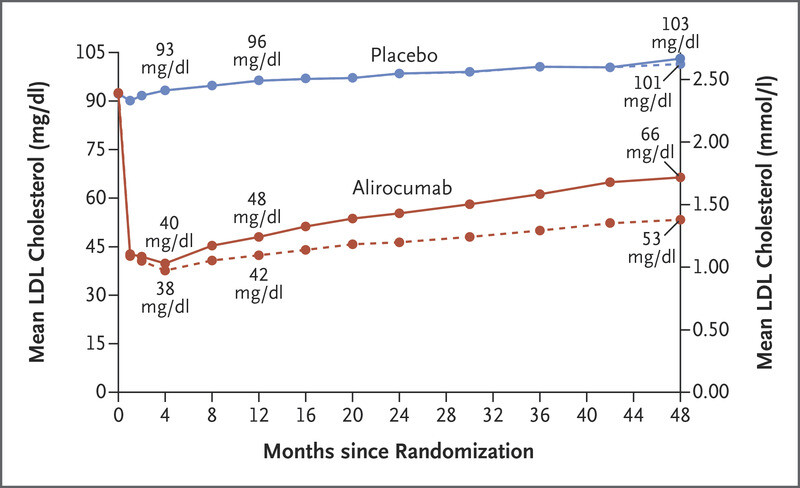
So of course the group treated to have LDL below 70 did better! What we want, to be able to conclude on <70 vs <55 mg/dL as a target, is for the second group not to receive the placebo but to reach the <70 target. Also, note that the group treated with alirocumab did not reach the <50 target. Especially the plain line was barely under 70. That line includes “premature discontinuation of the trial regimen”: why did these people quit? Because of side effects? If we had a trial of intensive control, the intensive control arm would HAVE to be below <50, using additional interventions (ezetimibe, bempedoic acid, changing statins to rosuvastatin, etc.). It’s only then that we can conclude on the potential benefits and tradeoffs of intensive LDL control.
This trial just shows that people at very high risk (previous acute coronary syndrome) who use alirocumab and don’t stop using it do better than their peers who only use statins and have LDL around 100 mg/dL. Not really a big learning, is it?
2 Likes