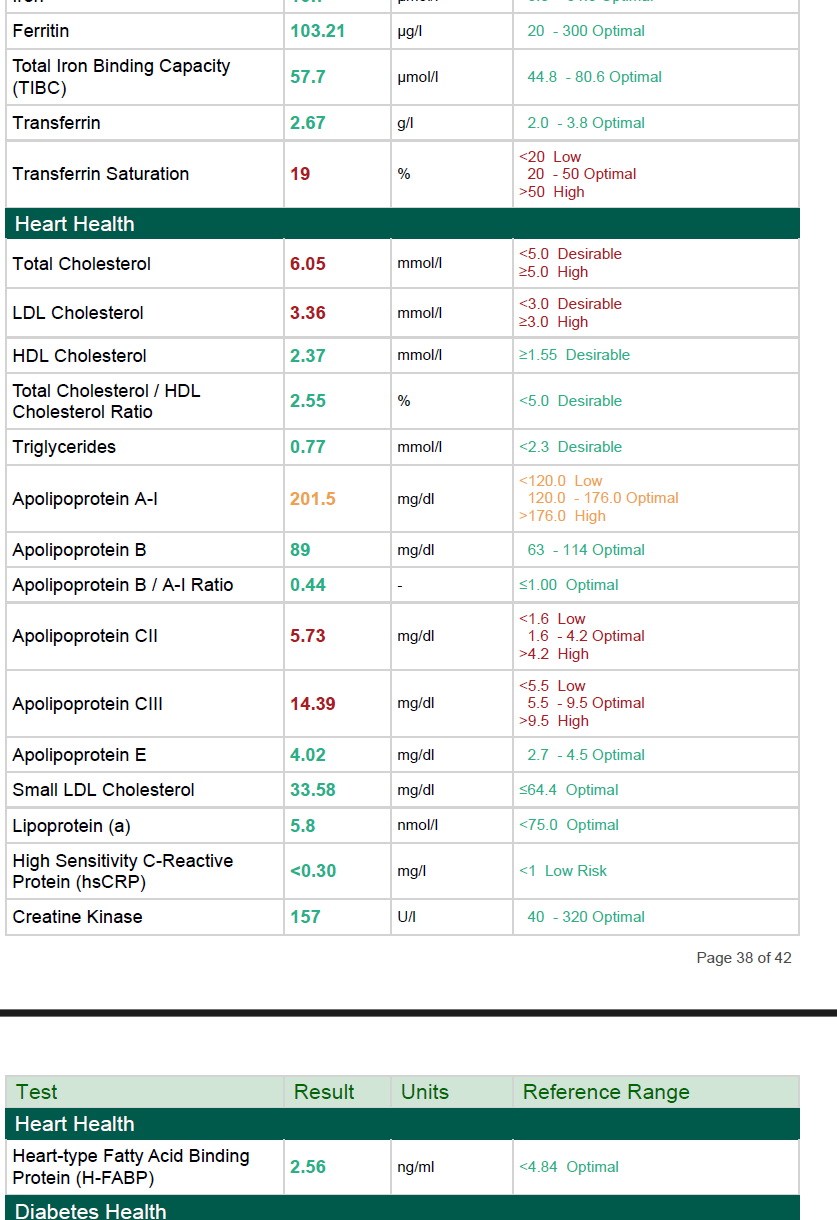
Only one of my labs tests for lp(a). I have glanced at this and it is quite low . I have not been recording it in my spreadsheet, but I could go through and see what variability it has if people would find that helpful. There is quite a bit of work in doing this, however, so I am not enthusiastic. Would people find it useful?
I will extract the page for curiosity. I don’t fast for the test and don’t worry about the LDL-C because it bounces around the Uk threshold which is 3 mmol/L.
I agree that we do not know what is clinically relevant, but a lot of the best guys in the world on Lp(a) to think that lowering in by 20-40% may be helpful and hence fight for PCSK9i for their patients. So I do not think you can say that it is not clinical relevant.
In fact as discussed on one of the Lp(a) threads on this forum you can see that there is clinical data that seem to show that PCSK9i are having benefits in people with higher Lp(a) that goes beyond the LDL lowering effects.
And where there is an option to avoid having Lp(a) up from statin use (in your case perhaps via Bempedoic Acid instead of statin given your cholesterol balance test and experience that Eze does not have any real impact for you) they often try that path out. So for that is a case where one might also want to measure Lp(a) changed - to understand whether the statin increased Lp(a) or not in a given individual.
This for me is the difference of precision medicine that a dedicated health optimizer/biohacker can pursue. I understand that most patients and physicians don’t have the energy or often cannot or do want to prioritize the time and/or resources to approach things this way.
Thanks John. From my perspective, given how low yours is it would probably be more interesting to see how much it bounced around with someone who has higher / more concerning levels.
I had a bad experience with Randox: when I got the results, my PTH was too high (8.5 pmol/L), while calcium and vitamin D were OK. I went to see my endocrinologist. He told me that I was the third person this month coming from Randox with an elevated PTH but normal calcium and vitamin D. He redid the test for all of us with an accredited lab, and they came back normal (4.6 pmol/L). So I’m afraid Randox is not reliable. Too bad because it’s the cheapest…
Since cardiovascular disease - and heart disease stroke alone - are the by far biggest killers and drivers of awful disability - in the western world, I think one has to see normal Apo B as one of one’s largest risks (even if healthy, exerciser, etc).
Not until you have optimal Apo B should you be satisfied if health and longevity optimization is your goal.
Especially in the context that there are powerful meds with side effects profiles that are good.
I not researched this. Most recently i have been working on getting my rhr and bp dpwn following a metabolic boost. I now am back to a hr just over 50, but with a higher stroke volume. I am curious about these figures, but they dont seem a priority.
I may still get an occasional full cholesterol test. But, in light of more recent studies.
ApoB is a better indicator of future cardiovascular outcomes.
This has been debated before in this and other threads. I was on the fence on this but I have changed my mind so that I like ApoB better than an ordinary lipid panel test.
Because I like to keep my supplement stack as low as possible, I would also like to keep my blood tests as few as possible while still maintaining the health information to make decisions in my diet etc. So, for the most part, I will just get my ApoB tested and not a cholesterol panel.
“The risk of myocardial infarction was best predicted by APOB levels, independent of LDL-C or triglycerides”
These studies may have already been posted, but I just got around to reading them.
This a large cohort study The primary study outcome was incident myocardial infarction (MI).
“Of the 389 529 individuals in the primary prevention group, 224 097 (58%) were female, and the median (IQR) age was 56.0 (49.5-62.5) years. Of the 40 430 patients with established atherosclerosis”
(“Patients with established atherosclerosis” would include just about everybody over the age of 30 because it starts quite early in life)
In contrast, we observed adverse neurocognitive effects related to HMGCR inhibition, which may well be outweighed by the cardiovascular benefits of statin use, but nonetheless may warrant pharmacovigilance.
There seems to be a tradeoff between CVD, AD, and PD
It doesn’t say dementia but cognitive impairment. But yes if you’re worried about PD, I would definitely take precautions. Despite that, lowering apoB is still a must.
The data you showed points to potentially a trade-off with the statins (though I think that randomized trials have suggested otherwise so the MR effect on cognition impact might be impacted by having HMGCR inhibition during fetal development or early childhood stages of life when the brain needs extra cholesterol - which is not when you’d now drug that pathway via a statin as an adult).
In any case, you have other options than statins. As one example, the paper you quoted form above has a sentence before what you quoted in it’s abstract that says:
Using data from a combined sample of ∼740,000 participants, we observed a neutral cognitive profile related to genetic PCSK9 inhibition, with no significant effects on cognitive performance, memory performance, or cortical surface area.
The effect is too small, it doesn’t matter. It’s not clinically significant.
Relatedly, the finding that HMGCR inhibition was associated with slowed reaction time translated to an increase of 0.067 milliseconds per 1 SD decrease (38.7 mg/dL) in LDL-C. For comparison, previous work evaluating choice reaction time tasks among healthy adults aged 18-65 years found an increase in reaction time latency of 2.8 milliseconds per year, suggesting a small impact of HMGCR inhibition.62 Therefore, we emphasize that any potential adverse effects of HMGCR inhibition on neurocognition found in this study likely do not outweigh the cardiovascular benefits of statin use.
It’s relatively small and can be mitigated in other ways.
@adssx this is perhaps the 10th time you have taken a holistic concept and picked out a more narrow subset, criticized that subset but not evaluated the larger holistic concept.
In this case, I never mentioned the word “statin”. (And while I support them in many cases, I have personally never taken a statin in my life). My comment was about that (a) cardiovascular is a massive risk for virtually anyone (except genetic mutants in PSCK9) and
(b) Not until you have optimal Apo B should you be satisfied if health and longevity optimization is your goal.
and
(c) Especially in the context that there are powerful meds with side effects profiles that are good.
As @A_User argued you many not have to worry about the statin effect, but let’s assume for sake of argument that you should worry about that, what do you think about the rest of statement (c)? Just as examples, you could do really low statin (most of the cardiovalular protection comes as very low dose and then is more incremental dose response from their) alone or combined with Eze of Bemp Acid. Or you could do those without any statin at all or you could use one that don’t cross the blood brain barrier as the others do. Or you could do PCSK9i - or any other low dose combo of the many powerful options without statins at all.
and importantly, what do you think about part (a) and (b) of my post that you replied to?