I just started rapamycin a couple weeks ago at 29, and I plan to test ApoB and lipid levels here soon. Before starting, my triglycerides last tested at 58 and LDL at 95. I definitely would like LDL to be a bit lower, so I’m going to play around with diet.
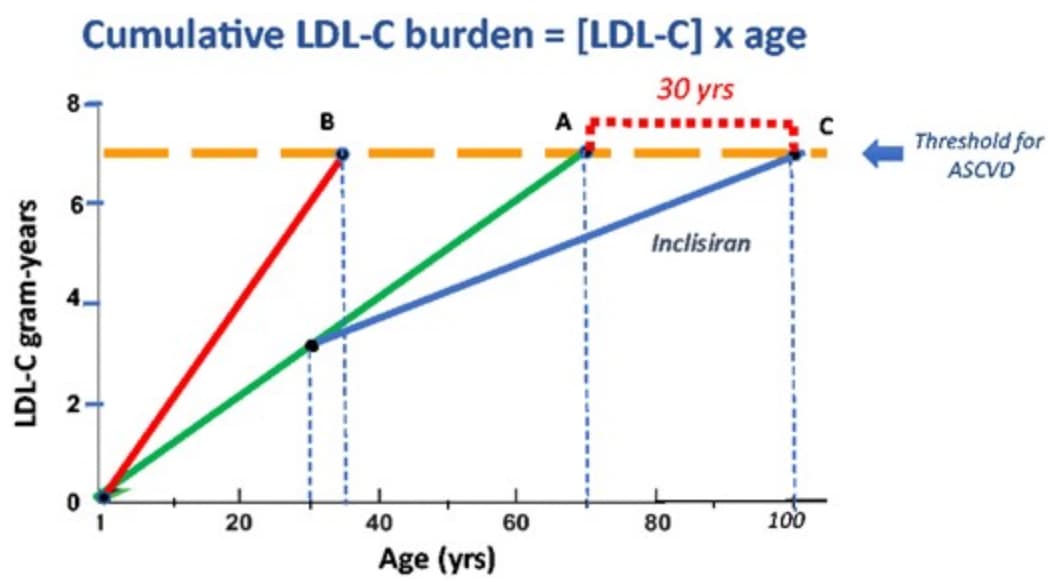
Line A represents a person with an average level of LDL-C of 100 mg/dL (2.6 mmol/L) either naturally or on a statin, who reaches the ASCVD threshold of 7 LDL-C gram-years at the age of 70 years. Line B represents an untreated patient with familial heterozygous hypercholesterolaemia with an LDL-C of 200 mg/dL (5.2 mmol/L), who reaches this threshold at the age of 35. My suggestion is to administer 300 mg of inclisiran once each year, beginning at the age of 30 years, to subjects represented in Line A. As a consequence, their LDL-C would fall from 100 to 60 mg/dL (Line C), the rate of progression of the atherosclerotic burden would decline, and the threshold of 7 gram-years would be reached 30 years later, when the subject reached the age of 100.
We provide mechanistic insight for this effect by showing that approximately 42% of the causal effect of LDL-c on lifespan is mediated through pathways independent of CAD and ischaemic stroke. This is consistent with the observation that LDL-c has a causal effect on a range of outcomes beyond CAD, including peripheral vascular disease46, 47 and abdominal aortic aneurysm.
As discussed on this forum before (you can search), there is also
(A) gold standard Mendelian randomization evidence
(B) the fact pattern that young humans even during development of the brain have lower apoB than middle age adults (and that evolution did not have incentives to optimize longevity or health post the most common historical reproductive age)
A bit off topic here (but since you brought it up) I have always been puzzled why human reproductive age has such a huge gap between males and females, whereas in all (or at least most) animals I know of there is little or no difference at all? Would be interesting to see if any scientists ever tried to explain this. Reason i bring it up is because somewhere somehow (in my brain) I think that what works for men, may not work for women (for the most part) when it comes to longevity.
The U-shape observational studies have been superseded by trials like JUPITER which showed a big reduction (-20% from 1.25 to 1.0) in all cause mortality in the rosuvastatin group compared to placebo. Do not trust observational studies until Mendellian randomization proves causation!
I thought the JUPITER trial was looking at the impact of rosuvastatin on men with median 108 mg/dL ldl-c. So quite a bit higher. Was there sub- analysis showing benefit below 50/60 mg/dl?
What you said has nothing to do with what I was saying. There was a 93 year old man that had a baby with his 32 year old wife a while back, and I think good old Al Pacino at 83 had a baby also.
If LDL-C can be kept very low from birth, atherosclerosis will not occur.
“initiating lipid-lowering therapy after a person has already been exposed to a cumulative burden of 6250mg-years of LDL by age 50 years means that person has very likely already developed a large atherosclerotic plaque burden … lowering LDL after this cumulative exposure to LDL should reduce the risk of cardiovascular events, but this person will remain at relatively high “residual” risk of experiencing an acute cardiovascular event because one of the underlying plaques can still disrupt to cause anacute coronary syndrome
Humans were never meant to harbor the low-density lipoprotein cholesterol (LDL-C) levels that are now commonplace. In one series of 147 full-term neonates, the average LDL-C was 20 ± 10 mg/dL [59] Despite the extraordinary rate of development and need for myelination, even neonates need very little LDL-C
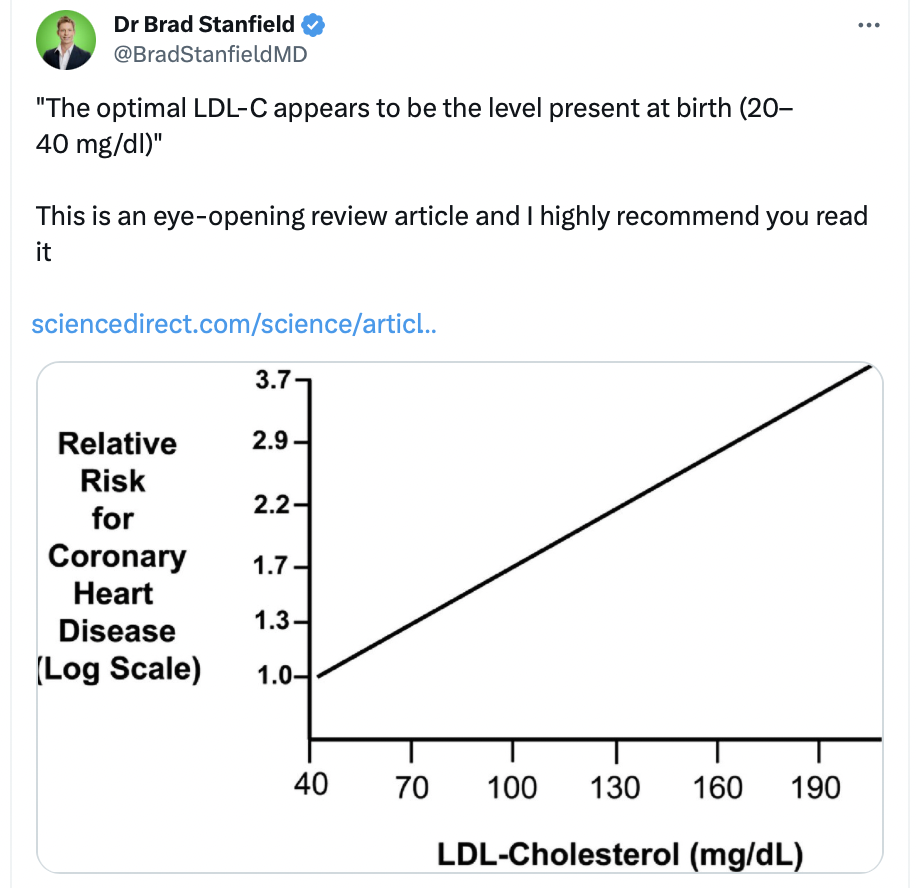
a ‘normal’ non-atherogenic LDL-C level is 20–40 mg/dl.
Based on the log-linear relationship of LDL-C to the hazard ratio for an acute ASCVD event, the LDL-C level where no excess risk occurs is approximately 38 mg/dL or 1 mmol/L
I’ve just spotted some issues. This doesn’t look at the impact of statins, and is for secondary prevention only.
“nonstatin LDL-C–lowering therapy added to background statin therapy were included in the meta-analysis (Table 1). All 3 were secondary prevention trials that enrolled patients with known atherosclerotic cardiovascular disease.”
I like Peter Attia’s analogy that if you leave it until you’ve acvd, then you need to slam on the brakes. That’s what seems to be happening here.
Of the three rcts it references I’m familiar with two look at the third now
I have been taking rapamycin for 2 years. The only time I saw rapamycin affected blood sugar and cholesterol was at high doses. i.e. over an effective dose, taking GFJ into account was at doses that exceeded 20 mg/wk. There is no discernable effect on blood sugar or cholesterol at the dose I am taking, 4mg/wk. All of my lipid measures are good and towards the good end of the spectrum. Even when I was taking high doses the effect wasn’t large, though it did concern me at the time. Of course, I am one, and the results may vary.
From the paper you reference, still another of many supporting lower is better.
“Meaning Further lowering of LDL-C beyond the lowest current targets is associated with further reduced cardiovascular risk with no offsetting safety risks.”
I am not going to argue the benefits of statins, I am a believer in low to moderate doses. If you can’t get the results you want with low does statins, then try adding something like Pantethine, if that doesn’t work then add ezetimibe.
Currently, I am taking all three, atorvastatin 40mg, Pantethine 600mg, and ezetimibe 10mg.
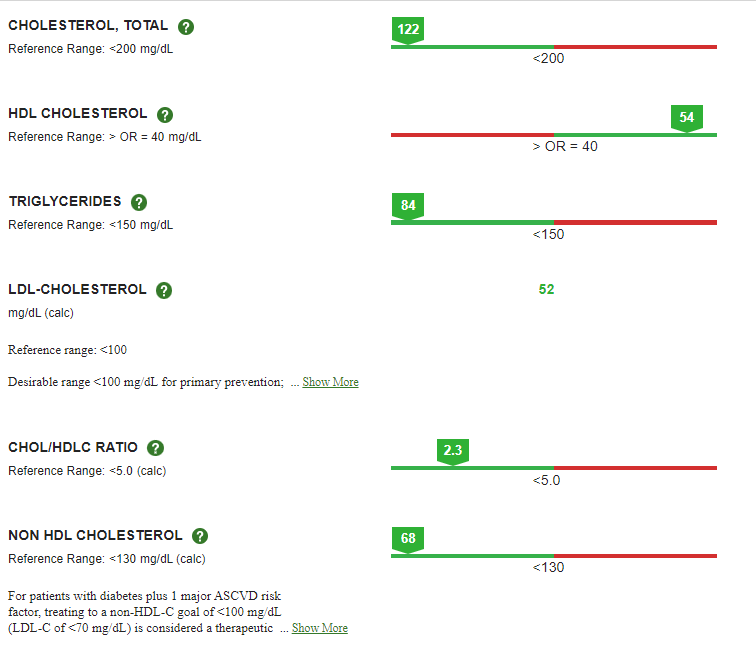
My latest results from taking the triple combo along with 4mg/wk of rapamycin with GFJ on 11/21/23.
This is the best result I have seen for some time. Also, I am on a low to moderate carbohydrate diet.
I’m taking reasonable steps to get below: apoB / 60 and HbA1c/ 5.5. If I fail, I will try harder but I’m steady for now.
My apoB is 48 (down from 74 12 mos & 64 6 mos ago)
My HbA1c is 5.5 (down from 5.8). I’d like to be lower but I’m focusing on sleep and stress improvement for further reduction.
ApoB: 10mg rosuvastatin every other day, 10mg ezetimibe 5 days/ wk, vit b5 500mg 5 days / week
HbA1c: metformin 500 mg 4 d/w, berberine 500mg 5 d/w, no added sugar in diet.