@RapAdmin first case of a GPT spam bot on the forum above, you probably need to figure out a way to ban all VPN’s, Tor, etc from the forum and other solutions before it becomes a problem.
1 Like
Lol
1 Like
I don’t think we can say “perfectly safe”
There’s clearly a dose/side effect curve with statins. And I think it’s reasonable to say that exercise and diet can play a large role in reducing apob and therefore the need for statins. And that we should be looking to these first to do much of the heavy lifting.
1 Like
Read what I said, “if someone doesnt get…”
So what is your apoB from exercising and dieting?
Yes, that was my point, you didn’t include all the possible caveats, only some.
I’m not dieting, just eating and drinking. My apob is below 70 and I’m not sure why. Could be related to high fish consumption, and high garlic, flaxseed, fibre? Could be tea (green and earl grey with bergamot!). Could be linked to my occasional accidental dose of beeswax/honeycomb (im a lazy beekeeper). Could be dumb luck and genetics.
I’ve not tested post rapamycin but if it does rise, I assume there’s much more i could be doing in terms of lifestyle before reaching for statins because i don’t consciously do anything “for” my blood lipids. That’s why im in interested in this board and hearing from people who aren’t fixated on exclusively pharmaceutical interventions. For me it’s easy to not spit out the odd bit of wax when i eat my honey, so the policosanol studies are of interest.
Fwiw i think v low dose rosuvastatin + ezetimibe carries the biggest “apob bang” for your “side effect risk buck”. The dose response curve for both is quite dramatic.
1 Like
70 is still too high if you don’t want atherosclerosis.
I never had problems with cholesterol or blood sugar until after Rapamycin. However, I feel that the benefits outweigh the negatives and I hope to pair Rapa with Metformin, Ezetimibe and Bempedoic Acid to counter negatives.
I think we can assume these combinations are beneficial from the ITP results.
I don’t think the evidence is there to support targeting a lower threshold. I’m comfortable with it in the 50s and 60s because im not convinced the weight of evidence is sufficient to warrant a pharmacological intervention.
What’s your apob? And what do you take?
1 Like
1 month of rosuvastatin 5 mg and my apoB was at 59 mg/dl, I haven’t tested it since. But I will try 5 mg with 10 mg ezetimibe.
1 Like
If i read this correctly you are implying that RAPA messed up your Blood sugar and cholesterol. If that is the case I think I’d have to rethink the RAPA journey myself. To be fair i have not checked my blood yet but I will in near future but If I notice that my biomarkers are screwed up that would definitely be because of RAPA since I’ve had my biomarkers in the normal range for all of my life.
Anecdotally, I have noticed that when I do my resting period (usually one week, sometimes two) I feel amazing, much better than when I’m doing the various meds and supplements. BTW, when i do the rest period I stop everything, just food and water. By same talking I have also noticed that if I extend my resting period (done 4 weeks couple times) my ageing symptoms (fatigue, indigestion, aches, laziness etc) start creeping up again. Therefore, I intend to experiment (dosage, timing, frequency etc) for next 6 months or so and try to find what works best for me. In conclusion i can certainly say that many of the things that I’m doing (which is what everyone/most in these boards are doing) is having a really great positive impact in my overall wellbeing and health. However, the dosing and frequency seem to be a big puzzle for me that I hope to solve in near future.
4 Likes
What are you targeting?
30-40 mg/dl but 20-30 mg/dl can be good too.
Very interested to see which studies support targeting at that level.
PCSK9 inhibitor studies support it.
So you’re taking statins and ezetimibe based on PCSK9 inhibitor studies?
Yes, but there are also statin studies.
Mechanism of action is based on apoB lowering.
Ok, but I’ve never seen a study (statin or pcsk9i) which gives decent data on the advantage of targeting Apob so low. Care to share? I’m keen to follow the science on this.
@SNK This is interesting. I think you are finding important info for yourself that could be useful to me as well. I also seek that sweetspot …. For me I look for high benefit (slowing aging and maintaining recovered function) without much cost beyond feeling tired for a day every week or so. I’m not looking to gather additional benefit on ann unverified assumption that feeling poorly will payoff in the long run. It might, I admit but I’ll wait for more information.
2 Likes
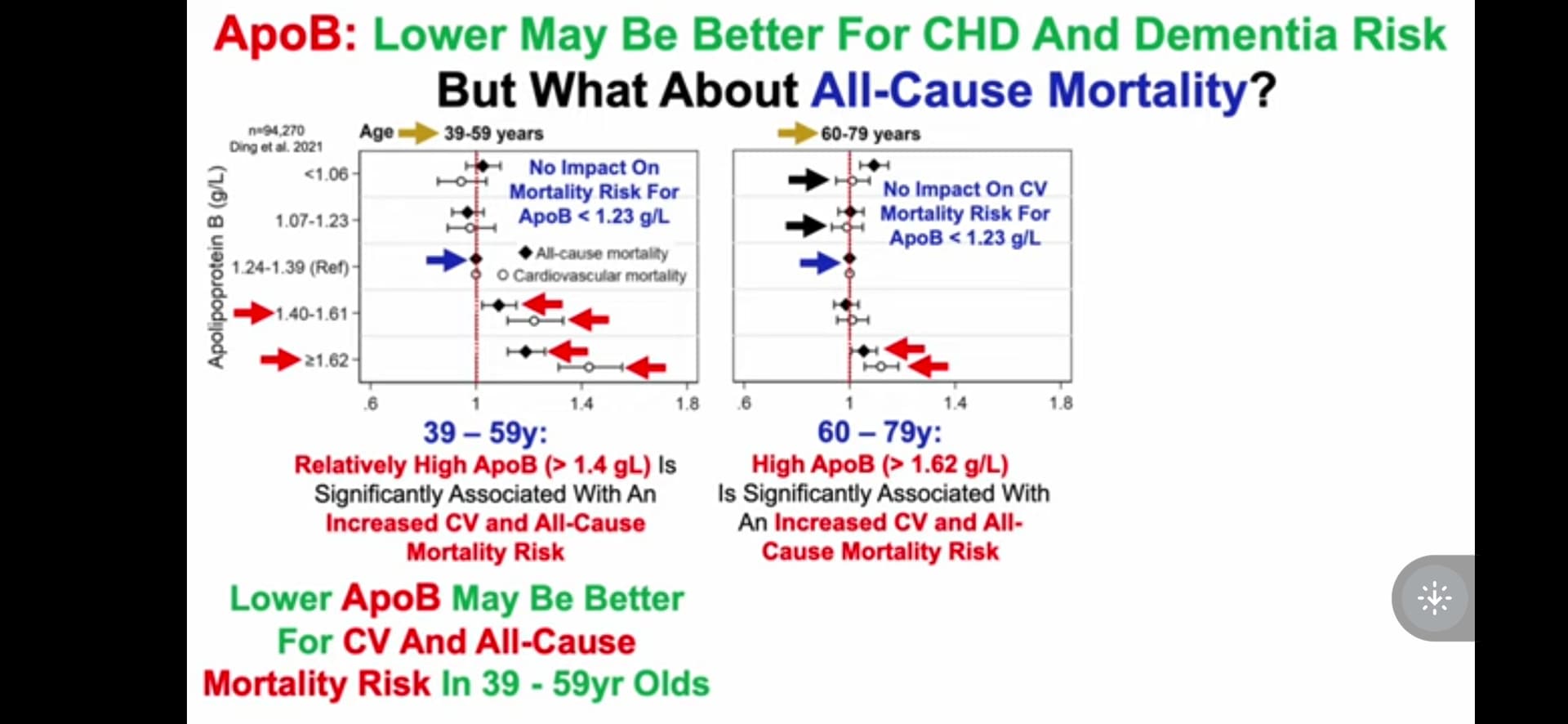
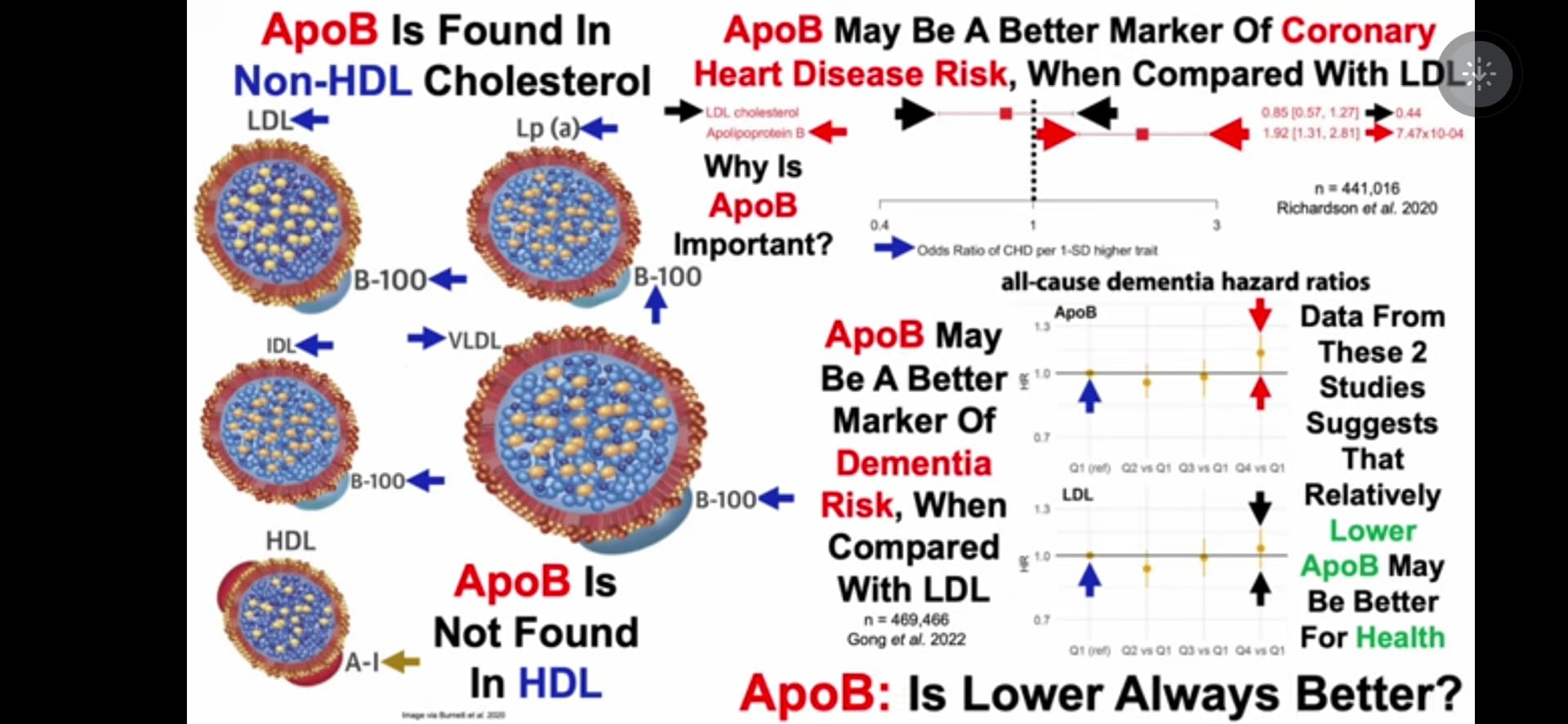
Hi, there seems to be some evidence that apob vs all cause mortality is u-shaped.And ditto for dementia risk. But I’m not totally convinced we know where the sweet spot is, or even if that’s correct.
3 Likes
Just thinking creatively for a moment, it does seem that everything we do naturally (eat, hydrate, breath, move, sleep …not including injections into blood stream or injuries or bullets) come with a sweetspot. Extremes tend to be the exception. But…when dealing with a damaged organism (an older person who has accumulated problems), it’s hard to understand how that might change. If I have some damage to my endothelium, maybe I need to act more aggressively to slow the rate of damage, as an example. This is what I am wondering. In the meantime I am acting aggressively to stay/get to a lower position on apoB / HbA1c.
2 Likes