You probably want to get the high-sensitivity CRP test, so its as accurate as possible:
4 Likes
No, you don’t need to fast before apoB test.
2 Likes
From my experience there is no difference between high-sensitivity CRP and regular CRP. I ordered both on several ocasions and they were identical.
High- sensitivity CRP is affected by any inflammatory process in the body, not necessarily by a cardiac cause.
4 Likes
have you seen all the PubMed papers about the benefits of rapamycin and the heart. I believe this also helped Dr Green with his heart.
The drug combo that Peter Attia mentions in his APOB reduction video is available cheap as dirt from India (I just found). Current exchange rate is about 80 rupees to the US$, so very cost-effective:
Its called: Bempedoic Acid 180mg Ezetimibe 10 mg Bempetol-EZ tablets
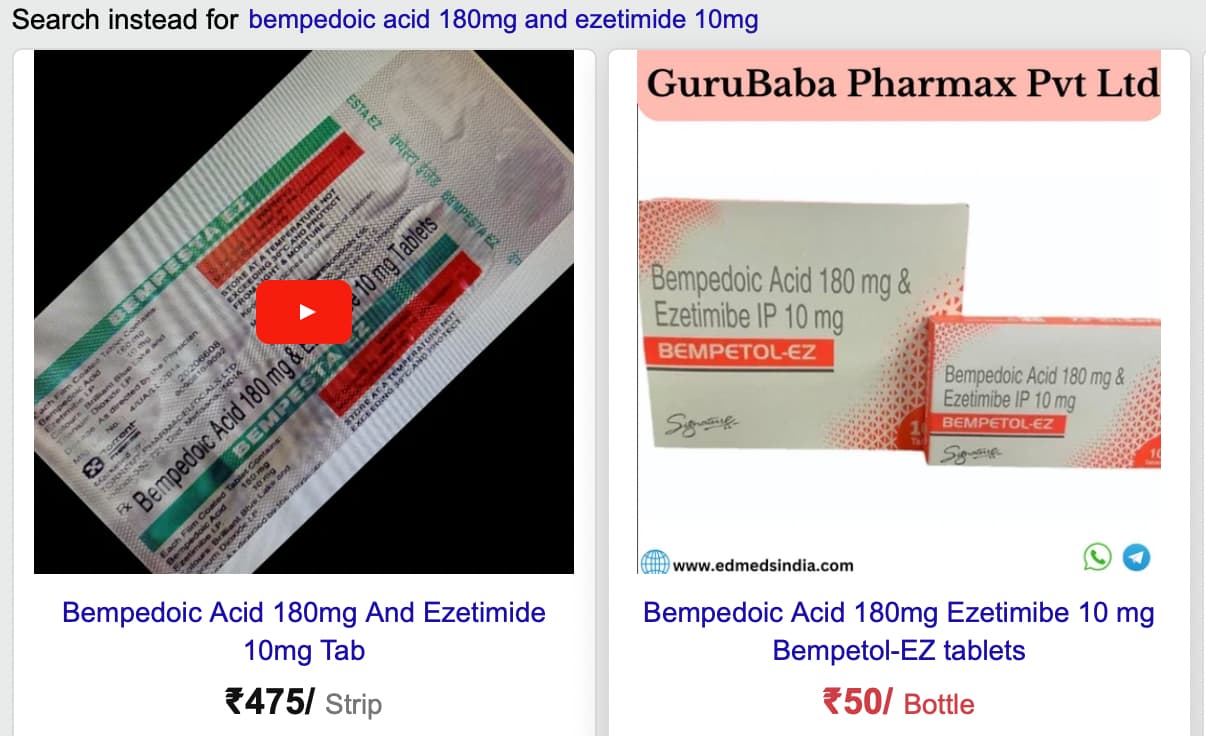
Compare in price to Nexlizet in the USA:

7 Likes
Personally I would not wish to take an ACLY inhibitor as this would cause difficulties with histone acetylation. I would think it might lead to a greater all cause mortality whilst reducing cholesterol.
1 Like
At some point you need to pick the path that offers you the best results. For anyone with a serious risk of ASCVD, Peter’s picks are probably perfect.
However, I was surprised it did not reduce all-cause mortality, although it did decrease heart attacks.
2 Likes
Failing to reduce ACM is unsurprising. If someone not at risk of heart attack takes it it would I think increase ACM simply because is holds back acetylation of the histone. Interestingly it reduced the non-fatal heart attacks whilst not reducing fatal ones (I assume).
If the study was done over decades I would not be surprised if it increased ACM.
Although I stopped taking a statin twice (once in the 2000s when I had one prescribed and then more recently when I stopped taking RYR with Monacolin K in it) I am not “anti-statin”. They inhibit the enzyme that is in the path to Cholesterol after the creation of acetyl-CoA, but ACLY creates acetyl-CoA from citrate so it reduces the amount available for all of the ac-CoA functions. IMO very dangerous.
1 Like
I haven’t looked into PCSK9i, but to be honest after ACLY the metabolic pathways of Cholesterol and Acetylation diverge. Some Acetyl-CoA is taken for manufacturing cholesterol, some for acetylation and some for other things (including generating cytosolic RoS).
1 Like
Why is that surprising to you?
Would you be suprised of a rapamycin trial that didn’t lower all cause mortality either? Since that is very difficult to detect a difference of that is not due to chance (statistical significance)?
I don’t have access to the full text, but I think the first thing that needs to happen is that ACM has to be stratified to the mechanism of action meaning LDL. So you see how ACM changes dependent on the LDL decrease.
3 Likes
Thank you for very valuable information. I had previously decided to get bempedoic acid as I was not aware of this negative aspect. It seems like a bad move now. Drugs already have my apoB lowered to 55 to 60. How much marginal benefit could there be to lowering the level to 20 to 40.
Could you explain why you think it seems like a bad move?
I gave a reason why I think inhibiting the creation of acetyl-CoA in the cytosol is a bad move even if it reduces the amount of cholesterol produced.
Bempedoic acid is converted into its active form in the liver, and it also activates AMPK. What do you think of it if it’s a hepatatic ACLY inhibitor?
I don’t understand why a decreas in acetyl-CoA is bad either way.
Less cytosolic acetyl-CoA means less acetyl-CoA in the nucleus to acetylate the histone. This creates both differentiation problems with stem cells and other problems getting mRNA sometimes causing aberrant splicing. (which can cause some cancers)
And does it matter that is a hepatatic ACLY inhibitor?
Or AMPK activator?
(Or possible HDAC6 inhibitor).
Bempedoic acid is converted to Bempedoyl-CoA in the liver, and bempedoic acid on its own is a AMPK activator.
I would be cautious about reducing acetyl-CoA levels even in the liver.
I am not aware of to what extent it is active in other tissues.
In the end have the study above which concluded it did not reduce ACM, but did reduce non-fatal heart attacks.
Activating AMPK should be good.
Higher acetyl-CoA in the liver leads to negative effects though, as evident by the massive amounts of people dying from dyslipidemia etc. Removing LDL from the blood by inhibiting synthesis of LDL’s is good.
It needs to be converted to Bempedoyl-CoA to inhibit ACLY, which requires Very long-chain acyl-CoA synthetase or ACSVL1 which apparently is mostly in the kidney and liver.
Bempedoic acid (that does not inhibit ACLY) activates AMPK and lowers CRP and it is in other tissues, decrease in CRP shows in clinical trials, it might also be a HDAC 6 inhibitor, what do you think of that since I’ve seen you post about that before?
1 Like
Absence of evidence is not evidence of absence.