Peptides / Bioregulators

Not surprised by these results, and I found the report a little alarmist for the people that bother testing their peptides.

First, about the Widespread Quality Failures. The quality benchmarks are:

  • Compounded Standards (CS) : 90–110% dose, 98% purity
  • Manufactured Standards (MS): 95–105% dose, 99.5% purity)

OK, I’ll go through all these points:

  • Widespread Quality Failures: So if you bought a kit of tirzepatide 30mg, and using the CS standard, you would expect between 27-33mg per vial. Good news: grey vendors have almost the same guarrantee (90% fill, 98-99% purity), and will refund or reship if your test proves that they have your vial is underfilled, or doesnt meet the purity standard. So, this isn’t an issue.
  • Dosing Inaccuracy: Of couse there was wild variability, they compared vials accross batches/vendors, and not within batches/vendors. Vendor V1 of batch B1 might have 60mg+/-5mg, while vendor V2 of batch V2 might have 60mg+/-1mg. It’s annoying, but there is no safety concern here.
  • Purity Issues: this is precisely why people pay for tests. When fill or purity comes under vendor guarrantee, the vendor refunds or reships.
  • Identity Failures: See point above. Wrong peptides occasionally get sent. This is a vendor issue, and they will refund ord reship.
  • Contamination (endotozins): this makes more sense. First, the report is right that there is no relationship between endotxin levels and purity, because they are 2 different things. The levels found were between 0.5 and 40 EU/via. Sounds high, but if you read USP<85>, you’ll get an idea of what is considered high: for injections, the limit is 5 EU/kg/hour. So if you had a 70kg person, the limit for them would be 5x70 = 350 EU per hour. That’s a pretty high limit. Also, keep in mind that this limit depends on the dose of the injection, which often is not be the whole vial. So if you have a vial with 60 EU for a 30mg vial, and your dose is 10mg, then your endotoxin amount for that dose is 20 EU, and your limit is 20x5x70kg = 700 EU.

So, not much new from this report to people used to buying grey peptides, and that bother testing.
3 Likes

While these concerns are valid, I find it hard to believe the claim that 15% had bacterial contamination. That is a lot and should have shown up on reddit, glp1, mesorx, telegram, whatsapp groups etc. I have NEVER run across a case of someone saying they got an infection or any issue for that matter. There are plenty cases saying that they didn’t feel any benefits but to this day I have yet to see one person post that they got sick. This of course doesn’t mean it has never happened, rather that I haven’t seen it posted out there. Therefore, it’s got to be very rare, much rarer than 15% unless the bacteria were harmless, which I believe we come in contact to millions of those daily.

2 Likes

I doubt that the risk with peptides is any higher than it is with generic drugs from India.

Why do you think that?

The major Indian pharma companies have many drugs that pass the FDA and are sold in the USA. They are Huge Multibillion corporations with well refined quality control systems (perhaps used less for drugs sold only in India and the 3rd world). And, they are occasionally (less frequently than I’d like to see) visited by FDA inspectors and its identified when they fail inspections (though I’m sure the miss many, as the FDA has to pre-alert the Indian pharma to visits).

Some peptides companies in China are probably as good as the Indian pharma, but identifying them is extremely hard, if not impossible, and the size and quality control rigor required for developing, and manufacturing FDA and European-approved generic drugs is a high hurdle.

It’s pretty easy for anyone to look up the major Indian pharma companies Generally Good Indian Pharma Companies. and access FDA reports on quality, or violations, and know what drugs have gone through the FDA approval process. Try to do that for the Peptide companies you are familiar with…

2 Likes

China makes the ingredients for Indian pharmaceuticals–probably some of the same companies sending peptides here. And the understaffed FDA rarely makes inspections. Independent testing labs say that 10-15% of drugs imported from India are contaminated in some way.

Yes “China makes the ingredients”… they are called the “Active Pharmaceutical Ingredients” or APIs - yes that is true. But there are thousands of pharma and chemical and peptide companies, but only a small subset of the largest China API manufacturers are the ones that provide most of the ingredients to the major pharma in India.

And all the major India pharma that sell generics to the USA (most generics sold in the USA are manufactured in India today… and generics are the majority of the pharma market by volume by a long shot.

I’m not saying India is perfect - I’m just saying generally India pharma is a lot less opaque and more validated than some random Peptide company that is likely just one of 6 different tiers of middlemen who have handled the peptide, know nothing about it really, and don’t care about the quality…

We’ve discussed this issues with the Indian companies, such as here: Ordering All meds from India - #9 by RapAdmin

Be sure to read this article to understand the state of the Peptide reseller world: ‘I wouldn’t dare take these drugs’: how China supplies untested peptides to the west (Financial Times)

3 Likes

You need to research the suppliers, focusing on quality with verifiable COA data. I like to search Peptides in Trustpilot.com for reviews as a first step as well.

@qBx123Yk Are you sending your own stash to be tested, or are you like me and relying on people from PGB sending vials in for round 2?

Also, while this is a very unscientific approach, in addition to the second layer of testing, I also assume as long as I’m not buying from a brand new ‘batch’, any potential problems with it would have shown up in by now. I say this assuming that an entire batch would be bad and not a specific vial?

On that note, my plan is if I never buy a brand new batch, I just wait a while before I touch it.

The article you cite is just clickbait, not scientific proof of anything.

“New, secret locations that locked out FDA regulators, deaths tied to negligence, and the first proof that Indian-made generic drugs pose a greater risk to patients.” Mostly one man’s reporting: "He told us it took sifting through trash, booking secret travel and working undercover to find what was, by his own admission, “terrifying.” In a court of law this would be hearsay at best. He offers no comparative “secret investigation” of the trash, etc., of US drug manufacturers.

IMO, there is no comparison between the gray peptide market and the generic drug market, of which India is a prime source. As I have posted before, I have taken too many peptide shots to remember and didn’t experience any problems, but I certainly think that my generic drugs from India are safer.

I source from India because it has been a cheap, hassle-free source of drugs that my insurance won’t pay for or my doctor won’t prescribe. Even with the shipping time, it is still much faster to test drugs this way.

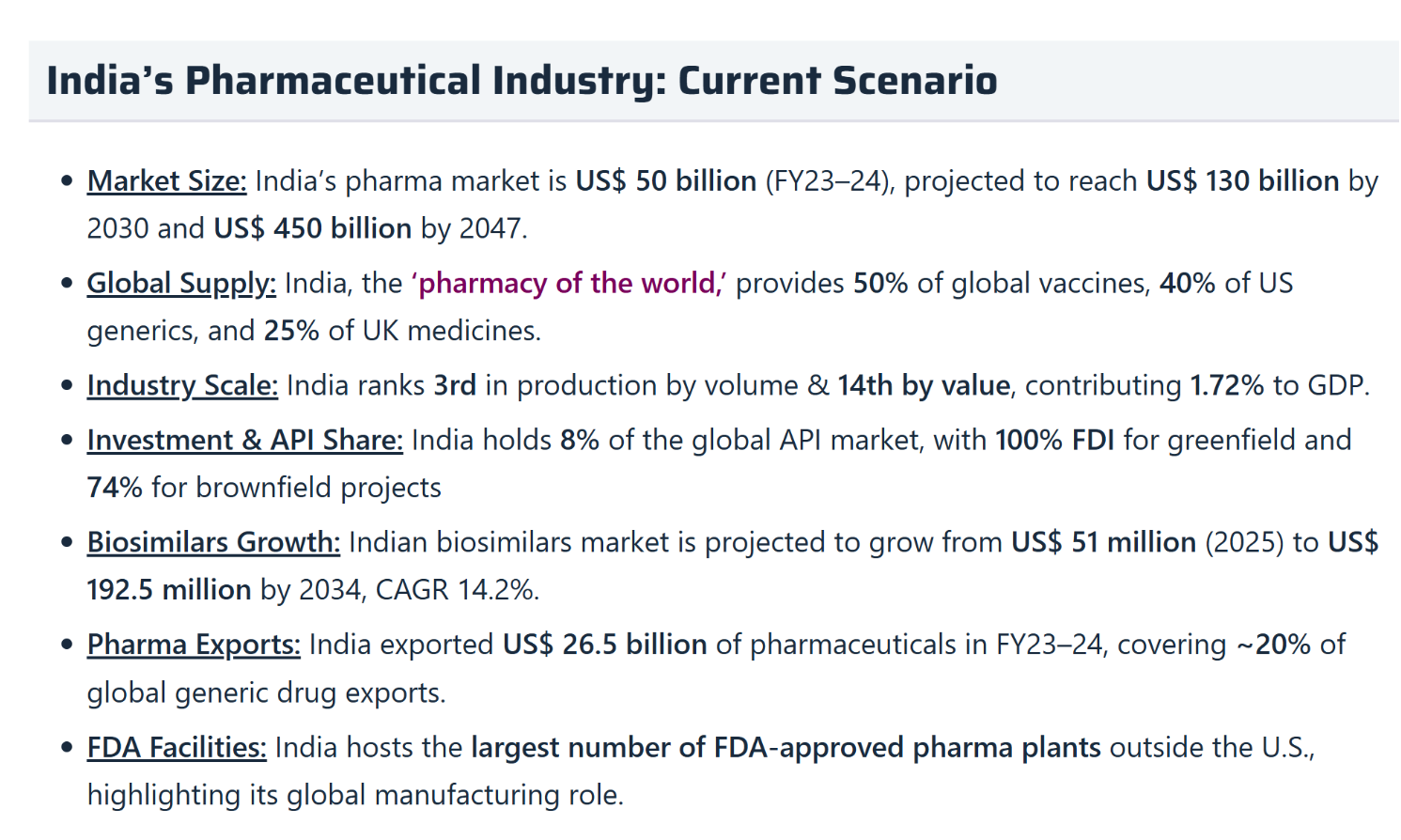
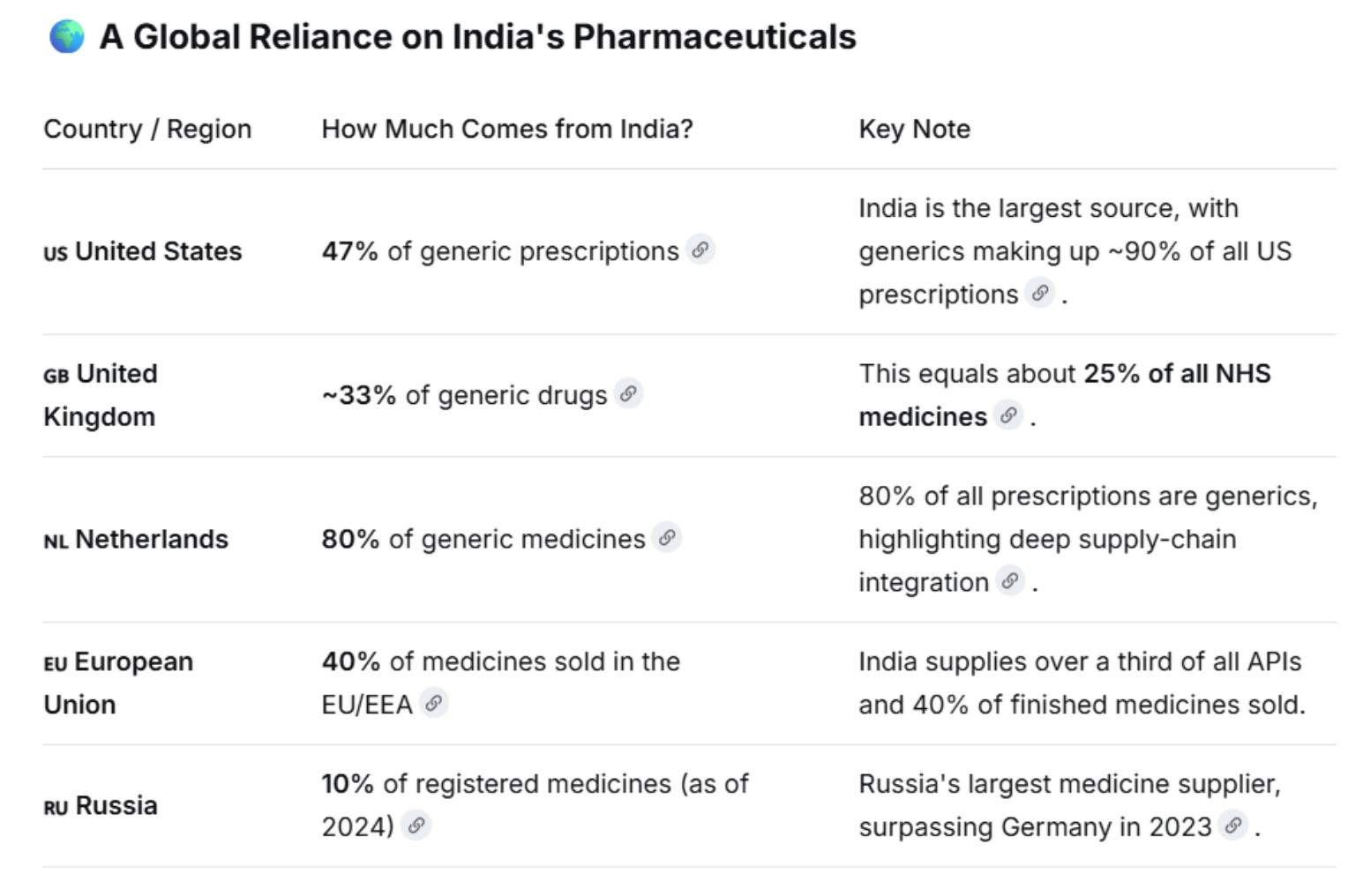
You may have been taking generic drugs sourced from India without even knowing it. My local pharmacy supplies most of my prescription drugs in amber pill bottles without giving any clue as to the source. "Indian industry that supplies nearly 40% of U.S. generic medicines"

The fact is that many companies have some of their drugs manufactured in India.

“The largest supplier of generic drugs globally, India continues to fortify its reputation as a hub for the production of affordable quality medicines.”

From various searches and AIs:

Examples of Major U.S. Drugmakers with India Manufacturing

Major U.S. drug manufacturers have a substantial footprint in India. For instance:

  • Pfizer operates a manufacturing plant in Goa and works with 18 contract partners in India to produce drugs.
  • Other top pharmaceutical companies such as Johnson & Johnson, GlaxoSmithKline, and Novartis also have manufacturing facilities in India.
  • Additionally, U.S.-based generic drug companies like Amneal Pharmaceuticals maintain a large manufacturing and R&D base in India, with nine facilities across the country.

India hosts the largest number of FDA-approved pharma plants outside the U.S

2 Likes

I use both group tests (split costs), and individual tests (assume all costs) to verify my peptides. I’m fine with the risk of the PGB model itself, but I do end up testing their products via third-party testing anyway. Lately, I’ve been testing individually more, mainly because some testing labs are now able to use HRLC-MS to identify peptides. This technique is able to quantify more precisely peptide purity, as well as detecting residual chemicals from synthesis, if present. It’s more expensive, and not Janoshik. Janoshik have been saying for awhile that they have an NMR machine coming in, but nothing concrete yet. Hopefully soon, because the first batch of eloralintide is coming next month, and to verify the integrity of the molecule, something more advanced than HPLC-UV will be necessary.

This will work fine with PGB, but I would not recommend that with most vendors:

  • batches sell out fast, especially GLP1 batches. By the time you’re ready to buy “old”, it’s already sold out.
  • most vendors still don’t have a sound batch system, even if they claim to have a batch number. You’ll see a vendor list a batch number for a product, but that batch number has been in use for >3 months. Highly likely that they haven’t changed the batch number, while producing new batches.

Agree with qBX123Yk’s analysis. WRT endotoxin this wouldn’t necessarily be “live” bacteria that would cause an infection, this could be present in a sterile vial but still elicit a potentially dangerous immune reaction when injected SubQ. However, the amounts generally appear to be well below the danger levels. I’m surprised they are finding any at all, I always thought that peptides were chemically synthesized with protein synthesizers not produced in bacteria. But a quick Gemini prompt states the opposite, most peptides are made using recombinant DNA technology because it can easily be scaled.

From Gemini

The production of peptide drugs like tirzepatide (Mounjaro/Zepbound) actually involves a sophisticated “hybrid” approach. While many smaller peptides are made purely through chemical synthesis, tirzepatide’s complexity requires a mix of biological manufacturing and traditional chemical engineering.

1. The Core Backbone: Recombinant Technology

Unlike simpler peptides that can be built atom-by-atom on a machine, the primary amino acid backbone of tirzepatide is typically produced using recombinant DNA technology.

  • Host Organisms: Genetically modified strains of yeast (Saccharomyces cerevisiae) or bacteria (E. coli) are used as cellular factories.
  • The Process: Scientists insert the DNA sequence for the tirzepatide peptide chain into the microorganism. The cells then “read” this code and churn out the peptide backbone through natural fermentation.
  • Purification: Once the fermentation is complete, the cells are harvested, and the crude peptide is extracted and highly purified using chromatography.

2. The “Acylation” Step: Chemical Synthesis

The reason tirzepatide is so effective is its long half-life, which comes from a specific C20 fatty acid diacid attachment. Microorganisms cannot naturally attach this complex “side chain” to the peptide.

  • Chemical Conjugation: After the peptide backbone is purified from the bacteria or yeast, it undergoes liquid-phase or solid-phase chemical synthesis.
  • The Linker: Chemists use specialized “protein synthesizer” equipment and reagents to manually attach a linker and a fatty acid chain to a specific lysine residue on the backbone. This side chain allows the drug to bind to albumin in the human bloodstream, preventing the kidneys from clearing it too quickly.

3. Why Not Just Use a Machine?

You might wonder why we don’t use Solid-Phase Peptide Synthesis (SPPS)—the standard “protein synthesizer” method—for the whole thing.

  • Length and Yield: Tirzepatide is 39 amino acids long. While synthesis machines can handle this length, the “yield” (the amount of perfect drug vs. flawed copies) drops significantly with every amino acid added.
  • Cost and Scalability: For the massive global demand for GLP-1/GIP drugs, biological fermentation in large vats is far more cost-effective and scalable than building the entire chain step-by-step using expensive chemical solvents and reagents.
2 Likes

Gemini has this wrong. Novo Nordisk uses recombinant tech for semaglutide, but this process isn’t used for tirzepatide and isn’t used for compounded or gray market synthesis of semaglutide either. Tirz is manufactured via hybrid synthesis (solid/liquid phase peptide synthesis).

3 Likes

@Davin8r Interesting, thanks for clearing that up.

I was referring to grey market synthesis because I stated earlier that risk should be low if everyone is using solid phase synthesis where contaminants should be low and clean up routine and similar between different vendors.

If grey market synthesis for other peptides can include purification from bacterial cultures I think risk and variation are likely higher. The fact that endotoxin is a contaminant in the study heading this thread confirms that it is a legit concern.

Investigating the mechanism of synthesis may be one way to assuage one’s fear of potential toxicity. As @Davin8r says Tirzep is synthesized using solid phase and it appears cannot be synthesized from recombinant DNA in bacteria because it includes non-biological aa’s. Apparently Retatrutide also must be synthesized using solid phase. I think that reduces the risk of contamination and certainly reduces the risk of endotoxin contamination for at least those two peptides.

1 Like

Solid phase/liquid phase synthesis doesn’t lower the risk of endotoxin contamination. The kind of “labs” these gray market peptides are manufactured in can and often do produce significant endotoxin contamination. There is SO much more info on this from true lab experts in the peptide-specific forums that I won’t try to get into here because it’s definitely not my area of expertise, but suffice it to say that endotoxin contamination is a fairly common thing in the gray market BUT it’s often low-level, below the cut-off for what is considered “high” by official standards; however, there are definite exceptions and the main lab testing for endotoxins (Janoshik) has recently refined his methodology to give a better idea of quantity/concentration as opposed to an arbitrary cut-off for endotoxins.

A new lab (Usharak I think?) has recently come into existence which uses a higher-resolution method for purity and also tests for a bunch of other things including contaminants. I’m really intrigued by the possibilities of what this new lab testing will show us as long as people are actually using it.

2 Likes

Blockquote Solid phase/liquid phase synthesis doesn’t lower the risk of endotoxin contamination.

We’ll have to disagree on that. I’ll agree that it doesn’t eliminate the risk but purifying peptides from a bacterial slury of endotoxin vs occaisional bacterial contamination of a test tube vial from a peptide sysnthesis machine is a huge difference in risk of ending up with a vial of peptide containing endotxin contaminants.

Yeah I’d assume if underground labs were trying to do recombinant syntheses, it would be a sterility and endotoxin disaster, but since that’s not what is happening then it doesn’t really matter. Point is, there’s plenty of room for endotoxin contamination from poorly-operated underground labs using solid phase synthesis methods.

1 Like

The solution is simple: don’t buy any drugs from India.
But you are probably taking them whether you know it or not.

I take both, drugs from India and peptides from China, and the risk is about the same.

Good to keep this in mind…

The absence of evidence (on peptide recalls, etc.) should not be confused with the evidence of absence…

https://nutritionfacts.org/blog/ndma-a-cancer-causing-contaminant-in-meds-and-meat/
