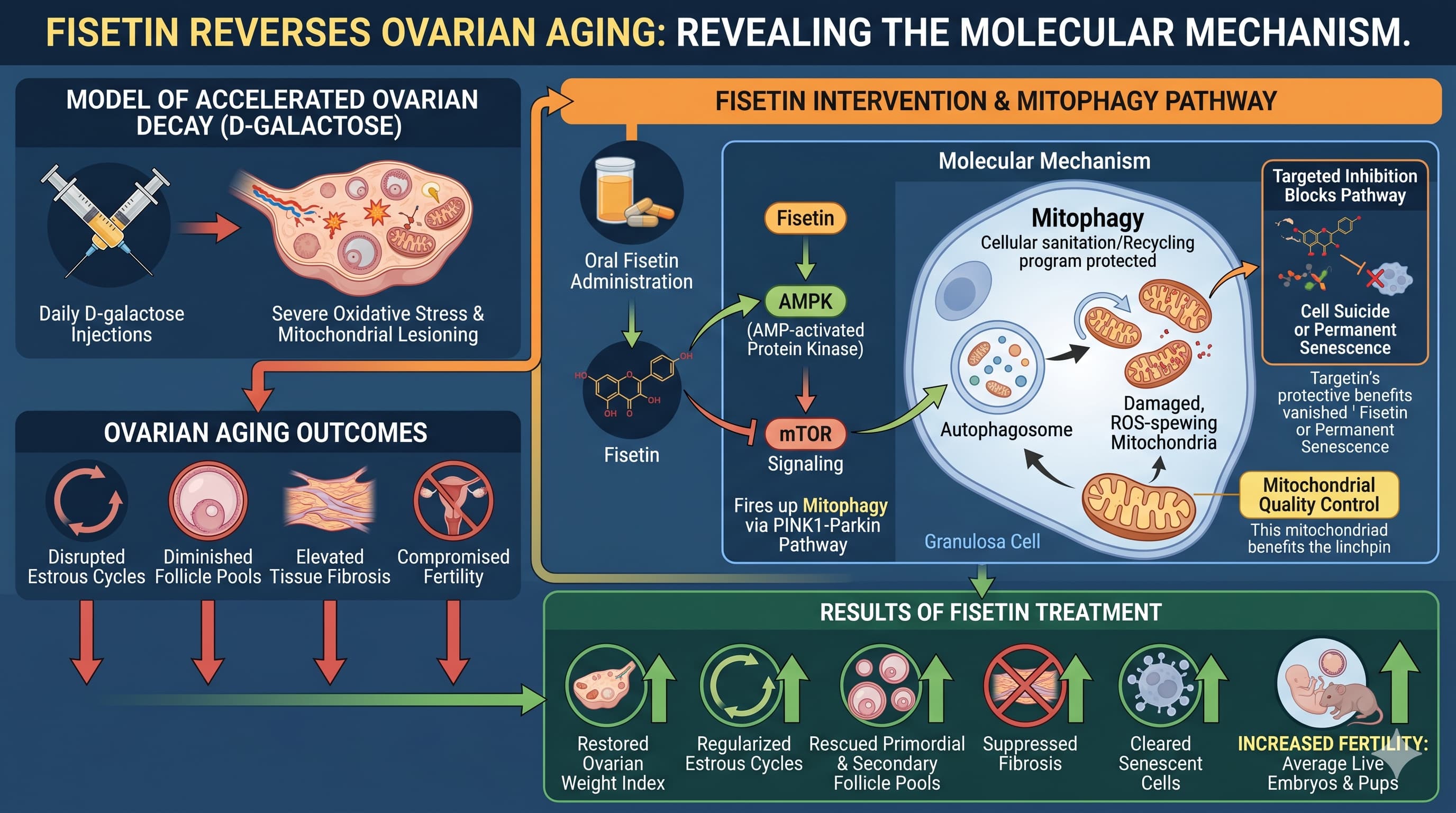
The female ovary is the earliest organ to fail during mammalian aging, a decline characterized by a sharp drop in follicle numbers and oocyte quality. This breakdown triggers reproductive senescence, infertility, and systemic endocrine disruption. At the center of this degenerative process is the vulnerability of follicular granulosa cells (GCs), the primary support network that nourishes developing oocytes. When GCs are subjected to chronic oxidative stress, their mitochondria suffer catastrophic damage, leading to an energy crisis, cellular senescence, and widespread follicular death (atresia).
A new study has demonstrated that fisetin, a natural polyphenolic flavonoid found in fruits and vegetables, can directly arrest and reverse this ovarian decay. Researchers established an accelerated aging model in female mice using daily injections of D-galactose, a compound that mimics natural senescence by inducing severe oxidative stress and mitochondrial lesioning. The aging mice exhibited disrupted estrous cycles, diminished structural follicle pools, elevated tissue fibrosis, and severely compromised fertility.
Oral administration of fisetin during the latter half of the experiment drastically altered these outcomes. Fisetin restored the ovarian weight index, regularized the estrous cycles, and elevated systemic estradiol production. Structurally, it rescued the primordial and secondary follicle pools while suppressing tissue fibrosis and clearing senescent cells. Most importantly, the treatment translated to real-world reproductive success, significantly increasing the average number of live embryos and pups in the mating trials.
By executing a series of cellular knockdowns, the team mapped the exact survival pathway. Fisetin acts through the master energetic sensor, AMP-activated protein kinase (AMPK), while concurrently downregulating mechanistic target of rapamycin (mTOR) signaling. This dual enzymatic shift fires up a critical intracellular sanitation mechanism known as mitophagy—specifically via the PINK1-Parkin pathway. Mitophagy acts as a cellular recycling program, systematically engulfing and degrading damaged, reactive oxygen species (ROS)-spewing mitochondria before they can force the granulosa cell into programmed suicide or permanent senescence. When researchers blocked this autophagic pathway using targeted inhibitors, all of fisetin’s protective benefits vanished, confirming that mitochondrial quality control is the ultimate linchpin of its therapeutic mechanism.
Actionable Insights
-
Human Equivalent Dose Calculation : Based on body surface area normalization, the lowest effective mouse oral dose used in this study (10 mg/kg/day) translates to a human equivalent dose of approximately 0.81 mg/kg/day. For a standard 70 kg human adult, this equals a daily oral intake of roughly 57 mg of fisetin.
-
Clinical Safety Margins : This calculated therapeutic dose sits comfortably well below the high, intermittent senolytic doses (20 mg/kg/day) currently being evaluated safely in human longevity trials for older populations.
-
Targeted Biomarker Modulations : The research demonstrates that oral fisetin effectively scales up native antioxidant defenses by significantly elevating total superoxide dismutase (T-SOD) and catalase (CAT) activities, while driving down malondialdehyde (MDA), a primary marker of lipid peroxidation.
-
Mitophagic Pathway Engagement : To leverage the specific pathway identified—AMPK activation paired with mTOR suppression and downstream PINK1/Parkin execution—fisetin acts as a targeted structural agent, outperforming standard broad-spectrum antioxidants that merely scavenge free radicals without clearing underlying mitochondrial damage.
-
Translational Boundary : While highly encouraging for female reproductive longevity, individuals must note that these insights originate from a chemical-induced rapid aging model rather than natural, multi-decade human oocyte depletion.
Source:
- Open Access Paper: Fisetin Attenuates D-Gal-Induced Ovarian Aging by Modulating Mitophagy via the AMPK/mTOR Pathway
- Institutions : Key Laboratory of Applied Technology on Green-Eco-Healthy Animal Husbandry of Zhejiang Province, College of Animal Science and Technology & College of Veterinary Medicine, Zhejiang A&F University, Hangzhou, China. Also co-authored by the College of Animal Sciences, Zhejiang University, Hangzhou, China.
- Country : China.
- Journal Name : Antioxidants.
- Impact Evaluation: The impact score of this journal is 6.0, evaluated against a typical high-end range of 0–60+ for top general science, therefore this is a Medium impact journal.
Related Reading:
- Rapamycin Restores Fertility Potential in Endometriosis by Reversing Ovarian Aging in Mice
- Study suggests Rapamycin could extend women’s fertility by five years
- Rapamycin for Fertility and Menopause; Clinical Results
- Recharging the Biological Clock: Multimodal Strategies to Combat Ovarian Aging
- New Evidence Links Ferroptosis to Ovarian / Fertility Decline but Ginseng Defends
- A guide to extend longevity by delaying menopause (Age1)
- The Ticking Biological Clock: How Environmental Oxidative Stress Accelerates Oocyte Aging—and How Biohackers Are Fighting Back