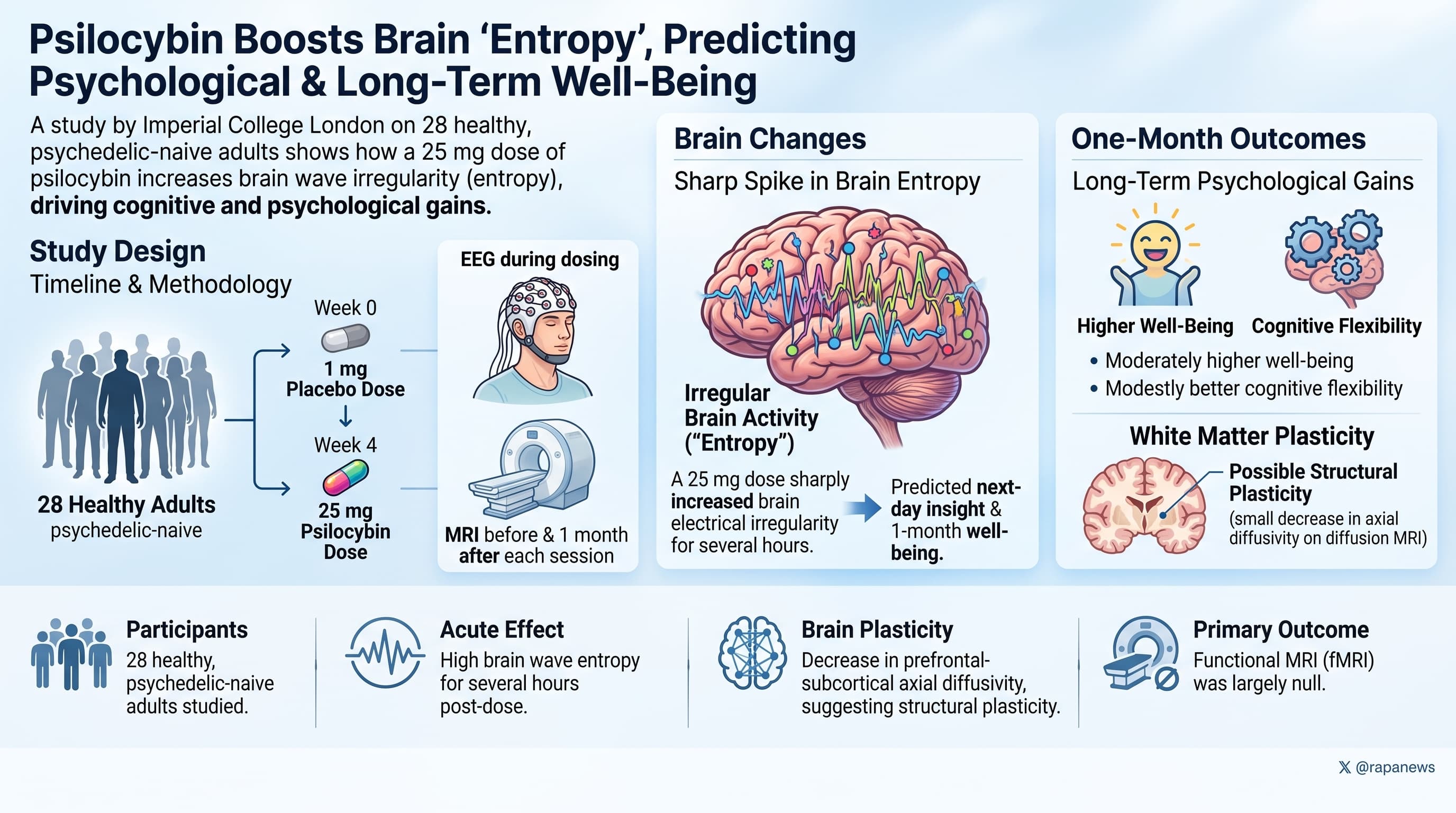
Researchers at Imperial College London gave 28 healthy, psychedelic-naive adults a 1 mg placebo dose of psilocybin, followed four weeks later by a 25 mg dose, with EEG during dosing and MRI before and one month after each session. The high dose sharply increased the irregularity (“entropy”) of brain electrical activity for several hours, and the size of that increase predicted next-day psychological insight and one-month gains in well-being. At one month, participants reported moderately higher well-being and showed modestly better cognitive flexibility. Diffusion MRI found a small decrease in axial diffusivity in prefrontal-subcortical white matter, which the authors tentatively interpret as possible structural plasticity. Functional MRI, the stated primary outcome, was largely null.
A single high dose of psilocybin leaves healthy first-time users feeling measurably better a month later, but the search for a matching lasting signature in the brain has come up largely empty. That is the mixed verdict from an imaging study by the Imperial College London psychedelic research group.
The team gave 28 healthy adults, none of whom had ever taken a psychedelic, two capsules four weeks apart. The first held 1 mg of psilocybin, a dose too small to feel. The second held 25 mg, the dose used in depression trials. Volunteers were told only that each capsule could contain anything up to 25 mg. Brain scans were taken before either dose and a month after each, and brain electrical activity was recorded with EEG during the sessions.
The big idea under test was the “entropic brain” hypothesis: that psychedelics work by making brain activity less predictable, and that this temporary loosening is what allows lasting psychological change. On this point the study delivers its clearest result. Within an hour of the 25 mg dose, the EEG signal became markedly more irregular. The people whose brain activity became most irregular reported the most psychological insight the next day and the largest gains in well-being a month on. Statistically, insight appeared to sit in the middle of that chain, as though the altered brain state produced the insight and the insight produced the improvement.
The lasting changes were harder to pin down. Functional MRI, which the authors name as their primary outcome, produced effects they describe as largely weak and non-significant. A measure of how compartmentalized the brain’s networks are, which fell after psilocybin in earlier depression trials, did not differ significantly from placebo here.
The headline-friendly finding is structural. Diffusion imaging showed a small drop in a measure called axial diffusivity in the white-matter tracts linking the prefrontal cortex to the striatum and thalamus. The authors cautiously float this as possible evidence of anatomical neuroplasticity in humans. They also concede that the same signal turns up in axonal injury and in aging, and that their scanning method cannot tell these apart. A second, standard analysis of the same data found nothing.
On the psychological side, well-being rose by about five points on a 56-point scale, and volunteers made fewer errors on a task that tests the ability to abandon an outdated rule.
The caveats are substantial. Every participant got the placebo first and the real dose second, so the effects of time, practice and repeat scanning are tangled up with the drug. All but one called the 25 mg session the most unusual state of consciousness of their life, so blinding was nominal. The analysis plan was not pre-registered, and dozens of comparisons were run on a sample of about 25.
What survives is one well-supported claim and one tentative one. The acute scrambling of brain activity is real and tracks later benefit. Whether one trip physically remodels a healthy human brain remains unanswered.
Actionable Insights
This paper is a mechanistic study in healthy volunteers, not a test of a health intervention, and it measured no aging outcome.
What it does show, in practical terms:
- Well-being rose 4.7 points more after 25 mg than after placebo at one month, on a scale running from 14 to 70. The UK population average is 51 with a spread (standard deviation) of 9, so this is about half a standard deviation, a moderate effect (Cohen’s d of 0.6). The uncertainty range runs from 0.1 to 9.3 points, so the true benefit could be trivial or large.
- Cognitive flexibility improved by about 6 percentage points fewer errors on rule-shift trials (d of 0.5), with an uncertainty range that touches zero.
- The white-matter change was tiny in absolute terms and its meaning is unknown. It should not be read as “brain rejuvenation.”
Context matters. Dosing occurred under medical screening, with psychological preparation, supervision and music. Psilocybin remains a controlled substance in most jurisdictions. The study followed people for one month only and reports no adverse event data in the main text.
Context/Source
- Open Access Paper: Human brain changes after first psilocybin use
- Institution: Centre for Psychedelic Research, Imperial College London (lead site and sponsor); corresponding author now at University of California San Francisco
- Country: United Kingdom (data collection), with co-authors in the USA, Australia and Canada
- Journal: Nature Communications, volume 17, article 3977, published 5 May 2026
- Impact Evaluation: The impact score of this journal is 18.1 (Journal Impact Factor, 2025 JCR data year, released June 2026), evaluated against a typical high-end range of 0 to 60+ for top general science, therefore this is a High impact journal.