Do you mean SymByx as in https://symbyxbiome.com/?
3 Likes
Yes a typo, thx for picking that up.
2 Likes
What is your view of PDE-5 inhibitors such as tadalafil to improve blood perfusion? And, what about intra-nasal insulin?
3 Likes
So for PDE-5 inhibitors, I’m pretty happy using these routinely, especially in ApoE4’s or older individuals that don’t have contraindications. There seems to be a strong association with use and decreased dementia risk, and increased cerebral blood flow … and decreased stroke and myocardial infarction. May not be causative, which is always the risk with associations. However, some will be proven and others disproven. This is why I often have patients on multiple items that have solid associations. It’d be bad luck if at least 25-50% of them didn’t end up being causative. But this is why I look at recommending multiple drugs/supplements, all acting on different pathways, that are well tolerated and also typically improve other health outcomes.
So on the intra-nasal insulin … I think I’ll go with this review for the time being: Intranasal insulin for mild cognitive impairment and Alzheimer's disease: A systematic review and meta-analysis of randomized controlled trials - PubMed
Basically, I don’t think it does much.
I however think that with tracking Beta Amyloid 42:40 ratio and p-Tau 217 serially, we can at least trend how things are going before MCI or even with some MCI.
It continues to be my opinion that once one gets well into MCI, probably the interventions I recommend are likely coming too late to the game.
Ask me in 10 years, and I’ll have my own patient’s data, and mine also and have a better sense. This is early days, but time is ticking and damage is being done, and the classes of medications I advise seem very low risk, and unknown on benefit. Given that we have nothing else right now …
7 Likes
Thank you Dr. Fraser. Interesting to see that IN insulin had no effect in people with MCI or dementia. It did say there were some cardio benefits. Although the benefits for the brain are questionable for people with decline, I wonder if there might be benefits as a preventative. (I know I’m reaching here…) In any case, it is low risk, and low cost. For now I will keep using it along with tadalafil and lithium.
1 Like
I personally would prioritize a statin, ezetimibe, glp-1, sglt-2 inhibitor, possibly low dose doxycycline, making sure vitamin B12/Omega 3’s/Vitamin D are optimized, tadalafil, low dose lithium as being a pretty good stack. Some of these items will prove to useless, but some of them will likely pan out. I just can’t say which as of today.
Lifestyle is critical in addition, with sleep, exercise, diet, stress all have probably a lot more importance that much of the items above.
7 Likes
The only thing you might be missing is HRT for women — if caught early enough in the transition to perimenopause/menopause. Estrogen is the foundation for everything to women.
Also ChatGPT warns me against doxy even in small subclinical doses, as potentially damaging to mitochondria, which are essentially ancient bacteria who’ve evolved laterally.
I agree with both Male and Female HRT in this area - although we have data that looks concerning when female HRT is started late - so there is a potential need to nuance this with trying to start this around menopause.
On the doxycycline, 20 mg BID … I don’t share the concern - but at 100 mg bid long term or even 100 mg daily, this is an interesting area.
Here is what Vera-Health.ai says on this issue:
At sub‑antimicrobial dosing (doxycycline 20 mg BID) taken long term, there is no direct human evidence that it causes clinically meaningful, persistent mitochondrial dysfunction, but mechanistically it can inhibit mitochondrial translation, so a small/individual‑susceptibility risk cannot be excluded.
What the best available evidence implies for 20 mg BID long term (ranked)
-
Mechanistic plausibility exists at doxycycline exposures that are used in biology models: tetracyclines (including doxycycline) inhibit mitochondrial ribosomal translation, producing mitonuclear protein imbalance and measurable bioenergetic shifts in cultured cells/animal models—this is why doxycycline is a known confounder in Tet-inducible research systems. 1 III; 2 II
2.Relevance:* establishes mechanism; does not define risk at 20 mg BID in humans. -
Dose/context dependence is real in vivo (preclinical): mouse and other model data show doxycycline can impair complex I–linked respiration and cardiac function under certain dosing paradigms. 3 II
4.Relevance:* supports potential tissue-level mitochondrial liability, but these are not sub-antimicrobial (20 mg BID) human outcomes data. -
Longer-term doxycycline use in clinical studies is generally tolerated without a “mitochondrial toxicity syndrome” signal, but mitochondrial endpoints were not evaluated: a 2023 systematic review/meta-analysis of longer-term doxycycline (≥8 weeks) across 67 studies found it generally safe with adverse events mainly GI/dermatologic and discontinuation uncommon; it did not assess mitochondrial function measures. 4 II
6.Relevance:* best human aggregate safety signal for chronic exposure, but it cannot rule in/out subclinical mitochondrial effects. -
Special populations likely matter most: doxycycline is being explored as a mitochondrial translation inhibitor that can be therapeutically beneficial in some mitochondrial disease models, underscoring that effects can be biologically significant and dose-dependent. 5 II
8.Relevance:* argues for caution in patients with suspected/known primary mitochondrial disease or other high vulnerability states—directionality (harm vs benefit) may depend on context.
Practical clinical takeaways for a patient on 20 mg BID long term
- In otherwise healthy patients: no evidence supports routine “mitochondrial monitoring”; focus on standard long-term doxycycline tolerability and adverse effects.
- Higher concern / consider alternatives or closer clinical follow-up: known/suspected primary mitochondrial disorder or unexplained multisystem symptoms suggestive of mitochondrial dysfunction developing on therapy (e.g., new severe exercise intolerance, recurrent lactic acidosis, progressive neuropathy/myopathy—recognizing these are not established typical effects of low-dose doxycycline based on available human data).
2 Likes
Yes absolutely right re: timing of HRT. It’s what I meant when I said “if the transition is done early enough.” I’ve had a very consultative, Socratic style discussion with ChatGPT on my health interventions and have found it orders of magnitude more useful than the way I’d been used to employing it before — i.e., hit and run digests in single questions / topics, as I often see done here too. It is usually very conservative about suggesting interventions for me and seems more “comfortable” being reactive in judging what I myself come up with, but with respect to HRT it’s almost insisting that I go on it asap. Funny thing is I haven’t felt any symptoms so far (I’m 39) but if thinks that because I’ve nursed 5 babies for a long time and am still nursing my toddler, I am de facto hypoesterogenic and have had a bit too much area under the curve over a lifetime so far in that condition so especially given my ApoE3/4 genotype, the single biggest lever I can pull to protect my brain is get on that HRT asap.
I’ve been amazed at how nuanced the recommendations have been though — it has consultatively come up with a stack for me that’s highly personalized on what it knows about my physiology and psychology and it’s been working great this past month since I started (best sleep in years, measured, much stronger nails, great skin, etc.) but I wonder how much of my stack is transferable to anyone else. It honed in on my oura data and 23&me data too. For me for example it is actively discouraging PDE-5 inhibitors saying they’re too blunt for me now, but perhaps later down the road, but it is green lighting l-citrulline. It’s got me taking on a @John_Hemming lite protocol with citrate salts indefinitely for kidney protection (I am prone to uric acid stones and have the low klotho genotype). I’ve really thrown the kitchen sink at it and got rid of all my supplement / pharma fomo, streamlining everything into sure, take it / maybe later / never touch buckets.
Re: doxy, it would tell me (and practically has when I brought up that reasoning) that absence of evidence of harm is no evidence of absence of harm. Its mechanistic reasoning is very persuasive.
1 Like
Saw the attached article and asked Perplexity to review it and answer a few questions.
As one of my interests is how senescent cells affect our overall health and health span, I had to ask about that as well. Especially since the author and “patient” Dr. Brent Beasley, notes that a Covid infection was a major trigger but “not the cause”.
I believe that senescence is a significant cause of all types of dementias.
If you are not killing your zombie cells, they will get you.
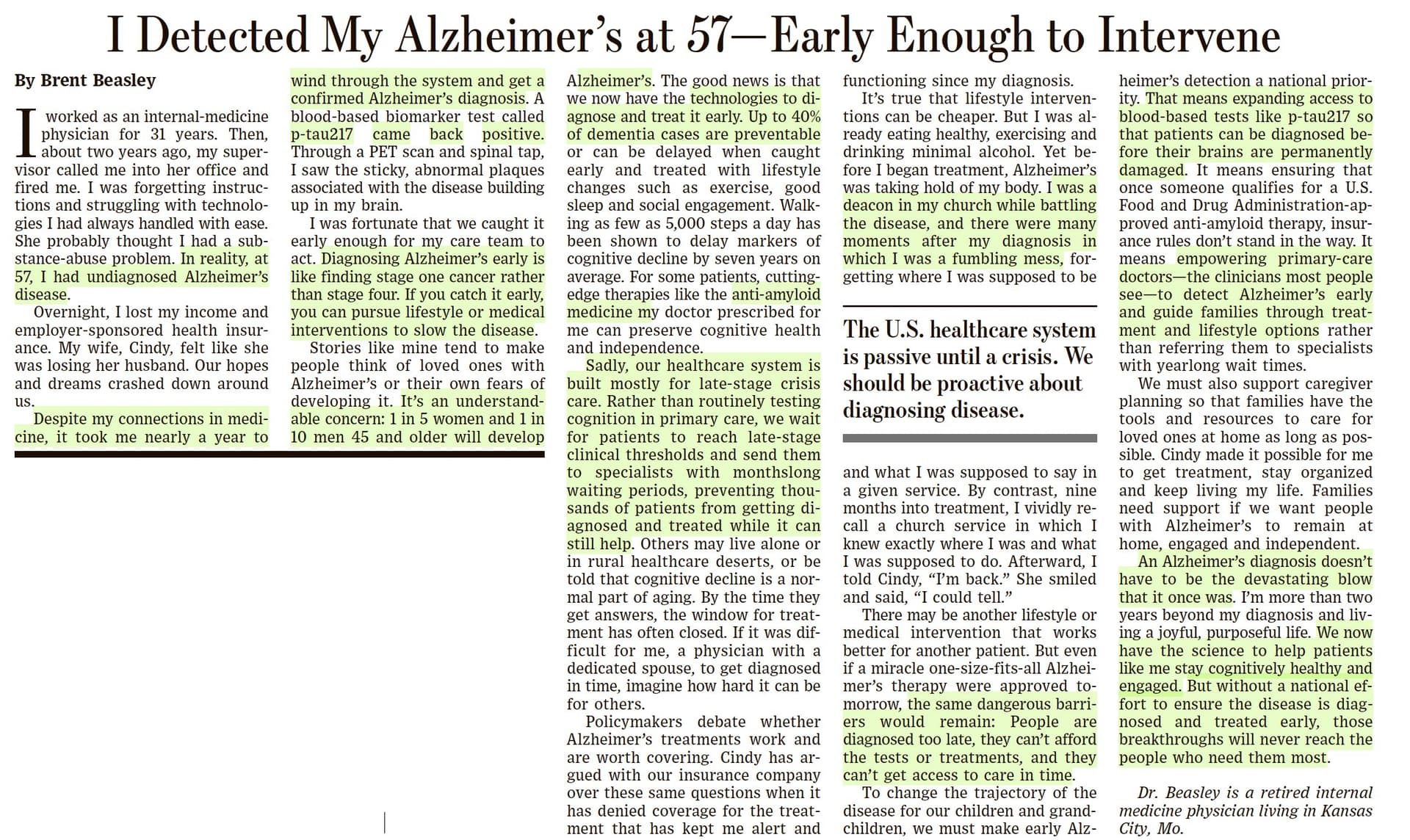
slowing_alzheimers_senescence-factor pdf.pdf (469.9 KB)
5 Likes
This seems to be the increasing realization… infections (and the associated inflammation) are much worse for the brain than we thought: Viral Pneumonia Accelerates Brain Aging
5 Likes
Indeed - on my video about immunizations - the big benefit is keeping someone from having a major inflammatory response as that injures all organs, but it seems like the brain is quite susceptible.
So I do recommend pretty much all the vaccines. I suspect with Covid, if you take Paxlovid early - probably just a good.
My experience thus far with patients on Rapamycin has been pretty favorable in regard to not getting horribly unwell with viral illnesses. Considering doing a similar protocol to the TRIIM trial to improve T cell immunity also should be on the plate as folks get older.
On @Steve_Combi 's article, yes, I have patients positive for Beta Amyloid 42:40 ratio and p-Tau 217 with no symptoms or very vague MCI. It is something to track to see if interventions are working and improving these test results, or slowing predicted worsening in these values over time. This is where the DORA agents are interesting as they have been linked with decrease in the isoforms of Beta Amyloid - but not necessarily the ratio we track.
7 Likes
Dr. Fraser, Would you please share your opinion of Paraspinal Etanercept. There are some studies showing that it can reverse MCI/early AD. It is approved for rheumatoid arthritis but is starting to be used off label (not approved by the FDA) for AD and seems to show promise. Do you think this is worth chasing, and if so, how/where to find a practitioner who would prescribe and inject (into the spinal column). Would appreciate your view –
I think I’ll go with Vera-Health.ai’s review of this … and apart from the expense, you’d have a very hard time finding someone to inject it; and the rationale for paraspinal versus simply subcutaneous makes little sense. This drug gets widely distributed through the body (apparently not crossing the BBB or into the spinal column) slowly, but through lymphatic uptake, which would have it be moving away from the spine anyway.
I think if one were compelled to do this, it would be hard to find a physician to prescribe it for this indication given it has more significant risks that anything that I would prescribe that I’d lump into “speculative therapy.” One of my rules for this, is that it has to be very low risk for adverse outcomes.
Clinical evidence for perispinal/paraspinal etanercept in Alzheimer’s disease is limited to uncontrolled human reports and is not supported by randomized controlled trial evidence; it should not be used outside a clinical trial.
Clinical Guideline
Do not offer etanercept (including perispinal/paraspinal administration) to treat Alzheimer’s disease outside research settings because there is no high-quality evidence of clinical benefit and biologic therapy carries meaningful infection risk. 1 I
Human clinical evidence (perispinal/paraspinal etanercept specifically)
-
Open-label case series / uncontrolled reports suggest “rapid improvement,” but are high risk of bias and not confirmatory:
- Journal of Neuroinflammation (2008): report of rapid cognitive improvement after perispinal etanercept; uncontrolled observational data only, hypothesis-generating. 2 III
- BMC Neurology (2008): report of rapid improvement in verbal fluency/aphasia after perispinal etanercept; case-based data without randomization/blinding. 3 III
- Narrative reviews proposing mechanism/clinical paradigm (not efficacy evidence): 4 III; 5 III; 6 III; 7 III; 8 III
- No randomized, double-blind, placebo-controlled trial evidence supporting perispinal etanercept for AD is provided in the retrieved sources. (The only RCT in AD below used subcutaneous systemic etanercept, not perispinal.)
Human RCT evidence for etanercept in AD (systemic SC, relevant for plausibility and safety, but not perispinal efficacy)
-
Weekly subcutaneous etanercept did not show statistically significant cognitive/global benefit in mild–moderate AD over 24 weeks (small RCT), though tolerability was acceptable:
- Neurology (2015) double-blind RCT (n=41 randomized) found no statistically significant changes in cognition/behavior/global function; designed primarily for tolerability/safety. 9 I
Mechanistic/PK plausibility for CNS delivery via perispinal route (preclinical)
-
A rat radiolabel study did not find evidence of CNS delivery after perispinal injection, directly challenging the proposed “CSF delivery” rationale:
- Alzheimer’s Research & Therapy (2015): radiolabeled biologics after perispinal injection in rats; concluded no evidence for CNS delivery. 10 II
Systematic review-level synthesis (TNF inhibitors in AD broadly)
-
Systematic review concludes evidence is limited/heterogeneous and not definitive for TNF-α inhibitors in AD, reinforcing that perispinal etanercept remains unproven:
- Int J Geriatr Psychiatry (2018) systematic review of TNF-α inhibitors in AD pathology/outcomes. 11 II
Observational epidemiology (risk of incident AD in inflammatory disease; does not test treatment of established AD; not perispinal)
- Large EHR/case-control signals that TNF inhibitors (including etanercept) are associated with lower AD odds in RA/psoriasis populations are hypothesis-generating and vulnerable to confounding by indication, health-user bias, and outcome misclassification:
- PLoS ONE (2020) EHR case-control analysis. 12 II
- RMD Open (2024) systematic review/meta-analysis in RA cohorts suggests lower incident dementia risk with biologic DMARDs/TNF inhibitors. 13 II
- Gerontology (2025) systematic review/meta-analysis in RA suggests association with lower dementia risk; retrospective evidence only. 14 II
Bottom line for practice
- Perispinal/paraspinal etanercept for Alzheimer’s disease lacks Level I efficacy evidence and has conflicting mechanistic support; the best available RCT evidence for etanercept in AD (systemic SC) is negative for clinical efficacy, so perispinal use should be considered experimental only. 9 I; 10 II
2 Likes
Thank you so much for your reply.
I guess for now, in addition to “behavior” will stick to lithium, tadalafil, intranasal insulin, and a few other supps like bacopa monnieri --but will continue to explore. MCT oil???
3 Likes
At the recent UC Berkeley longevity conference I spoke to one of the local scientist attendees who mentioned his wife is APOE3/4 and was concerned about her risk, so took a proteomics test provided by the following company: called “Molecular You”. https://www.molecularyou.com/
Here is a link to their website product page. Advanced Biomarker Insights | Biomarker Testing Service Company where they describe their services looking at 190+ biomarkers.
It looks like they charge $1,100 list price for the one time test (and maybe annual subscriptions), which includes a home visit by a phlebotomist to draw blood.
Note these guys DO NOT test for genetic markers like APOE4, but only proteomic ones which would be activated, in theory, as a result of, say, APOE4—but not necessarily if there are other mitigating factors.
The result of the proteomics evaluation was that, despite the E3/4 status, they concluded she was extremely low risk of alzhiemers due to all the positive measures evident from the proteomics test (I think she was in excellent health, regular exerciser, good blood markers, etc. too).
So, perhaps another way to look at your E4 risk profile with greater information.
2 Likes
Anything new on if Rapamycin are still on for many of those SV tech people? If not on, what they opted to? Metformin? GLP1?
1 Like