MTORC1: The Master Switch of the Aging Brain, and Why Rapamycin Might Turn It Back

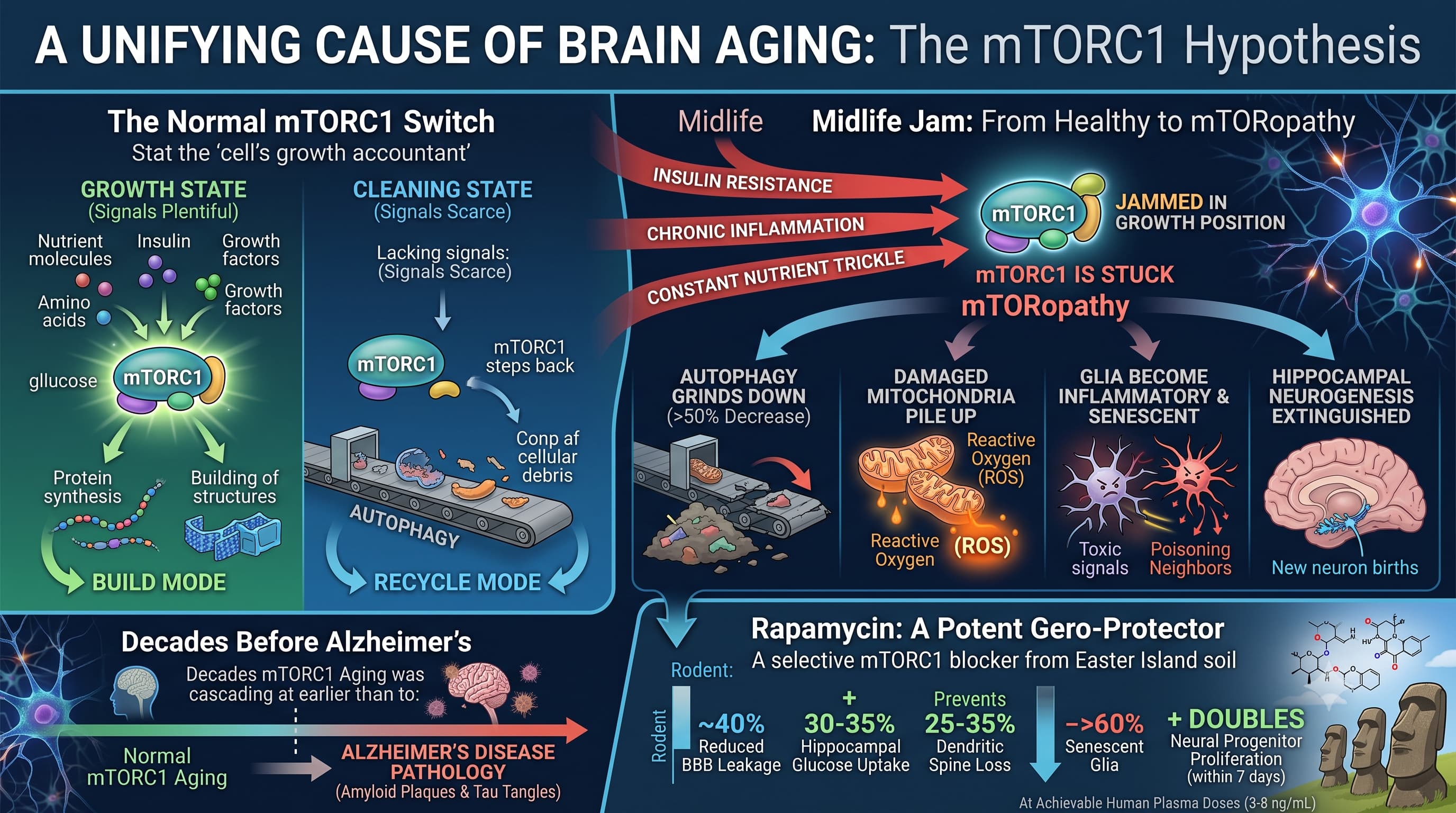
This review argues that most of the slow, universal decline of the aging brain traces back to one molecular culprit: chronic overactivity of mTORC1, a nutrient-sensing protein complex the authors nickname “mTORopathy.” When mTORC1 is stuck in the “on” position from midlife onward, it shuts down cellular housekeeping (autophagy), poisons mitochondria, inflames glial cells, and strangles the birth of new neurons. The authors marshal a large body of rodent evidence that intermittent, low-dose rapamycin — the drug that inhibits mTORC1 — can reverse, not merely slow, these changes even when started in old age.

For decades, neuroscientists have been unable to name a single unifying cause for the ordinary decline of the aging brain — the fading memory, the slower processing, the shrinking of connections that eventually touches nearly everyone who lives past 75. This review makes an ambitious claim: there is a common cause, and it is a protein complex called mTORC1.

mTORC1 is the cell’s growth accountant. When food, insulin, and growth signals are plentiful, it tells the cell to build; when they are scarce, it steps back and lets the cell clean house. The authors’ “big idea” is that from midlife onward this switch gets jammed in the growth position — by insulin resistance, chronic inflammation, and a constant trickle of nutrients — and never fully turns off. They call this stuck state mTORopathy.

The consequences, they argue, cascade through every compartment of the brain. Cellular recycling (autophagy) grinds down by more than half. Damaged mitochondria pile up and leak reactive oxygen. Support cells called glia slide into an inflammatory “senescent” state and poison their neighbors. The birth of new hippocampal neurons — a process now known to continue into old age in humans — is nearly extinguished. Crucially, the authors say all of this begins decades before the amyloid plaques and tau tangles of Alzheimer’s, meaning it is a feature of normal aging, not just disease.

The therapeutic hook is rapamycin, an immunosuppressant discovered in Easter Island soil that selectively blocks mTORC1. In aged mice, dogs, and marmosets, short intermittent courses reportedly restore blood flow, memory, synapse density, and neurogenesis to near-youthful levels — with benefits lasting months after the drug is stopped. The authors frame this as the single most mechanistically justified anti-brain-aging strategy currently available, and argue it outperforms every rival geroprotector tested (metformin, senolytics, NAD+ boosters).

The honest counterweight, which the authors do concede, is that this entire edifice rests on inbred lab rodents and monkeys living in sterile cages. No large human trial with cognitive endpoints has been done. There are no validated biomarkers to even measure brain mTORC1 in a living person.

Actionable Insights

The take-home messages are indirect, because the star intervention (rapamycin) is prescription-only and unproven for longevity use in humans. What the review supports, without needing a prescription:

The most robust, human-relevant lever is suppressing chronic mTORC1 activation through lifestyle modifications, because the review states that every well-validated geroprotector (caloric restriction, exercise, metformin, resveratrol, intermittent fasting) works largely by activating AMPK, which inhibits mTORC1. Magnitudes the authors cite for the drivers you can modify: midlife type-2 diabetes/insulin resistance accelerates brain aging by 4–7 years, and chronic inflammation (inflammaging) doubles the risk of substantial cognitive decline over the following two decades. Reducing branched-chain amino acid excess, insulin resistance, and inflammation therefore targets the exact upstream inputs the paper blames.

For the rapamycin data (rodent, not human): reported effects include a ~40% reduction in blood–brain barrier leakage, a 30–35% increase in hippocampal glucose uptake, prevention of the normal 25–35% loss of dendritic spines, a >60% reduction in senescent glia, and a doubling of neural progenitor proliferation within 7 days — all at plasma levels (3–8 ng/mL) already reached in human frailty trials.

Bottom line for a health-conscious reader: the lowest-risk actions are the AMPK-activating basics (exercise, avoiding insulin resistance, controlling inflammation). Rapamycin/rapalogs remain experimental for brain aging.

Context / Source

  • Paywalled Paper: Unlocking the aging brain: mTORC1 as a convergent integrator for neurodegeneration and therapeutic intervention, 2026 Jun 15.
  • Type: Review article.
  • Authors / Institutions / Countries: Mokhtar Rejili (Imam Mohammad Ibn Saud Islamic University, Saudi Arabia); Hayder M. Al-kuraishy (Mustansiriyah University, Baghdad, Iraq); Mustafa M. Shokr (Sinai University–Arish, Egypt); Gaber El-saber Batiha (Damanhour University, Egypt).
  • Journal: Biogerontology, 2026, Publisher: Springer Nature.
  • Impact Evaluation: The impact score of this journal is 4.0, evaluated against a typical high-end range of 0–60+ for top general science, therefore this is a Medium impact journal.

Related Reading:

3 Likes

Biomarker Data (effect-size extraction)

What the authors assert (all second-hand, rodent unless noted):

  • Autophagic vacuole content in aged human hippocampus/PFC: reduced >50% vs young adults (cross-sectional, correlational).
  • Rapamycin → blood–brain barrier permeability reduced ~40% (aged mice, 4–8 weeks).
  • Rapamycin → hippocampal glucose uptake +30–35% (aged mice, 4–8 weeks).
  • Rapamycin → prevents 25–35% age-related dendritic spine loss in CA1/PFC.
  • Rapamycin → senescent (SA-β-gal+) glia fraction reduced >60%; from a baseline where >40% of hippocampal glia were senescent at 28 months.
  • Neurogenesis: declines >90% adult-to-old; progenitor proliferation doubles within 7 days of rapamycin, newborn-neuron survival ~3x.
  • Epidemiological drivers (human, correlational): insulin resistance +4–7 years brain aging; inflammaging ~2x (RR ≈ 2.0) risk of cognitive decline over 20 years.
  • Pharmacology: steady-state target 3–8 ng/mL; doses 2.5 mg/kg/day or 14 mg/kg every other day (mouse); benefits persist 6–12 months post-withdrawal; chronic dosing tolerated for ~40% of adult lifespan without immunosuppression (rodent/primate).

The only figure resembling a formal effect measure is the inflammaging “doubling” of risk, i.e. RR ≈ 2.0, but the review gives no confidence interval, so its precision is unknown.

3 Likes

I would really like to see some PK/PD using phosphorylation of p70S6 kinase (p70S6K/S6K1 at Thr389) or its downstream target ribosomal protein S6 (p-S6 or p-S6RP) kinase activity, peripherally measured, over a range of daily lower doses administered to steady state - 1 -2 months, much lower than presently in the literature, focusing on >50 yo. Starting at 0.1 mg/day and going to .5 mg/day.

Predicted blood levels across dose range:

Steady-State Estimates (Whole Blood, ng/mL)

Css,avg (average concentration over 24 h dosing interval) = Dose / (CL/F × τ), where τ = 24 h.

For 0.1 mg/day:
Css,avg: ~0.2–0.4 ng/mL
Cmax,ss (peak, ~1–4 h post-dose): ~0.3–0.7 ng/mL (clinical fluctuation often shows Cmax ~1.5–2× Cmin due to distribution/absorption phases)
Cmin,ss (trough/pre-dose): ~0.15–0.35 ng/mL

For 0.5 mg/day:
Css,avg**: ~1.0–2.0 ng/mL
Cmax,ss**: ~1.5–3.5 ng/mL
Cmin,ss**: ~0.8–1.7 ng/mL

Scaling note: Per mg/day, Css,avg is roughly 2.0–2.9 ng/mL (using CL/F ~200–250 mL/h/kg in a 72 kg adult).

The conjecture is that a) consistent low level inhibition matches age-related increases in mTOR1, may be effective and b) avoids higher Cmax that inhibit mTOR2 dosed at higher levels with lower frequency dosing cycles and decreases risk of immune dyregulation.

This could then inform a much larger study looking at relevant outcome variables.

The low daily dose rapa studies would be a critical part of designing a much longer duration RCT (N=1000 - 5000 x 5-10 years) and some of the information obtained from the low dose daily rapamycin work would still be useful for PD correlation.

Figure this only needs $50M to $100M in funding for the whole project (!)

3 Likes

(a)How low? Daily dosing means there’s a chance rapa can accumulate since clearance is in excess of 24 hours. For transplant patients on daily rapa, they measure blood levels and adjust the dose to get to a specific number that can be maintained longer term. Often it comes to like 1-2 mg daily. How do we know what level to shoot for wrt. longevity? Transplant patients are a poor guide, because whatever the sides are, like immunosuppression, you seldom have them on rapa monotherapy, usually there’s a bunch of other drugs and rapa at best is an adjunct, so there are too many confounders.

(b)Why avoid higher Cmax? My understanding is you need continuous long term TORC1 suppression for it to translate to TORC2 suppression. Once weekly transient high excursion is too little to have that effect. Furthermore, it can be that a burst of high Cmax is a good thing, not a bad thing, and might even have benefits (some claim BBB penetration at higher peak exposure).

I think continuous rapa exposure has a higher chance of immune dysregulation than once weekly transient spikes followed by a very low trough allowing for mTOR to reactivate briefly if some short term growth/regeneration might still be desirable. That’s the whole thinking behind pulse dosing. This is all speculation of course, but you’d need many arms to adjudicate between all of them each with enough cohort numbers to power them, and $100 mil might not be enough, especially if it’s a longer trial. Unfortunately. YMMV.

1 Like

Its an interesting thought that with permeable BBB enough rapamycin gets through to stop the BBB being permeable.

3 Likes

Compare to 1mg/week:

Steady-State Estimates (at SS)

Cmax,ss (peak, shortly after weekly dose): ≈ 0.7–0.8 ng/mL (model central estimate 0.77 ng/mL). Occurs ~1–4 h post-dose.
Cmin,ss** (trough, immediately pre-next weekly dose): ≈ 0.13–0.18 ng/mL** (model central estimate 0.15 ng/mL).

At the 1 mg/week dose, Cmin,ss is around 0.13 - to 18 ng/ml whereas at 0.1 mg/day, Cmin, ss is 0.15 - 0.35 ng/mL.

Because of the long half-life, you are still getting continuous exposure to rapa at the weekly vs daily dosing. Then the issue comes up that with even more infrequent dosing intervals, where rapa concentrations go to zero, mTOR1 inhibition may decrease or even go back to baseline.

Another issue to consider is that rapa binding and inhibition of mTOR complexes may persist for a time, so that blood concentration may not fully reflect PD effects. That is what the PD portion of a study might answer. What dose and dosing frequency is the “sweet spot”?

My conjecture is the sweet spot is to obtain consistent but very low concentration of rapa across the dosing time to avoid mTOR2 inhibition, as would occur with daily dosing. Several rapa dosers here on the forum have reported that with less than daily rapa dosing frequency, mostly weekly dosing if I recall, biomarker evidence of mTOR2 inhibition was suspected as causal to higher blood glucose, lipids, etc.

You bring up the issue of immune suppression. I agree this is an important consideration. The literature suggests that the concentrations associated with a 0.1 mg/d rapa dosing regimen are highly unlikely to cause immune suppression. Early human studies show immune enhancement, not suppression, at low doses of everolimus. In older adults, everolimus (0.5 mg/day or 5 mg weekly for 6 weeks) increased influenza vaccine response titers by ~20% and reduced PD-1–positive exhausted T cells, without increasing infection risk. Granted that everolimus has a 50% shorter half-life and better bioavailability, but I think the translation holds.

Given where we are now with the research, I agree, YMMV, and the odometer is still being perfected.

The good news is that much more specific mTOR1 inhibitors are in development, thereby possibly avoiding the mTOR1/2 quagmire.

2 Likes

that’s a lovely thought. But this would suggest
no bbb penetration needed to improve bbb:
from Gemini:
No, rapamycin does not need to cross into the deep tissues of the brain to improve the blood-brain barrier (BBB). [1]
Because the BBB is fundamentally a vascular structure made of endothelial cells, rapamycin directly interacts with and repairs the barrier from the “blood side” of the circulatory system. It can completely fix a leaky barrier without ever setting foot in the central nervous system (CNS). [2, 3, 4, 5]
Rapamycin heals the BBB from the outside through several distinct mechanisms: [6]

1. Direct Contact with Brain Endothelial Cells

The primary wall of the BBB is composed of brain endothelial cells that face the bloodstream. [2, 3, 7, 8, 9]

  • What happens: When rapamycin circulates in your blood, it binds directly to the mTOR receptors on the surface of these endothelial cells. [2, 3, 10]
  • The result: This local action upregulates tight junction proteins (the “glue” holding the barrier together) and downregulates matrix metalloproteinases (the enzymes that chew up the barrier) without requiring the drug to cross the threshold. [11, 12, 13, 14]

2. Reducing Peripheral “Inflammaging”

A leaky BBB is often caused by systemic, low-grade chronic inflammation originating in the body. High levels of circulating inflammatory cytokines (like TNF-alpha or IL-6) constantly batter the barrier from the blood side. [15, 16]

  • What happens: Rapamycin acts systemically to quiet down immune cell hyper-reactivity in the bloodstream.
  • The result: By lowering the inflammatory storm in the general circulation, the physical stress on the BBB drops, allowing the barrier to naturally heal and seal itself. [15, 16, 17]

3. Taming Autoreactive T-Cells

In an aging or diseased immune system, peripherally activated T-helper cells cruise through the bloodstream and actively attack the BBB, causing it to disintegrate. [18, 19]

  • What happens: Rapamycin acts on these immune cells while they are still in the peripheral blood supply. It rescues the calming function of regulatory T-cells (Tregs). [18, 19]
  • The result: These corrected immune cells protect the vascular lining instead of breaking it down, reinforcing the BBB from the systemic side. [18, 19]

The Takeaway for Longevity

If your primary goal is to protect and tighten your BBB to prevent age-related cognitive decline, you do not need to worry about chasing massive doses to force rapamycin deep into your brain tissue. Standard longevity pulsing (like 5 mg to 6 mg once a week) is highly effective at targetting the systemic immune system and vascular lining—giving you the barrier-restoring benefits right from the bloodstream. [1, 15, 16, 20]
If you are designing a protocol, would you like to know which specific blood tests (such as high-sensitivity inflammatory panels) can help you track whether your systemic inflammation is dropping?

[1] https://www.rapamycin.news
[2] https://pmc.ncbi.nlm.nih.gov
[3] https://pmc.ncbi.nlm.nih.gov
[4] https://www.marinbio.com
[5] https://www.biorxiv.org
[6] https://pmc.ncbi.nlm.nih.gov
[7] https://www.sciencedirect.com
[8] https://pmc.ncbi.nlm.nih.gov
[9] https://www.sciencedirect.com
[10] https://pmc.ncbi.nlm.nih.gov
[11] https://pmc.ncbi.nlm.nih.gov
[12] https://pmc.ncbi.nlm.nih.gov
[13] https://autoimmune-encephalitis.org
[14] https://www.rapamycin.news
[15] https://pmc.ncbi.nlm.nih.gov
[16] https://pmc.ncbi.nlm.nih.gov
[17] https://www.discovmed.com
[18] https://www.biorxiv.org
[19] https://www.biorxiv.org
[20] https://pmc.ncbi.nlm.nih.gov

2 Likes

I’m skeptical. Animal models are obviously fraught. But it seems there is a dose response effect with rapa where more is better (up to a point). With humans, looking at the PEARL trial, men on 3mg/1-week (highest dose tried) got zero effects of any kind, while women got some slight muscle benefits at that dose. It was speculated that men needed a bigger dose based on body mass - FWIW, in murines it does seem females benefit more already from smaller doses compared to males although I don’t think body mass is involved because sexual dimorphism in mice is not as great in body mass as in humans. There may be a threshold effect - at least for males, although again based on PEARL only women in the highest dose (3mg) were reported to have benefits (with none at 1mg and 2mg).

But OK, we may accept lesser benefits with lower doses in exchange for avoiding negative sides, and hopefully landing at your “sweet spot”. You put down avoiding sides to avoiding inhibition of C2. I don’t think that’s ever been clearly shown - is it in fact a degree of C2 inhibition that’s a negative vs greater benefits of higher dose C1 inhibition? To me this is murky. And as you say, case reports here show people get glucose and lipid handling dysregulation - but then again, the majority seem not to get this effect even at very high doses. Maybe it’s down to individual differences - as an example, based on serum tests Matt Kaeberlein reported extremely fast clearance, whereas I, also based on multiple tests seem to clear sirolimus much slower than most people report (5.6 ng at 50 hours with 6mg dose). And yet for all that, after many months of rapa, which for some weeks I escalated to 8mg and 10mg once a week, I experienced no sides that I could feel or measure (including glucose and lipids). From this I suspect that blood levels of rapa may not tell you how someone may react to rapa wrt. C2 inhibition, may occur at different levels depending on the person, or C2 inhibitionis not that consequential, or the glucose/lipid issues are due ti a different mechanism and not through C2 specifically.

What else does rapa at higher doses (but not so high as to be immunosuppressive) do negative? Because if that is all, my inclination would not be to look for a sweet spot based on rapa dosing very low, but get a higher dose for the benefits and deal with glucose and lipids with drugs which by themselves are beneficial (like SGLT2i, acarbose etc. - and ApoB should be hammered into the ground on principle anyway, regardless of why). That’s also a sweet spot. But of course there are other serious issues - interstitial lung disease; fortunately, it’s resolvable upon quitting rapa or switching to everolimus - but ILD seems to happen mostly if not exclusively at very high doses in immunosuppressed patients. Then there’s pancreatic beta cell toxicity, probably increasing with dosage, but seemingly present already at low doses; I don’t know how that looks clinically at low doses. Testicular shrinkage like immunosuppression again happens at high doses.

That said, yes mTOR inhibitors are being developed that don’t trigger C2 inhibition. Joanne Mannick did a presentation on one when she was still at Tornado where crazy high doses didn’t have sides.

2 Likes