Your mouth is slowly drying out, and most people don’t notice until the damage is extensive.
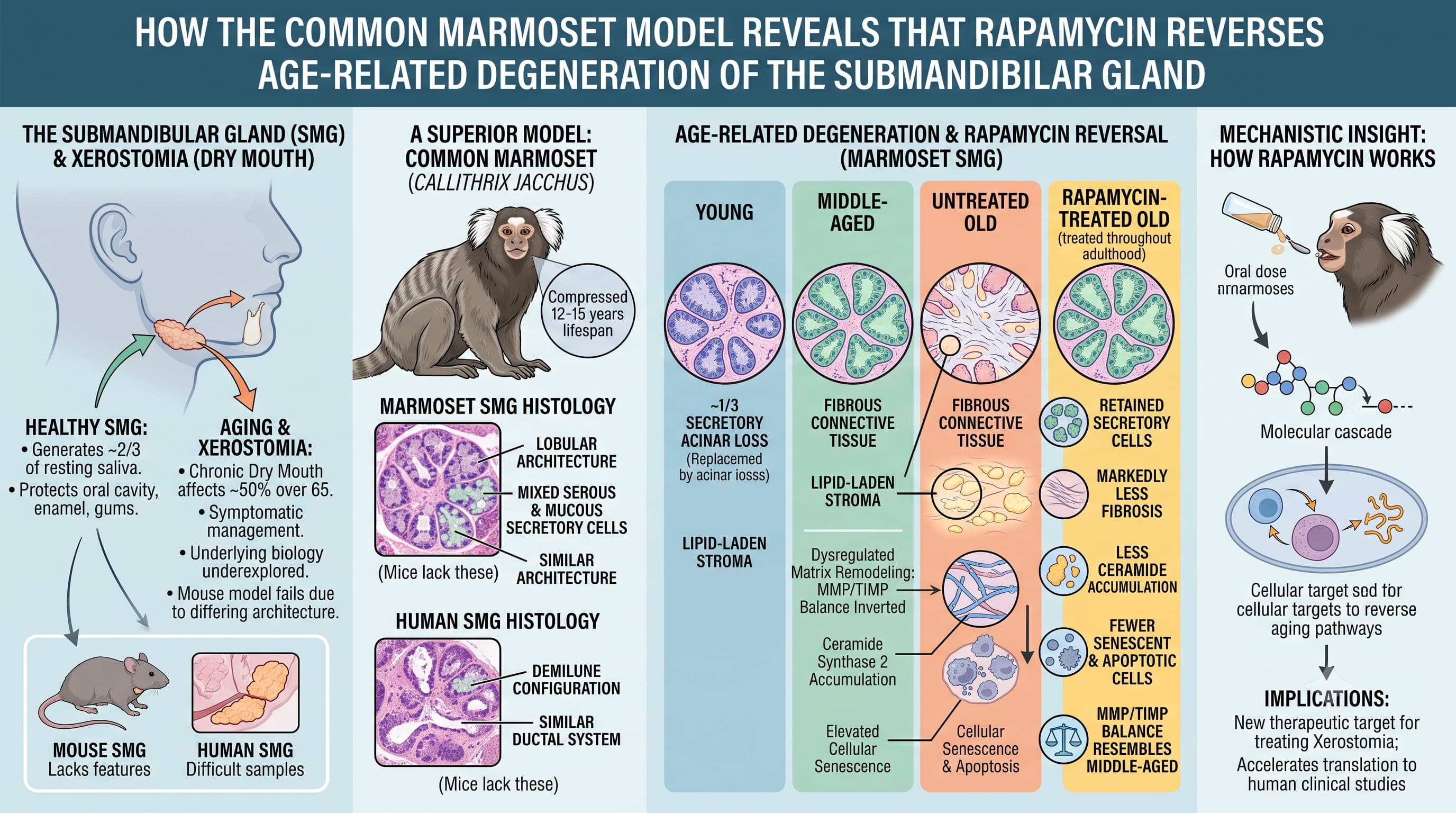
The submandibular gland (SMG)—a walnut-sized secretory organ tucked beneath the jaw—generates roughly two-thirds of your resting saliva. Without adequate saliva, the oral cavity becomes a hostile environment: bacterial populations shift, tooth enamel softens, swallowing becomes difficult, and the mucosal barrier protecting gums and cheeks begins to fray. Xerostomia, the subjective experience of chronic dry mouth, affects an estimated half of adults over 65. Clinicians largely manage it symptomatically. Its underlying biology, particularly why the gland progressively destroys its own secretory tissue with age, has remained underexplored partly because human gland samples are difficult to obtain and because mice—the default lab model—have salivary gland architecture that differs meaningfully from ours.
This paper from UT Health San Antonio proposes a better model and tests one of longevity biology’s most studied drugs within it.
The common marmoset (Callithrix jacchus) is a small South American primate with a compressed lifespan of around 12–15 years and, critically, salivary gland histology that maps closely onto the human pattern: mixed serous and mucous secretory cells arranged in the same lobular architecture, with the same demilune configuration and a ductal system resembling our own. Mice lack these features. The marmoset closes the translational gap.
What the researchers found when they compared glands from young, middle-aged, old, and rapamycin-treated old marmosets tracks almost exactly what autopsy studies have documented in elderly humans. Old glands had shed roughly a third of their secretory acinar cells, replaced by fibrous connective tissue and lipid-laden stroma. Enzyme markers for matrix remodeling were dysregulated—the balance between tissue-degrading matrix metalloproteinases and their inhibitors was inverted. Ceramide synthase 2, a lipid metabolism enzyme, accumulated. Markers of cellular senescence and programmed cell death were elevated throughout.
Rapamycin—given orally throughout adulthood at a dose achieving blood levels comparable to some human longevity protocols—substantially reversed this portrait. Glands from rapamycin-treated old animals retained more secretory cells, showed markedly less fibrosis, accumulated less ceramide, harbored fewer senescent and apoptotic cells, and displayed an MMP/TIMP balance resembling the middle-aged group rather than their untreated old counterparts.
The researchers are themselves explicit that this is exploratory and hypothesis-generating. But this is the first primate data connecting rapamycin to salivary gland preservation, and it adds oral health to an already long list of tissues where rapamycin appears to forestall the structural hallmarks of biological aging.
For the aging adult who takes rapamycin for longevity reasons, the practical implication is novel: the intervention may be offering protection against a quality-of-life detriment—dry mouth, oral fragility, dysbiosis—that rarely appears on the target organ list but carries outsized consequences for long-term health.
This paper delivers the first primate-tissue evidence that rapamycin attenuates aging across the full suite of salivary gland hallmarks—acinar loss, fibrosis, matrix remodeling imbalance, lipid dysregulation, apoptosis, and senescence. The marmoset’s histological fidelity to human SMG architecture substantially strengthens translational credibility relative to any rodent dataset.
Source:
- Open Access Paper: Rapamycin Attenuates Age-Related Changes in Marmoset Submandibular Gland: A Non-Human Primate Model of Human Oral Aging, June 22, 2026.
- Institution: University of Texas Health Science Center at San Antonio (UT Health San Antonio), San Antonio, Texas,
- Country: United States of America
-
Journal: Aging and Disease, an open-access peer-reviewed journal published by the International Society on Aging and Disease.
Impact: The impact score of this journal is 6.9 (JIF, Clarivate JCR 2025) , therefore this is a High-impact journal within its field niche .