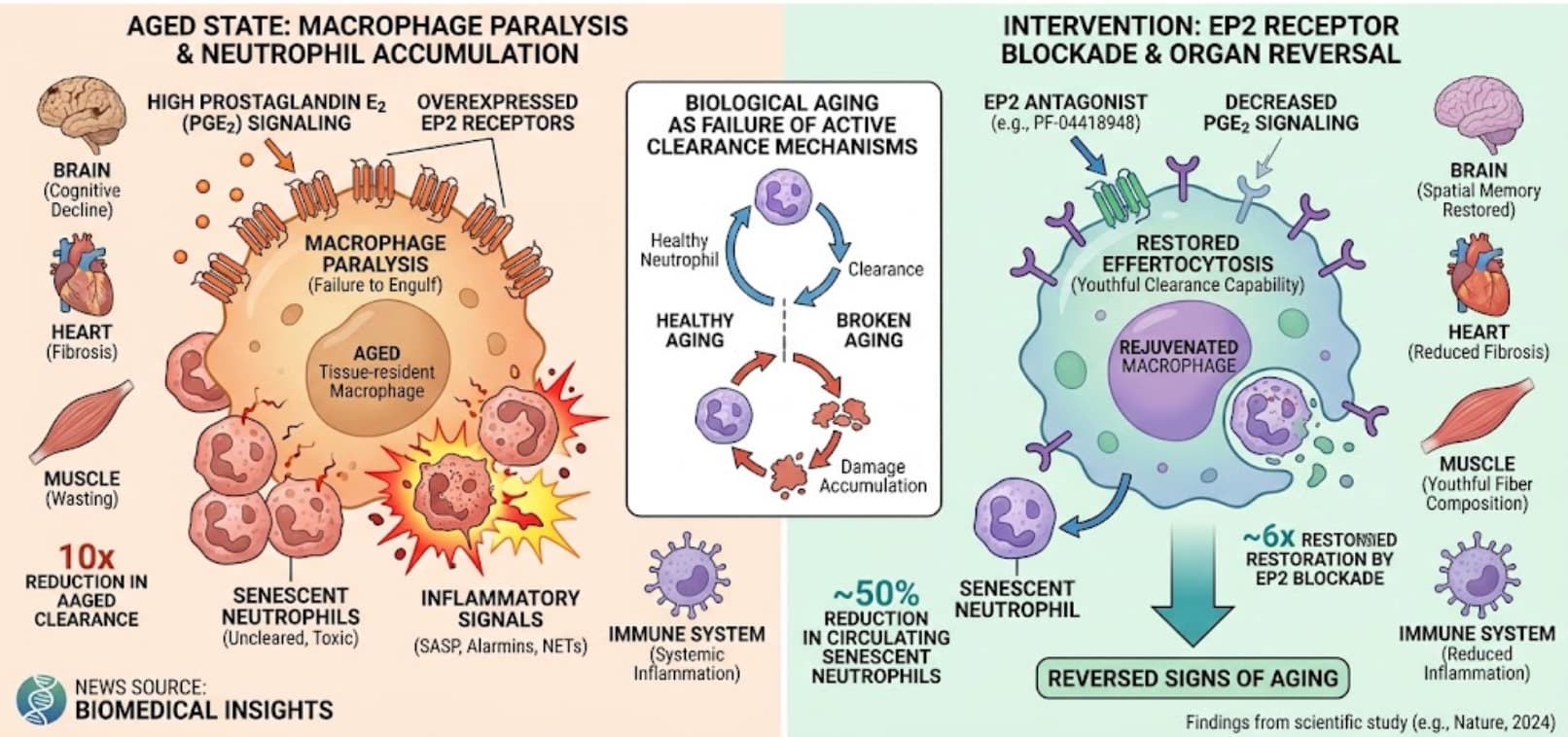
Long-lived macrophages that sit permanently inside the liver, heart, lungs, brain and spleen are responsible for eating dying cells, and their busiest job is clearing worn-out neutrophils, the white blood cells the body produces by the hundreds of billions each day. This Stanford-led group shows that with age these resident macrophages accumulate a receptor called EP2, which responds to the lipid signal prostaglandin E2 and acts as a brake on their metabolism and their ability to grab and swallow cargo. Switching EP2 off in resident macrophages only, starting in mid-life, kept old mice’s mitochondria healthy, prevented the buildup of stressed senescent neutrophils across organs, and left 23 to 25 month old animals with better memory, more muscle, less abdominal fat, lower frailty scores, near-youthful heart function and almost no cardiac scarring. An experimental EP2-blocking drug given to 22 month old mice for two months restored the clearance defect, most strongly in liver. Human liver and heart data show the same receptor rising in aged resident macrophages, but no lifespan was measured and no female mice were studied.
This paper makes an argument that organs may age partly because the cleanup crew stops working, and the crew stops working because a single receptor gets stuck in the on position.
The crew in question is the tissue-resident macrophage. These cells arrive before birth, settle into the liver, heart, lungs, brain, spleen and bone, and stay for the life of the animal, renewing themselves in place. They make up 60 to 90 percent of macrophages in major organs. Their day job is efferocytosis, the engulfment of dying cells, and by volume their main customer is the neutrophil. Humans make more than 100 billion a day and each survives 8 to 12 hours in circulation. If they are not removed on schedule they spill proteases and throw out sticky webs of DNA that injure surrounding tissue.
The Stanford group, with collaborators in Münster, deleted the prostaglandin E2 receptor EP2 selectively in resident macrophages of middle-aged mice, then aged the animals to 23 to 25 months. The results across organs were consistent. Resident macrophage numbers held up instead of collapsing. Their mitochondria kept normal mass and voltage instead of losing roughly 60 percent of both, and stopped leaking superoxide. Inflammatory signals in blood, liver, colon, kidney, heart and hippocampus stayed closer to young patterns, and circulating endotoxin, a marker of gut barrier leak, fell by about 70 percent.
Function followed. Old animals without macrophage EP2 learned the Barnes maze faster, recognized novel objects, gripped harder, had more limb muscle and less visceral fat, scored lower on frailty, and had hearts that pumped and thickened like young hearts, with cardiac scar tissue at youthful levels.
The mechanistic payoff is the specificity. Aged macrophages could still recognize dying cells but failed at the next step: locking integrin adhesion molecules into their high-affinity shape to hold cargo while the membrane closes around it. The coactivators required for that lock were suppressed with age and restored by EP2 deletion. Senescent neutrophils, which lean hardest on that step, were the substrate that suffered most.
Then the practical test. Old mice, already 22 months, received an EP2-blocking compound by mouth for two months. Senescent-type neutrophils in blood, spleen and bone marrow fell toward young values, and liver macrophages regained most of their eating capacity. Liver responded best, likely because it sees the highest drug concentration.
Human tissue is consistent rather than confirmatory. In published single-cell datasets of aged and diseased human liver and aged human heart, resident macrophages decline, the EP2 gene rises in them, and neutrophils expand. Large genetic studies of human longevity show no signal at that gene, which the authors read as a limitation of those studies rather than evidence against the mechanism.
One design point deserves emphasis before anyone reaches for a conclusion about people. The organ and behavioral benefits came from switching the receptor off in middle age and waiting, which is prevention. The drug arm, started in old age, restored the cleanup machinery but was never tested on memory, strength, frailty or heart function. Whether late treatment recovers function, in both sexes, is the experiment that has not been run.
Actionable Insights
For individuals seeking practical interventions to improve healthspan, this study highlights the prostaglandin E2 pathway as a major target for mitigating systemic inflammation. While the highly specific EP2 antagonist drug used in the study (PF-04418948) is currently limited to laboratory research, the findings validate the broader strategy of managing cyclooxygenase-2 (COX-2) and downstream prostaglandin E2 production to maintain immune clearance. Over-the-counter NSAIDs inhibit COX-2, but they carry well-documented gastrointestinal and cardiovascular risks that preclude them as chronic longevity therapeutics. A more practical takeaway is the importance of minimizing chronic systemic inflammation that drives prostaglandin E2 elevation in the first place.
New drugs that target PGE2 are currently in development and testing, and if the results are positive, we might see a drug on the market in the next 3 to 5 years.
What the magnitudes look like: in the drug arm, two months of treatment in 22 month old mice cut senescent-type blood neutrophils from about 46 percent to about 11 percent of neutrophils, a 76 percent reduction, and restored liver macrophage engulfment from about 10 percent to 48 percent, against 53 percent in young mice. In the genetic prevention model, frailty fell about 63 percent, grip strength rose about 33 percent, muscle volume rose 38 percent, visceral fat fell 58 percent and cardiac scarring fell 72 percent.
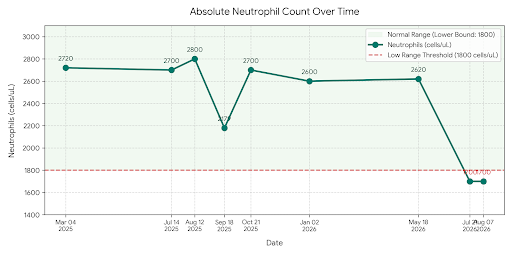
Cheap human proxies worth tracking, because this biology predicts them, are hs-CRP, ALT, AST, GGT, ALP and the neutrophil-to-lymphocyte ratio. In these mice, CRP dropped 74 percent and ALT 65 percent.
Context and Source
- Paywalled Paper: Restored clearance of senescent neutrophils by tissue-resident macrophages limits organ aging.
- Institution: Stanford University, USA, and University of Münster, Germany.
- Journal: Science.
- Impact Evaluation: The impact score of this journal is 44.7, evaluated against a typical high-end range of 0-60+ for top general science, therefore this is an Elite impact journal.