In Silicon Valley, some quests for the fountain of youth have most definitely won the backing of tech’s leading names.
Sam Altman, OpenAI’s CEO, personally invested $180 million to launch Retro Biosciences, which is working on ways to rejuvenate aging cells. CoinBase’s Brian Armstrong co-founded NewLimit, which has raised over $200 million for a similar pursuit from investors that include Peter Thiel’s Founders Fund. And Jeff Bezos reportedly helped bankroll a startup focused on life extension therapies, Altos Labs, which has amassed $3 billion in funding.
Then there are longevity startups like Mitrix Bio, a Pleasanton, Calif.–based company that’s working with only $4 million in funding, none of it coming from the tech billionaires who lately have become enthralled by the idea of treating death like a correctable software glitch.
And while the higher-profile companies still have years ahead of expensive clinical trials to try to get possible Food and Drug Administration approval, Mitrix is testing its proposed anti-aging treatment today on customers willing to pay $50,000 for a small share of equity in the company.
“This is patient-funded medicine,” said Tom Benson, founder and CEO of Mitrix.
Those patient-investors include people like John Cramer, a renowned experimental physicist and the author of three science fiction novels. At the age of 91, Cramer has decided he simply can’t wait any longer for treatments that he hopes will improve the quality—and quantity—of his remaining years. His hearing isn’t great, and he has already had cataract surgery and a knee replacement. A cardiologist monitors his irregular heartbeat.
SO what’s the return of these investments, at least in fundamental biology knowledge in non-human systems before clinical trials?
Altos Labs launched ~3-2 years ago, hired 2 Nobel laureates, including Yamanaka, and no apparent breakthroughs since then.
$ x AI should generate breakthroughs exponentially, and still apparently nothing?
Maybe because biology (with any related fields regarding humans) needs more fundamental breakthroughs, rather than incrementally improving on already existing.
I think if these investments would generate something similar to rapamycin, in a form of a pill or more complex, affordable for middle class world-wide (at least in Europe), then there would be enough mindful_enough biohackers, content and knowledgeable enough of their N=1 to not wait for expensive randomized clinical trials and etc consensus settlement, eager to try it right now.
Well, I’m glad that they found a way to through with it. Still, unless they see something remarkable, I can’t see them getting much traction, but have to admire the tenacity. I do think it’s a missing piece of the puzzle. Here’s hoping for some positive data.
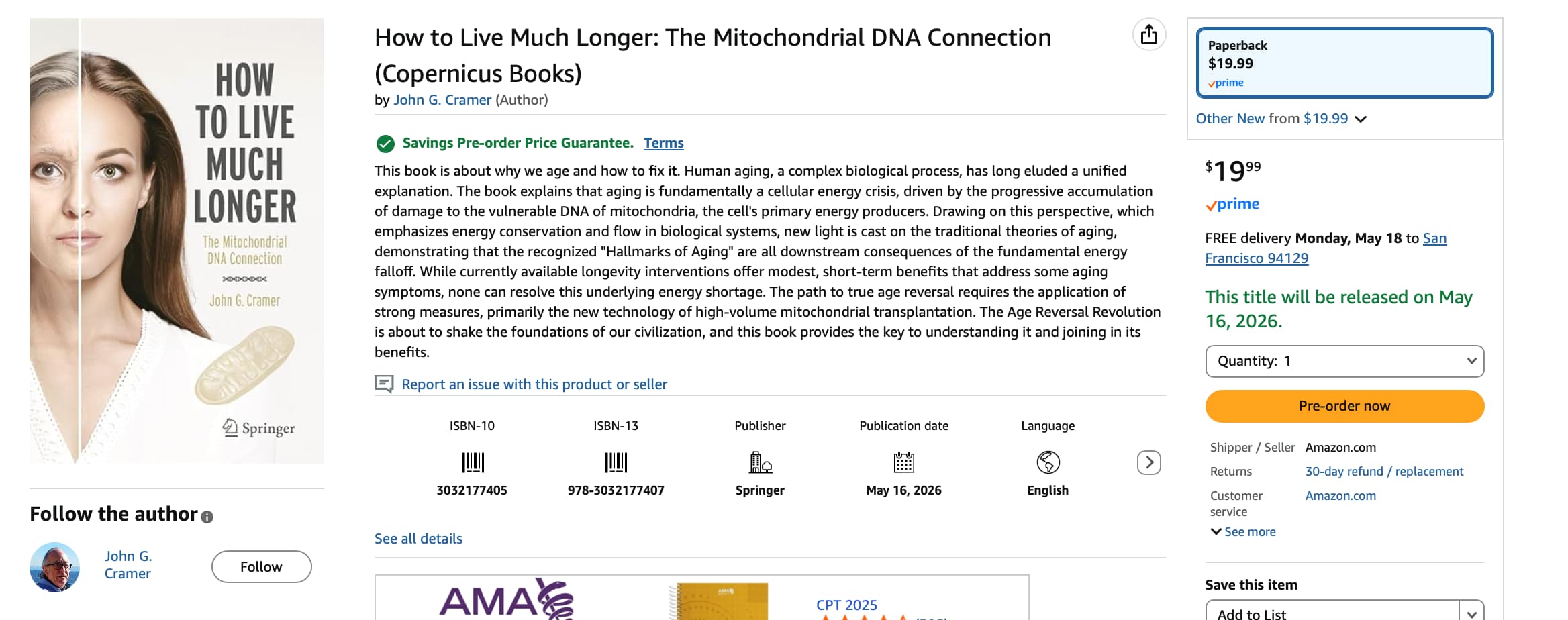
John Cramer has written a book, focusing on the role of mitochondria in aging, to be published by Springer May 18 - available for pre-order on Amazon. Mitrix Bio makes a pretty good case that we are unlikely to achieve systemic age reversal without focusing on mitochondrial DNA as well as nuclear DNA. Cell growth, division, and “epigenetic age reversal” (via OSK etc.) are all highly energy intensive, and nearly all that energy must come from mitochondria … which suffer cumulative mtDNA damage as we age. There’s (much) more to this story – the mitochondria play a far more extensive role than “we were taught in college” - migrating constantly from stem cells or platelets to other cells, and even (it is believed) coordinating their activity across nearby cells via intra-cellular signaling. Though mitochondrial dysfunction is listed as one of the “Hallmarks of Aging”, IMHO this aspect of aging has been underestimated for a long time.
Sure many progresses are energy intensive but that doesn’t mean energy is the bottleneck. Epigenetic age reversal works in old cells in vitro without first doing anything in particular to fix their mitochondria or improve energy production/availability in those cells.