How do we increase our Irisin levels? I would love to postpone sarcopenia.
Irisin, a newly described hormone released from skeletal muscles after exercise
At first glance, it would appear that exercise is a starting place.
5 Likes
It seems like either you exercise, or you buy it:
I am cautiously optimistic that this is a safer approach than steroids or sarms which bind to the androgen receptor. Cautious because what happens to endogenous myokine production when we introduce exogenous myokines? People thought sarms were safe at first, but only 1 mg per day of lgd 4033 will tank a man’s natural testosterone production.
More good news about Irisin:
As reported in the journal Neuron, the Massachusetts General Hospital (MGH)–led team has uncovered promising results suggesting that irisin-based therapies might help combat AD.
Physical exercise has been shown to reduce amyloid beta deposits in various mouse models of AD, but the mechanisms involved have remained a mystery.
Exercise increases circulating levels of the muscle-derived hormone irisin, which regulates glucose and lipid metabolism in fat tissue and increases energy expenditure by accelerating the browning of white fat tissue.
Research Paper:
- Eunhee Kim, Hyeonwoo Kim, Mark P. Jedrychowski, Grisilda Bakiasi, Joseph Park, Jane Kruskop, Younjung Choi, Sang Su Kwak, Luisa Quinti, Doo Yeon Kim, Christiane D. Wrann, Bruce M. Spiegelman, Rudolph E. Tanzi, Se Hoon Choi. Irisin reduces amyloid-β by inducing the release of neprilysin from astrocytes following downregulation of ERK-STAT3 signaling. Neuron, 2023; DOI: 10.1016/j.neuron.2023.08.012
1 Like
From the Alzheimer’s Forum: (and of course, you could just buy the irisin).
Sit Less, Move More to Induce Irisin and Stave Off Dementia
Physical activity staves off dementia, but does that mean being sedentary makes cognitive decline more likely? Yes, according to David Raichlen, University of Southern California, Los Angeles, and colleagues. In the September 12 JAMA, the scientists reported that, among almost 50,000 people, being inactive for 15 hours per day tripled dementia risk over seven years compared to the group’s average of nine hours of sitting a day.
“Sitting all day long deteriorates pretty much all biological systems in the body, including the brain,” wrote Borja del Pozo Cruz, University of Southern Denmark in Odense, to Alzforum (comment below).
The study implies that exercise benefits the brain. “Moving and engaging in physical activities as much as possible is very important for physical and cognitive health in old age,” wrote Kumar Rajan, Rush University, Chicago.
Read the full, in-depth story on the Alzforum Website:
https://www.alzforum.org/news/research-news/sit-less-move-more-induce-irisin-and-stave-dementia
Related Reading:
Optimal Irisin Dosing…
Results:
Eleven of the total 391 qualifying studies were included. A daily injection of 500 μg/kg irisin may be the optimum dose of effect in mice and rats.
Conclusion:
More studies are required to determine the optimum dose of irisin to be used as a therapeutic intervention based on animal model.
Suppliers:
2 Likes
“A striking feature of these investigations was the vast variation of reported irisin levels, differing by orders of magnitude even in healthy subjects. This was the case for results obtained with tests from different manufacturers but also with the same test from a single supplier used in different laboratories. More than 80 studies have been published with irisin levels ranging between 0.01 and more than 2,000 ng/mL in human serum or plasma.”
Perhaps Irisin isn’t key, but exercise is.
1 Like
Irisin Shows Potential as Alzheimer’s Disease Biomarker
Irisin levels in cerebrospinal fluid (CSF) are significantly lower among patients with Alzheimer’s disease, and levels positively correlate with amyloid beta 1-42 (Abeta42), increasing support for this emerging Alzheimer’s disease biomarker, according to investigators.
Irisin, a hormone released by muscles during physical exercise, also negatively correlated with Clinical Dementia Rating Scale Sum of Boxes (CDR-SOB) in female patients, pointing to a sex-specific disease phenomenon, reported by co-lead authors Manuela Dicarlo, PhD, and Patrizia Pignataro, MSc, of the University of Bari “A. Moro,” Bari, Italy, and colleagues.
Regular physical exercise can slow cognitive decline in individuals at risk for or with Alzheimer’s disease, and irisin appears to play a key role in this process, the investigators wrote in Annals of Neurology. Previous studies have shown that increased irisin levels in the brain are associated with improved cognitive function and reduced amyloid beta levels, suggesting the hormone’s potential as a biomarker and therapeutic target for Alzheimer’s disease.
Open Access Paper:
Irisin Levels in Cerebrospinal Fluid Correlate with Biomarkers and Clinical Dementia Scores in Alzheimer Disease
Interestingly, studies on mouse AD models revealed that the FNDC5/irisin levels were reduced in the hippocampus of mice that developed memory deficits, whereas the increase of the circulating and/or brain irisin levels increased the synaptic plasticity, improving memory and cognitive performance.20, 21 Furthermore, cognitive and memory dysfunctions were observed in global FNDC5 knockout mice.22 In parallel with these results, human studies showed the presence of decreased levels of FNDC5/irisin in the cerebrospinal fluid (CSF) and in postmortem samples of patients affected by AD
2 Likes
I’m not sure I’d trust this paper out of China, but interesting results:
Serum Irisin Levels are Inversely Correlated with Acute Ischaemic Stroke Incidence: Implications for Early Diagnosis in Southern China
Objective: This study aimed to examine the correlation and prognostic value of serum irisin levels in acute ischaemic stroke (AIS) and the subsequent development of hemiplegia.
Methods: This study recruited participants from the Department of Neurology and Rehabilitation Medicine at Shunde Hospital, Southern Medical University. The Fugl–Meyer Assessment was used to assess functional impairment. Serum irisin levels were measured using the enzyme-linked immunosorbent assay method. Multivariate logistic regression was employed to explore the factors related to serum irisin levels and AIS.
Results: Serum irisin levels in the AIS group were significantly lower than those in the control group. However, no significant association was observed between serum irisin and stroke severity within the AIS cohort. Multivariate logistic regression analysis revealed an inverse correlation between serum irisin levels and AIS risk, indicating that it serves as a protective factor against AIS. The increase in serum irisin levels (adjusted odds ratio (OR) 0.938, 95% confidence interval [CI]: 0.899– 0.977 per 100 pg/mL increment) was associated with a decreased risk of AIS. Analysis of the receiver operating characteristic curve confirmed the diagnostic value of serum irisin for AIS, with the area under the curve being 0.591 (95% CI: 0.522– 0.659, p = 0.012).
Conclusion: Serum irisin levels were significantly lower in AIS and were identified as a protective factor, suggesting that serum irisin may have diagnostic value for AIS.
Open Access Paper:
1 Like
As discussed in a previous thread, PGC-1a has similar properties. Boosts energy, reduces pain, retards aging, and provides neuroprotection. Induced by exercise, fasting, low temperatures.
Irisin in degenerative musculoskeletal diseases: Functions in system and potential in therapy
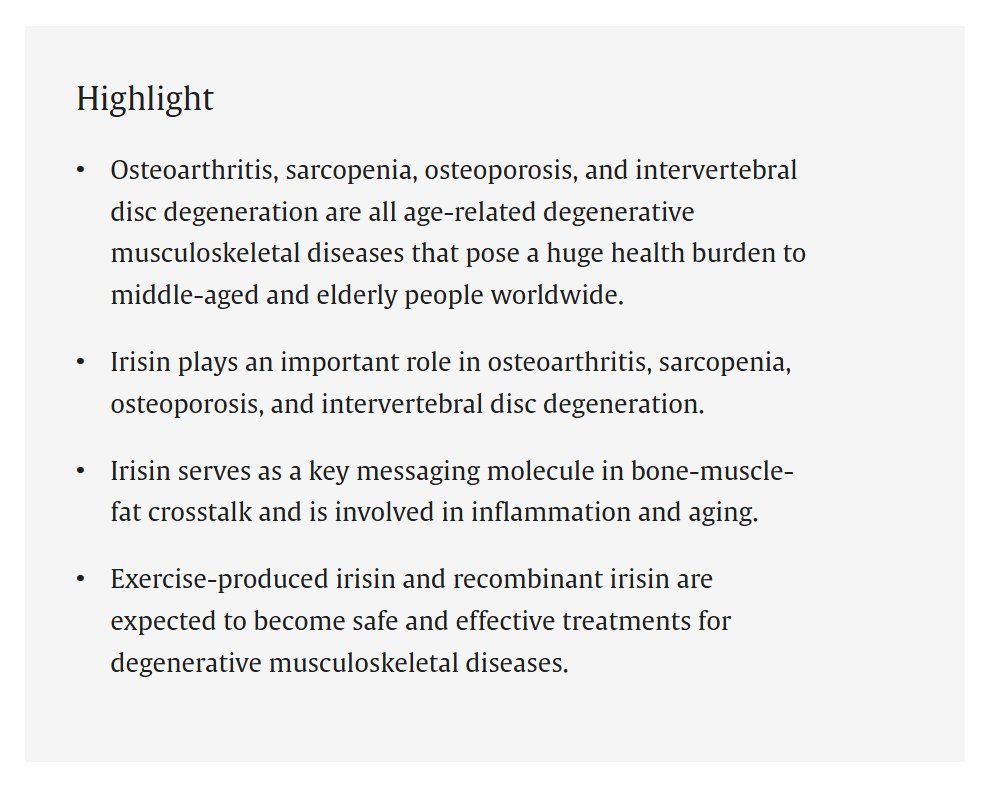
Open Access Paper:
https://www.sciencedirect.com/science/article/pii/S1043661824004250?via%3Dihub
1 Like
New open access paper:
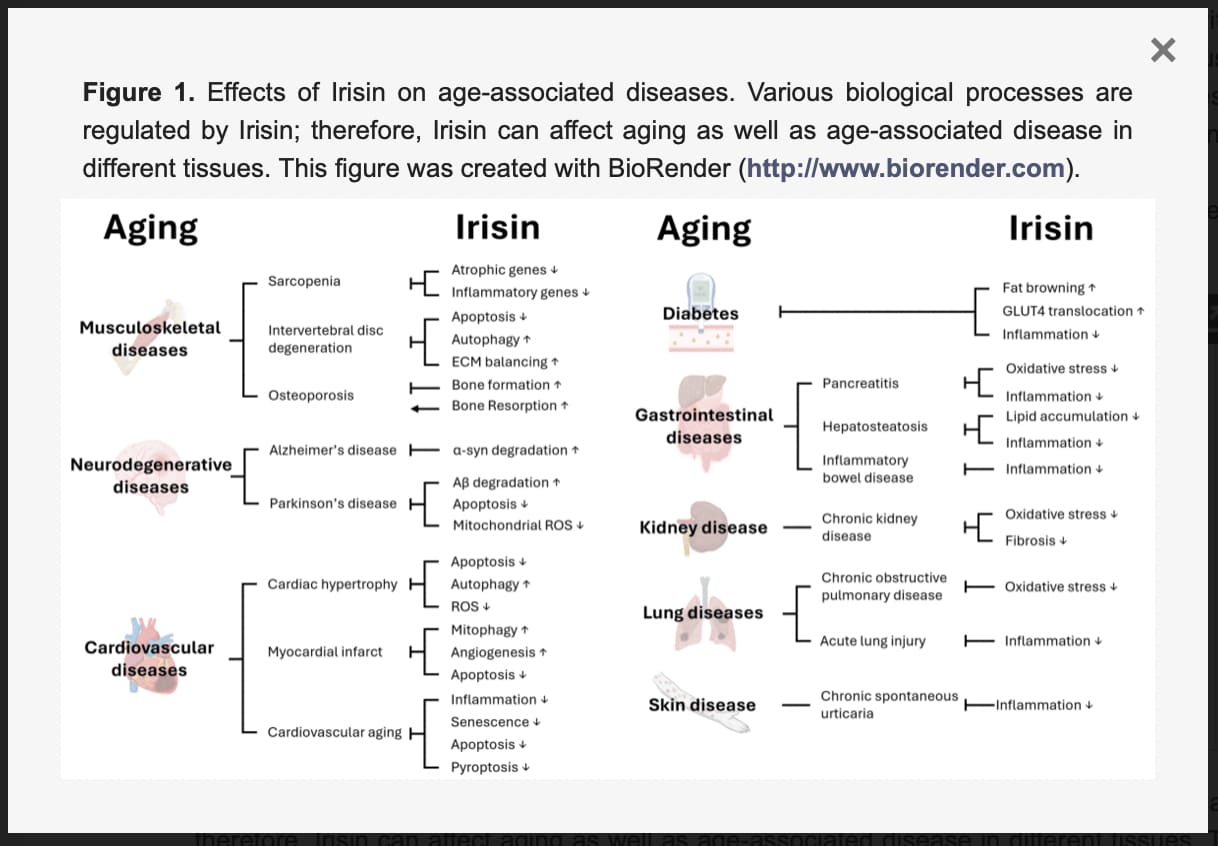
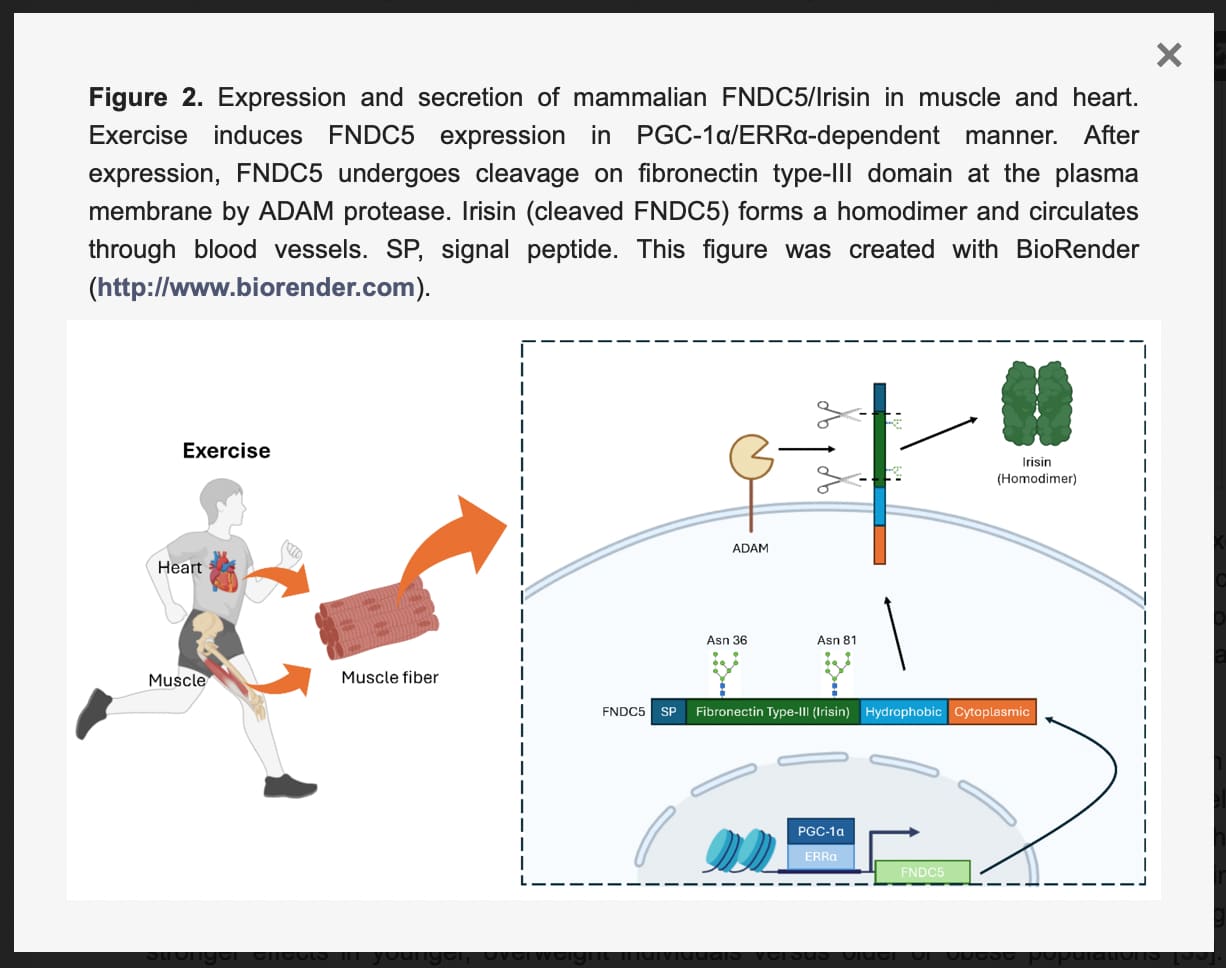
Evolutionary Insights into Irisin / FNDC5: Roles in Aging and Disease from Drosophila to Mammals
The Irisin/FNDC5 protein family has emerged as a pivotal link between exercise and the prevention of age-associated diseases. Irisin is highly expressed during exercise from skeletal and cardiac muscle cells, playing a critical role in mediating systemic health benefits through its actions on various tissues. However, Irisin levels decline with age, correlating with a heightened incidence of diseases such as muscle weakness, cardiovascular disorders, and neurodegeneration. Notably, the administration of Irisin has shown significant potential in both preventing and treating these conditions. Recently, an Irisin/FNDC5 homolog was identified in an invertebrate Drosophila model, providing valuable insights into its conserved role in exercise physiology. Importantly, Irisin/FNDC5 has been demonstrated to regulate autophagy—a process essential for clearing excessive nutrients, toxic aggregates, and dysfunctional organelles—in both flies and mammals. Dysregulated autophagy is often implicated in age-related diseases, highlighting its relevance to Irisin/FNDC5’s functions. These findings deepen our understanding of Irisin/FNDC5’s roles and its potential as a therapeutic target for mitigating aging-related health decline. Further studies are needed to elucidate the precise mechanisms by which Irisin regulates autophagy and its broader impact on physiological aging and related diseases.
1 Like
Caffeine promotes the production of Irisin in muscles and thus facilitates the browning of white adipose tissue
2 Likes
Irisin levels are boosted by the use of vibration plates. I don’t remember the source for this but I remember reading it in a paper so confirm on PubMed.
1 Like
A new open access paper:
Irisin suppressed the progression of TBI via modulating AMPK/MerTK/autophagy and SYK/ROS/inflammatory signaling
In this study, we will investigate the relevant research progress of Irisin’s protective role in traumatic brain injury (TBI) in recent years in terms of attenuating oxidative stress, inhibiting pyroptosis, suppressing inflammatory response, and improving autophagy, with the aim of providing valuable references for the diagnosis and treatment of traumatic brain injury (TBI).
Additionally, Irisin reduces ROS levels and decreases SYK expression, thereby inhibiting the inflammatory response. Irisin improves the learning and spatial memory abilities of TBI mice and reduces cell apoptosis, as well as decreases hippocampal neuron death. HE staining shows that the brain injury in mice treated with Irisin is significantly alleviated. Irisin can enhance the expression of phosphorylated AMPK and phosphorylated MerTK proteins, promote autophagic response, and inhibit pyroptosis/inflammatory response. Correction experiments confirmed that after stimulation with an AMPK agonist, the expression of phosphorylated MerTK protein is significantly increased, autophagic response is enhanced, and pyroptosis/inflammatory response is weakened. When treated with a MerTK inhibitor during AMPK agonist stimulation, the autophagic response is weakened while pyroptosis/inflammatory response is enhanced. Irisin can inhibit the progression of traumatic brain injury by regulating AMPK/MerTK/autophagy and SYK/ROS/inflammatory signaling.
1 Like
Irisin prevents liver injury during exhausting physical activity by suppressing ferroptosis via Nrf2/GPX4 signaling
Background
Irisin, a recently identified protein that is released during exercise and promotes the transformation of white adipocytes into brown adipocytes. The expression of irisin in the liver suggests its possible involvement in liver function and performance, however it has not been comprehensively investigated.
Methods
The investigation included creating exhaustive exercise (EE) models using 8-week-old C57BL/6 mice. Following exhaustion exercise, irisin was administered intraperitoneally on a daily basis. The liver damage was assessed by HE staining and by measuring the levels of ALT (alanine aminotransferase) and AST (aspartate aminotransferase). The impact of irisin on liver inflammation levels during EE was assessed using ELISA and qRT-PCR. The impact of irisin on ferroptosis was assessed by measuring the levels of GSH (glutathione), GPX4 (glutathione peroxidase 4), MDA (malondialdehyde), and Fe2+. The concentrations of MDA, ASCL4 (achaete-scute family bHLH transcription factor 4), ALOX12 (arachidonate 12-lipoxygenase), GPX4, SLC7A11 (solute carrier family 7 member 11), and Nrf2 (nuclear factor erythroid 2 - related factor 2) were assessed by the administration of the Nrf2 inhibitor ML385 via intraperitoneal injection. This study was carried out to investigate the underlying mechanism of irisin in relation to liver damage during EE.
Results
This research discovered that EE resulted in liver damage, disruption of liver cell organization, increased levels of ALT and AST enzymes (all P < 0.001), and raised levels of inflammatory cytokines and chemokines (all P < 0.001). Simultaneously, EE triggered hepatic ferroptosis, as evidenced by elevated levels of ROS (reactive oxygen species) (P < 0001), Fe2+ (P < 0.001), and MDA (P < 0.001), decreased levels of GSH (P < 0.001), and altered expression of proteins associated with ferroptosis (GPX4, ACSL4, and SLC7A11). Conversely, irisin mitigated the disorderly arrangement of hepatic cells, sinus dilation in the liver, and hepatic cell ferroptosis induced by exercise. Nevertheless, the Nrf2 inhibitor ML385 effectively abolished irisin-mediated ferroptosis.
Conclusion
These findings indicate that irisin has the ability to safeguard the liver from damage caused by intense exercise by suppressing ferroptosis triggered by the Nrf2/GPX4 signaling pathway and reducing the inflammatory response after oxidative stress. These results provide novel perspectives on the correlation between irisin and liver disease.
1 Like
Boosting the levels of irisin, a protein found at lower levels in people with pulmonary arterial hypertension (PAH), may help slow disease progression by stopping abnormal cell growth and blood vessel remodeling in the lungs, a study has found.
“[I]risin is a novel protective factor against PAH development and is associated with disease severity and prognosis,” researchers wrote.
The study, “Irisin Attenuates Pulmonary Vascular Remodeling in Pulmonary Arterial Hypertension via Ubiquitin-Mediated Regulation of ENO1,” was conducted by researchers in China and published in Advanced Science
1 Like
More good news on Irisin: Exercise-induced irisin has shown potential in maintaining muscle homeostasis, but critical research gaps persist
Protective effects of irisin in sarcopenia: a promising treatment
https://www.sciencedirect.com/science/article/pii/S2214031X26000458
Related Reading: Long-Acting Irisin With 30-Fold Longer Half-Life has Potent Anti-Inflammatory Effects
EXERCISE IN A BOTTLE: IRISIN EMERGES AS A MULTI-TARGETED BIOLOGIC TO HALT AGE-RELATED MUSCLE DECAY
Sarcopenia—the relentless, age-dependent loss of skeletal muscle mass and strength—remains one of the most significant barriers to human longevity and healthspan. To date, no FDA-approved pharmacological interventions exist to halt this musculoskeletal decline. However, a comprehensive analysis originating from Beijing Jishuitan Hospital, Capital Medical University in China, published in the Journal of Orthopaedic Translation, positions the exercise-induced myokine irisin as a highly promising, multi-targeted therapeutic candidate for reversing sarcopenic muscle wasting.
The impact score of this journal is 7.8, evaluated against a typical high-end range of 0–60+ for top general science, therefore this is a Medium impact journal.
Originally identified in 2012 as a hormone responsible for browning white adipose tissue, irisin is a polypeptide cleaved from the FNDC5 precursor protein during muscle contraction and cold exposure. Circulating irisin levels plummet with age, correlating directly with diminished muscle mass, impaired grip strength, and an increased risk of osteosarcopenia (the deadly combination of muscle and bone loss). This review synthesizes mounting preclinical evidence demonstrating that restoring irisin directly rehabilitates the metabolic equilibrium of skeletal muscle. Rather than acting via a single pathway, irisin operates as a master regulator of protein turnover. Under normal aging, the ubiquitin-proteasome system (UPS) becomes hyperactive, aggressively shredding muscle proteins. Irisin suppresses this catabolic destruction by blocking FOXO transcription factors, while simultaneously boosting anabolism through the IGF-1/PI3K/AKT cascade. Furthermore, irisin actively rehabilitates the cellular energy grid. By upregulating PGC-1α, it drives mitochondrial biogenesis and induces selective mitophagy to clear out defective, ROS-leaking mitochondria.
Crucially, the researchers highlight irisin’s unique ability to inhibit distinct pathways of cellular execution. Beyond classical apoptosis, irisin shows significant potential in suppressing ferroptosis (iron-dependent lipid peroxidation) and pyroptosis (inflammation-induced cellular lysis)—two distinct mechanisms recently implicated in sarcopenic degeneration. It accomplishes this by fortifying the NRF2/GPX4 antioxidant axis and silencing the NLRP3 inflammasome.
Despite its immense physiological potential, translating irisin into a clinical pharmacological intervention faces severe pharmacokinetic hurdles. The most pressing limitation is its abysmal plasma half-life of roughly one hour, rendering standard injections practically useless for sustained therapy. While bioengineers are currently exploring albumin-fused long-acting variants and biodegradable silk hydrogel delivery systems to achieve sustained local release, irisin therapy remains confined to the preclinical laboratory. For now, intense mechanical loading and cold exposure remain the primary validated methods to endogenously pulse this longevity-promoting myokine.
Technical Biohacker Analysis
Study Design Specifications
- Type: Comprehensive Literature Review and Conceptual Analysis.
Mechanistic Deep Dive
- mTOR & IGF-1/PI3K/AKT Anabolic Axis: Irisin amplifies the IGF-1/PI3K/AKT signaling cascade. The activation of AKT stimulates mTORC1 (promoting protein synthesis via 4E-BP1 and S6 kinase) and inhibits glycogen synthase kinase 3 (GSK3), improving glucose influx and glycogen synthesis via GLUT4 translocation. [Confidence: High].
- FOXO & The Ubiquitin-Proteasome System (UPS): By activating AKT, irisin phosphorylates FOXO transcription factors, sequestering them in the cytoplasm. This prevents FOXO nuclear translocation, effectively silencing the transcription of muscle-wasting E3 ubiquitin ligases (MuRF1 and MAFbx/atrogin-1). [Confidence: High].
- Autophagy & Mitochondrial Dynamics: Irisin upregulates PGC-1α, acting as a direct driver of mitochondrial biogenesis. It also enhances autophagic flux—demonstrated by an elevated LC3-II ratio and accelerated p62 degradation—ensuring the clearance of damaged organelles without pushing the cell into excessive, destructive proteolysis. [Confidence: Medium].
- Ferroptosis & Pyroptosis: The review postulates that irisin limits iron-dependent cell death by acting through the SIRT1/NRF2/GPX4 axis, and suppresses inflammation-mediated pyroptosis by inhibiting the NLRP3 inflammasome, preventing gasdermin D (GSDMD) cleavage. [Confidence: Low] (Note: These mechanisms are highly verified in renal, vascular, and cardiac models, but their direct role in sarcopenic skeletal muscle remains largely extrapolated).
- Organ-Specific Aging Priorities: Targeted preservation of skeletal muscle myofibers and the mitochondrial network. Additionally, irisin drives satellite cell (Pax7+/MyoD+) activation and differentiation via the upregulation of the Mst1/2 and YAP pathways.
Novelty
This paper successfully consolidates irisin’s well-established metabolic roles with emerging, highly specific programmed cell death pathways (ferroptosis and pyroptosis). It shifts the biological narrative of irisin from a mere “fat-browning” metabolic agent to a master regulator of skeletal muscle proteostasis, offering a unified molecular theory for how exercise protects against muscle wasting.
1 Like
More good news about Irisin:
Irisin: An Exercise Hormone Tracks With Bigger Memory Hubs in the Aging Brain
Australian researchers measured weekly exercise, fasting blood irisin, and high-resolution hippocampal subfield volumes in 74 healthy older adults, and report the first human evidence that the muscle-derived hormone irisin sits on the path between physical activity and hippocampal structure. More exercise went with more irisin, and more irisin went with larger hippocampi, most strongly on the right side and concentrated in the CA3 and CA4 subfields that house the dentate gyrus and are central to memory formation and Alzheimer’s pathology.
Exercise protects the ageing brain. That has been settled for more than a decade. People who move more tend to have larger hippocampi, the seahorse-shaped structures that build new memories and that shrink early in Alzheimer’s disease. What nobody has shown in humans is the courier. How does a contracting thigh muscle send a message that ends up as preserved tissue inside the skull?
A team at the Thompson Institute in Queensland has put forward the first direct human evidence for one candidate courier: irisin, a hormone released from skeletal muscle when it works hard. In mice, irisin looks close to essential for the brain benefits of exercise. Delete the gene that produces it and the gains vanish. Give it back and the gains return. Whether any of that carries over to people has been an open question, partly because measuring irisin in human blood is notoriously difficult and partly because the two or three small imaging studies that tried gave contradictory answers.
The new study took 74 healthy Australians aged 50 to 84, asked how much they exercised in a typical week, drew fasting blood, and scanned their brains at high resolution, splitting the hippocampus into eleven compartments per side rather than treating it as a single lump.
Three results emerged. People who exercised more carried more irisin in their blood. People with more irisin had larger hippocampi, especially on the right. And the irisin signal was not spread evenly. It concentrated in CA3 and CA4, the inner compartments that handle pattern separation and that contain the dentate gyrus, the one region of the adult human brain where new neurons are thought to be born. A visual cortex region used as a control showed nothing at all, which argues against the finding being a generic marker of bigger brains or better health.
The awkward result is what they did not find. In this sample, exercise showed no relationship whatsoever to hippocampal size. The statistical method they used can still report a pathway under those conditions, and it did, for all nine hippocampal compartments tested. But the honest reading is narrower than the headline. Exercise tracks with irisin. Irisin tracks with hippocampal volume. Whether exercise causes irisin to cause brain preservation is not something this design can settle, because everything was measured on a single occasion with no follow-up.
That distinction governs how the result should be used. If irisin really is the courier, the target for intervention shifts from the brain to the muscle, and from generic activity to whatever specifically drives muscle to release this hormone. It would also open a route for people who cannot exercise at all, since irisin can in principle be administered as a drug. If instead irisin is a passenger, a proxy for muscle mass or metabolic health that happens to travel alongside brain size, then chasing the hormone directly is a distraction and the muscle itself remains the intervention.
This study does not separate those two possibilities. It does establish that the question now justifies the cost of a proper longitudinal trial.
Actionable Insights
What the numbers actually say. Exercise explained an extra 11.8 percent of the variation in blood irisin. In plain terms, someone one standard deviation more active than average, roughly two to three additional vigorous sessions per week on the questionnaire used, carried about 1.1 nanograms per millilitre more irisin, against a group average near 5.9.
On the brain side, irisin explained an extra 12.4 percent of right hippocampal volume and 7.5 percent of left. Translated into tissue, one standard deviation more irisin corresponded to roughly 145 cubic millimetres more right hippocampus, close to 4.8 percent of that structure. Comparing the top quarter of irisin levels with the bottom quarter gives a gap near 12 percent. At the roughly 1.5 percent annual hippocampal loss typical after age 60, that gap is equivalent to about eight years of ageing.
Treat those figures as an upper bound. They come from 74 people measured once, and correlations of this kind reliably shrink when tested properly. The defensible take-home is that resistance and vigorous aerobic training, which build the muscle that secretes irisin, remain the intervention with the best mechanistic case behind it.
Context and Source
- Open Access Paper: The Myokine Irisin Represents an Indirect Pathway Linking Exercise to Hippocampal Subfields Relevant to Alzheimer’s Disease and Neurogenesis. published: 24 April 2026.
- Institution: Thompson Institute, University of the Sunshine Coast, Birtinya, Queensland
- Country: Australia
- Journal: Aging Cell (Wiley, on behalf of the Anatomical Society)
- Impact evaluation: The impact score of this journal is 7.7 (2025 Journal Impact Factor; CiteScore 13.8), evaluated against a typical high-end range of 0 to 60+ for top general science, therefore this is a Medium impact journal. Qualifier: within the narrower field of biogerontology, Aging Cell is a leading specialty venue and ranks Q1 in the Aging category, sitting below Nature Aging but above most ageing-focused titles