The long-sought biological link between physical exertion and brain health is becoming undeniably clear, and it centers on a single circulating molecule: irisin. Identified just over a decade ago as a peptide hormone secreted by skeletal muscle during endurance exercise, irisin was initially celebrated for its capacity to convert inert white fat into metabolically active brown fat. However, this comprehensive review establishes that irisin’s most profound and life-extending impacts occur inside the skull.
When muscles vigorously contract, they enzymatically cleave a membrane protein known as FNDC5 to release irisin into the systemic circulation. This myokine acts as a primary messenger within the muscle-brain axis, effectively bridging peripheral metabolic activity with central nervous system resilience. Upon reaching the brain, irisin binds to integrin αV/β5 receptors and ignites a cascade of cellular survival pathways that reliably culminate in the robust expression of Brain-Derived Neurotrophic Factor (BDNF). BDNF functions as the brain’s premium metabolic fertilizer, representing a critical component for generating new neurons, maintaining synaptic plasticity, and preserving memory pathways under stress.
Crucially, the accumulated data demonstrates that irisin provides a formidable, multi-pronged defense against age-related neurodegenerative decline. Experimental models indicate that it actively accelerates the clearance of toxic amyloid-beta plaques and limits alpha-synuclein pathology, which are the defining pathological hallmarks of Alzheimer’s and Parkinson’s diseases. Furthermore, irisin directly stabilizes the brain’s innate immune system by actively shifting resident microglia from a destructive pro-inflammatory M1 state to a protective, tissue-repairing M2 phenotype. It even structurally fortifies the blood-brain barrier, reinforcing tight junctions to reduce toxic permeability.
While the immediate physiological takeaway definitively reinforces the evolutionary mandate to maintain rigorous physical activity, the pharmacological implications are vast. The development of an “exercise mimetic” therapeutic based on irisin signaling pathways remains highly tantalizing for aging populations, particularly individuals immobilized by advanced sarcopenia or progressing neurodegeneration. Preliminary animal models suggest that directly injecting recombinant irisin successfully mimics the neurocognitive benefits of exercise, crossing the blood-brain barrier to suppress destructive neuroinflammation. Yet, direct clinical translation remains hindered by the peptide’s short biological half-life and the inherent complexity of its systemic off-target effects. Ultimately, fully mapping the irisin signaling network reveals a profound biological reality: skeletal muscle is not merely a mechanical apparatus, but a vital endocrine organ directly dictating the trajectory of human brain aging.
Institution: University of Milan; Fondazione IRCCS Ca Granda; LUM University; Fondazione Policlinico Universitario ‘A. Gemelli’ IRCCS Country: Italy Journal: Experimental Gerontology
Impact Evaluation: The impact score of this journal is 4.3 (JIF), evaluated against a typical high-end range of 0–60+ for top general science, therefore this is a Medium impact journal.
AMPK & Autophagy Pathways: Irisin binds to the integrin αV/β5 receptor complex, which activates AMPK. This metabolic shift consequently inhibits mTOR signaling and upregulates autophagy, creating a mechanism that actively clears pathological beta-amyloid plaques and tau tangles.
Mitochondrial Dynamics & Oxidative Stress: Irisin signaling engages the nuclear respiratory factor-2 (NRF2) antioxidant pathway. This directly drives the expression of protective genes—such as glutathione peroxidase 4, heme oxygenase-1, and NAD(P)H:quinone oxidoreductase 1—to aggressively improve cellular resistance to oxidative stress. It also triggers PGC-1α to promote mitochondrial biogenesis.
Neurotrophic Signaling: Irisin stimulates the cyclic AMP (cAMP) secondary messenger cascade, which activates PKA and phosphorylates CREB. This directly enhances the transcription of Brain-Derived Neurotrophic Factor (BDNF). BDNF and its TrkB receptor act as pro-survival mediators absolutely essential for synaptic plasticity and neurogenesis.
Neuroinflammation: Irisin efficiently shifts microglia from a pro-inflammatory M1 state to an anti-inflammatory M2 state by activating AMPK, which subsequently curtails IL-1β expression. It further suppresses NF-κB signaling, reducing broad systemic inflammation.
Novelty
This review consolidates emerging proteomics evidence demonstrating that exogenous recombinant irisin can successfully cross the blood-brain barrier (BBB) to exert neuroprotective effects.
It firmly establishes that systemically circulating irisin is not exclusively a muscle or adipose regulator, but acts as a highly potent bidirectional immunomodulator capable of preserving BBB tight junction proteins (occludin, claudin-5) and preventing post-operative cognitive dysfunction.
The tripeptide Pinealon (Glu-Asp-Arg) is reported to upregulate irisin expression and mimic exercise effects like fat browning and neuroprotection, though it acts indirectly.
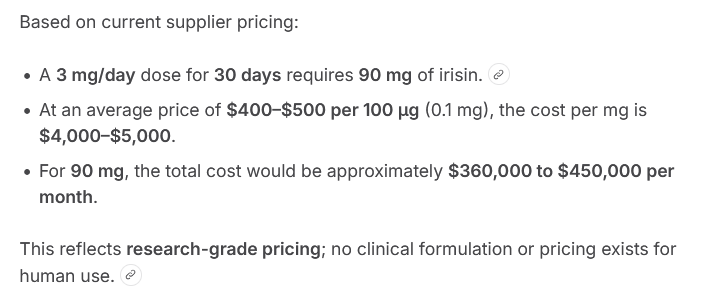
The existing irisin, in addition to being crazy expensive, has a very short half life, so likely to be ineffective.
The issue, as we’ve discussed many times here, with the Russian research on Pinealon is that most of it seems to have been published in (what I tend to call) “The Journal of Irrepreduceable Results”… I wouldn’t trust Russian research with the life of any mammal. Perhaps with the FDA changing some peptide regulations we’ll see some efforts at duplicating the original research outside of Russia.
From Gemini Pro:
The statement that the tripeptide Pinealon (Glu-Asp-Arg) upregulates irisin expression is confirmed by specific scientific research, though it is important to contextualize the scope and origin of these findings.
Here is a breakdown of the scientific literature and clinical context surrounding this claim.
The Research Confirming the Statement
The primary scientific backing for this statement comes from epigenetic and gerontological research, most notably from the St. Petersburg Institute of Bioregulation and Gerontology.
Key Study: A foundational 2016 study titled “Short Peptides and Telomere Length Regulator Hormone Irisin,” published in the Bulletin of Experimental Biology and Medicine (Khavinson et al.), directly investigated this mechanism.
Findings: The researchers evaluated the effects of short synthetic peptides, including the neuroprotective tripeptide Pinealon (Glu-Asp-Arg). The data demonstrated that Pinealon acts as an epigenetic regulator that promotes the gene expression of FNDC5 (Fibronectin type III domain-containing protein 5), the precursor protein that is cleaved to create irisin.
Conclusion: The study concluded that Pinealon and similar peptide bioregulators can modulate lifespan and cellular health specifically by upregulating irisin gene expression.
The Proposed Mechanism
To understand why this is significant, it helps to look at how these two molecules interact:
What is Irisin? Irisin is a well-documented myokine (muscle-derived hormone) typically released into the bloodstream during physical exercise. It is highly regarded in anti-aging research for its ability to convert white fat to brown fat, protect neurons from oxidative stress, and promote telomere elongation (a key marker of cellular youth).
How Pinealon Fits In: Pinealon is classified as a “peptide bioregulator.” Due to its tiny size (just three amino acids: Glutamate, Aspartate, and Arginine), it can easily cross cell and nuclear membranes. Research suggests it binds directly to the DNA/histone complex, essentially “unlocking” the FNDC5 gene. This theoretically tricks the body into producing exercise-induced irisin even in the absence of physical activity.
The Clinical Reality Check (Caveats)
While the scientific mechanism is documented in literature, a candid look at the clinical landscape reveals some important limitations:
Source Concentration: The vast majority of the research linking Pinealon to irisin upregulation is pioneered by Dr. Vladimir Khavinson and his team in Russia. While their work on peptide bioregulators spans decades, it has not been widely replicated by independent, international research bodies.
In Vitro vs. In Vivo: The data confirming irisin upregulation by Pinealon is heavily reliant on in vitro (cell culture) models and animal studies.
Lack of Broad Human Trials: There is currently a lack of large-scale, randomized, double-blind clinical trials in humans confirming that taking Pinealon yields a clinically significant increase in systemic irisin levels.
Regulatory Status: Pinealon is not approved by the FDA (or equivalent Western regulatory bodies) for the treatment of any disease. It remains an experimental, off-label research peptide.
Summary: The scientific literature does report that Pinealon upregulates irisin expression via epigenetic modulation of the FNDC5 gene. However, this relies on a specific niche of experimental research, and robust human clinical trials are still needed to validate these effects for therapeutic use.
On a side note, I worked in a good laboratory at the UofS for several years. There was a group of mostly Russian scientists that shared our large space. There was nothing wrong with these people. Conversely, when I first started my MSc, I’d discovered the respected Canadian researcher had falsified all his data, leading to retractions and his resignment. You shouldn’t base a researcher’s credibility based on his nationality.
<much respect for Khavinson. If I were still researching, I’d be studying all those bioregulators, as I imagine many will be doing soon.
but I hear what yo are saying. My original response was to a) show how unrealistic recombinant irisin would cost, and b) noticed pinealon claimed to increase its expression.
Oh - I’m not criticizing Russian people at all - I think they are just as capable of great science as people of any other country. I just think the environment in Russia is likely toxic for good science; all sorts of bad incentive structures that encourage bad science. I’m also not saying the USA is any sort of nirvana; lots of problems in the current “publish or perish” incentive structures for publishing all sorts of junk.
Exercise-driven irisin from muscle lowers amyloid burden and dementia risk
In July, a research team led by Professor Seong-Hun Kang of the Department of Neurology at Korea University Guro Hospital published results in the international journal ‘Alzheimer’s & Dementia: Diagnosis, Assessment & Disease Monitoring’ analyzing the relationship between blood irisin levels and brain amyloid accumulation, the core pathology of Alzheimer’s disease.
The team divided 100 older adults into four groups: individuals without brain amyloid and with normal cognitive function, individuals with amyloid accumulation but normal cognition, patients with mild cognitive impairment, and patients with Alzheimer’s dementia.
They found that the three groups with amyloid accumulation in the brain had lower blood irisin concentrations than the normal group without amyloid. Irisin levels were already reduced at the stage where amyloid had just begun to accumulate in the brain, even before cognitive decline appeared. There was also a tendency for higher irisin levels to be associated with lower amounts of amyloid accumulation.
The researchers explained that irisin may connect muscle and brain and be involved in amyloid pathology and cognitive decline in Alzheimer’s disease.
There are also studies showing how irisin is linked to amyloid. In 2023, researchers at Massachusetts General Hospital and Harvard Medical School published findings in the international journal ‘Neuron’ using a three-dimensional cell culture model that mimics Alzheimer’s disease.
When irisin was applied, astrocytes in the brain secreted more of an enzyme called ‘neprilysin’. Neprilysin is an enzyme that breaks down amyloid beta. The study confirmed a process in which increased irisin led to greater neprilysin secretion and, as a result, reduced amyloid beta.