More evidence that IL-11 drives cancer progression, this time by promoting CD8+ T cell exhaustion:
Also, there’s a number of epidemiological studies linking IL-6 to poorer cognitive function, as well as MR evidence that the relationship is causal. Would love to see an RCT looking at cognitive function when IL-6/11 is inhibited:
Yes I agree with that. My point is mainly that the odds of these interventions above having a significant inhibitory effect on IL-11 is low so taking them specially to inhibit IL-11 is most likely a waste of money. If someone takes them for some other purpose, then the small chance of a slight IL-11 inhibition would be like a potential added bonus.
I have been considering trying IL-6 Inhibitors or JAK Inhibitors, which is more readily available. I have severe eczema flare-ups at times, and my doctor is willing to prescribe JAK Inhibitors. Thoughts?
I started rapamycin for my psoriasis, which seems to be helpful and has a somewhat dose-dependent response. Most inflammatory skin diseases are immunotriggered.
I am also considering adding Doxycycline as some of you are doing.
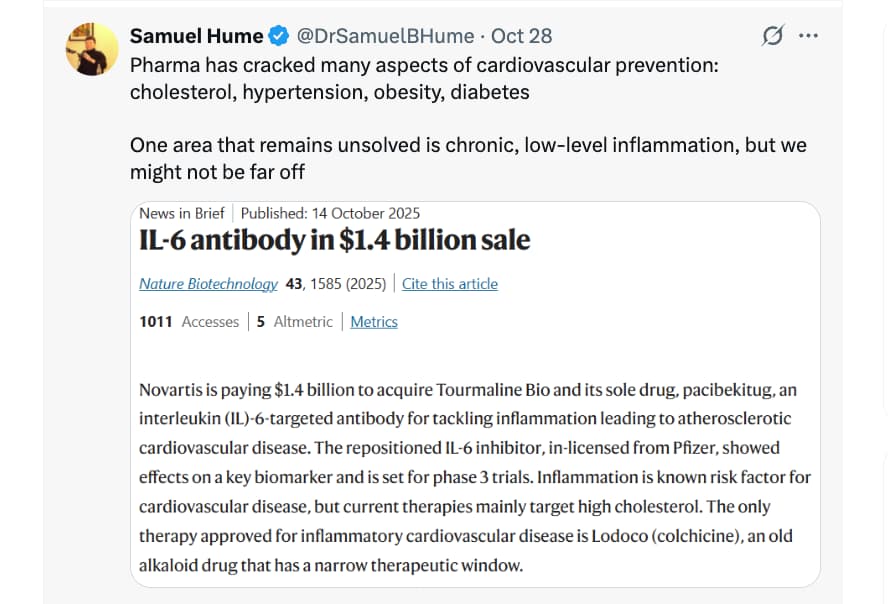
IL-6 Pathway Inhibition
IL-11 Inhibitors: Generally unavailable for clinical use.
IL-6 Inhibitors: A widely available and effective alternative for managing inflammatory diseases.
Mechanisms of Action & Examples
1. Biologics (Monoclonal Antibodies): These large molecules directly target the IL-6 protein or its receptor.
Inflammation-inducible IL-1-targeted therapy using an rAAV vector as a long-lasting, pathophysiologic treatment for chronic inflammatory diseases
The interleukin (IL)-1 pathway is a key mediator of inflammation and innate immune responses. Its dysregulation contributes to rheumatoid arthritis (RA) and autoinflammatory diseases (AIDs). In this study, we develop a recombinant adeno-associated virus (rAAV)-based gene therapy to deliver an inflammation-inducible, secreted human IL-1 receptor antagonist (sIL-1Ra) as a complementary approach to existing IL-1 blockers. rAAV-mediated expression of sIL-1Ra dampens IL-1 signaling and inflammatory arthritis in mice. As the expression of endogenous sIL-1Ra is tightly regulated by inflammation, we developed an rAAV vector that produces sIL-1Ra in response to pro-inflammatory cytokines and bone morphogenic proteins (BMPs) enriched in the inflamed joints of patients with RA. Remarkably, inflammation-inducible sIL-1Ra is more effective than constitutively expressed sIL-1Ra in ameliorating inflammatory arthritis in the mouse model of RA. These mice showed a significant reduction in circulating immune cells, expression of the genes associated with inflammatory responses, joint swelling, and bone destruction. Similar to patients with deficiency of IL-1Ra (DIRA), IL-1Ra-deficient mice spontaneously develop inflammatory arthritis and skeletal abnormalities, which are almost completely reversed by a single systemic administration of the sIL-1Ra-expressing rAAV vector. Collectively, our results highlight inflammation-inducible IL-1-targeted therapy using an rAAV vector as a long-lasting, pathophysiologic treatment for chronic inflammatory diseases.
I agree. I first started getting into supplements by reading Life Extension magazine and every article convinced me to buy something else. It was a complete waste of money.
Learned a lot from this article by Chris Masterjohn:
If IL6 is high, lactoferrin can cut it in half and high doses can do more than that. Only a couple companies make the form that works like this. I take the wrong form of course. Luckily I’m getting low, so will restock with the right stuff.
Thus, the natural, partially iron-saturated form of lactoferrin is what should be used to try to resolve sticky inflammation.
Until recently, the only lactoferrin supplement on the market was an Italian product, Lattoglobina.
However, two brands have recently started selling such a product in the US:
Double Wood sells a natural partially iron-saturated lactoferrin that appears to be purified from dairy products using a patented process with high purity.
The Lactoferrin Co sells 95% pure partially iron-saturated lactoferrin isolated from grass-fed milk, as a powder or as enterically coated capsules.
The need for enteric coating is unclear and has not been clinically studied. Taking the lactoferrin on an empty stomach can prevent the stomach from becoming acidic enough to degrade it, and the successful anemia trials approximated this by having the lactoferrin taken just prior to the meals. It is likely the Double Wood product is more pure for those sensitive to dairy, but neither product is dairy-free. It is worthwhile to experiment with the three products from the two brands to compare their utility since their differences lie in gray areas.
100 milligrams twice a day cut IL-6 in half, so it might be that 400 milligrams per day in 2-4 divided doses could completely normalize IL-6. While this has not been studied much, it is worth trying 200-400 milligrams of natural iron-saturated lactoferrin per day in 2-4 divided doses, taken before meals or on an empty stomach, to help resolve stubborn inflammation, especially if your IL-6 is high.
Is there any human research on suppressed Il-11 – controlled or quasi-experimental – demonstrating effects that are likely to be geroprotective? I see a mechanistic rationale linking Il-11 to multiple aging phenotypes and impressive mouse longevity data (but not dissimilar to mouse data which has subsequently failed to generalize to humans). In mice at least, it does appear to be relatively safe to target Il-11 reduction (there were no gross abnormalities in knockouts). But it looks to me like we have zero human data on healthspan and/or lifespan outcomes and the therapeutic window for dosing and effect optimality is undefined and incalculable based on current human data. Additionally, there are potential risks and the bet (which I generally subscribe to) that rate-limiting is causal to aging rate is plausible but not proven). Last in my thinking is that it would be nice to see some human genetic validation beyond the current implications.
There is no human data for longevity on it, but earlier in the thread there was mentioned of the antibody called LASN01. It is an IL-11 inhibitor which almost totally blocks the pathway and is currently being trialled in humans. There were relatively minimal side effects in the first stage as well.
Unfortunately, the last update on its progress was 2 years ago.
Did you ever go ahead and test for mTORC1 and/or 2?
@DrFraser have you ever looked into this / do you offer it for interested patients:
If your goal is personal monitoring (e.g., longevity/rapamycin context): the most defensible approach is (1) PBMC phospho-flow with a standardized protocol (fasting state, consistent timing, defined stimulation conditions), using pS6/p-4E-BP1 for mTORC1 and pAKT Ser473 for mTORC2.
@RapAdmin@medaura post on this topic is very intriguing - has the topic been discussed elsewhere with me missing to find such a discussion?
Sorry, her post that I linked to is about that it actually seem possible to measure mTORC1 and 2 activity/levels via blood in a way that might be accessible.
And if so that could be huge for each individual finding how high he or she can dose rapa / how long washouts need to be / how helpful thing like like acarbose that might help raise mTORC2 are, etc, etc
I think the more interesting use case would be comparing mTORC1 serum activity with other biomarkers, to see if it has any effect suggesting improvement in biomarkers.
Yes it is interesting but I haven’t done it. The juice isn’t worth the squeeze to me as I’m too busy with life but I have to admit I was almost surprised none of you hard corers had picked up that thread.
I can’t link to the whole convo I had with ChatGPT as it’s full of personal data but I am happy to provide more details in screenshots to whomever wants them.
Why is it either or / “vs” - that is interesting, yes - AND having a sense of how much different dosages of rapa impact levels of mTORC1 and mTORC2 would be a gold mine to take out the guessing work that everyone today is doing how high a dose to take while still not being too high?
What are your suggestion for how to currently deal with question like
each individual finding how high he or she can dose rapa / how long washouts need to be / how helpful thing like like acarbose that might help raise mTORC2 are, etc, etc