I don’t understand what all the fuss is about. If you are that worried about uniformity put it in a larger container and flip it upside down a couple times before each dose to keep it mixed. Seem to be way overthinking it.
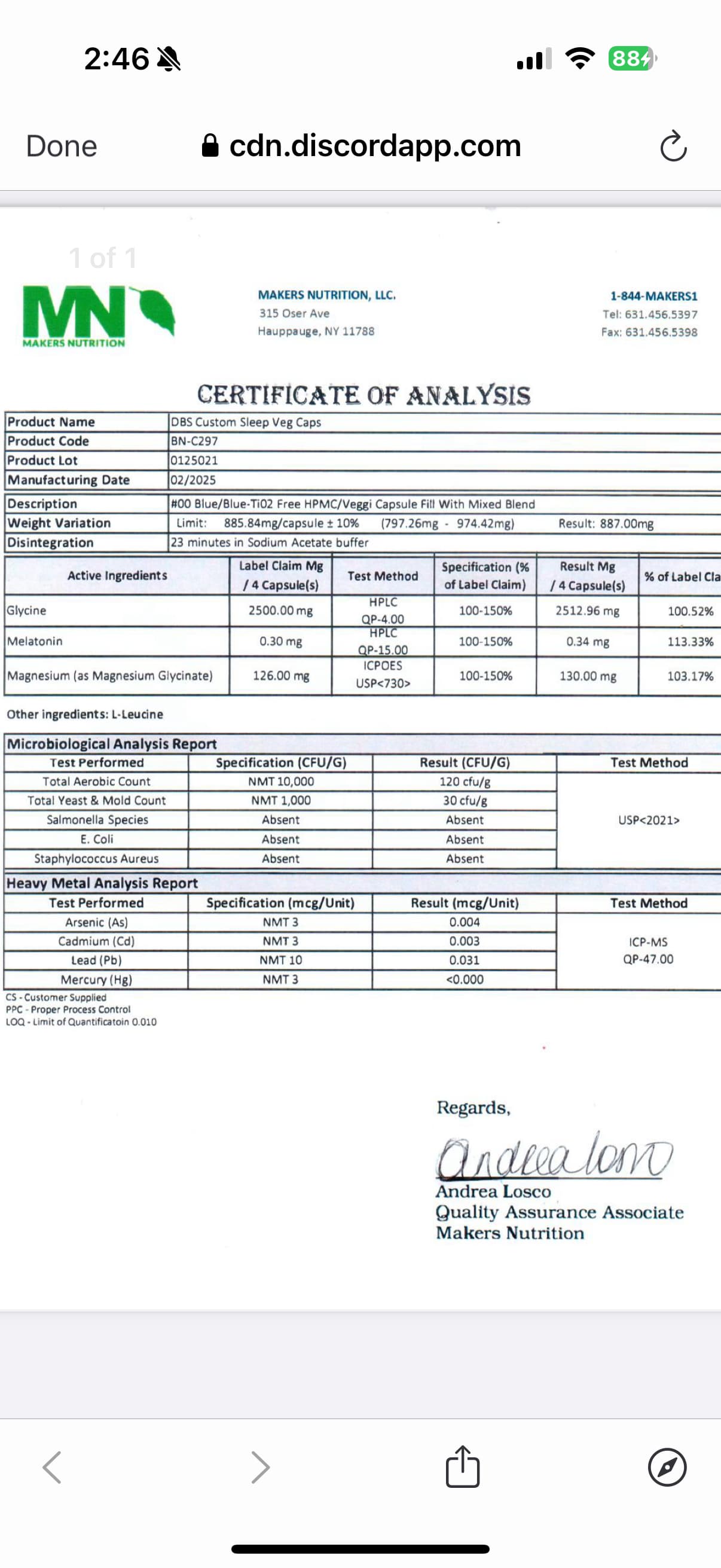
There’s the one for his upcoming sleep supplement. He also has them for his Microvitamin pills and powder
1 Like
Thought it might be time to get an updated AI view on the top 10
this from Grok 4.20
Based on the latest research and trends as of February 2026, here are 10 supplements or pharmaceuticals most likely to improve healthspan (the healthy, functional years of life) for a 50-year-old. This selection prioritizes interventions with human clinical evidence supporting benefits like reduced inflammation, better metabolic function, preserved muscle/cognitive health, and mitochondrial efficiency—key to countering age-related decline. Rankings are based on evidence strength (e.g., randomized trials), accessibility, safety for midlife use, and potential systemic impact. Pharma options (e.g., prescription drugs) are included where they show geroprotective promise, often used off-label for longevity. Always consult a physician before starting, as individual needs vary (e.g., via blood tests for deficiencies).
-
NAD+ Precursors (e.g., NMN or NR supplements)
Boosts NAD+ levels to enhance mitochondrial function, DNA repair, and sirtuin activity. Human trials show improvements in walking endurance, sleep quality, cognitive function, and reduced inflammation in middle-aged adults.
Dose: 300–1000 mg/day; widely available as supplements. -
Urolithin A (e.g., Mitopure)
Promotes mitophagy (clearing damaged mitochondria) for better energy production and immune health. Randomized trials in 45–70-year-olds demonstrate muscle endurance gains, reduced inflammaging, and immune rejuvenation.
Dose: 500–1000 mg/day; supplement form. -
Rapamycin (pharma, off-label)
mTOR inhibitor that extends lifespan in models; human studies suggest delayed age-related decline via autophagy enhancement. ARPA-H-funded trials (2026) test analogs for healthspan in 60+ adults.
Dose: Low pulsed (e.g., 1–6 mg/week); requires prescription and monitoring. -
Semaglutide (GLP-1 agonist, pharma like Ozempic)
Improves metabolic health, weight management, and cardiovascular outcomes; emerging as a healthspan extender by reducing inflammation and metabolic dysfunction. Adoption surges in 2026 for longevity medicine.
Dose: Injectable, per doctor; for those with metabolic risks. -
Omega-3 Fatty Acids (EPA/DHA supplements)
Reduces cardiovascular events, triglycerides, and inflammation; supports brain and vascular health. Meta-analyses confirm benefits in aging populations.
Dose: 1–2 g/day; fish oil or algae-based. -
Creatine Monohydrate (supplement)
Enhances muscle strength, power, and cognitive function (e.g., in sleep-deprived states); prevents sarcopenia. Strong evidence from 2025 reviews in older adults.
Dose: 3–5 g/day; pairs well with resistance training. -
Vitamin D (supplement)
Corrects common deficiencies to support bone density, immune function, and metabolic health; linked to lower fracture risk and better outcomes in deficient 50-year-olds.
Dose: 1,000–4,000 IU/day; test levels first. -
GlyNAC (Glycine + N-Acetylcysteine supplement)
Boosts glutathione to reduce oxidative stress, inflammation, and mitochondrial dysfunction; improves physical function in older adults per Baylor trials.
Dose: 1–3 g each/day; emerging for anti-aging. -
Coenzyme Q10 (CoQ10/Ubiquinol supplement)
Supports mitochondrial ATP production and antioxidant defense; reduces cardiovascular events in heart failure trials; beneficial for statin users or energy decline.
Dose: 100–200 mg/day. -
Magnesium (e.g., glycinate supplement)
Aids enzymatic reactions, sleep, and cardiovascular/nervous system health; addresses common insufficiencies in midlife diets.
Dose: 300–400 mg/day.
Combinations (e.g., NAD+ with exercise) often amplify effects. Emerging pharma like ER-100 (epigenetic therapy) or LNS8801 may advance by 2030 but lack broad access yet. Lifestyle factors (diet, exercise) remain foundational.
1 Like
This is the first time I’m hearing of this. It appears to be anticancer, are there any other effects that it has that interest you?
 Wow, this is quite eye opening. In the sense of just how utterly useless AI seems to be (at least in this example) for anyone wishing to get solid evidence based advice about supplements and drugs that might be useful in life extension. Completely unsupported or very poorly supported evidence for these supplements, with the even more surprising absence on this list of drugs that might actually be helpful (but fine, to each their own). NAD precursors - I’m surprised anyone is still flogging this, given that NAD precursors seem to have failed in every single formulation including IV. Apparently, it’s one of those evergreens like vitamin E that some portion of the biohacker crowd that never gave up on the memories of hope for the molecule from the days of their youth when the hype for that molecule was at its height. CoQ10, same thing - a lot of claims with zero proof or outright failure (like the supposed help with statins). Urolithin A - studies from just that one lab which sells it - which have been roundly criticized, poorly conducted studies with nothingburger results. This is “solid” evidence? Lord help us. Vitamin D - only ever shown to be bad if deficient, but scarce proof of help when supplemented - and contrary to claims here failed in bone and balance studies in the elderly (btw., and very amusingly the recent look at vitamins shows negative health from supplementing with just two vitamins, D and B12, lol
  ). Magnesium same deal - certainly bad when deficient, but why would a biohacker ever get to the point of being deficient in magnesium? Are they on a SAD diet? If so, why do we call them biohackers? May as well advise not to get deficient on water and air, as that’s unhealthy. Omega-3, very complicated, with serious doubts about DHA, and GlyNAC, again quite complicated. Neither an obvious LE supplement. Then we have semiglutide - OK, perhaps useful in some contexts, but no obvious evidence for LE, (meanwhile no SGLT2i with far better evidence of LE). That leaves rapamycin, which, well, the best of the bunch. Absolutely abysmal analysis by AI. Based on my experience of AI in its present form and level of development, I had very low expectations - it’s just sh|t, let’s face it (at this point), but even I didn’t expect such an atrocious performance from what is presumably a more advanced version. I’d sooner look to badger entrais for guidance on health practices. YMMV.
6 Likes
Big yikes at the top two
AI is great unless you let it think for you. It can help us scale thinking very effectively. Always ask it for sources for claims and check those sources. Always read what it has output thoroughly and manually edit before posting.
I hate AI slop but I do like it when it is used intelligently.
AI is like a popularity contest. It gives you the results of things with the most hype. If you look at that list, you can see it’s which LE supplements get the most press.
It’s not a list of what is the best. It’s a list of the most talked about on the internet.
4 Likes
In this case, AI is looking at a specific list of drugs and supplements. The problem is, that in evaluating the worth of those it bases its analysis on what the most common and hyped claims are. It doesn’t look for what claim is most valid, only which one is repeated most often. So, as an example, say, vitamin D had an obscure benefit of protecting your brain from aging (I’m making this up), but even though it’s very well documented, only one study has found this brain benefit. Meanwhile the greatest number of claims for vit. D is that it “helps bones”. Guess what AI is going to do - yep, it’ll vomit back to you claims about the bone, not because that’s best documented or most important, but because it’s the most popular and frequent. It’s a fatal flaw. Because not only does it force you to wade through a pile of commonly repeated garbage trying to validate it, but because it will likely not even include that one single study on brain protection, because it doesn’t know how to evaluate that claim… all the AI evaluations I’ve ever seen are the most simple minded following of some previously established procedure regardless of ultimate validity. We are still a very long way to it being useful in ways people already think of it as being. In other words, people give it more credit than it deserves. People assume AI abilities that may only come sometime in the future. We’ll see!
5 Likes
That’s a much better list. How did you compile it?
I built a prompt using this thread as inspiration. Different Ai gave me different lists.
I used Claude Ai and this prompt:
" Prompt:
You are a Longevity Research Analyst and Science Journalist.
Create a rank-ordered list of the Top 10 molecules/supplements to slow biological ageing, ranked purely on overall human outcomes evidence quality. Do NOT rank based on any specific mechanistic framework.
Ranking criteria (in order of weight):
- Hard human endpoints — all-cause mortality, cardiovascular death, hospitalisation, functional independence
- RCT quality and sample size — powered trials, not pilots
- Mammalian lifespan data — specifically ITP (NIA Interventions Testing Program, multi-site)
- Epidemiological signal strength — cohort size, confounder control
- Mechanistic breadth — secondary consideration only
For each molecule provide:
- 2–3 sentence rationale for its rank
- Mechanisms: 3–5 bullet points
- Evidence: table with 5 key studies (Title, Year, Species, 1-sentence finding)
- Safety: explicit statement — “Safe in short-term human trials”, “Known risk X at dose Y”, or “Data Absent”
Style: Objective, critical, no hype. Explicitly challenge weak evidence (e.g. “only rodent data”, “surrogate endpoints only”, “retrospective with healthy-user bias”, “conflicting trials”). Prefer human hard endpoints over mechanistic claims. If a molecule has strong rodent or mechanistic data but weak human outcomes data, say so clearly and rank it accordingly.
End with: a summary rankings table and an honest editorial conclusion about the state of evidence across supplements vs. approved drugs.
2 Likes
Gemini came up with this list, using the same prompt.
| Rank | Molecule | Human Endpoint | ITP Status | Quality of Evidence |
|---|---|---|---|---|
| 1 | SGLT2i | Mortality | Positive | High (RCTs) |
| 2 | Metformin | Mortality (Diabetic) | Neutral | High (Epidemiology) |
| 3 | Acarbose | CV Events | Positive | Moderate (RCTs) |
| 4 | Rapamycin | Biomarkers Only | Positive | Moderate (Pilots) |
| 5 | Omega-3 | CV Mortality | Neutral | High (RCTs) |
| 6 | Vitamin D3 | Cancer Mortality | Neutral | High (Meta-analysis) |
| 7 | Astaxanthin | Biomarkers Only | Positive | Low/Moderate (ITP-led) |
| 8 | GlyNAC | Functional Pilots | Mixed | Low (Sample Size) |
| 9 | Urolithin A | Muscle Function | N/A | Moderate (Function) |
| 10 | Lithium | Epidemiology | Neutral | Low (Observational) |
2 Likes
I think thats a pretty good list, as a starting point for people. It seems that exactly how you ask the question (your prompt) and the LLM system you ask, drives a wide variation in the end result you get.
I ran the same prompt on my Google Pro account and got a very similar response:
| Rank | Molecule / Intervention | Greatest Strength | Greatest Weakness |
|---|---|---|---|
| 1 | SGLT2 Inhibitors | Hard mortality RCTs + ITP lifespan | Side effect profile (Rx only) |
| 2 | GLP-1 Agonists | Massive cardiovascular mortality reduction | Lacks direct mammalian longevity data |
| 3 | Statins | Decades of human mortality reduction data | Targeted mechanism (lipids/CVD) |
| 4 | Metformin | Huge human epidemiological dataset | Conflicting human exercise/mammalian data |
| 5 | Omega-3 (EPA) | Strong secondary prevention mortality data | Mixed primary prevention results |
| 6 | Rapamycin | The undisputed gold standard in mice (ITP) | Zero human hard endpoint mortality RCTs |
| 7 | Acarbose | Excellent male mouse ITP data | Lacks primary prevention human longevity RCTs |
| 8 | Taurine | Unprecedented multi-species lifespan data | Zero human RCTs for longevity endpoints |
| 9 | GlyNAC | Reverses human aging biomarkers in RCTs | Zero human hard endpoint mortality RCTs |
| 10 | NAD+ Precursors | Mechanistic theory and marketing | Zero human outcome data; surrogate endpoints only |
A stark bifurcation exists between approved pharmaceuticals (ranks 1-4) and over-the-counter supplements (ranks 8-10). Because aging is not recognized as a disease by regulatory bodies, powered human clinical trials—which require hundreds of millions of dollars—are exclusively funded for pathology-specific drugs. Consequently, molecules like SGLT2 inhibitors and GLP-1 agonists possess indisputable human mortality data, whereas the supplement industry relies entirely on extrapolating from mice and marketing surrogate markers. If the objective is to base longevity interventions strictly on verifiable human outcomes rather than mechanistic promises, repurposing approved cardiometabolic drugs currently holds a vastly superior evidence base compared to any heavily marketed longevity supplement.
6 Likes
I sometimes think of AI as a hive mind/focus group summarizer. This list probably reflects the
balance of internet attention/noise rather than evidence. However it’s useful for that alone.
AI can be a great tool for signposting for attention though, which this thread is a lot about. Urolothin A for example - I’m interested to see replication by other labs. And the ai signposted me to a 2025 Whitefield study I was unaware of
1 Like
Using the above suggested prompt (You are a Longevity Research Analyst and Science Journalist), the latest version of Claude came up with a somewhat different list.
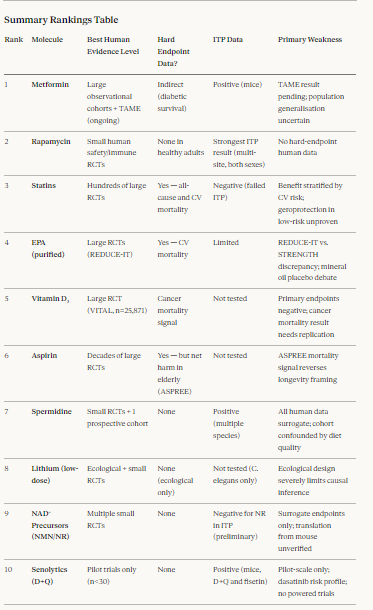
5 Likes
And the latest GPT, also in deep thought mode. (Reproducing only the summary tables. Some of the discussion texture is more interesting.
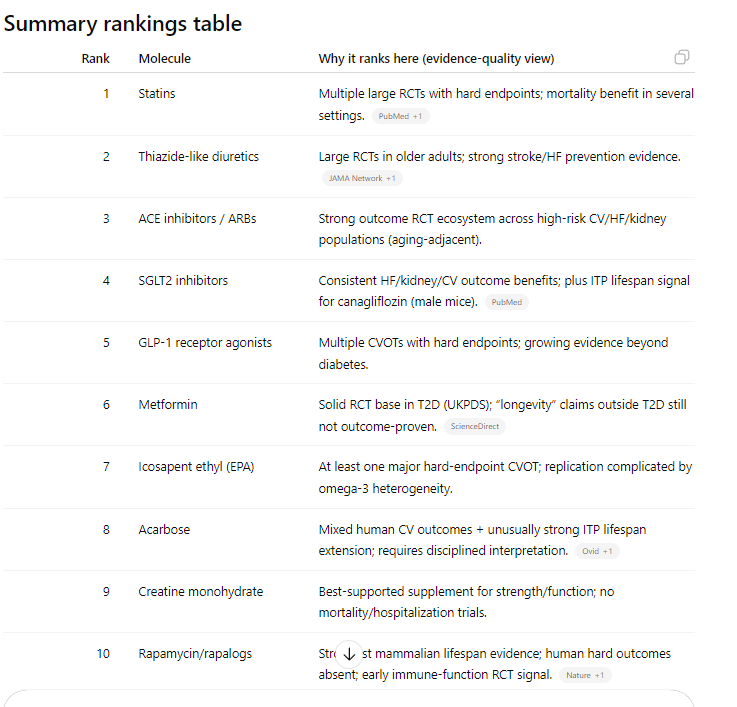
4 Likes
I was surprised to see SGLT2 inhibitors at the top of the list. From my perspective, I take Jardiance (empagliflozin), the most popular drug in this class, and in my case, it is perhaps the poorest option for fasting glucose control that I have taken. Its glucose-lowering effect was barely noticeable. To achieve such a high ranking, it must be attributable to its other properties:
"While they were originally developed to lower blood sugar, large-scale clinical trials have proven they provide significant protection for the heart and kidneys, often even in patients who do not have diabetes.
5 Likes
SGLT2I are the most helpful to your kidneys of any of the most popular longevity medicines or supplements currently recommended.
4 Likes
These AI lists would be pretty good if they didn’t include metformin
4 Likes