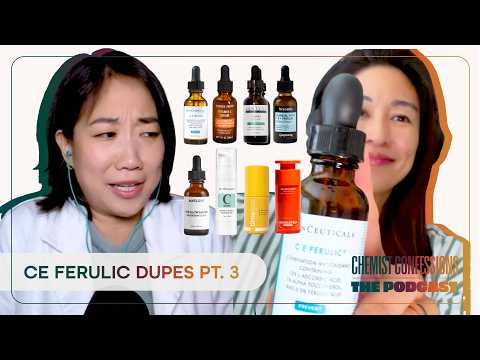
Chemists Test 7 CE Ferulic Dupes vs. the Original
. Executive Summary
This evaluation critically examines market formulations modeled after the benchmark Duke Antioxidant formulation (15% L-ascorbic acid, 1% alpha-tocopherol, 0.5% ferulic acid at acidic pH) established by Pinnell et al., 2005. L-ascorbic acid (AA) provides established photoprotective and pro-collagen synthesis benefits, but its thermodynamic instability causes rapid degradation into biologically inactive, oxidative byproducts (notably dehydroascorbic acid, 2,3-diketogulonic acid, and carbon dioxide gas).
The analytical framework relies on independent high-performance liquid chromatography (HPLC-UV) testing of 41 commercial vitamin C products conducted by researchers at the University of Ljubljana (Gašperlin et al., 2026) combined with an empirical 8-week accelerated stability trial (40°C thermal exposure) testing seven commercial “dupes” against the benchmark formulation. The Slovenian market analysis revealed substantial failure rates across finished cosmetic goods: 22% exhibited critical mislabeling (including non-detectable active levels or ingredient substitutions), and 50% of aqueous AA products fully degraded to 0% concentration under accelerated conditions. Degradation was heavily mitigated exclusively in water-free (anhydrous) systems or formulations with specific stabilizer networks (ferulic acid, glutathione, EDTA, tocopherol).
The 8-week thermal stress test demonstrated that chemical stabilization must be matched by structural primary packaging integrity. Formulas undergoing degradation release CO₂ gas, leading to container failure, dispensing sputtering, and rapid oxidative amber/brown discoloration. Low-cost airless pumps and basic dropper assemblies exhibited varying degrees of failure; lower-tier airless pumps leaked and oxidized heavily around the rim, while the reference dropper exhibited severe bulb deformation due to internal headspace pressure. Secondary ingredient choices significantly altered physical stability: substituting alpha-tocopherol with tocopheryl acetate compromised synergistic photoprotection and formula stabilization, while adding incompatible lipids or unvalidated botanical extracts catalyzed phase separation, cloudiness, and precipitate fallout. While derivatives like 3-O-ethyl ascorbic acid (EAA) and encapsulated complexes demonstrate higher thermal stability, they introduce translational trade-offs, including documented contact dermatitis risks and unverified in vivo bio-conversion efficiency compared to pure, stabilized L-ascorbic acid.
II. Insight Bullets
- Analytical HPLC-UV testing of 41 commercial vitamin C products by researchers in Slovenia found that only 78% contained detectable levels of the declared active ingredient (Gašperlin et al., 2026).
- Inappropriate labeling occurred in 22% of tested retail products, including formulations where the claimed vitamin C derivative was missing or replaced with an undeclared form (Gašperlin et al., 2026).
- An aqueous 1% pure L-ascorbic acid control solution degraded to zero active concentration within four weeks under accelerated thermal testing (40°C) (Gašperlin et al., 2026).
- Fifty percent of tested commercial aqueous ascorbic acid finished goods degraded to zero detectable active ingredient by the conclusion of stability testing (Gašperlin et al., 2026).
- Anhydrous (water-free) formulations suspended in glycols exhibited virtually zero active degradation across the entire testing window (Gašperlin et al., 2026).
- Ascorbic acid stability was ranked highest in anhydrous systems, followed by oil-in-water emulsions, and aqueous solutions stabilized with co-solvents and antioxidant complexes (Gašperlin et al., 2026).
- Unstabilized aqueous ascorbic acid solutions degrade rapidly, reinforcing that the synergistic combination of alpha-tocopherol and ferulic acid is strictly necessary for aqueous shelf-life integrity (Pinnell et al., 2005).
- Commercial products formulated with sodium ascorbyl phosphate (SAP) and ascorbyl glucoside (AG) degraded faster than simple 1% standard solutions, driven by formulation destabilizers such as pH adjusters (sodium hydroxide, tromethamine) or unstandardized plant extracts (Gašperlin et al., 2026).
- Ascorbic acid showed severe temperature sensitivity across refrigerated, ambient, and 40°C thermal points, confirming that cold storage meaningfully attenuates hydrolytic and oxidative degradation (Gašperlin et al., 2026).
- Clinical literature identifies 3-O-ethyl ascorbic acid (EAA) as an emerging contact allergen, with patch-test confirmed allergic contact dermatitis reported at concentrations ranging from 0.05% to 10% (Gašperlin et al., 2026).
- The original reference serum, SkinCeuticals C E Ferulic ($185 / 30 mL), developed significant bulbous pipette swelling due to carbon dioxide outgassing under thermal stress.
- Carbon dioxide generation is an obligatory chemical byproduct of ascorbic acid decarboxylation and degradation, causing internal headspace pressurization in sealed packaging.
- The Timeless Skin Care 20% C + E + Ferulic Serum ($28 / 30 mL) utilizes a glass airless pump that demonstrated superior oxidation resistance compared to competing plastic dispensers over 8 weeks.
- Airless pump dispensers exposed to internal CO₂ buildup experience dispensing sputtering and nozzle clogging if the pump design lacks precise tolerances.
- The Dr. Brenner Vitamin C Serum ($24 / 30 mL) changed to a plastic airless pump that showed pump-rim failure, leaking, and localized product darkening.
- The Maelove The Glow Maker ($30 / 30 mL; 15% L-ascorbic acid) maintained structural packaging integrity but exhibited slightly faster yellowing than previous iterations, likely attributable to raw botanical extract variations or batch-to-batch sourcing.
- The Brandefy 15% Vitamin C Serum ($55 / 30 mL) substituted pure alpha-tocopherol with tocopheryl acetate, resulting in rapid baseline yellowing and inferior synergy.
- Tocopheryl acetate lacks the rapid free-radical scavenging capacity of free alpha-tocopherol and fails to provide equivalent chemical stabilization to aqueous ascorbic acid in vitro.
- The Dermelect / Dermatology 15% formulation ($69 / 30 mL) retained acceptable color stability but includes superfluous peptides and ceramides that provide marginal utility at the required low formulation pH.
- Formulating peptides and ceramides in an environment requiring a pH below 3.5 creates chemical instability and hydrolysis risks for peptide bonds.
- The Trader Joe’s 15% Vitamin C Serum ($10 / 30 mL) exhibited catastrophic phase instability, developing a dark soy-sauce appearance, phase separation, and non-uniform sediment.
- Inclusion of non-emulsified oils to reduce ascorbic acid tackiness without robust surfactants creates emulsion cracking and phase precipitation.
- The Educated Mess Golden Hour Serum ($85 / 30 mL) utilizes a gold-glutathione-encapsulated ascorbic acid complex that remained completely clear across 8 weeks at 40°C.
- Gold-encapsulated and conjugated ascorbic acid complexes improve oxidative resistance, but translational human RCT data verifying equivalence to pure L-ascorbic acid for in vivo collagen stimulation remains limited.
- The critical formulation threshold for transdermal penetration of free L-ascorbic acid requires a pH strictly below 3.5, as non-ionized molecular flux drops precipitously at higher pH values (Pinnell et al., 2001).
- Formulations operating at an ultra-low pH (below 3.0) combined with elevated active concentrations (20% AA) markedly increase stratum corneum irritation, erythema, and barrier disruption without proportional increases in dermal bioavailability.
- Visual color shifts from clear/pale straw to deep orange/brown directly correlate with the accumulation of dehydroascorbic acid and subsequent degradation polymers.
- Pure alpha-tocopherol contributes inherent formula tackiness, leading inferior dupes to omit or substitute it despite sacrificing photoprotective synergy.
- Ascorbyl glucoside (AG) requires enzymatic cleavage by cutaneous alpha-glucosidases to yield active L-ascorbic acid, a process demonstrating wide biological variability across human subjects.
- Sodium ascorbyl phosphate (SAP) demonstrates clinical utility primarily in sebum oxidation control and mild inflammatory acne, serving as a distinct therapeutic modality rather than a direct replacement for high-potency photoprotection.
- Tetrahexyldecyl (THD) ascorbate serves as a lipophilic, non-acidic alternative for sensitive skin types, with clinical data supporting dermal delivery from premium vehicles (Revision Skincare), though at a significantly higher price barrier.
III. Actionable Protocol (Prioritized)
High Confidence Tier (Level A/B Evidence)
-
Formulation Parameter Verification: Procure only formulations combining 10% to 20% L-ascorbic acid, 0.5% to 1.0% pure alpha-tocopherol (not tocopheryl acetate), and 0.5% ferulic acid, buffered to a pH range between 2.5 and 3.5 (Pinnell et al., 2005; Lin et al., 2005; systematic review by JCAD, 2024).
-
Temperature-Controlled Storage: Store all aqueous ascorbic acid formulations in a refrigerator (4°C). Low thermal kinetic environments significantly slow down degradation to dehydroascorbic acid and suppress carbon dioxide headspace pressurization (Gašperlin et al., 2026).
-
Packaging Integrity Standards: Prioritize airless pump assemblies constructed with inert materials (glass or medical-grade plastic) over open-dropper pipettes to minimize exposure to atmospheric oxygen and prevent bulb elasticity failure from gas evolution.
-
Consumption Window: Consume all opened aqueous L-ascorbic acid serums within 60 to 90 days. Discard immediately if the solution progresses past a pale straw yellow to dark amber or brown.
Experimental Tier (Level C/D Evidence, High Safety Margins)
-
Anhydrous Glycol Formulations: For consumers unable to maintain refrigeration or complete products within 90 days, utilize anhydrous suspensions (e.g., ascorbic acid solubilized in propanediol/butylene glycol). These eliminate hydrolytic degradation entirely, though they present higher subjective friction and lower cosmetic elegance (Gašperlin et al., 2026).
-
Sodium Ascorbyl Phosphate for Acne-Prone Profiles: Utilize 1% to 5% SAP as an alternative where primary concerns are sebum lipid peroxidation and Cutibacterium acnes colonization rather than deep dermis collagen remodeling.
-
Gold-Conjugated Ascorbic Acid: Employ encapsulated complexes (e.g., gold-glutathione conjugates) for total formula clarity and non-acidic stabilization, while recognizing that translational human proof of dermal collagen induction remains preliminary compared to free L-ascorbic acid.
Red Flag Zone (Debunked or Lacking Safety Data)
-
High-Concentration 3-O-Ethyl Ascorbic Acid (>10%): Avoid formulations using >10% EAA without prior patch testing due to documented risks of allergic contact dermatitis (Gašperlin et al., 2026).
-
Unstabilized Aqueous Ascorbic Acid: Discontinue use of water-based products lacking secondary antioxidant stabilization (absence of ferulic acid, metabisulfite, EDTA, or glutathione). Degradation exceeds 50% within weeks (Gašperlin et al., 2026).
-
Phase-Separated Formulations: Discard any serum exhibiting turbidity, oily droplet formation, or sediment stratification (e.g., poorly emulsified budget formulas), as active availability is lost and localized oxidation induces dermal irritation.
-
High-Strength/Low-pH Cocktails on Impaired Barriers: Formulas combining 20% L-ascorbic acid with a pH below 2.8 in poorly preserved vehicles cause chemical barrier impairment and inflammatory cascades.
Produced by Gemini 2.5 Pro
Brands that meet these criteria:
The evaluation establishes strict parameters for a viable L-ascorbic acid formulation: 15–20% concentration, the synergistic inclusion of pure alpha-tocopherol and ferulic acid, a pH strictly below 3.5, and functional primary packaging capable of managing internal carbon dioxide outgassing without structural failure or rapid oxidation.
The following brands meet these functional criteria based on the accelerated stability testing and formulator evaluations:
Primary Recommendations (Empirically Validated L-Ascorbic Acid)
-
Timeless Skin Care: Evaluated as the superior formulation in the trial. The 20% Vitamin C + E Ferulic Acid serum remained chemically true to the original reference benchmark. It utilizes a robust glass airless pump that effectively mitigated atmospheric oxygen exposure, maintaining high solution clarity with minimal degradation over the 8-week stress test at 40°C.
-
Maelove: Assessed as functionally acceptable. The Glow Maker (15% L-ascorbic acid) maintained structural integrity and did not exhibit packaging failure or phase separation. It demonstrated slightly accelerated yellowing compared to previous manufacturing batches, highlighting the inherent volatility of compounding ascorbic acid with unstandardized botanical extracts.
-
DRMTLGY: Maintained acceptable physical stability and color profile. The Advanced C E Ferulic formula operates at an ultra-low pH (< 3.0), which successfully preserves the ascorbic acid but fundamentally compromises the hydrolytic stability of its superfluously added peptides and ceramides.
Secondary Approvals (Historically Validated)
-
Prequel and Geek & Gorgeous: Explicitly cited as highly effective, structurally sound ascorbic acid formulations evaluated favorably in previous laboratory assessments. Both serve as chemically stable, economically viable alternatives to the reference benchmark.
Alternative Mechanisms (Derivatives & Conjugates)
-
Educated Mess: Utilizes a gold-glutathione conjugated ascorbic acid complex (Golden Hour Serum). It exhibited zero degradation, gas evolution, or color shift during thermal testing. It is structurally optimal for physical stability, though clinical translation for pro-collagen synthesis differs substantially from free L-ascorbic acid.
-
Revision Skincare: Identified as the clinical standard for tetrahexyldecyl (THD) ascorbate. Recommended exclusively for individuals incapable of tolerating the highly acidic pH parameters required for free L-ascorbic acid transdermal penetration.
Pricing Comparison and Links:
Here is the comparative pricing data for the validated formulations, normalized to standard 30 mL (1 fl oz) retail sizing to allow for objective cost analysis. Retailer sourcing impacts final acquisition costs, and the current market offerings are available through official and authorized distributors.
You can source the Timeless 20% Vitamin C + E Ferulic Acid Serum, 1.7Oz directly from Timeless Skin Care. The MAELOVE Vitamin C Serum, Glow Maker is available through Maelove. The DRMTLGY’s Vitamin C E + F Brightening Serum can be procured at drmtlgy.com. Additionally, you can acquire the Prequel Lucent-C Vitamin C Serum 1 fl oz via prequelskin.com and the Geek & Gorgeous 101 C-Glow 15% Vitamin C Serum 30 ml via TikTok Shop.
For the premium clinical and derivative formulations, the Golden Hour Gold-Stabilized Vitamin C Serum is carried by Educated Mess, the C+ Correcting Complex 30% | Revision Skincare is listed on Dermstore.com, and the baseline reference SkinCeuticals C E Ferulic Combination Antioxidant Treatment 1oz (30ml) is available directly from SkinCeuticals US.
|
Timeless 20% Vitamin C + E Ferulic Acid Serum, 1.7Oz Opens in a new window |
MAELOVE Vitamin C Serum, Glow Maker with Vitamins C, E, Ferulic Acid and Hyaluronic Acid, Fragrance Free, Award Winning Opens in a new window |
DRMTLGY’s Vitamin C E + F Brightening Serum with Vitamin C (L-Ascorbic Acid) 15% Stable, Non-Irritating Formula Opens in a new window |
Prequel Lucent-C Vitamin C Serum 1 fl oz Opens in a new window |
Geek & Gorgeous 101 C-Glow 15% Vitamin C Serum 30 ml Opens in a new window |
Golden Hour Gold-Stabilized Vitamin C Serum Opens in a new window |
**C+ Correcting Complex 30% |
Revision Skincare Opens in a new window** |
SkinCeuticals C E Ferulic Combination Antioxidant Treatment 1oz (30ml) Opens in a new window |
|
$13.99 eBay & more 4.8 (15k+) Opens in a new window |
$81.10 eBay - giftsbyccm & more 4.6 (15k+) Opens in a new window |
$69.00 drmtlgy.com 4.6 (2k+) Opens in a new window |
$14.00 eBay & more 4.1 (2k+) Opens in a new window |
$28.00 eBay - authenticallee & more 4.6 (4k+) Opens in a new window |
$85.00 Educated Mess & more Opens in a new window |
$132.92 $210.99 FragranceNet.com & more 4.7 (2k+) Opens in a new window |
$179.00eBay & more 4.5 (18k+) Opens in a new window |
|
| Estimated Base Price (30ml) |
Estimated Base Price (30ml) $28.00 |
Estimated Base Price (30ml) $32.95 |
Estimated Base Price (30ml) $69.00 |
Estimated Base Price (30ml) $23.00 |
Estimated Base Price (30ml) $16.90 |
Estimated Base Price (30ml) $85.00 |
Estimated Base Price (30ml) $190.00 |
Estimated Base Price (30ml) $185.00 |
|
| Estimated Price per 100ml |
Estimated Price per 100ml $93.33 |
Estimated Price per 100ml $109.83 |
Estimated Price per 100ml $230.00 |
Estimated Price per 100ml $76.66 |
Estimated Price per 100ml $56.33 |
Estimated Price per 100ml $283.33 |
Estimated Price per 100ml $633.33 |
Estimated Price per 100ml $616.67 |
|
| Key Active Compound |
Key Active Compound 20% L-Ascorbic Acid |
Key Active Compound 15% L-Ascorbic Acid |
Key Active Compound 15% L-Ascorbic Acid |
Key Active Compound 15% L-Ascorbic Acid |
Key Active Compound 15% L-Ascorbic Acid |
Key Active Compound Gold-Glutathione Ascorbic Acid |
Key Active Compound 30% THD Ascorbate |
Key Active Compound 15% L-Ascorbic Acid |
|