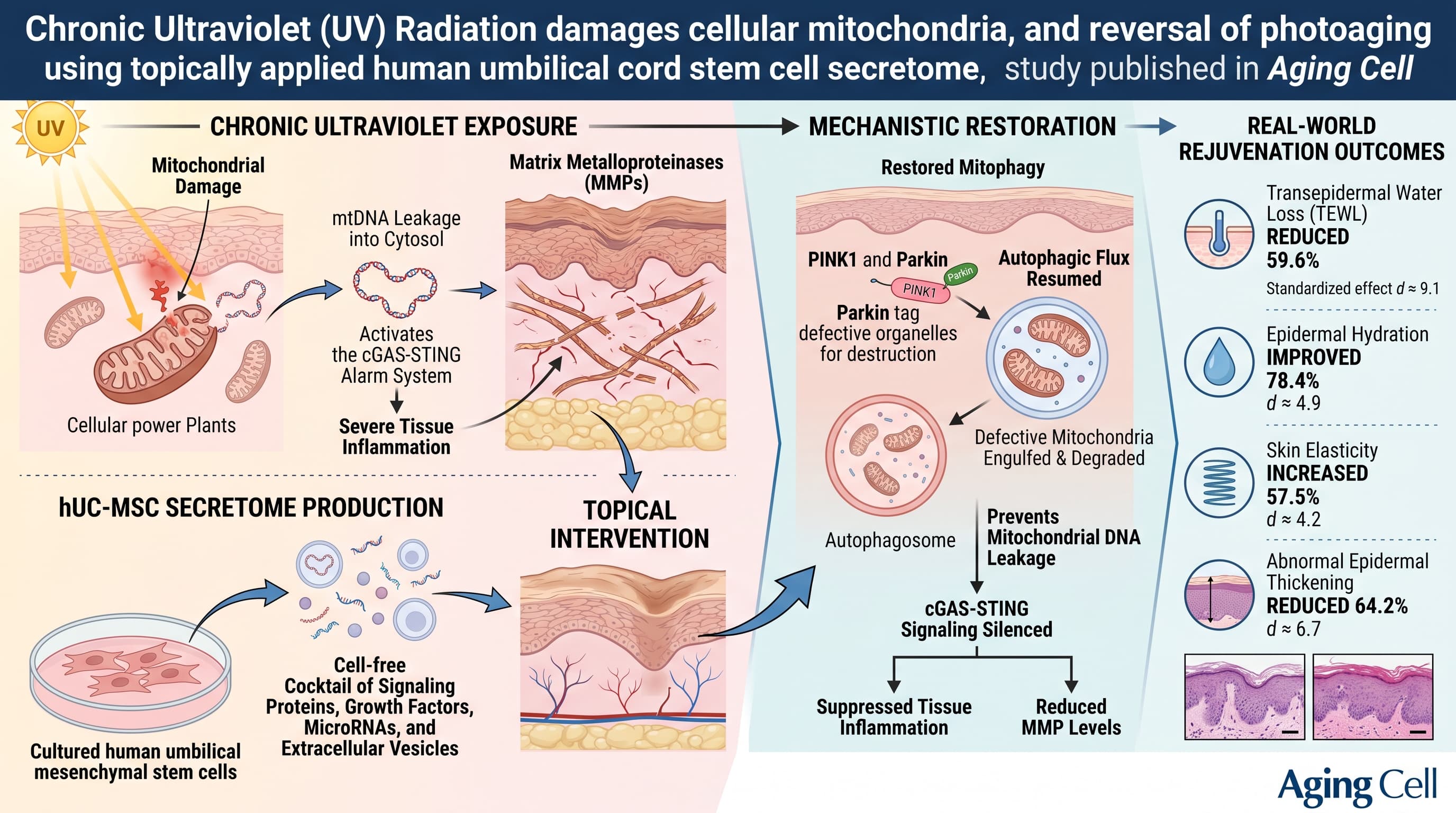
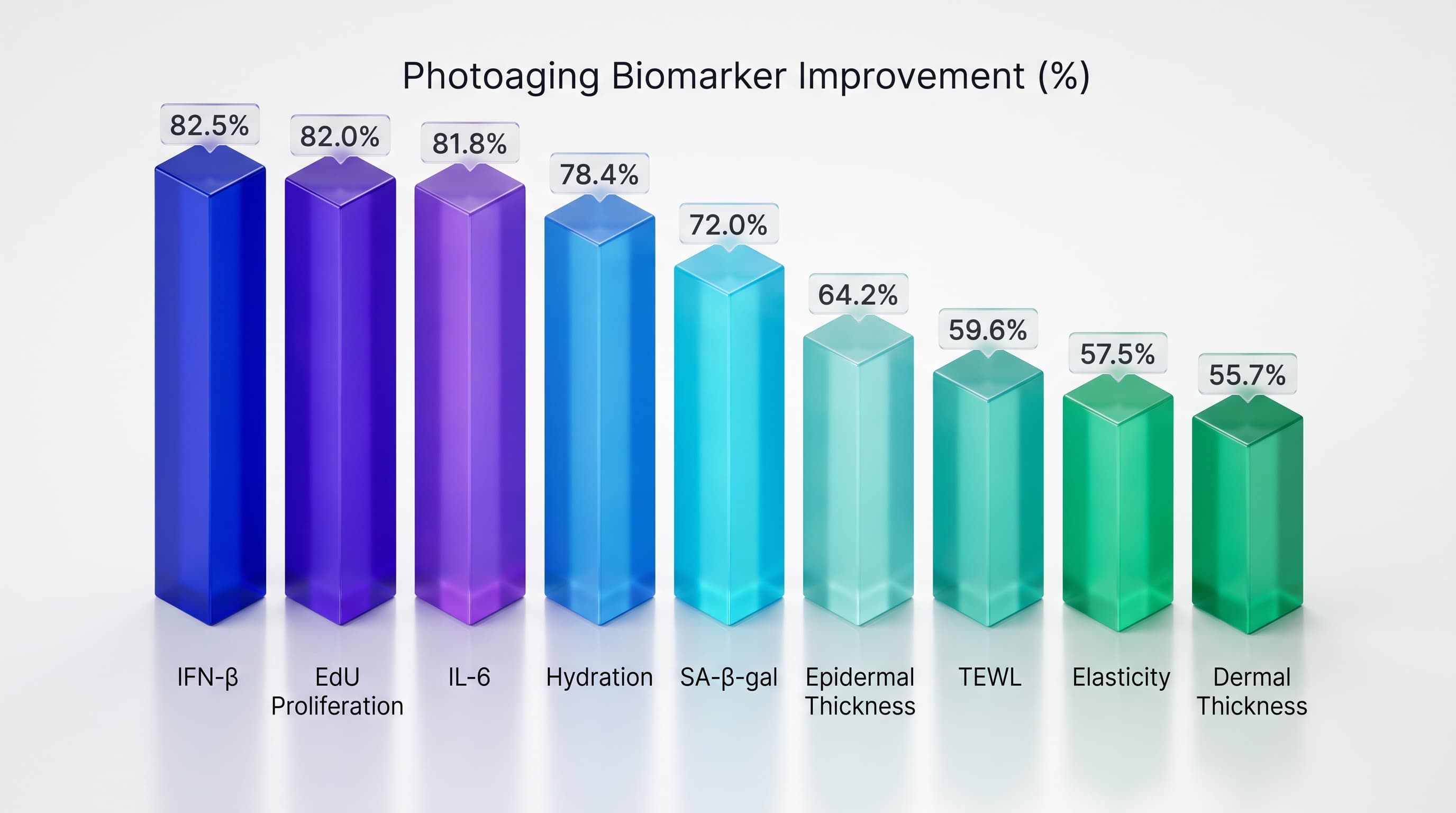
My effort at looking into any possible commercialization efforts related to this research (via Claude Opus 5 Extra):
Short answer
No commercialization traceable to this group or this specific paper. The broader line of research, topical MSC-derived secretome for skin aging, is one of the most heavily commercialized areas in aesthetics worldwide, but almost entirely outside a regulatory framework that would require efficacy evidence. Human clinical evaluation exists, is modest in size and quality, and has never tested the product or the mechanism described here.
What the paper itself discloses
The paper declares no conflicts of interest. Funding is entirely public: National Natural Science Foundation of China grants 82073417, 81703147 and 81402613, plus Guangdong Basic and Applied Basic Research Foundation grant 2022A1515010768. No company supplied the secretome. It was produced in house from a single donor’s Wharton’s jelly, passage 5, 72 hours in serum-free medium, 2.548 mg/mL total protein, with pooling of donors explicitly avoided.
Two signals are worth noting anyway.
The Southern Medical University group sits inside China’s cosmetics regulatory apparatus. Affiliation 5 on this paper is the NMPA Center for Innovation and Research in Regulatory Science. Their companion paper on the same secretome platform for hair growth (Stem Cell Research and Therapy, 2025, full text) lists an NMPA Key Laboratory for Safety Evaluation of Cosmetics affiliation alongside a Nanfang Hospital plastic and aesthetic surgery co-affiliation. That is a lab positioned at the science-to-regulation interface, not a lab with a spinout (confidence 0.8).
They are building a platform rather than a one-off result. Skin photoaging plus hair growth from the same conditioned medium preparation is the usual pattern preceding IP filing. I found no patent under these inventors’ names. The surrounding IP space is already crowded with unrelated filings on the same material, for example CN116987151A, granted in February 2024 to Shaanxi Zhonggang Wanhai Life Science Research Institute, covering umbilical cord MSC supernatant in skin repair and anti-aging skincare. Caveat on my search: CNIPA filings are poorly indexed by English-language search and carry an 18-month publication delay, so a 2025 or 2026 filing from this group would not yet be visible. Confidence that no public patent exists today is 0.85; confidence that none has been filed is 0.5.
Commercialization of the same approach
China
Mainland China is the one place this cannot legally become a cosmetic. The 2015 Safety and Technical Standards for Cosmetics prohibit human cells, tissues and human-origin products as cosmetic ingredients, and NMPA has not approved exosomes as a cosmetic ingredient, as summarized in CIRS Group’s jurisdiction-by-jurisdiction analysis and in ZMUni’s compilation of global requirements for human-derived exosomes. CDE has separately been folding exosome products into the cell therapy regulatory framework. The practical result is that a topical hUC-MSC secretome carrying anti-aging claims has no clean domestic route: too human-derived to be a cosmetic, too poorly characterized to be a straightforward biologic.
The workaround is to commercialize offshore. Beijing Guowei Biotechnology obtained an INCI listing for “Human Umbilical Wharton’s Jelly Mesenchymal Stem Cell Exosomes,” which is the identical starting tissue to this paper. That listing opens the US, EU, Japan and Korea, and explicitly not China. It is the closest commercial analogue to this paper’s material that I could identify, with the caveat that the paper uses whole secretome rather than purified exosomes, so it is a tissue-source match and not a product match (confidence 0.9 on the tissue-source match).
China’s domestic exosome sector is real but mostly pharmaceutical rather than dermatological. An industry census of roughly 49 Chinese exosome companies names Enze Kangtai, Bailai Regenerative Medicine and Bailian Pharmaceuticals, none of them positioned in skin aging. Meanwhile Chinese medical aesthetics clinics sell stem cell supernatant facials in a substantial gray market with no ingredient approval behind it.
South Korea
The most productized market. ExoCoBio’s ASCE+ line of adipose-derived stem cell exosomes is the category leader; the company received MFDS GMP licensing for exosome biopharmaceuticals in 2023 and that same year completed its acquisition of the US aesthetic brand BENEV. Korea permits human cell and tissue culture fluid in cosmetics under Article 8, Appendix 3 of its Cosmetics Act.
Korea also shows what happens when a category outruns its evidence. In January 2025 MFDS expanded the list of prohibited cosmetic advertising expressions to bar the word exosome unless the ingredient is plant or animal derived, bar hospital-exclusive framing, and bar quantitative anti-aging claims. By May 2025, inspections had logged 237 online advertising violations, with roughly 48 percent judged to read as drug or medical claims.
Japan
Clinic-sold human stem cell culture supernatant is permitted under Japan’s Guidelines for Biological-Derived Materials, with source controls and strict advertising limits, again per the CIRS analysis. Clinics market it directly to consumers as drip, injection or topical treatment, as at Elm Clinic and Setagaya Clinic. This is the closest real-world match anywhere to the paper’s actual material, an undefined conditioned medium applied to skin, sold at scale. Permission here reflects a materials-safety category, not any efficacy assessment.
United States
Most permissive for topical use, most restrictive for injection. The INCI database lists 59 exosome ingredients, mostly plant derived, and human MSC exosome topicals sell as cosmetics. Elevai Skincare is a publicly traded example that has run its own small studies, launching one in October 2024 and announcing positive results on completion. Company-sponsored, unregistered, and not peer reviewed, so weight accordingly.
Injectable exosomes are unapproved biologics. FDA issued a public safety notification on exosome products and a public safety alert on unapproved stem cell and exosome marketing after patient hospitalizations. Enforcement has continued through the Kimera Labs warning letter in September 2023, Supreme Rejuvenation in May 2025, and Dynamic Stem Cell Therapy in February 2026.
Southeast Asia
Indonesia and Thailand have active secretome clinic markets and, tellingly, contribute a disproportionate share of the published clinical trials in this area. Indonesian dermatology reviews treat secretome as a standard clinical option in a way no Western review does.
Clinical evaluations
Nothing has tested this paper’s product or its mechanism in humans. No trial has used single-donor, serum-free hUC-MSC whole secretome topically for UV photoaging, and no human study has evaluated mitophagy restoration or cGAS-STING suppression in skin as a readout (confidence 0.95).
What does exist, in descending order of relevance to this paper:
Closest cell source and delivery match. Efficacy of Microneedling Combined With Local Application of Human Umbilical Cord-Derived MSC Conditioned Media in Skin Brightness and Rejuvenation, a randomized controlled split-face study in Frontiers in Medicine (2022, PubMed). Same tissue source and same unfractionated conditioned medium, but delivered through microneedling channels rather than across intact skin, which is a materially different pharmacokinetic situation.
Pooled evidence. Effectiveness of Topical Conditioned Medium of Stem Cells in Facial Skin Nonsurgical Resurfacing Modalities for Antiaging, a systematic review and meta-analysis in Aesthetic Plastic Surgery (2023, PubMed), identified five RCTs and pooled four. It reported improvement in wrinkles, pigmentation, pores and overall skin condition, at Level of Evidence III. Two structural problems limit what you can take from it. The conditioned medium is always an adjunct to a resurfacing procedure that is independently effective, so the increment attributable to the secretome is not separable. And it reports p values rather than standardized effect sizes, so the practical magnitude of benefit cannot be recovered from the paper. A published commentary in the same journal argued explicitly that further studies are needed before these conclusions hold.
Umbilical cord source, individual trials:
Adipose source, for comparison, since the adipose literature is deeper:
-
Efficacy of Microneedling Plus Human Stem Cell Conditioned Medium for Skin Rejuvenation, Annals of Dermatology 2014, randomized controlled blinded split-face, n=25.
-
Randomized controlled study for the anti-aging effect of human adipocyte-derived MSC media combined with niacinamide after laser therapy, Journal of Cosmetic Dermatology 2021, n=28. Note the confounder in the design: niacinamide is itself an active.
-
Efficacy of combined treatment with human adipose tissue stem cell-derived exosome-containing solution and microneedling, Journal of Cosmetic Dermatology 2023, 12-week prospective randomized split-face.
-
Microneedling combined with concentrated adipose-derived MSC secretome, Journal of Cutaneous and Aesthetic Surgery, double-blind RCT, n=40, reporting roughly 26 percent elasticity gain and 28 percent wrinkle reduction. In plain terms, an effect of that size is visible on instrumented measurement and at the edge of what a patient notices unprompted.
-
A Comparative Study on Adipose-Derived MSC Secretome Delivery Using Microneedling and Fractional CO2 Laser, comparing delivery routes rather than testing the secretome against placebo.
China specifically. The registered trial closest to this work is NCT06677931 at Fujian Medical University Union Hospital: umbilical cord MSC-derived exosomes delivered with a 1565 nm non-ablative fractional laser for melasma, n=30, completed, listing details here. Pigmentation rather than photoaging, and a different institution from this paper’s group.
Certainty of the whole body of evidence. A 2026 systematic review applying GRADE rated certainty as low for elasticity, collagen synthesis and wrinkle reduction, and moderate for safety. Across 347 participants with detailed adverse event reporting, 98.4 percent of events were grade 1 and self-limiting within 24 to 72 hours, with no tumorigenicity signal out to five years. That review also tabulates two studies I could not retrieve as primary sources and am therefore citing at second hand: Estupiñan et al. 2025 (US, adipose exosomes intradermal versus PRP, split-face non-inferiority RCT, n=20, roughly 31 percent elasticity and 24 percent wrinkle improvement) and Ponnikorn et al. 2026 (Thailand, umbilical cord versus adipose exosomes intradermal, prospective cohort, n=120, five-year follow-up). The Thai study is the largest and longest dataset in the field but is a cohort, not randomized, so it cannot separate treatment effect from selection.
In plain terms: the safety picture is reasonably reassuring, the efficacy picture is not yet trustworthy, because the studies are small, short, mostly split-face, mostly adjunctive, and the product differs in every single one. A 2024 review of the same literature reaches the same conclusion from a different angle.
Two gaps worth flagging for your readers
Dose. The mice in this study received 200 uL of undiluted stock daily onto a 2.5 by 1.5 cm field, which works out to about 136 micrograms of secretome protein per square centimeter per day, for 30 consecutive days, on skin with a thinner barrier than human facial skin. Commercial topicals essentially never disclose secretome protein content, so the comparison cannot be completed, but the mouse exposure is almost certainly far above what any consumer serum delivers (confidence 0.85). The paper’s disclosure of a 2.548 mg/mL stock concentration is itself more transparency than the commercial category offers.
Product identity. The paper’s material is deliberately single-donor, unpooled, serum-free and unfractionated. Commercial products are typically pooled across donors, exosome-enriched or lyophilized, and reconstituted. The preclinical result therefore does not transfer to anything currently on sale, even where the cell source matches exactly, as with the Guowei Wharton’s jelly exosome ingredient.
The mechanism claim, mitophagy restoration suppressing cGAS-STING-driven inflammaging, is scientifically the most interesting part and the least commercialized. Small-molecule STING inhibition for inflammaging is an active drug development thread, but nobody is selling a secretome on a STING-suppression rationale (confidence 0.9). If this group files IP, that axis is the plausible claim.