Interestingly, the summary didn’t mention Hydroquinone cream, which is the strongest anti-pigmentation treatment, as far as I know.
1 Like
It was found that hydroquinone users had higher rates of leukemia and lymphoma, possibly due to DNA damage. This is associational, not proof of causation, but it raises concern. U.S. FDA removed OTC hydroquinone due to safety concerns, including possible cancer risk, but did not declare it carcinogenic.
EU, Australia, Japan banned OTC hydroquinone out of caution.
2 Likes
Good point, thanks for raising it. I found the study here:
https://www.jidonline.org/article/S0022-202X(23)00491-8/fulltext
As you said, it’s quite a strong association but it comes from a database search so doesn’t show causation. Still, it’s a big increase, and there’s a plausible mechanism.
I believe topical hydroquinone is used for fairly short periods of time to treat dark patches etc. It’s not something you’d really use in a typical beauty regime. If I had severe melasma on my face or something, I’d still consider it.
1 Like
I purchased a bunch of hydroquinone prescription cream from India and have been trying it out. If you follow the strict guidelines on use I think it’s fine. It seems very effective. You need to limit the square inches of skin you use it on, and the duration (I think you want to use it in 3 month pulses, if I remember correctly). Price is a few dollars a tube. Probably much more effective than the over the counter nutraceutical topical formulations: Adapalene (Differin) Report / Skincare Benefits - #21 by RapAdmin
Full list of products, prices and video on hydroquinone here: How to Reverse Skin Aging (2022 to 2024) - #447 by RapAdmin
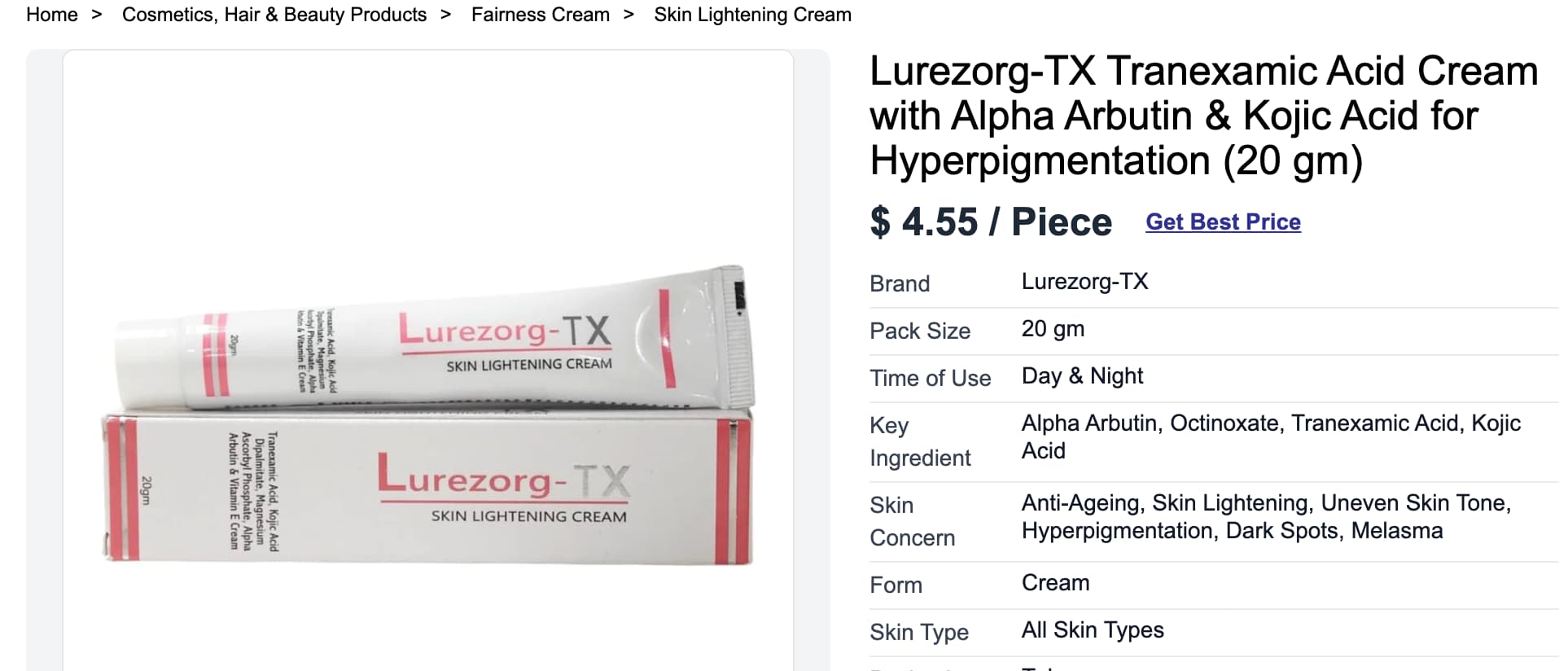
In an ideal world you might use combinations of the products; many of the products seem to be mixed this way with hydroquinone / Kojic acid, etc. Like the one below, listed on IndiaMart:
1 Like
Just saw this in my google news feed:
Part of the problem is that “dark spots” is a vague classification that is used to describe several biologically distinct conditions, and they don’t all respond to the same treatments. How hyperpigmentation looks and behaves depends on what part of the body it’s on — as does how it’s perceived. Research on visual aging has found that uneven facial pigmentation plays a significant role in how old we appear: In one widely cited study published in the Journal of the American Academy of Dermatology , women with hyperpigmentation on their cheeks were perceived to be up to 20 years older than their actual age.
…
What ingredients help fade dark spots at home?
Belkin recommends looking for brightening ingredients that interrupt pigment production, such as vitamin C, niacinamide, kojic acid, n-acetylglucosamine, azelaic acid, tranexamic acid, or licorice-root extract. Gentle chemical exfoliants like glycolic, lactic, or mandelic acids can also help by speeding up cell turnover so pigmented cells shed more quickly. Retinol and bakuchiol also work in this way.
1 Like
I went and did a consult for CO2 laser therapy and microneedling. I’m going to do them together as soon as I find 10 days in my schedule where I can just hide and not be seen since the recovery is brutal to say the least. CO2 is a hell of a treatment from what it looks like though
2 Likes
My wife has done the CO2 laser, and yeah the first 7 days or so afterwards were rough. Looks like a bad sunburn, and if they focus on any spots, they go super red. Once that faded, I would say she looked back to normal for the next ~2 weeks or so. But by 1 month she definitely looked better - skin much smoother, brighter, plumper.
2 Likes
Only very brave ppl can go through such skin abuse in hope of good results that hopefully would last. I would never do it for myself. Could you please update us again in the same in 6-12 months? Interested in the final outcome.
1 Like
I had CO2 and not sure it made a noticeable difference.
My friend had it done to the point of looking like she was in a fire, and she was very pleased with her results.
If you go gentle or fractional you have much better recovery but the results are subtle and you’d need a few rounds spaced months apart to really make a difference. If you go meatgrinder level like your friend, then the recovery is brutal and you also risk infections or other complications. If you dodge those bullets then you likely have a much more impressive result.
I haven’t done it myself and will not consider it because I’ve got other tools in the arsenal for my needs that I much prefer. But IF I wanted CO2-like results, I’d probably do a series of chemical peels instead (high % TCA). They work very similarly and peels can be self administered at a tiny fraction of the cost. CO2 laser isn’t something I’d dabble into self administration or want to purchase the device.
The only exception is eyelids — you can’t do chemical peels on those boys but you can laser the skin off of them … by a properly trained technician or preferably cosmetic dermatologist with eye shields / guards on.
3 Likes
She actually did it a few years ago. It’s just really difficult to say whether it lasted or not, because there are other factors at play. She did it because she was feeling a bit “rough” after we were done having kids. We both think her skin got a lot better, and she still looks great now - but at the same time, the youngest kid has grown up, sleeps through the night etc, plus all the other skincare interventions (LED face masks, OneSkin a few months ago).
1 Like
^ In related news a really cool paper was just published in Cell by a team at Harvard. They showed that embryonic skin is capable of regenerating full-thickness skin injuries, due to the absence of a specific fibroblast subpopulation. These “postnatal wound-specific” fibroblasts inhibit regeneration of multiple lineages/secondary structures by driving excessive innervation within the wound. Blocking Cxcl12 signaling within these fibroblasts, or blocking neurotransmitter release with Botox, are both sufficient to drive a regenerative wound healing response instead.
This suggests that controlled skin damage (e.g microneedling) would show enhanced recovery in the presence of Botox. I searched for a bit and found quite a few reports on people combining Botox with microneedling, but the vast majority of them are doing microneedling first. According to this, you’d want the Botox simultaneously, so it can suppress the neural activity which in turn suppresses regeneration. You might also want a microneedling device which can deliver Botox directly to the dermal layer of the wounds.
The below image was an individual who survived scalping as a child. Perhaps Botox and/or an antagonist of CXCR4 (the receptor through which CXCR4 signals) and he’d still be an NW < VII.

1 Like
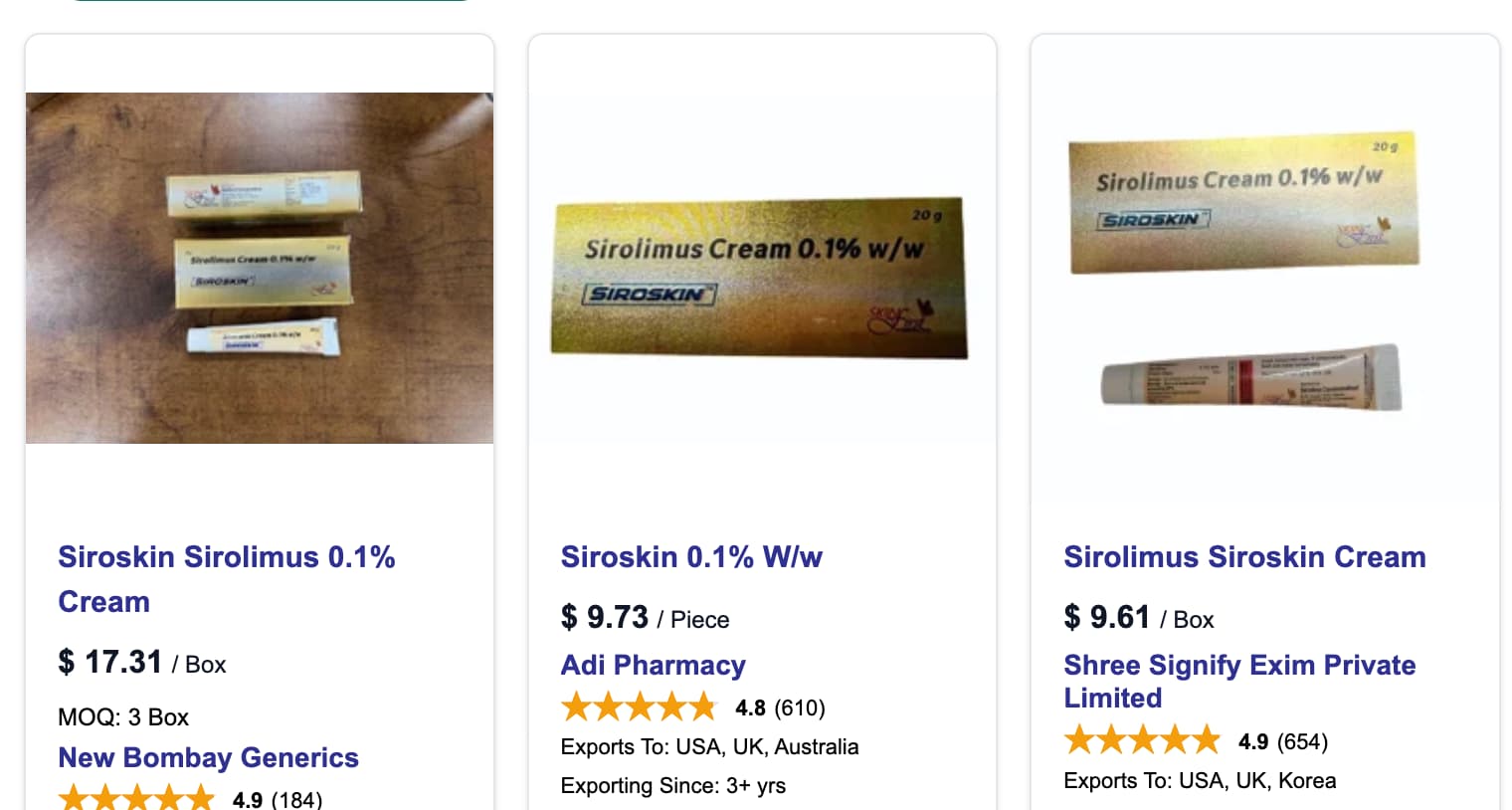
On Indiamart you can now find topical rapamycin cream, 0.1%, under the generic brand name Siroskin.
7 Likes
Great news! I’ll definitely be trying that now.
Does anyone combine it with Tretinoin or is it better to use them on alternating days? How often should someone be using the Rapamycin cream?
2 Likes
Skin cells remember inflammation for life. Here’s why
Skin remembers. That scar above your eye from when you fell at age 6. That freckle from the summer you turned 13. Our skin is a repository of moments from our lives, and now scientists have found it really does remember. For people with inflammatory skin conditions such as psoriasis, the skin’s memory manifests in flare-ups in the same spots over and over. And now scientists think they know precisely why this happens.
In a new study in mice published on Thursday in Science, researchers showed how skin cells inherit patterns of gene expression every time they regenerate. The team found not only that successive generations of skin cells maintain the memory of their DNA’s structure but also that the cells inherit chemical modifications to the DNA called epigenetic marks, which can turn on or off, or turn certain genes up and down in a process called gene expression.
“People knew that stem cells had the ability to change their behavior and remember, but they didn’t know if it was through this epigenetic mechanism,” says Shruti Naik, a molecular biologist at the University of Maryland, College Park, who has previously worked with the study’s senior author, Elaine Fuchs, but was not involved in the new research. “And I think what this paper does is definitively demonstrate that it’s through marking of DNA … that it allows that stem cell to now behave differently moving forward.”
Skin stem cell memory can be beneficial: if you get a cut, for example, your skin will heal faster in that place if it is injured again because the cells remember the experience. But that becomes problematic in conditions like psoriasis, for which the memory of a flare-up can make the tissue overly sensitive to environmental triggers such as stress, leading to chronic inflammation.
“Your DNA can remember, far longer than we appreciated, a past injury,” says Dana Pe’er, a co-author of the study and chair of the Computational and Systems Biology Program at the Sloan Kettering Institute. “It’s a double-edged sword.”
Read the full story: Skin cells remember inflammation for life. Here’s why (Scientific American)
2 Likes
This is why human life is limited to 115 to 120 years
Among other factors
Remove all the other factors and we still can’t live past 115 - 120 without fixing the elastin problem. Ignoring this fact is what drives the “don’t die” - “live forever” mantra that enriches a lot of hucksters in the longevity space.
All we really have is some ability to increase health span, which on it’s own is a marvel of human ingenuity, now being augmented by AI, thanks to human ingenuity  I admire the people working on this noble cause, the others, not so uch.
2 Likes
“Belides™ ORG lightens and evens skin tone. It is derived from organic daisy blossoms with a multifaceted activity on the synthesis of melanin. It decreases ET-1 expression, inhibits a-MSH binding capacity and minimizes endocytosis of melanosomes by keratinocytes. This product is proven to lighten and even skin tone and to make age spots less visible.”
https://www.ulprospector.com/en/na/PersonalCare/Detail/1381/222723/Belides-ORG
Looks interesting. I can’t find anything on Pubmed however there are studies and information elsewhere
1 Like