Very short video on cryonics.
I for one find it super interesting and thanks for bringing it up. I’d want to try and talk my family members into it so I don’t wake up in 200 years with my whole family long dead
1 Like
3 Likes
New Cryonics startup announced: Startup Brings New Hope to the Pursuit of Reviving Frozen Bodies (Bloomberg)
2 Likes
See also:
1 Like
The money that immortality-chasers pour into longevity trends, both as consumers and patrons, is furthering real-world scientific progress. Even cryogenic freezing is less “Star Trek” than it sounds: human embryos are already cryopreserved as part of in-vitro fertilization. In the future, cryogenic freezing could help store human organs, keeping them viable longer for transfers. It could also save and revive endangered species.
1 Like
Don’t forget about space travel. Interstellar travel is dangerous and not practical as of now, but with cryogenics we can send people on month, year or even century long missions to other moons, planets and star systems.
4 Likes
I think working out hibernation (which looks to be an option for the human genome) is more practical.
2 Likes
Think they both would be valuable, but for different things.
Hibernation can be key for trauma and critical care medicine and perhaps short space travel within our inner solar system as it will likely only work for a week, weeks or perhaps months.
That won’t be enough to fully transform organ transplantation, or for the “ambulance through time to better medicine” that might need years, or even decades, or for human kind to become a multi-solar system species (and have a chance to survive the expansion phase / death of our sun and many other existential risks) which might require hundreds, if not thousands of years of travel vast distances to other stars (if we don’t find ways to build warp drives). So for things like this we’d need indefinite stop of biological time that ice free, vitrification at cryogenic temperatures provides.
2 Likes
@DeStrider @Virilius @RapAdmin @desertshores @Olafurpall @tongMD @A_User
Here is a quite in-depth review of the field just published this past week
Prof George Church from Harvard University, Harvard Medical School and the Wyss Institute and Prof JP Maghales from Birmingham and Oxford University are among the senior co-authors
(Just note that the review has a bit extra focus towards toward so called “fluid preservation” (the focus area of the first author) which in my mind while cheaper does not have the same potential for real working “medical time travel” as ice-free cryopreservation via vitrification has)
Structural brain preservation: a potential bridge to future medical technologies
When faced with the prospect of death, some people would prefer a form of long-term preservation that may allow them to be restored to healthy life in the future, if technology ever develops to the point that this is feasible and humane. Some believe that we may have the capacity to perform this type of experimental preservation today—although it has never been proven—using contemporary methods to preserve the structure of the brain. The idea is that the morphomolecular organization of the brain encodes the information required for psychological properties such as personality and long-term memories. If these structures in the brain can be maintained intact over time, this could theoretically provide a bridge to access restorative technologies in the future. To consider this hypothesis, we first describe possible metrics that can be used to assess structural brain preservation quality. We next explore several possible methods to preserve structural information in the brain, including the traditional cryonics method of cryopreservation, as well as aldehyde-stabilized cryopreservation and fluid preservation. We focus in-depth on fluid preservation, which relies on aldehyde fixation to induce chemical gel formation in a wide set of biomolecules and appears to be a cost-effective method. We describe two theoretical recovery technologies, alongside several of the ethical and legal complexities of brain preservation, all of which will require a prudent approach. We believe contemporary structural brain preservation methods have a non-negligible chance of allowing successful restoration in the future and that this deserves serious research efforts by the scientific community.
6 Likes
TimeShift : World’s first cryopreservation facility (Concept now) .
The project was unveiled on January 7, 2025.
Created by Dr. Alex Zhavoronkov, a generative AI scientist and anti-aging researcher, and Hashem Al-Ghaili.
TimeShift is described as the world’s first cryopreservation facility and is based on cutting edge AI and new cryopreservation techniques. The concept could allow cancer patients to wait in stasis for medical advancements or even for humanity to outlive apocalyptic disaster. The system would even use AI to let your digital avatar communicate with loved ones during cryostasis.
3 Likes
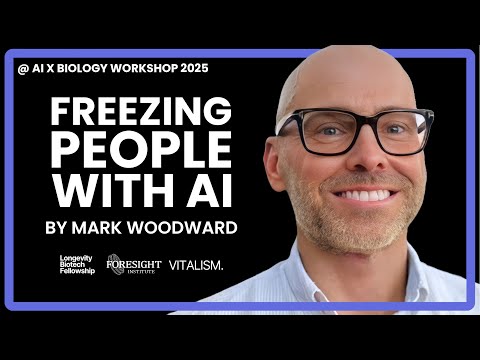
The main points are about using AI to improve cryopreservation and the challenges of scaling it for humans.
Here are the main points from Mark Woodward’s talk, “Freezing People with AI” at the AI X Bio Workshop 2025:
1. Background and Motivation
- Mark Woodward has a PhD in computer science, focusing on machine learning and AI. He previously worked at Google Brain, which merged with DeepMind.
- He decided to apply AI to something he felt was more meaningful: cryonics.
2. Cryopreservation Example
- He shares the story of Lydia and Timothy, embryos frozen for 30 years (since 1992), thawed in 2022, and now healthy toddlers. This demonstrates that low temperatures can halt biology for decades.
3. The Problem of Death
- About 60 million people die each year, and most—even those in hospice—would prefer to keep living.
- Even as longevity technologies advance, there will always be cases where preservation is needed as a “safety net.”
4. Technical Challenges in Human Cryopreservation
- Scaling up from embryos to whole humans is difficult because humans are much larger.
- Thicker tissue means slower heat transfer, which increases the risk of ice formation—ice damages cells.
- Preventing ice requires higher concentrations of cryoprotectant chemicals, but these become toxic at high levels.
5. Wake Bio’s Approach
- Woodward’s company, Wake Bio, founded in January, is working on preserving adult organisms, starting with zebrafish.
- They use AI to identify new, less toxic cryoprotectants and to optimize preservation parameters (like cooling rates and annealing phases).
- Their process involves rapid experimentation, feeding results back into machine learning models to guide the next experiments.
6. Call for Collaboration
- Wake Bio is seeking investors and organic chemists to help advance their work.
7. Q&A: Why Focus on Cryonics?
- Woodward sees cryonics as a necessary safety net alongside other longevity treatments, motivated by a desire to provide an option for those who “slip through the cracks.”
Perhaps we’ll relearn an old skill 
3 Likes
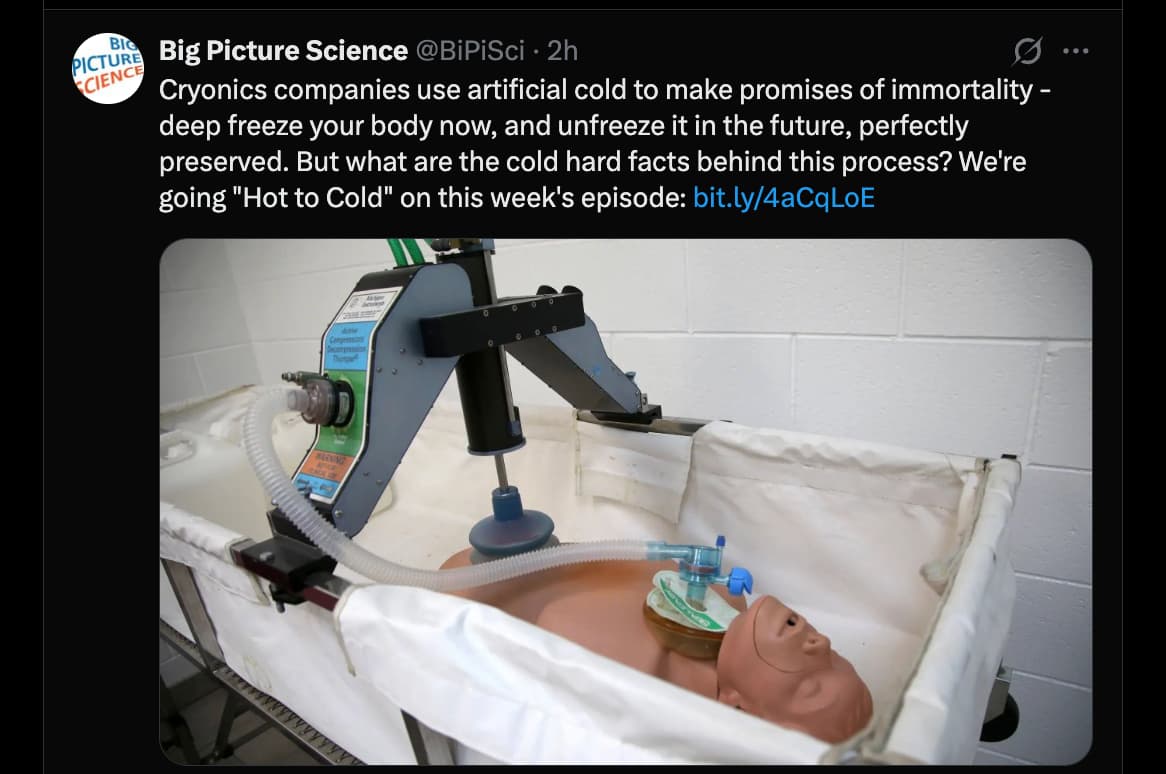
There are benefits to chilling out. When we cool superconductors to 460℉ degrees below zero, they acquire extraordinary properties that help run quantum computers. Can artificially cooling human bodies also provide profound benefit? Some cryonics startup companies say yes, promising “life after death” through cryogenic freezing. While it’s one thing to freeze all the cells in a body, it is another to revive them. What happens, for instance, to memories when brains thaw? While we gauge how low human body temperatures can go, new research suggests another form of life could find home in the cooler temperatures of Jupiter’s moon Europa. Find out how NASA’s Europa Clipper mission will investigate whether that moon could support alien microbes.
Guests:
Steve Austad – Distinguished Professor at the University of Alabama at Birmingham and Scientific Director of the American Federation for Aging Research
Olivia Lanes – Global Lead for Quantum Content and Education at IBM Quantum
Austin Green – Post doctoral research associate at Virginia Tech University, and former JPL postdoctoral fellow and affiliate scientist on Europa Clipper
Listen to the full Podcast here:
1 Like
Steve has too much common sense for this. Lol, I gotta listen tomorrow.
1 Like
Although I wish everyone the best, I can’t convince myself that there is any chance to revive someone who decides to go this route. Alternatively, my skepticism might be incorrect. Anyway, for a view of the awakening try reading.
We Are Legion (We Are Bob) by Dennis E Taylor
2 Likes
Still a long way to go, but some progress:
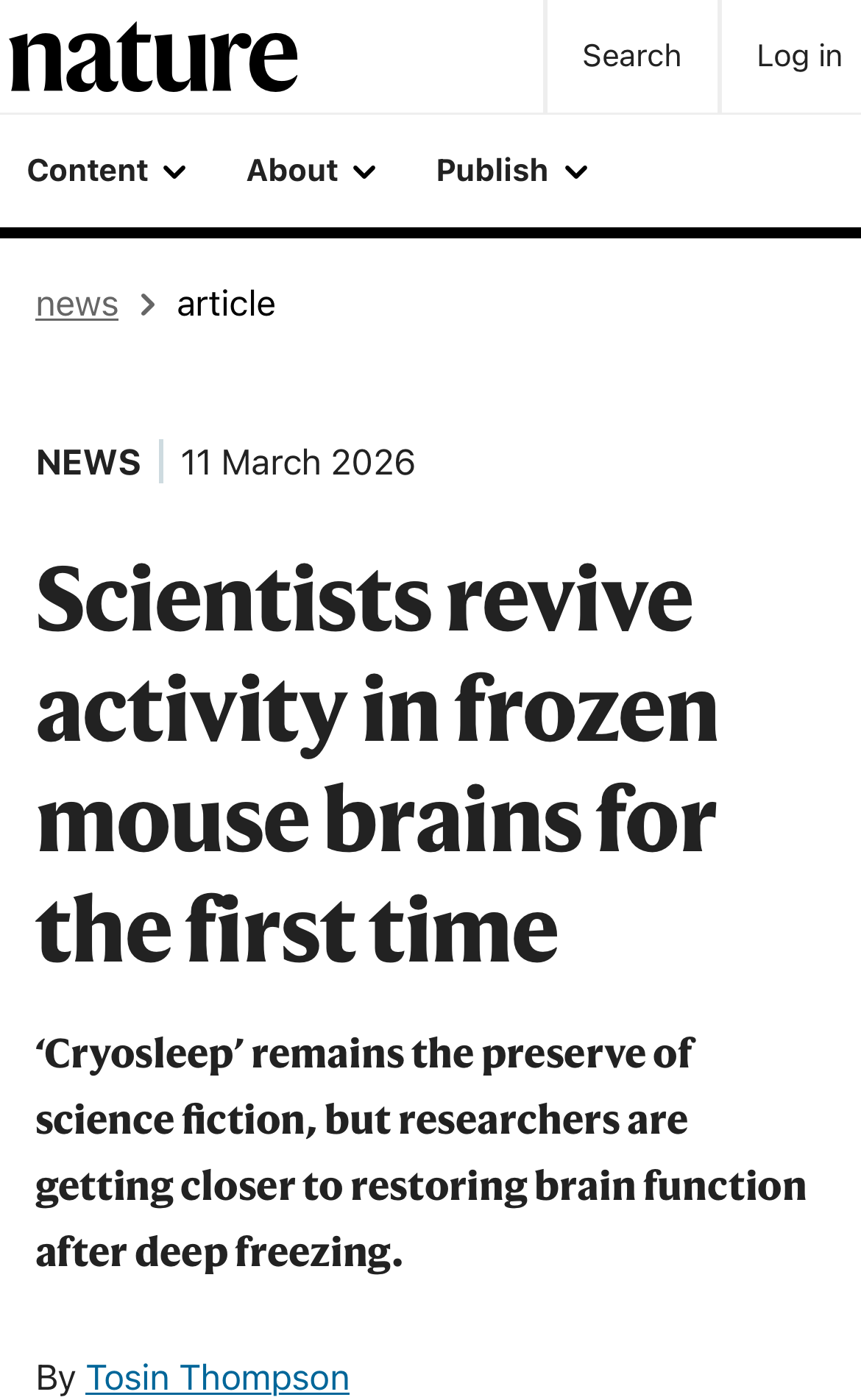
Scientists revive activity in frozen mouse brains for the first time
‘Cryosleep’ remains the preserve of science fiction, but researchers are getting closer to restoring brain function after deep freezing.
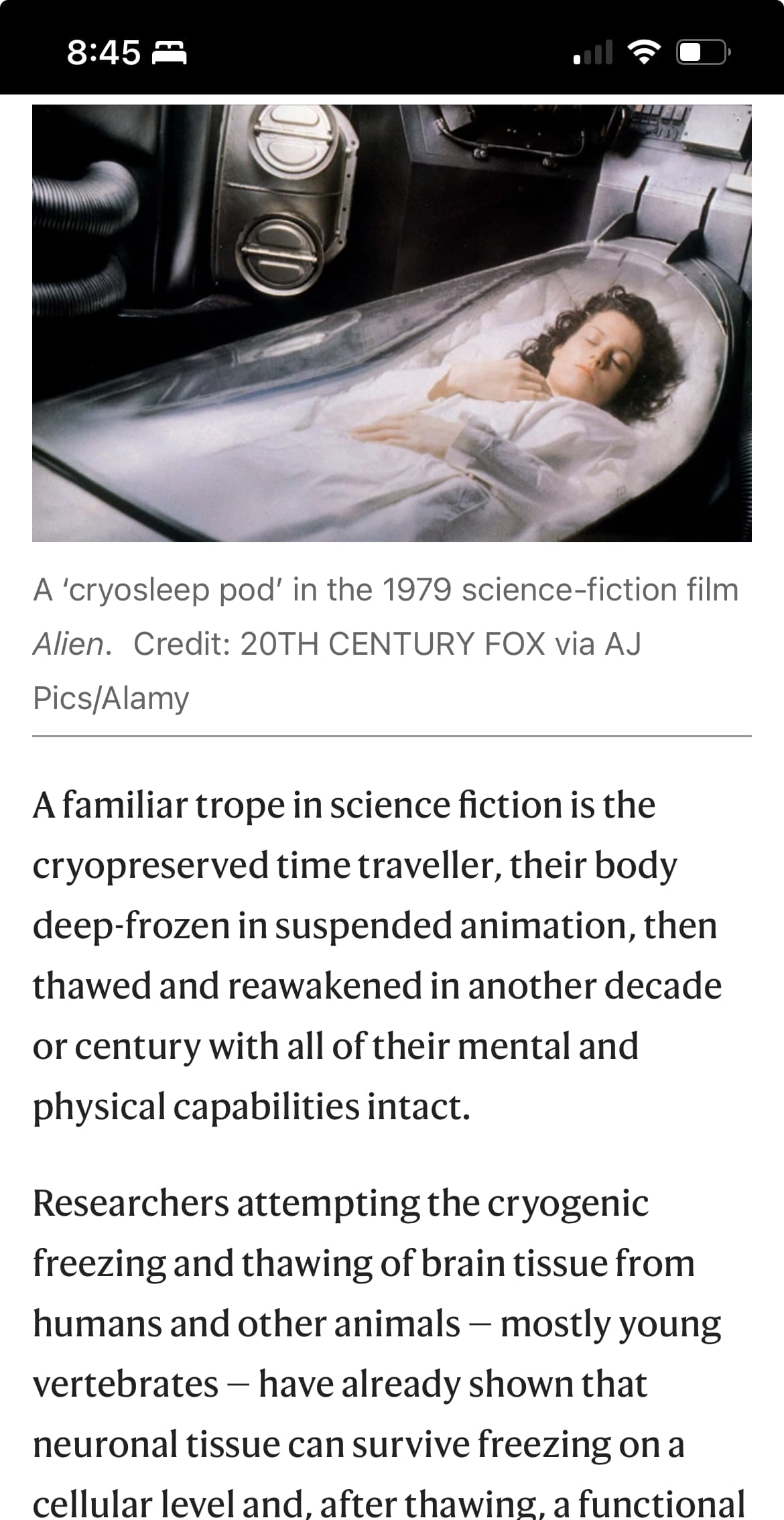
A familiar trope in science fiction is the cryopreserved time traveller, their body deep-frozen in suspended animation, then thawed and reawakened in another decade or century with all of their mental and physical capabilities intact.
Researchers attempting the cryogenic freezing and thawing of brain tissue from humans and other animals — mostly young vertebrates — have already shown that neuronal tissue can survive freezing on a cellular level and, after thawing, a functional one to some extent. But it has not been possible to fully restore the processes necessary for proper brain functioning — neuronal firing, cell metabolism and brain plasticity1,2.
A team in Germany has now demonstrated a method for cryopreserving and thawing mouse brains that leaves some of this functionality intact. The study, published on 3 March in Proceedings of the National Academy of Sciences 3, details the authors’ use of a method called vitrification, which preserves tissue in a glass-like state, along with a thawing process that preserves living tissue.
“If brain function is an emergent property of its physical structure, how can we recover it from complete shutdown?” asks Alexander German, a neurologist at the University of Erlangen–Nuremberg in Germany and lead author of the study. The findings, he says, hint at the potential to one day protect the brain during disease or in the wake of severe injury, set up organ banks and even achieve whole-body cryopreservation of mammals.
Mrityunjay Kothari, who studies mechanical engineering at the University of New Hampshire in Durham, agrees that the study advances the state of the art in cryopreservation of brain tissue. “This kind of progress is what gradually turns science fiction into scientific possibility,” he says. However, he adds that applications such as the long-term banking of large organs or mammals remain far beyond the capabilities of the study.
Full story: Scientists revive activity in frozen mouse brains for the first time