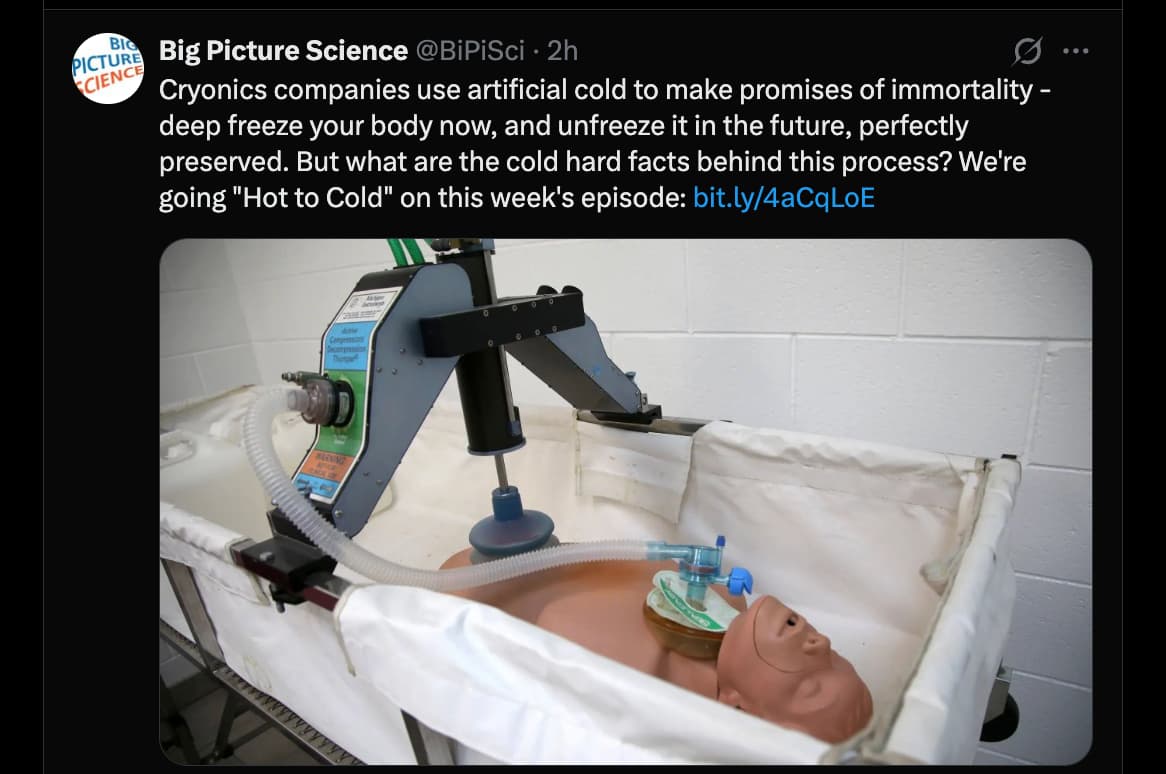
There are benefits to chilling out. When we cool superconductors to 460℉ degrees below zero, they acquire extraordinary properties that help run quantum computers. Can artificially cooling human bodies also provide profound benefit? Some cryonics startup companies say yes, promising “life after death” through cryogenic freezing. While it’s one thing to freeze all the cells in a body, it is another to revive them. What happens, for instance, to memories when brains thaw? While we gauge how low human body temperatures can go, new research suggests another form of life could find home in the cooler temperatures of Jupiter’s moon Europa. Find out how NASA’s Europa Clipper mission will investigate whether that moon could support alien microbes.
Guests:
Steve Austad – Distinguished Professor at the University of Alabama at Birmingham and Scientific Director of the American Federation for Aging Research
Olivia Lanes – Global Lead for Quantum Content and Education at IBM Quantum
Austin Green– Post doctoral research associate at Virginia Tech University, and former JPL postdoctoral fellow and affiliate scientist on Europa Clipper
Although I wish everyone the best, I can’t convince myself that there is any chance to revive someone who decides to go this route. Alternatively, my skepticism might be incorrect. Anyway, for a view of the awakening try reading.
Scientists revive activity in frozen mouse brains for the first time
‘Cryosleep’ remains the preserve of science fiction, but researchers are getting closer to restoring brain function after deep freezing.
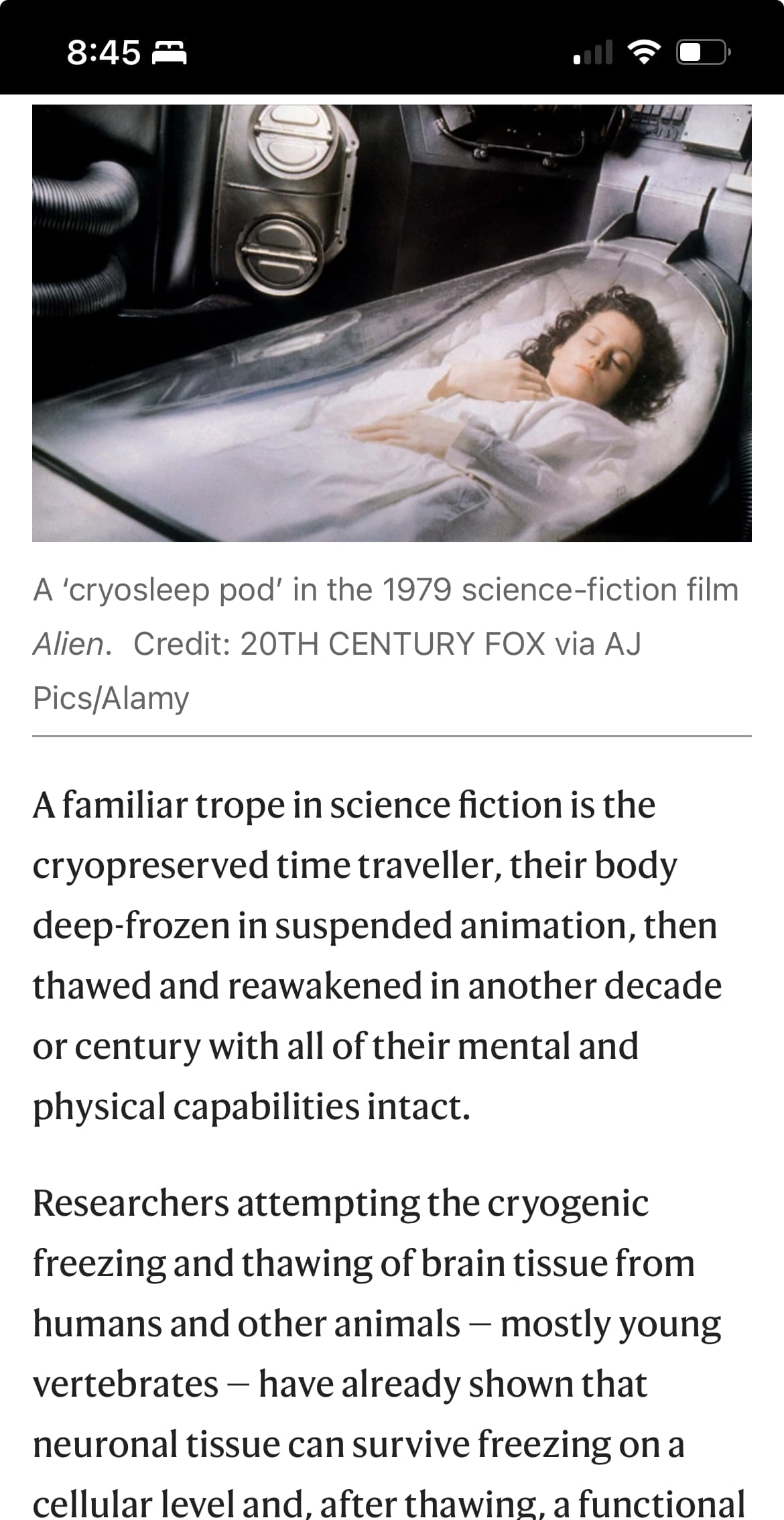
A familiar trope in science fiction is the cryopreserved time traveller, their body deep-frozen in suspended animation, then thawed and reawakened in another decade or century with all of their mental and physical capabilities intact.
Researchers attempting the cryogenic freezing and thawing of brain tissue from humans and other animals — mostly young vertebrates — have already shown that neuronal tissue can survive freezing on a cellular level and, after thawing, a functional one to some extent. But it has not been possible to fully restore the processes necessary for proper brain functioning — neuronal firing, cell metabolism and brain plasticity1,2.
A team in Germany has now demonstrated a method for cryopreserving and thawing mouse brains that leaves some of this functionality intact. The study, published on 3 March in Proceedings of the National Academy of Sciences3, details the authors’ use of a method called vitrification, which preserves tissue in a glass-like state, along with a thawing process that preserves living tissue.
“If brain function is an emergent property of its physical structure, how can we recover it from complete shutdown?” asks Alexander German, a neurologist at the University of Erlangen–Nuremberg in Germany and lead author of the study. The findings, he says, hint at the potential to one day protect the brain during disease or in the wake of severe injury, set up organ banks and even achieve whole-body cryopreservation of mammals.
Mrityunjay Kothari, who studies mechanical engineering at the University of New Hampshire in Durham, agrees that the study advances the state of the art in cryopreservation of brain tissue. “This kind of progress is what gradually turns science fiction into scientific possibility,” he says. However, he adds that applications such as the long-term banking of large organs or mammals remain far beyond the capabilities of the study.
I’m planning on signing up for it. Its admittedly a bit of a Hail Mary. But I think some people might consider rapamycin a Hail Mary, i.e. no large scale human trials, so no evidence of efficacy, no FDA approval for longevity so its just smoke and mirrors Please Don’t Bury Me
Rapamycin has a lot of positive evidence and certainty as to risk factors. Cryo at the moment looks like a position on a spectrum between certain death and serious pain and lack of quality of life at the best.
Morning John, you’re an early riser!
Your points: “certain death and serious pain and lack of quality of life at the best” Certain death; Correct especially with the nuero option where they cut off your head after being pronounced dead. So I will rate this criticque as TRUE.
Serious pain Correct, especially if you view death as a “process” that continues after your heart stops beating and your brain slowly powers down. But they administer pain meds, so the pain exists, but it is muted. serious pain. So once again a true claim!
“Lack of quality of life” I don’t know how it would effect quality of lilfe. Nothing really happens to you until you’re legally dead, so I’m confused, so I rate this claim as confusing.
My only counter-claim is that the alternative is to have my dead body and brain rot in the ground and have microbes and insects eat it… I rate this claim as true!
So its a choice you have to make, ok, some people will choose to have their earthly remains eaten by bugs. Its the traditional way to go, ashes to ashes, dust to dust. Or you could donate your organs, but 80 year old organs don’t have much of a market.
Quick Summary
• A German research group froze mouse-brain tissue in a way that preserved its circuits and functionality after thawing.
• The method used liquid nitrogen and specific chemicals to vitrify tissue, preventing ice crystals.
• Applying the method to intact human organs or whole bodies remains far off due to scalability limitations.
So its only a small bit of a brain right now. But both Alcor and C.I. use cryo-perservatives and liquid nitrogen. So the hope/wish/dream is the future science will be able to mis-mash the brain back to a coherent shape, enough for consciousness. But of course, THIS IS NOT THE STATE OF CURRENT SCIENCE, ok I got it. But these kinds of steps indicate to me that it might work, maybe not in 100 years, but a thousand years is a long time and the odds start to look non-zero, and time speeds by quickly when chilling on ice.
I wouldn’t dare make any predictions for next three years, let alone 100 or a thousand. Who’s to say that in 1000 years I won’t be able to have lunch with my mistress in mars and then have dinner at ruth’s Chris steak house at Garden City, NY LOL . Yeah, things are changing so fast that no one knows where we are headed and how fast we’ll get there (at time being). Exiting times ahead (but no one knows if it’s for good or for bad LOL)
I think progress will continue in this field. As I recall Alcor cooled a pigs head to near long term storage temp then warmed it back up and pumped blood through it and they claimed it made motions that indicated memory preservation. They didn’t say what memories, but I’m guessing some movement response of the eyes involving a learned, as opposed to reflexive motion.
Regarding the WSJ articale, I would guess that science will get around to testing other species and larger bits of the brain. I believe the German’s cyro option is just brain, no body, no skull. They say it gives a better cleaner freeze to the brain which is really what its all about. And they’re probaly right.