you may wat to save a cheap lunch by buying it on amazon
2 Likes
You’re the best!
I’m now having my BFF discuss all the pros and cons … and Wyze is an excellent find, as you know!
He also brought up these models for consideration… by chance, did you evaluate them?
InBody H30
Tanita RD-545
RENPHO MorphoScan Nova
He’s saying some of these MIGHT be better to track trends in lower body mass people… but I dunno… no shock, but my bff keeps changing his mind!
Wouldn’t touch any of these. Bad reviews and very expensive. I never buy anything that has less than a solid 4 star review and at least over 100 reviews. If you want something different than Waze, and very cheap with great reviews here:
1 Like
So.
Many.
Options.
Ok, I’m sending these to Claude… and ha, it never occured to me to look at anything but Withings… one of these other options will help pay for the Apple watch I want to get in the fall… and no, I don’t want to wear a watch, but I now know multiple people who had it detect afib!
have three of them, and all useless IMo. Any smartwatch that needs charging daily I wouldn’t touch with my worst enemy’s money LOL. I’m beyond shocked that apple, Samsung and other big names are still selling watches with only 24 h battery capacity when there are other manufacturers having watches that last from 7 days to one month. Pathetic of apple
1 Like
I have a 1st or 2nd gen i haven’t put on in years… I’m only interested in the safety features at this point… afib or if i should have an accident and ‘can’t get up’
I doubt I’d wear it all the time, but if I’m on a hike etc
1 Like
Actually, I love them and would wear them daily no problem but the fact that they need to be charged daily is such an aggravating point to me, it’s appalling they haven’t come up with one that last at least 7 days. You have some big names such as Garmin etc, that have 10 days+ battery life and I don’t know what the hell is apple waiting for. I think it is their rigid/stupid mentality of not conforming with customer demands fast enough. I remember same thing with the screen size when apple refused to make a large screen iPhone (their CEO kept saying a phone is not a computer and doesn’t need to have a large screen_) until they started losing market share rapidly and all the sudden all their models become XL lol. I wish nobody bought an apple watch, so they get the message that having a large battery is very important to consumers. Believe it or not I was so pissed that I kept emailing their CFO and CEO demanding they start making large screen iPhone sizes or they will dissapear. . it took them couple years or so to catch up to what people wanted, but they finally got the message and did the right thing. I hope same happens with the watches and battery life. I would definitely buy and wear one if it provided at least 7 days battery time.
1 Like
Ha, on that note, the reason I never loved my Apple Watch because back in the day, I didn’t always have reading glasses with me and the screen was too small!!! But now that I’m old, I have them with me 24/7!!! A watch is now back in play :).
1 Like
I tried FitBit’s Aria 2, and an Omron scale with handles, which I ordered from Japan. Both of these wildly overestimated my BF%, and the Omron was expensive. I’m currently happily using Withings Body Smart and have done so for the last two years. During that time, I’ve had two DeXA scans from two different providers. Both times, the Withings measures were 1% of BF greater than the DeXA values. Interestingly, weighing myself multiple times once after the other can produce readings with .5 to 1% BF variance, so if I get a reading that seems off, I take a few more and select the one that’s closest to yesterday’s values. YMMV, perhaps accuracy is related to body type. For reference, I’m around 16% BF and slightly muscular. I also like Withings software: setup is easy, the UI is decent, and it integrates nicely with Cronometer, which I use for nutritional tracking. Bottom line is, Withings Body Smart is an easy way to track directionally correct BF values if I manage its variance with occasional multiple measurements. It’s not a precise measurement, but even DeXA isn’t. It’s good enough to know if I’m trending in the right direction.
2 Likes
Thanks for this great feedback! It’s really neat to hear it will work with cronometer!!
Interesting to hear how accurate your model is without having handles… I was assuming those added a lot more accuracy, but your results say otherwise.
@ageless64 I love cronometer but don’t use it often enough… it got me thinking, I wonder if AI can track my meals in an easier way…
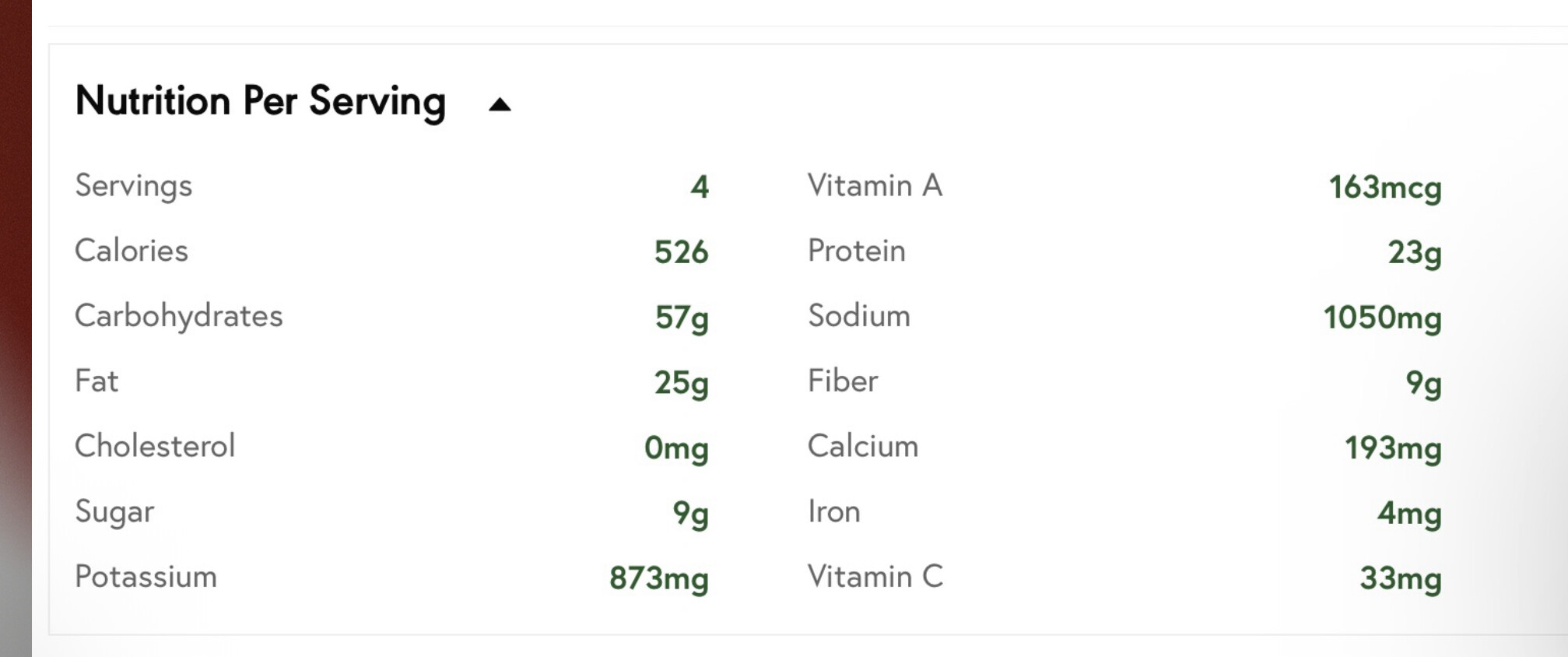
The source for the recipe I used provided the nutritional breakdown (probably from AI!), so I thought I’d see how closely Claude could do.
I haven’t tried it yet, but Claude also said I could show a photo of my meal and he can estimate a portion size and nutrients.
Here is the result
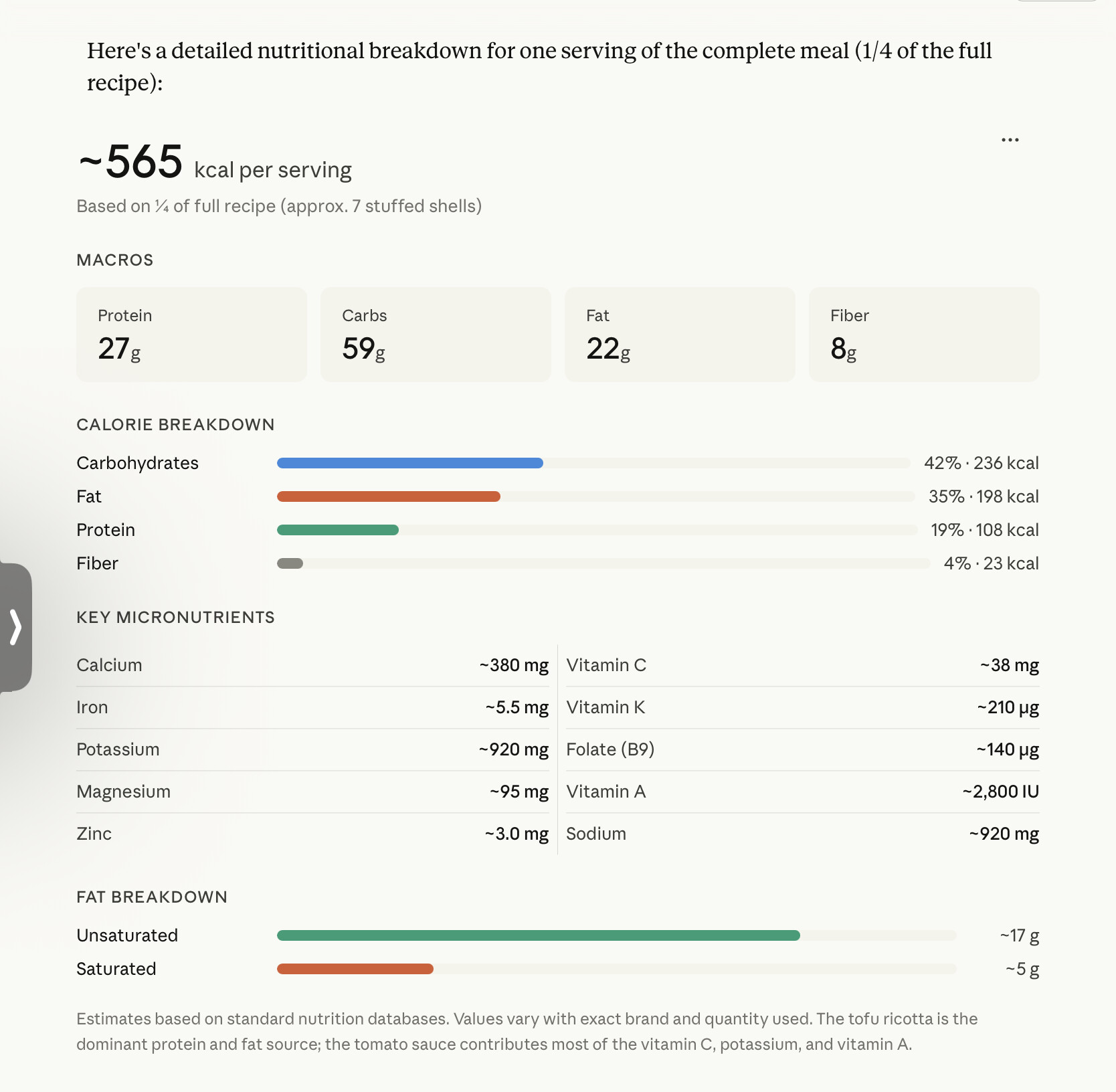
“Here’s a detailed nutritional breakdown for one serving of the complete meal (1/4 of the full recipe):A few highlights worth noting:
Protein powerhouse for a vegan meal — 27g per serving is impressive, coming almost entirely from the extra-firm tofu in the ricotta. That’s comparable to a chicken breast serving.
Micronutrient standouts:
- Vitamin K is very high (~175% DV) thanks to the spinach and basil
- Vitamin A is strong (~56% DV) from spinach and tomatoes
- Iron is solid (~30% DV) — the lemon juice in the ricotta actually helps your body absorb the plant-based (non-heme) iron more effectively
- Folate (~35% DV) from the spinach is a nice bonus
Sodium is the one to watch at ~920mg (~40% DV), mainly from the kosher salt across all three components and the miso in the ricotta. Easy to reduce by going lighter on salt in the tomato sauce.
Fat quality is excellent — about 77% unsaturated, coming from olive oil and tofu. Very little saturated fat for a creamy pasta dish.
All figures are estimates since exact amounts of salt, lemon juice, and olive oil vary by cook, but these should be quite close.
From the recipe website:
EDIT:
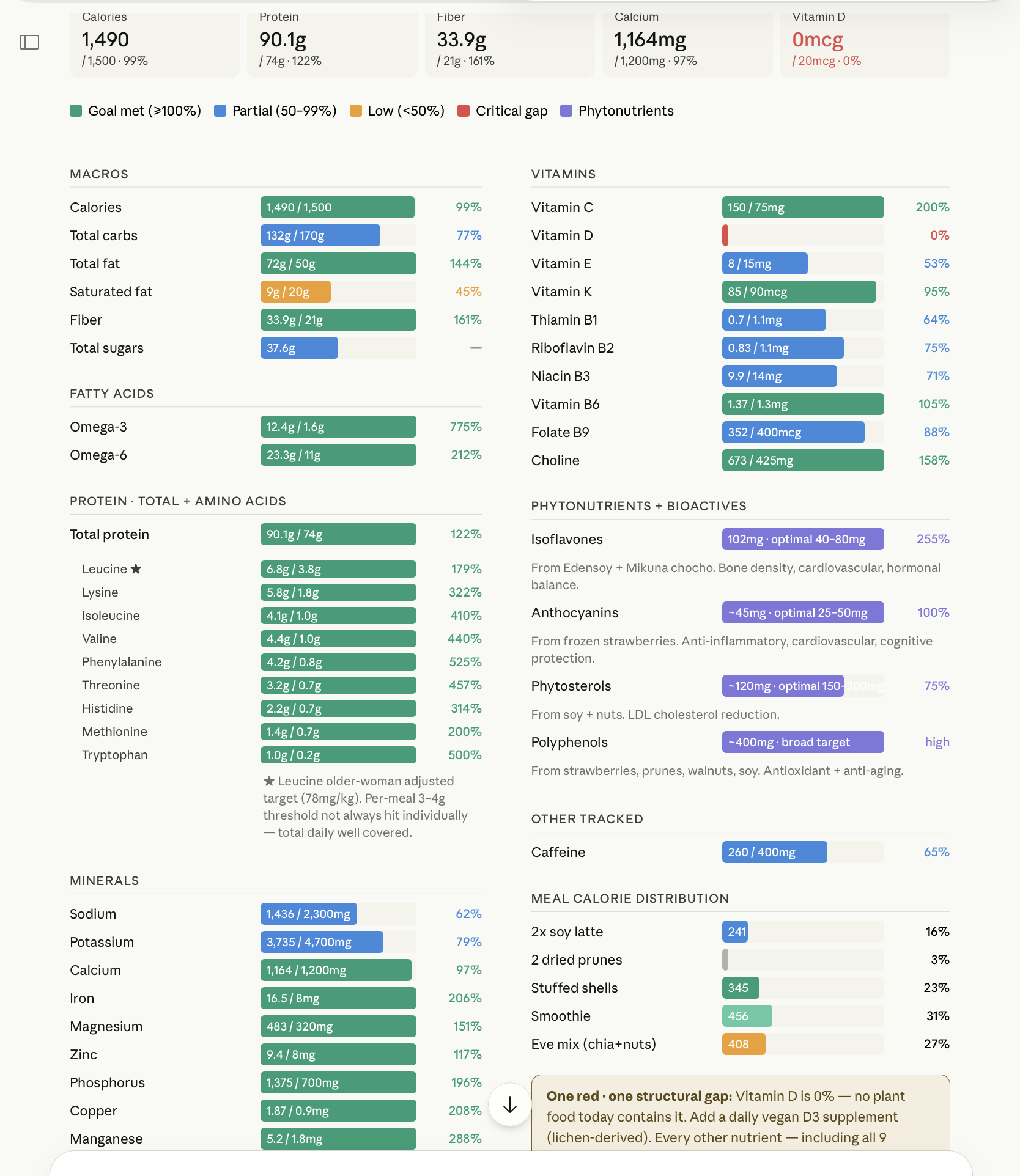
I have been playing and my mind has been blown!!! I think this AI thing is gonna catch on 
I still had some nutrients I needed to hit for the day, so Claude automatically presented a recipe! I said I’m not in the mood to cook and will make a protein shake, just tell me how many strawberries, chia seeds and nuts I should add to get me as close to closing out my goals for the day… it recommend exactly how many almonds, walnuts etc…
2 Likes
I conducted a 3 scale experiment for science. Claude Opus suggested the least expensive model until he saw the results. Now he says spend for Withings
I loaded all the stats from the 3 scales
Renpho Smart Scale
Wyze Ultra
Withings Body Scan (@ageless64 I’m still intrigued their less expensive models after seeing your results and how wildly off the trunk is on their body scan… perhaps measuring my arms is not worth the price difference).
I thought it was worth mentioning all 3 are very inaccurate on visceral fat, so if you use one and don’t get a dexa, be kind to yourself!
My dexa visceral is .79, Wyze is 4.0, Withings is 1.9, Renpho is 3.0
Opus said:
This is excellent data — well-structured comparisons across multiple days with DEXA as ground truth. Let me break this down systematically by what matters most for your sarcopenia-prevention goal.
MUSCLE Accuracy vs. DEXA (the metric that matters most for you)
LEGS (your primary target):
| Scale | Apr 2 | Apr 4 | Avg Offset | Day-to-Day Variance |
|---|---|---|---|---|
| Withings | +1.1 | +1.2 | +1.15 lb | 0.3 lb |
| Wyze | +1.2 | +1.0 | +1.1 lb | 0.2 lb |
| Renpho | +3.2 | +3.2 | +3.2 lb | 0.0 lb |
All three scales overestimate leg muscle vs. DEXA, but Renpho is off by a huge margin — over 3 lbs on a 23.2 lb compartment. That’s a ~14% overestimate. For sarcopenia tracking, that’s dangerous because it would mask real losses. If you lost 2 lbs of leg muscle over the next year, Renpho would still show you above your current DEXA value. You’d feel reassured while actually declining.
Withings and Wyze are both around +1.1 lb offset, which is a ~5% systematic bias — tolerable as long as it’s consistent over time, because you’d track the delta, not the absolute number.
TRUNK:
This is where the scales diverge most dramatically.
- Withings: +8.7 to +9.4 lb (red — wildly high, ~25% overestimate)
- Wyze: -2.6 to -3.0 lb (red — underestimates)
- Renpho: -0.1 to -0.3 lb (green — nearly perfect)
Renpho nails trunk muscle. Withings is absurdly high here. But trunk muscle isn’t your sarcopenia priority, so while this is interesting, it shouldn’t drive the decision.
ARMS:
- Withings: +0.1 to +0.3 lb (green — excellent)
- Wyze: -0.4 to -0.6 lb (orange — slight underestimate)
- Renpho: +0.2 to 0.0 lb (green — excellent)
Arms are small compartments where all three are reasonably close, but Wyze consistently underestimates here.
FAT Accuracy vs. DEXA
LEGS (primary target):
- Withings: -0.6 to -0.5 lb (good)
- Wyze: -3.5 to -3.1 lb (terrible — underestimates leg fat by ~30%)
- Renpho: -4.7 to -3.9 lb (even worse)
This is the flip side of the muscle story. Wyze and Renpho are dramatically underreporting leg fat. Since BIA can’t truly see inside each limb independently, what’s happening is that Wyze and Renpho are misclassifying leg fat as leg muscle — which is exactly why their leg muscle numbers are inflated. Renpho does this the worst, which explains both its +3.2 lb muscle overestimate and its -4.7 lb fat underestimate in legs. The errors are almost perfectly mirrored.
Withings, by contrast, gets leg fat within 0.5–0.6 lb of DEXA, meaning its tissue partitioning algorithm in the lower extremities is substantially more accurate.
TRUNK FAT:
- Withings: -3.0 to -3.1 lb (underestimates)
- Wyze: -1.5 to 0.0 lb (decent, and improving on day 2)
- Renpho: +0.4 to +1.8 lb (variable)
Here Withings underestimates trunk fat, which is the mirror of its trunk muscle overestimate. The scale appears to be shifting tissue from fat → muscle in the trunk compartment. This is a known BIA limitation with 4-electrode scales.
Day-to-Day Consistency (Critical for Trend Tracking)
This is arguably more important than absolute accuracy for your use case. You need to detect a 1–2 lb change in leg muscle over 6–12 months. If the scale’s noise is 1 lb day-to-day, that change disappears into the noise floor.
Withings (3-day variance):
- Leg muscle: 0.3 lb
- Leg fat: 0.4 lb
- Trunk muscle: 1.1 lb (noisier, but not your target)
- Arms: 0.2 lb muscle, 0.0 lb fat
Wyze (3-day variance):
- Leg muscle: 0.2 lb
- Leg fat: 0.4 lb
- Trunk muscle: 0.4 lb
- Arms: 0.2 lb muscle, 0.4 lb fat
Renpho (2-day variance):
- Leg muscle: 0.0 lb (only 2 data points though)
- Trunk muscle: 0.4 lb
- Arms: 0.2 lb
Both Withings and Wyze show tight day-to-day consistency in legs, which is good. We only have 2 Renpho data points so its consistency is harder to judge, but the numbers were stable.
The Bottom Line
For sarcopenia tracking specifically — legs are what matter, and here’s the hierarchy:
Withings is the clear winner. Here’s why:
-
Tissue partitioning accuracy in legs is far superior. Withings gets leg muscle within +1.1 lb AND leg fat within -0.6 lb. The errors are small and don’t mirror each other in a way that suggests gross misclassification. Wyze and especially Renpho are systematically misclassifying leg fat as leg muscle — their muscle numbers look better than they are, and their fat numbers are implausibly low.
-
Day-to-day consistency is tight where it counts. Leg muscle variance of 0.3 lb means a real 1.5 lb change over 6 months would be clearly detectable above noise. That’s the signal resolution you need.
-
The trunk muscle overestimate is a known, stable bias. Yes, Withings adds ~9 lbs to trunk muscle — but it does this consistently every day. Since you’re not tracking trunk muscle for sarcopenia decisions, this is irrelevant. And if it stays consistently wrong by the same amount, it wouldn’t corrupt trend data even if you did care about trunk.
Wyze is a reasonable second choice — good leg muscle consistency (0.2 lb variance) and similar offset to Withings (+1.1 lb). But its leg fat underestimate of 3+ lbs reveals that its tissue partitioning algorithm is doing something fundamentally wrong in the lower extremities. Over time, if that misclassification drifts, your muscle trend data becomes unreliable.
Renpho is the wrong tool for this job. The +3.2 lb leg muscle overestimate paired with the -4.7 lb leg fat underestimate tells you the algorithm is essentially guessing at limb composition. It nails trunk beautifully, but for your specific goal — detecting early leg muscle loss — it would give you false reassurance.
My Recommendation
Invest in the Withings for long-term leg muscle tracking. Use it under the same conditions every time (morning, fasted, same hydration routine), and track 7-day rolling averages rather than individual readings to further smooth the 0.3 lb noise. Cross-reference with DEXA every 6 months at BodySpec to recalibrate and confirm the bias hasn’t shifted.
The one caveat: all consumer BIA scales are rough tools compared to DEXA. The value isn’t in the absolute numbers — it’s in catching a trend break. If Withings shows your leg muscle rolling average dropping by 1+ lb over 2–3 months, that’s your signal to escalate training intensity or investigate before the next DEXA confirms it. Think of it as an early warning system, not a measurement device.
3 Likes
Do your scales break down muscle by arms/legs? Mine does not. Just provides whole body value.
They ain’t that smart, and if they claim to be, they are lying.
1 Like
Not sure why this would be called a micro dose.
It is in the clinical use range.
2 Likes
There are different Renpho “smart scales”. their top of the line version is the Renpho Morpho 8 Lead dual frequency scale. This was not used in the evaluation.
2 things make this version superior to the other Renpho models,
- 8 leads
- dual frequency
Not to say any smart scale is as good a DEXA (which has it’s own repeatability issues from machine to machine. time of day, hydration, etc)
Looking at trends over time as opposed to absolute numbers is about all we can expect from a smart scale and I’m OK with that.
The first part of this PDF is about the Renpho “smart scale” then I specified the 8 lead dual freq version for a bit more info on that,
renpho morpho vs dexa for visceral fat measurement (1).pdf (869.0 KB)
That is actually the scale I had.
I remembered it did a great job in one area (maybe it was my arms). It was worse on my legs. Visceral fat on all 3 were not in the ballpark… but yes, trends are all that matters
Ultimately, after using enough electricity for the discussion to power Singapore, Claude said at my small size it will be really hard to even track trends because a I’m only going to gain/lose so much muscle and I’m not losing weight, so ‘he’ didn’t think the scales are sensitive enough to track minuscule trends… even dexa is probably off based on my lunch! I realize he might be wrong but he made me return them
@ageless64 yes, all three scales I tried had the handles which broke down arms/trunk/legs. After days of arguing with Claude, he eventually told me these are not as helpful for tiny people… ?
2 Likes
Ha ha. “… he made me return them.” Sounds like you’re talking about your husband. What do we call this, a cyber-social relationship? The other day, Claude scolded me for not getting my blood work done before adjusting my testosterone dose. We had a back and forth. I cited my sources, and Claude backed down, retreating to a more nuanced position. I get good advice, so I’m willing to tolerate this lack of deference, but sometimes I have to push back.
3 Likes
HA!! No other man would get away with telling me so many lies… just making things up… at least he always apologizes and promises to do better!!!
1 Like
always push back on AI’s
1 Like