any updates on your search for a supplier and a group buy?
Not yet… working on it.
2 Likes
The ‘rising tide’ of mitochondrial therapies in longevity
Stealth BioTherapeutics CSO says bioenergetic dysfunction lies at the center of the aging process.
While Stealth is singularly focused on developing a clinical pipeline targeting multiple diseases, others are already investigating the potential of its technology from a broader aging perspective. University of Washington professor David Marcinek is collaborating on a project in the $101 million XPRIZE Healthspan competition, exploring whether treating older adults with elamipretide can counter aspects of functional decline associated with aging.
“The ultimate goal is to conduct a gold standard, randomized double-blind, placebo-controlled study on whether elamipretide improves function across muscle, cognitive, and inflammation aspects of aging,” Marcinek told us. , “Our previous research supports the view that mitochondria are a key link between the molecular drivers of aging and age-related pathology leading to reduced quality of life.”
The project has successfully advanced to the semifinal stage of the XPRIZE competition, where teams conduct early clinical studies to demonstrate feasibility and gather initial data on functional and biomarker outcomes.
Full story:
3 Likes
A Summary on University of Washington professor David Marcinek’s XPRIZE Efforts
University of Washington professor David Marcinek and colleagues are utilizing elamipretide, a mitochondria-targeted tetrapeptide, as their primary intervention in the $101 million XPRIZE Healthspan competition. The central hypothesis is that age-related functional decline is fundamentally driven by mitochondrial bioenergetic dysfunction. By pharmacologically restoring mitochondrial function, the team aims to demonstrate measurable, multi-systemic improvements in human healthspan.
XPRIZE Development Plan and Current Status
The Marcinek team has advanced to the semifinal stage of the XPRIZE Healthspan competition. Their structured clinical plan includes:
- Pilot Phase (Completed): The team recently concluded data collection for an initial pilot study aimed at establishing feasibility and safety. Marcinek reported successful recruitment and safe delivery of the elamipretide intervention in healthy older adults.
- Definitive Trial (Planned): The ultimate objective for the competition is to execute a randomized, double-blind, placebo-controlled clinical trial.
- Clinical Endpoints: The planned trial will quantify functional improvements across three distinct domains of aging: skeletal muscle function, cognitive performance, and systemic inflammation.
2 Likes
Drug development scientist here. Dose selection is not driven simply by the fact that Barth syndrome patients are severely ill. In modern drug development, doses are determined through pharmacology-driven, exposure–response analyses across multiple indications, including less severely affected populations.
Dosing is established through PK/PD studies that define a biologically active exposure window, rather than tailoring dose purely to disease severity. We evaluate exposure–response relationships and typically select a dose near the top of the pharmacodynamic curve (plateau region), where efficacy is maximized without a meaningful increase in toxicity.
For elamipretide, the clinical development program suggests a pattern along these lines:
- ~10 mg: evidence of biologic activity, but less consistent functional signal
- ~20 mg: clearer pharmacodynamic engagement
- ~40 mg: most consistent functional signal across studies without a significant increase in systemic toxicity
Importantly, this general exposure–response relationship was observed across multiple populations, including primary mitochondrial myopathy and dry AMD, which are substantially less severe systemic conditions than Barth syndrome.
Lower doses (e.g., ~20 mg) are still being evaluated in some programs to determine whether reduced exposure can maintain efficacy, but 40 mg daily is currently the most evidence-aligned dose for achieving consistent mitochondrial effects in humans.
10 Likes
Great to have you here. Thanks for your input - very helpful!
3 Likes
Any idea if lower doses were tested and shown not to have biologic activity? Or how “biologic activity” was tested in the first place in humans (tissue biopsy?). thanks
1 Like
@Carla Wonderful feedback!
We know Hazel uses small doses daily. If I recall, it is 4-5mg in a nasal spray.
To stretch your supply $$$, would you personally choose to give yourself fewer higher doses, hitting that 10-40mg exposure, or 5mg (ish) daily for constant exposure?
1 Like
SS-31 concentrates more than 1,000-fold within the inner mitochondrial membrane relative to cytoplasmic concentrations. Relatively modest plasma concentrations can achieve therapeutically relevant mitochondrial concentrations.
With the catastrophic mitochondrial failure seen in Barth syndrome, 40 mg/day was needed to approach efficacy. - But if we are trying to help partial mitochondrial dysfunction, -ie. due to age-induced cardiolipin disruption, (as I assume most people on this post are interested in) rather than genetic and complete(Barth syndrome), a much smaller plasma concentration might saturate enough cardiolipin binding sites to restore function. Once cardiolipin binding sites are occupied, additional drug provides diminishing returns. -this is not a linear PK curve - so trying a 1-5mg/day dose might be efficacious for most of us on this thread and 40mg/day is likely pointless.
5 Likes
I find your explanation very informative and qualified. Out of curiosity are you a doctor, or a scientist? (or perhaps you’re just the type that does a lot off research)
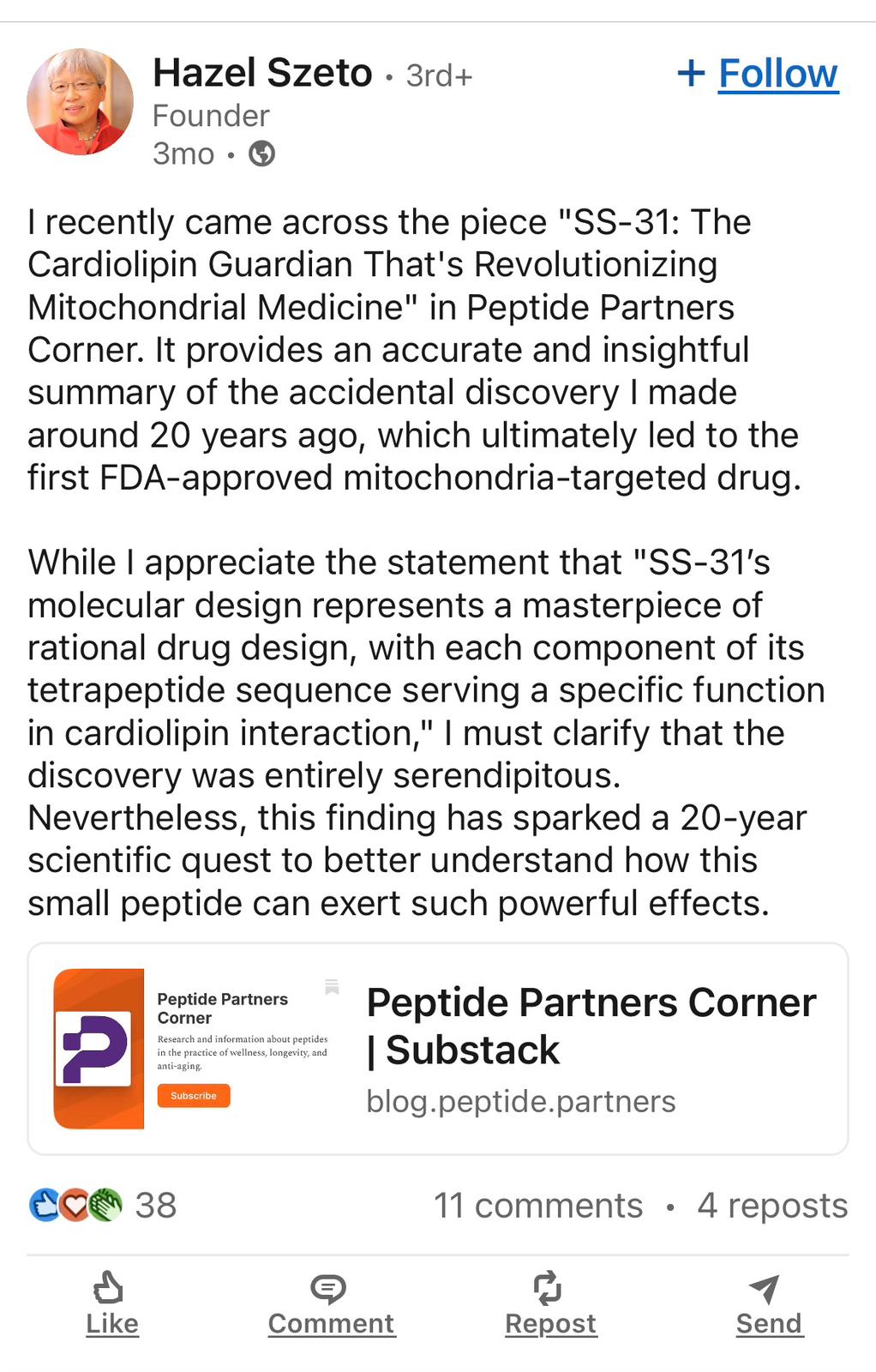
SS-31: The Cardiolipin Guardian That’s Revolutionizing Mitochondrial Medicine
Sometimes the most profound medical breakthroughs emerge not from grand theoretical leaps, but from the patient, methodical pursuit of understanding life’s most fundamental processes.
3 Likes
Note that this article is from a company selling peptides.
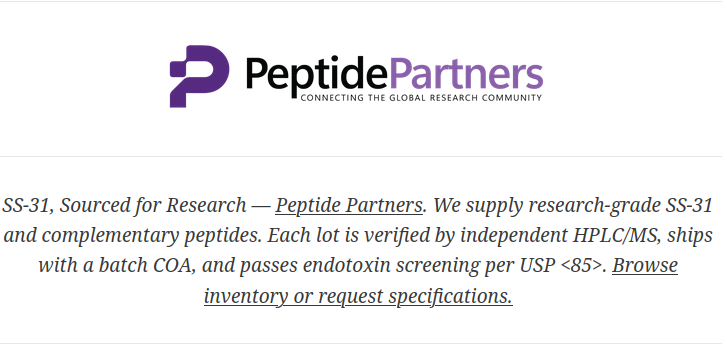
I found an article on the same website, talking about GHK-cu “Rewriting the Rules of Regeneration”. Referenced studies are almost all in pre-clinical or animal models.
4 Likes
Interesting how there are activity threshold steps.
1 Like
A good video on SS-31 I discovered…
Mitochondria in Aging: From Bench to Bedside and Back Again

Analytical Brief: Mitochondrial Interventions and Geroscience
Source: Transcript of Presentation by Dr. Dave Marcinek, University of Washington
Executive Summary
This presentation reviews the role of mitochondrial dysfunction as an amplifier of age-related pathology, specifically sarcopenia (skeletal muscle aging) and cardiovascular decline. The core actionable insight focuses on the pharmacological manipulation of the inner mitochondrial membrane using the tetrapeptide Elamipretide (SS-31) to suppress proton leak and restore cellular sensitivity to energy demand.
Compound Profile: Elamipretide (SS-31)
Elamipretide demonstrates an acute capability to reverse age-related mitochondrial deficits rapidly (within hours), indicating it operates independently of slower, upstream processes like mitophagy or mitochondrial biogenesis.
- Primary Mechanism of Action: SS-31 associates with cardiolipin on the inner mitochondrial membrane, stabilizing cristae structures and promoting the assembly of electron transport supercomplexes.
- Direct Protein Interaction: Cross-linking mass spectrometry identifies 12 specific mitochondrial proteins that bind SS-31. Most notably, SS-31 directly interacts with the Adenine Nucleotide Transporter (ANT). ANT functions to import ADP into the mitochondrial matrix and export ATP, but it is also a primary channel for aberrant proton leak in aged tissues.
-
Energetic Modification: SS-31 is modeled to bind to the matrix-facing (‘M state’) hinge of the ANT channel. This interaction biases the transporter away from an open, “leaky” conformation, resulting in two verified outcomes:
- Reduced Proton Leak: Improves the P/O ratio (coupling efficiency).
- Increased ADP Sensitivity: Enhances the rate of ATP production in response to physiological, submaximal concentrations of ADP (10–30 $\mu$M), without necessarily elevating the absolute maximum ATP ceiling.
Translational Efficacy & Physiological Impact
The data indicate that acute energetic corrections trigger cascading, systemic benefits across multiple tissue types.
- Skeletal Muscle: While absolute maximum force production remains unchanged with intervention, SS-31 significantly improves submaximal force endurance and fatigue resistance. This targets the functional threshold required for the activities of daily living.
- Cardiovascular & Renal: Eight-week administration in aged murine models improved both diastolic and systolic cardiac function (via global longitudinal strain analysis) and arrested age-related glomerular injury in the kidneys.
- Human Clinical Trial (Phase II Randomized Controlled Trial): In older adults (aged 60-85) screened for low baseline mitochondrial function, a single intravenous dose of Elamipretide elevated maximum mitochondrial ATP production in vivo within two hours. Interestingly, while the acute metabolic markers washed out after seven days, voluntary muscle fatigue resistance continued to improve at the seven-day mark. This suggests that a short-term correction of energy and redox states initiates a longer-term remodeling effect within the cellular environment.
Emerging Diagnostics: The Mitochondrial Protein Interactome
Moving beyond traditional bioenergetic analyses, Marcinek’s lab utilizes quantitative cross-linking mass spectrometry with Protein Interaction Reporter (PIR) molecules to map the mitochondrial interactome—the structural and functional network of protein-protein assemblies.
- Biological Age vs. Chronological Age: The degree of structural change in the mitochondrial interactome correlates directly with the Frailty Index (a multi-parameter assessment of overall health status).
- Sex-Specific Disparities: Analysis revealed that older females possess a significantly more deteriorated mitochondrial interactome and correspondingly higher frailty indices compared to chronological-aged matched males.
- Predictive Modeling: Deep neural networks are currently being trained to utilize interactome data as a predictor of biological age, functioning similarly to an epigenetic clock, but anchored strictly in mitochondrial structural fidelity.
Knowledge Gaps & Unresolved Mechanisms
- Short-Term vs. Long-Term Remodeling: The exact signal transduction pathways triggered by the acute correction of cellular redox/energy states remain unverified. The prevailing hypothesis is that reversing baseline energy stress un-blunts contraction-induced signaling pathways (e.g., AMPK, AKT, NRF2), allowing aged tissue to adapt to exercise stimuli similarly to young tissue.
- Structural Dynamics: The physical modeling of how SS-31 modulates the proton flow across the ANT pore currently lacks complete molecular dynamic simulations.
2 Likes
I can’t post links so I suggest those interested search for the Substack called k-hole and read their recent article on SS31
Battle of the labs; The SS31 case
Their bottom line is that the SS-31 currently on the market should be removed , because it contains teflon-like polymers and is reportedly 5–10% acetylated .
2 Likes
It sounds like someone tested one or two samples from one or two companies… and had some questionable results on some of the tests. You can hardly claim that all manufacturers have this specific issue from an extremely small sample size…
I think this is the article you are talking about: Battle of the labs; The SS31 case - Krysia
But yes, people should be concerned generally about the quality and contamination of grey market peptides, and we’ve discussed the different tests (including ones that generally are not done) that help you identify whether a peptide supply is what it claims to be. See here: ‘I wouldn’t dare take these drugs’: how China supplies untested peptides to the west (Financial Times)
2 Likes
Is there any way that you could put this questionnaire at the top or near the top of this topic? It may be getting lost in this long thread of comments.
Thanks,
Jay
Yes paypal can send the popular coins but has a bias toward their own coin pyusd. Cash app just deals with bitcoin, BTC. Paypal i hear is the worst for banning users from sending crypto to drug vendors. Cash app just blocks you saying dangerous account.
That URL above for crypto training is good but these apps are not easy to use so the click by click steps are missing.
I chose Exodus as my soft wallet to hold crypto funds in wait prior to buying stuff. Few mention the 5 days ++ needed to get through KYC, know your customer, setup before you can buy coins. Or the lag time for funds to be “good funds”. So I move a sizable amount of cash through these apps and leave it. Yes a risk for being ripped off.
Much back and forth using cash app / paypal to send crypto TO Exodus I’ve decided that the easiest and lowest fees (treamendous losses to fees with multi hops) is to fund Exodus from WITHIN Exodus using their xfer app Moonpay. I’ve not had luck hooking a CC or debit card up to Moonpay but using Venmo under neath Moonpay.
EVERY tool needs KYC and 5 days to setup. The above within Exodus can take 10 days +/- 5 for KYC (can be shorter) for Exodus initially and another possible 5 for Moonpay. The quick verification of KYC never worked fast for me and always took many days. Maybe your electronic selfie can be electronically matched to your uploaded drivers license better then my DL and bad picture.
Glad to help over PM or email etc if you want to get these tools setup. Like Beth this qualifies as brain excersize doiing thinking things of “consequence” vs just sodocu puzzels.
Edging in a rant; this whole pitch about crypto being the future is such BS and crap! Slow, huge fees, insanely slow and not just BTC, monstrously complicated, too many tools. I can’t stop bitching about the huge falling short crypto has been!!! Avoid bitcoin, BTC, if you can. Vendors take many coins over many networks. USDC over Solana is often taken. Or Solana over of course solana. I used to think I was smart by storing long term in Exodus in Tether Gold, then gold dropped. I now give up and just store reserves in Solana. You need a small amount of solana if you send varioius coin types over solana to pay the fees anyway.
Good luckl, curt
1 Like
Hahahaa @curt504 I’ve been doing it and yet I only understood half of what you said… more brain exercising to do!
Instead of paying with Solana for my last order from PGB, and losing a little bit of value during the process due to currency fluctuations, I tried to keep it all in stablecoin… I couldn’t figure out how to pay and just gave up.
I don’t actually need anything but am thinking of stocking up incase it eventually gets harder to get things in the country.
I’m really here to comment that I’ve experienced the things you’ve mentioned.
I’ve purchased crypto through venmo, PayPal, and coinbase… each and every one of those places has frozen my transfers and cost me money during the time while my crypto was stuck in purgatory (and why I tried to keep it all in stablecoin last time). I ultimately send the crypto to exodus before paying. So yes, they freeze my transfers even sending my own money to my own wallet… grrrrrr.
I mostly try to use coinbase becasue I’m told the fees are lower, but I haven’t done it enough times to really know
The least expensive way, so I’m told, is to somehow buy solana within the exodus app… you go to an entirely different section… I looked but it was WAY too confusing for my old ADD brain  One day I hope to learn just for the sake of learning. Maybe Claude can teach me!
1 Like
After posting the above I looked at my fees for funding $1000 into solana in Exodus; 3 layers, total fees where $96. Only $994 arrived. I went nutz and chatted in the Luther (peptide vendor on whatsapp, better then PGB, wider if not every peptide) crypto sub group. After googling I’m doiing this:
Moving to Kracken Pro, which unlike Exodus, supports native (integral to the app) ACH from a bank account. Free xfer with a few day ACH lag.
Sad, that funding Exodus via the many means: cash app sending BTC, paypal sending PYUSD, worse choice is the integral Moonpay under Exodus. Exodus is an ok wallet and xfer fees are tolerable its just so expensive to get funds unto an Exodus wallet from what ever tool you use.
Best of luck, curt
2 Likes