That looks great. I’m doing it all separately because I’m trying to avoid a huge b12 dose. But I may have to give in at some point to reduce pill burden!
Have you tried creatine also? The idea is that most of our homocysteine is a byproduct of our body making creatine.Which can be avoided if we supplement. I’m hopeful creatine will do most of the heavy lifting to reduce homocysteine risk.
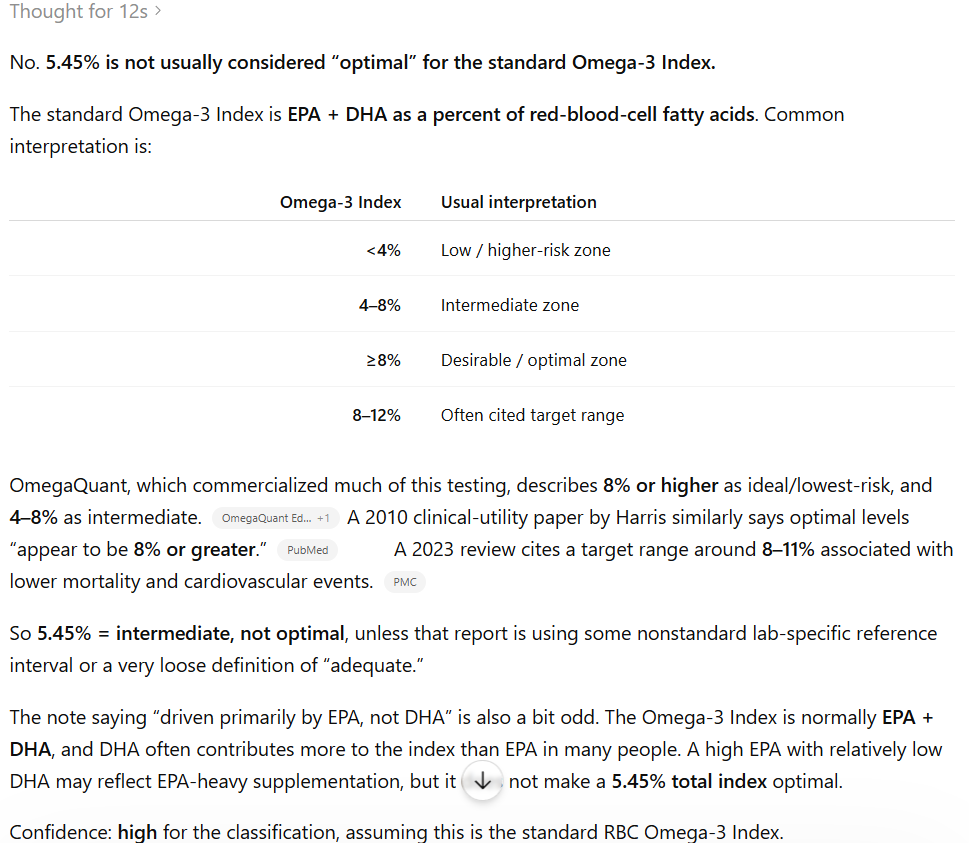
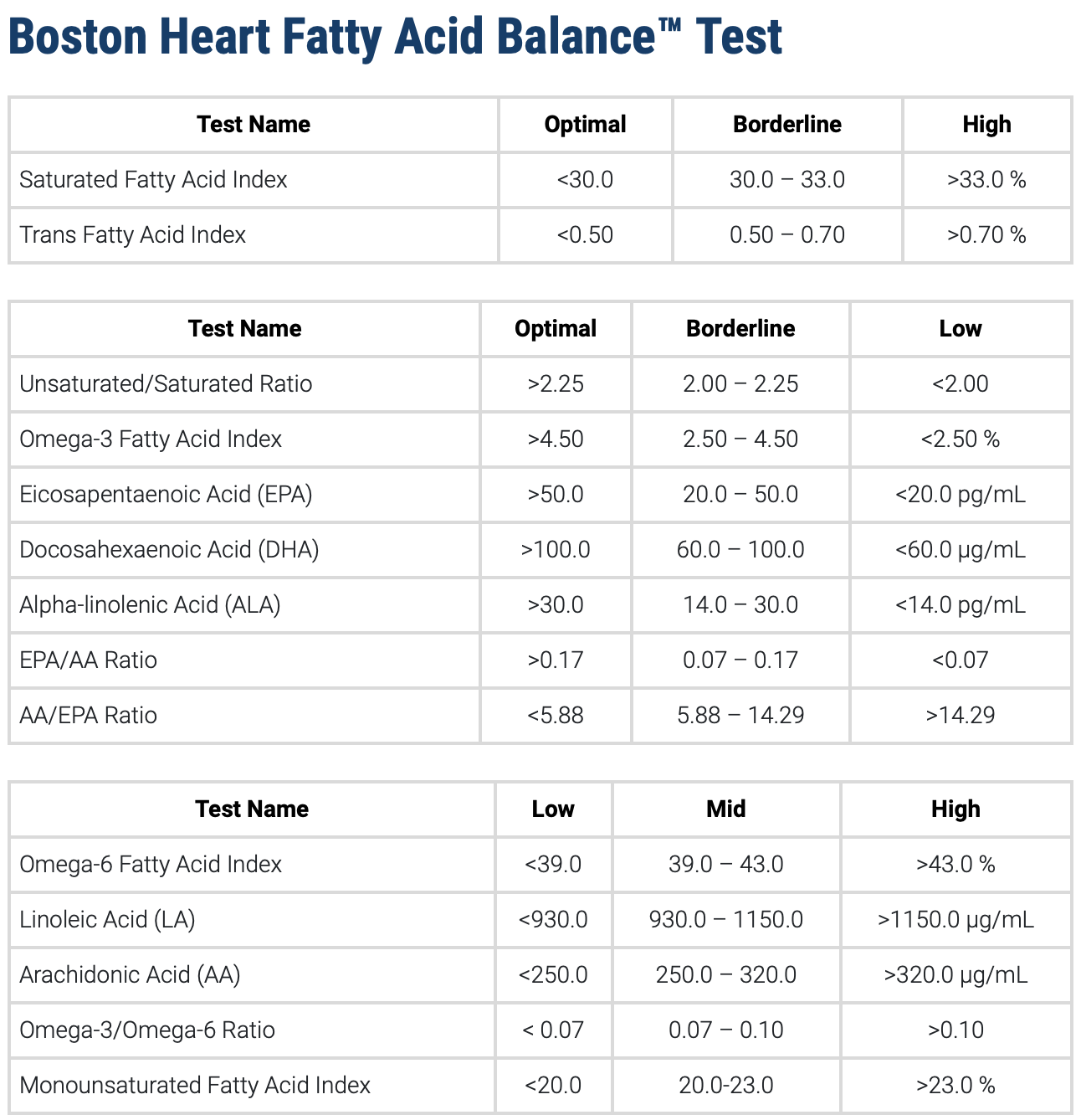
In fact the Omega 3 index from the Boston Heart Fatty Acid Balance test is not the same as the Omega 3 index from OmegaQuant.
Basically it’s that same difference as fasting blood glucose vs HbA1C.
Gemini 3 thinking:
While both tests assess your omega-3 status, they are not the same. They measure fatty acids in different “compartments” of the blood, which results in different numerical values and clinical interpretations.
The primary difference lies in the specimen type: OmegaQuant measures fatty acids in the red blood cell (RBC) membranes, while the Boston Heart Fatty Acid Balance test typically measures them in the blood plasma.
Short-term (days to weeks). Reflects recent dietary intake.
Optimal Range
8% – 12%
> 4.5%
Fasting Required
No (RBCs are stable regardless of recent meals)
Yes (Plasma levels fluctuate significantly after eating)
Clinical Standard
Based on the Harris/von Schacky protocol
Proprietary Boston Heart methodology
Why the Numbers Differ
The numerical discrepancy (e.g., 8% vs. 4.5%) is due to how fatty acids are distributed in the blood.
Red Blood Cells (OmegaQuant): The Omega-3 Index specifically measures the percentage of EPA + DHA relative to the total fatty acids in the RBC membrane. Because RBCs have a lifespan of about 120 days, this index acts as a “moving average” of your omega-3 status, similar to how an HbA1c test measures long-term blood sugar.
Plasma (Boston Heart): Plasma fatty acids are highly sensitive to what you have eaten in the last 24–72 hours. Even if you fast for 8 hours, the plasma lipid pool is more reflective of recent habits than long-term cellular integration. The total concentration of fatty acids in plasma is also different from the membrane bilayer, leading to a lower “optimal” percentage threshold.
Which One Should You Use?
For Long-Term Tracking: The OmegaQuant (RBC-based) test is generally considered the gold standard in nutritional research because it is less “noisy.” It isn’t affected by a single meal of salmon or a missed supplement dose the day before the test.
For Comprehensive Lipid Profiling: The Boston Heart test is often bundled with other cardiovascular markers (like cholesterol balance and inflammatory markers). If your goal is to see a snapshot of all circulating lipids in the context of cardiovascular risk management, it provides a broader, albeit more transient, picture.
Summary of Interchangeability
You cannot directly compare a 6% result from Boston Heart to an 8% goal on the OmegaQuant scale. If you are tracking your progress over time—especially if you are adjusting supplementation or high-intensity training loads—it is best to stick with one methodology to ensure the data is longitudinally consistent.
@cl-user , I may have missed this if you posted it earlier, but is there a “research date” specified in any of the primary genetics reports you’ve gotten with regard to identifying specific genetic / SNP / Allele reports as associated with specific problems/disease or benefits?
I see a constant flow of new research, like these I posted yesterday:
So, obviously, our understanding of genetic predispositions or beneficial alleles is something that is changing every month, as these new research papers come out. But, how exactly do we know if these new research paper findings are being integrated into the platforms that we’re using to identify these software platforms (I’m not sure what you used to identify the specific deleterious genes / SNPs / Alleles - was it the Genome processing site, or some intermediate software platform, or Claude?).
Do you have a strategy for tracking how this new knowledge that is published every month, gets updated in the software we use to evaluate our genome, and mapped directly onto our genomes, so we have a better understanding over time as the science progresses?
As data comes in, you need to rerun the analysis, I recon. It could be a schedule, like once a month. When I got my sequencing done, it was first a super limited set done years ago when 23andme was just starting out. So I had to repeat it with greater precision some years later, but progress is still being made. Therefore I see another sequencing in my future (it’s at 100x atm?).
It’s a dual process. More snps data is flowing in all the time and the sequencing is getting more fine grained. This means both will need to be regularly updated.
The minimum usable sequencing covering 100% of the genes is 30x but you can still have some missing or low quality ones. At 100x the probability of those is virtually eliminated.
Gemini: Key Differences Between 30x and 100x Sequencing
Accuracy and Confidence: 30x is sufficient for most clinical-grade analyses and general health screenings. 100x provides higher confidence in calling rare variants and significantly reduces the false-positive/negative rates compared to lower depths.
Application Focus:
30x (Standard): Ideal for identifying inherited (germline) diseases and routine personal genomics.
100x (Deep): Better suited for cancer genomics, where detecting low-frequency mutations in heterogeneous tumor samples requires higher depth (often 100x–200x) to distinguish true mutations from noise.
Cost vs. Utility: 30x offers the best “value for money” for the vast majority of consumers, as 100x often provides marginal added value for standard ancestry or general health reporting.
In summary, 30x is the standard for high-quality, comprehensive personal genomics, whereas 100x is a specialized, “ultra-deep” approach for finding rare or complex mutations.
I’m still in the learning phase because this entire topic is way over my head… but in the meantime, AI is telling me 100x will be 1k or so.
Have you by chance found it for less?
I do believe 100x is better, but I don’t yet understand HOW much extra value I get for the spread vs what health benefits I could get if I spent that money on something else.
No, I did the full genome. But that company is no longer in business, it was one of the first to offer it, and it was pretty affordable at $600. I definitely need to do it again, but I’m waiting for a solid 100x without proprietary formats, downloadable and no subscription, hopefully $1K or under.
I’m also looking for that. Currently the only one I’ve found is DNAcomplete (Nebula.org). They provide the VCF and CRAM files. I’m just waiting for the price to go under 1k. Sequencing.com used to do it but not anymore it seems.
How often do you estimate that one will have to pay for sequencing? I had initially thought only SNP data would require some recurring cost, but looks like that’s not the case. Also, where do you store your donwloaded data? 100GB is a lot.
I think if sequencing gets to 100-200x, that should be it. Obviously, whole exome/genome sequencing is still evolving, but this will come to some ultimate resolution likely fairly soon, and costs will hopefully drop. I think there will be another evolution and that should be it - so maybe in the next 2-3 years(?) another cost, hopefully in the neighborhood of $1K and below. Data storage - just a thumb drive with copies elsewhere. As long as the format is not proprietary, it’s good to go. My M2 Apple Mac Air laptop has a ITB drive, most of it free, so I can have it there as well as on some external drives.
I have a neighbor who knows a ton about this topic. Because I only know him very casually, I have not had a chance to discuss anything with him… (I think he used this information in his career)
I sent him the list of options RapAdmin posted yesterday and asked if he had opinions… all he did was reply with a link
I’ll share that here. I don’t know of any pluses or minuses yet. I do think a doc has to order it. AI says it can be any old doc, though ?
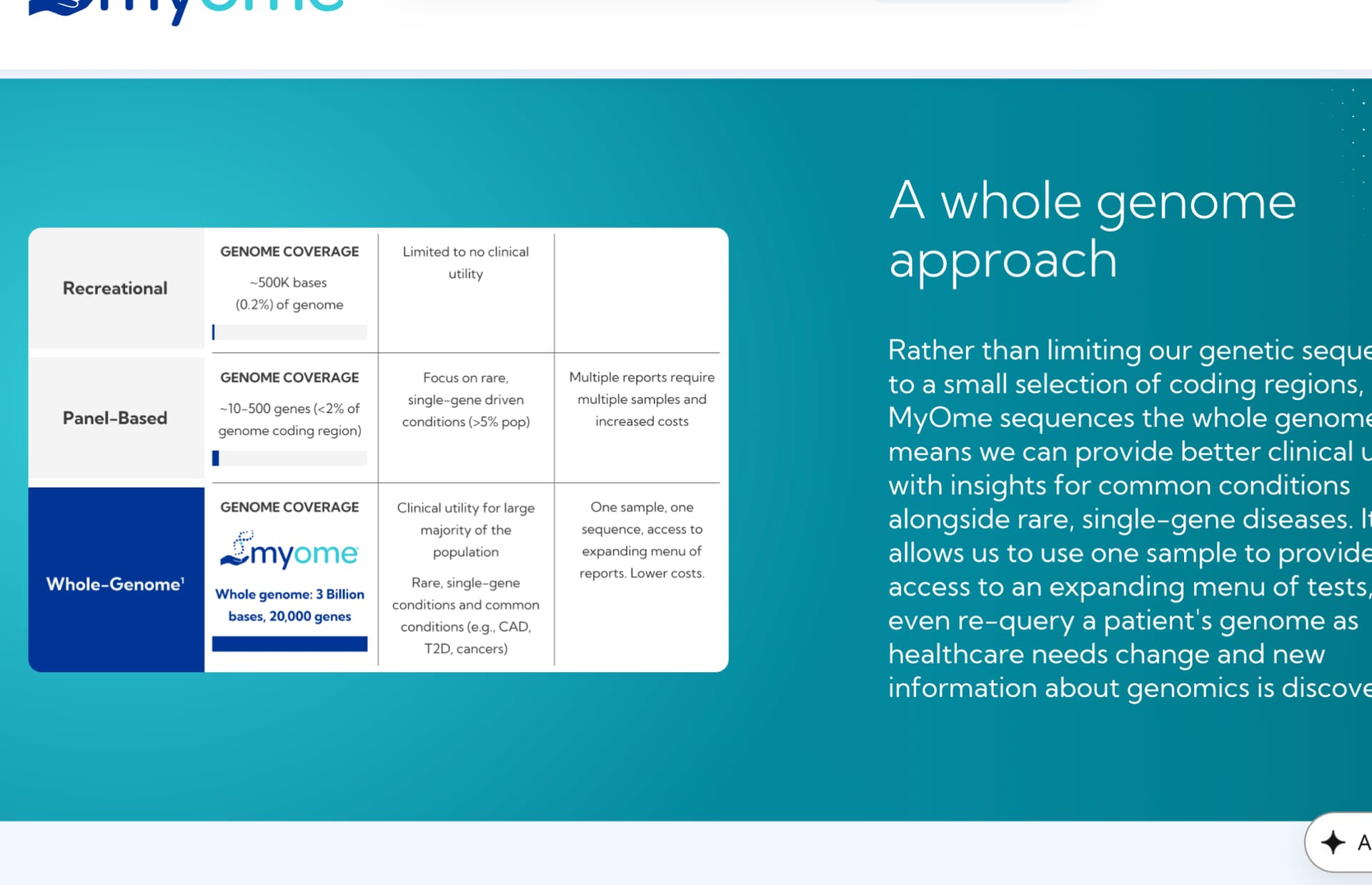
Not at all what I would be looking for. All I need is whole genome data at the highest resolution. Looking for clinical insights is up to my own analysis (see @cl-user examples). Not useful to me. YMMV.
Yeah, I was not really clear on exactly what they do. I only became a ‘provider’ so I could potentially see more info and pricing. If I learn anything, I’ll share.