I think if sequencing gets to 100-200x, that should be it. Obviously, whole exome/genome sequencing is still evolving, but this will come to some ultimate resolution likely fairly soon, and costs will hopefully drop. I think there will be another evolution and that should be it - so maybe in the next 2-3 years(?) another cost, hopefully in the neighborhood of $1K and below. Data storage - just a thumb drive with copies elsewhere. As long as the format is not proprietary, it’s good to go. My M2 Apple Mac Air laptop has a ITB drive, most of it free, so I can have it there as well as on some external drives.
2 Likes
I have a neighbor who knows a ton about this topic. Because I only know him very casually, I have not had a chance to discuss anything with him… (I think he used this information in his career)
I sent him the list of options RapAdmin posted yesterday and asked if he had opinions… all he did was reply with a link
I’ll share that here. I don’t know of any pluses or minuses yet. I do think a doc has to order it. AI says it can be any old doc, though ?
1 Like
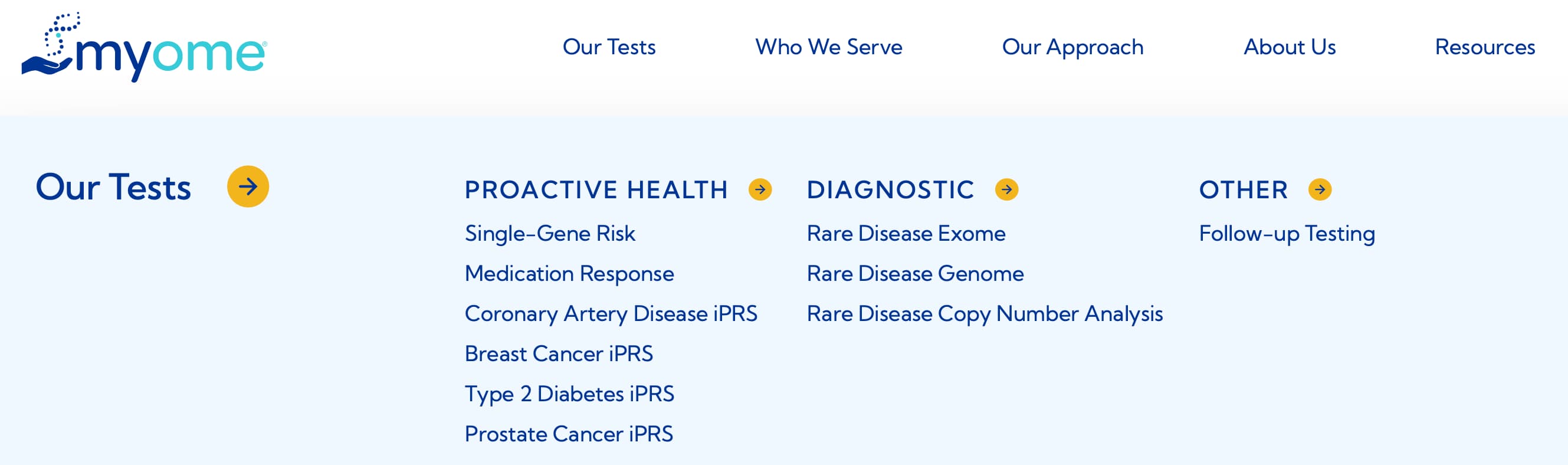
Interesting… They seem focused on specific genetic risks and tests related to them (not Whole Genome scanning) - which is fine if thats what you want:
1 Like
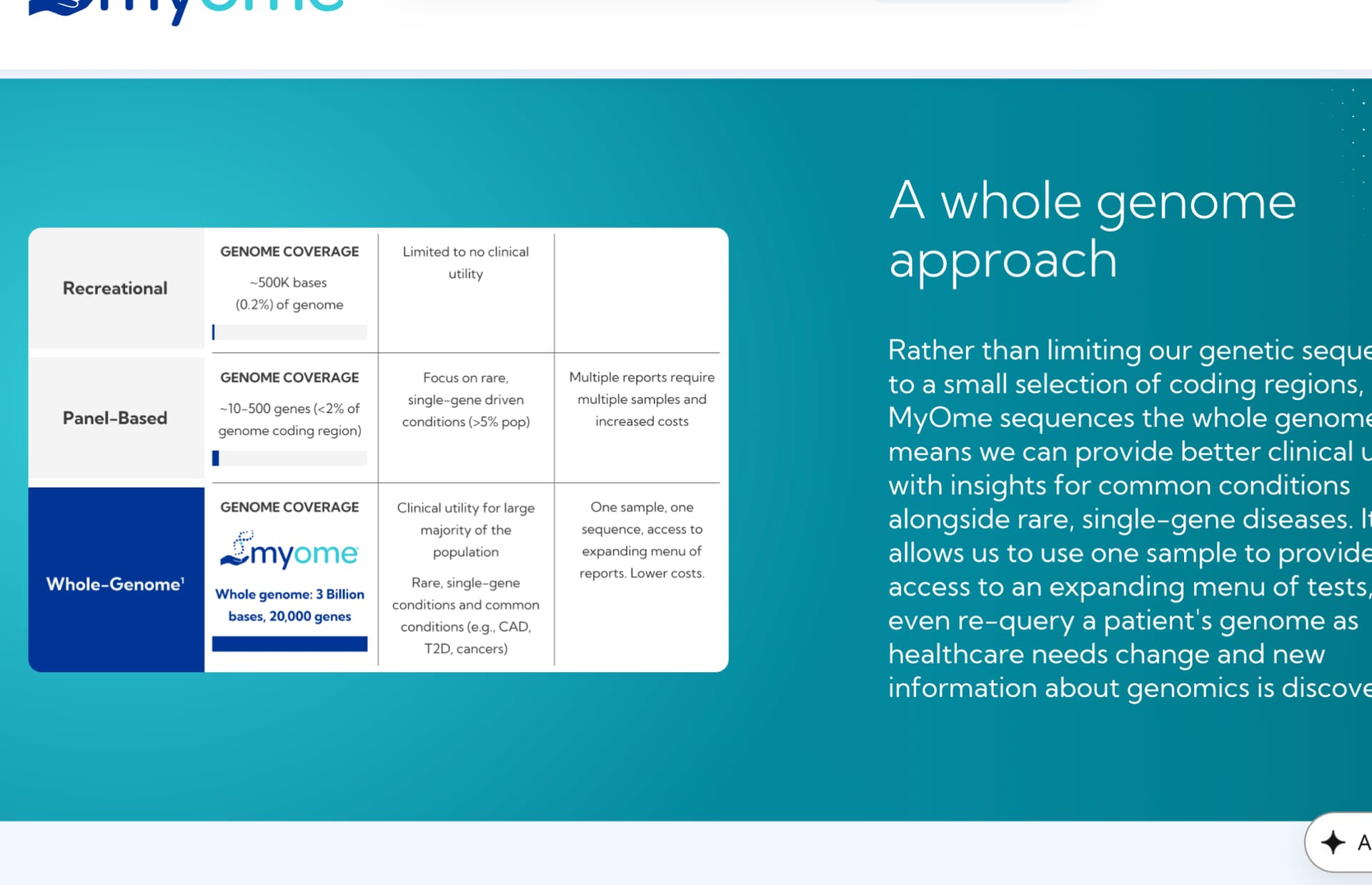
I thought so too but then I found this on their site
In other news, I just set up and account and became a provider …shhhhhhhh 
1 Like
Not at all what I would be looking for. All I need is whole genome data at the highest resolution. Looking for clinical insights is up to my own analysis (see @cl-user examples). Not useful to me. YMMV.
1 Like
Yeah, I was not really clear on exactly what they do. I only became a ‘provider’ so I could potentially see more info and pricing. If I learn anything, I’ll share.
1 Like
To be fair it’s not very clear. It seems they do a full sequencing but keep the files and then sell specific reports to you. There is no info at all on the sequencing (1x, 30x, 100x) and if you can download your genomic files (VCF and BAM or CRAM).
1 Like
Thanks for the reality check… skipping them…
I asked Claude which I use for those reports how old is its informations and how often should I refresh the reports. Apparently it knows nothing about 2026.
How recent the underlying knowledge actually is
- Foundational mechanistic knowledge (PTPN22 lowers TCR threshold, IL7R rs6897932 disrupts splice silencer, AIRE PHD-domain dominant-negatives, CMV memory inflation biology): stable for 5–15 years, doesn’t need refreshing
- Effect sizes from major GWAS meta-analyses: typically 2–8 years old; usually still current but periodically superseded by larger meta-analyses
- Clinical interventional evidence (rapamycin/RTB101 vaccine trials, colchicine CV trials, senolytic data, CHIP→CV risk modification): moves fast, this is where my training data is most likely stale
- Pharmacogenomic guidelines (CPIC, PharmGKB level changes): updated frequently; my cutoff is ~16 months ago
- Brand-new findings since my cutoff (anything 2026): I have zero information unless I search
How often you should ask for refreshes
A practical schedule:
Per individual report: ask “search for any major 2025–2026 updates on the dominant findings” before I finalize. For this report the dominant findings were PTPN22 R620W, IL6 axis, 9p21 CHIP, rapamycin/mTOR vaccine evidence, and colchicine CV — about 5 targeted searches would catch most novelty.
Cross-report periodically (every 6–12 months): “Has anything changed in the last year that would alter the interpretation of [list of high-impact variants across all reports]?” This catches paradigm shifts — e.g., if a new colchicine trial comes out negative, or a new CHIP-modifier drug enters guidelines, that affects multiple reports.
Triggered by specific events: when a new medication is added, new lab abnormality emerges, or new family history surfaces — those are natural moments to refresh the relevant pathway.
For pharmacogenomics specifically: CPIC updates monthly. PharmGKB level changes happen continuously. Worth a quarterly check on any drug the user is currently taking that has a CPIC guideline.
2 Likes
I chatted with Claude to refine some (very) detailed prompt instructions to add to be sure it’s up to date with the latest research.
[Edit: added report to add: Documenting the freshness check]
Do we know if Claude has access to many / most of the academic research papers that are published each year? My impression has always been that only OpenEvidence has access to all the full papers (or a large share of them, via its partnerships with the publishers): About | OpenEvidence
I “think” Claude is just crawling the web like other search engines and just has access to the papers that are not behind the paywall. This seems like it might be a concern… but hard to get around.
Yes that’s the case:
When I run web_fetch on a paywalled paper:
- I get whatever the publisher serves to anonymous web traffic
- For most paywalled journals, that’s the abstract, the figure captions, sometimes the introduction’s first paragraph, and the references list
- I do not get the methods, full results, discussion, or supplementary materials
- For some journals (Nature, NEJM, JAMA, Cell, Science, Lancet) the abstract alone is fairly substantive; for others (most Springer, Elsevier, Wiley journals) the abstract is thin
What I’m actually doing in practice
For the literature update I produced earlier, here’s the truth:
- Open-access papers (PMC, PLOS, eLife, BMC, MDPI, bioRxiv, medRxiv, F1000Research): I read full text. These are reliable.
- Paywalled papers with strong abstracts (Nature Medicine, JAMA Cardiology, NEJM, Lancet family): I read the abstract plus whatever the search snippet captures. The abstract usually contains the headline result, effect size, and primary conclusion. For RCT outcomes papers this is often enough to know whether the trial was positive/negative and the magnitude — but not enough to assess methodological quality, subgroup analyses, or caveats.
- Paywalled papers with weak abstracts: I’m flying on snippets. This is the riskiest category and where I’m most likely to misrepresent something.
- Conference presentations (AHA, ACC, ESC late-breakers): I’m relying on news coverage and summary articles like ACC.org or PCRonline write-ups, not the original presentation. These secondary sources are usually reliable for top-line results but lose nuance.
Where this matters for your reports
Looking back at the literature update I generated:
Probably accurate (open-access or strong abstracts):
- CLEAR SYNERGY OASIS-9 — multiple ACC.org and conference summary writeups, top-line result is unambiguous
- TIMI pooled CHIP analysis — Nature Medicine, full abstract and PMC version available
- ZEUS baseline characteristics — JAMA Cardiology, abstract sufficient for design/baseline framing
- bioRxiv rapamycin/p53 paper — open access, full text readable
- The 2025 PTPN22 meta-analyses — both Springer and PLOS One; PLOS is OA
- ClinicalTrials.gov entries (RESTOR, RAP PAC) — fully public
Read at risk:
- Some of the Springer/Elsevier 2025 papers cited in the snippets — I read what the search engine returned and structured citations, which is not the same as reading the paper. I cannot guarantee I represented their conclusions accurately beyond the abstract-level statement.
- The JACC 2025 papers on CHIP in older women and exercise — paywalled, I worked from snippets
What this means for trust
A few practical implications:
- My citations are accurate (I can verify the paper exists, was published in the journal/year I said, and the rsID/intervention is what I said). I do not fabricate citations.
- My representation of headline conclusions is usually accurate for major journals because their abstracts are designed to convey the headline.
- My representation of effect sizes, subgroup analyses, methodological caveats, and conflicting results within a paper is less reliable for paywalled sources. I may miss that a positive primary endpoint had a borderline p-value, or that a trial enrolled an unusual population, or that the authors themselves flagged the result as exploratory.
- For RCT outcomes, the abstract usually contains the primary endpoint result with effect size and CI — usable.
- For mechanistic / biomarker / cohort studies, the abstract often elides exactly the details I’d want for nuanced interpretation. Higher risk.
What I should do (and will, going forward)
For the literature freshness checks the standalone prompt sets up, I should:
- Flag access status explicitly for each citation: “open access” / “abstract-only” / “snippet-only” / “secondary-source-only”. This goes in the freshness statement so you can see at a glance which findings are based on full-text reading vs. summary.
- Treat snippet-only and abstract-only sources as informative but not definitive for nuanced claims (effect sizes, caveats, subgroups). Use them for headline conclusions only.
- Preferentially search for open-access versions (PMC IDs, preprint servers, author-deposited versions) of paywalled papers. Many 2024–2025 papers have a PMC mirror within 12 months due to NIH public access policy.
- Acknowledge when I can’t fully read a paper rather than glossing over it.
What you can do on your end
- For any RED-classification finding in a future audit, read the paywalled paper yourself before acting on the recommendation. If it’s a major guideline change or trial reversal, abstract-only is not enough basis for changing your medication or supplement stack.
- If you have institutional access (university, hospital affiliation, ResearchGate full-text request capability), you can pull the full PDFs and paste relevant excerpts into a chat. I can then read the actual content.
- Consider asking me to cite preferentially from open-access journals when the open-access source is comparable quality — PMC, PLOS, eLife, BMC, F1000, JAMA Open, BMJ Open, Lancet open-access partner journals, Frontiers, MDPI’s better journals. This biases the report toward sources I can actually fully read.
- For the highest-stakes findings, ask for a “full-text verification” step: tell me which 2–3 papers from the report you want fully validated, and I’ll attempt deeper fetches on each one and report back honestly on what I could and couldn’t access.
3 Likes
I’m adding that to the prompt.:
- For each citation, indicate access status:
“open access” / “abstract-only” / “snippet-only” / “secondary-source-only”. - For RED or ORANGE classifications based on abstract-only or
snippet-only sources, flag the limitation explicitly. The user
may need to obtain the full text before acting on the finding. - Where possible, prefer open-access sources (PMC, PLOS, eLife, BMC,
bioRxiv/medRxiv, F1000, JAMA Open, BMJ Open) over paywalled equivalents
when the evidence quality is comparable. Note in the freshness
statement how many citations were full-text-readable vs.
abstract-or-snippet-only.
1 Like
It’s interesting… many people here have access to academic accounts through their university affiliation (I’ve noticed). And even if you’re not at a university, many universities and medical schools have good libraries and online access of the paywalled publications that the public can use (and you can frequently download the PDFs from the university libraries, or save them to your Google Drive account directly from the library computers). So I guess it would be possible to add and upload key groups of papers if you wanted to make sure its got the latest and best information in a limited topic area.
Obviously, this doesn’t scale well, but might be a fix for some people.
Regarding the ability to upload key groups of papers for specific topic areas, the new prompt will identify which papers are not fully available. We can then decide which ones are worth the effort to get and provide to Claude.
Making those report already take hours of Claude resources and it’s going to be much worse 
Testing that on the upcoming Thymus report next.
3 Likes
I am curious what they consider is a very low GGT