Mouse Data, (2025): https://academic.oup.com/jes/article/9/Supplement_1/bvaf149.080/8298362?login=false
Fat-Burning Pill Keeps the Weight Off After Semaglutide Stops, at Least in Mice
Note on the source: this is a one-paragraph conference abstract (ENDO 2025, oral presentation OR22-05), not a full paper.
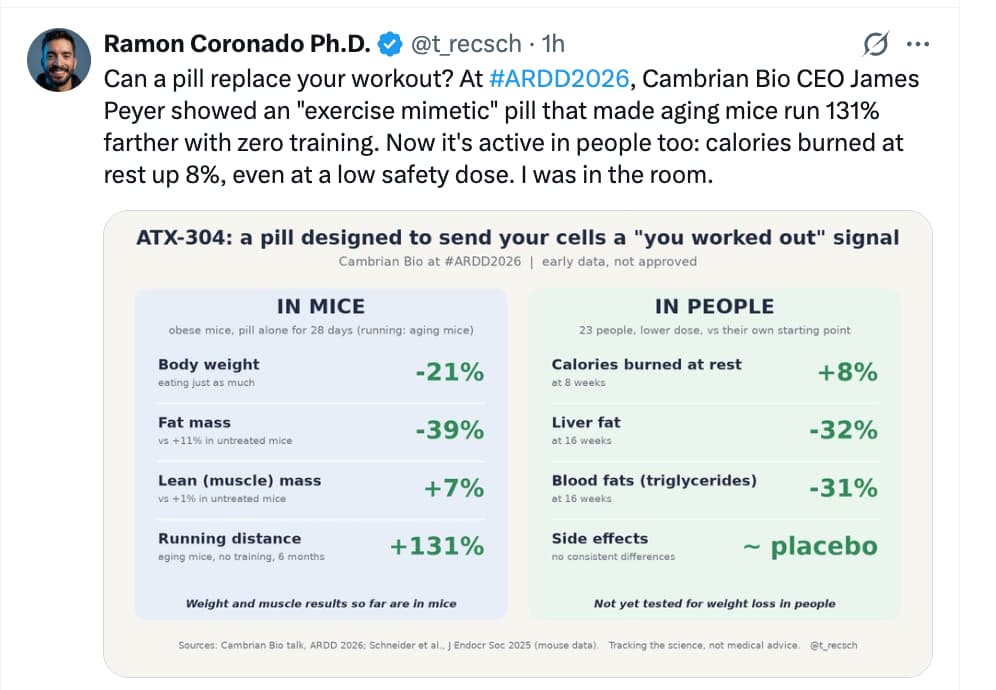
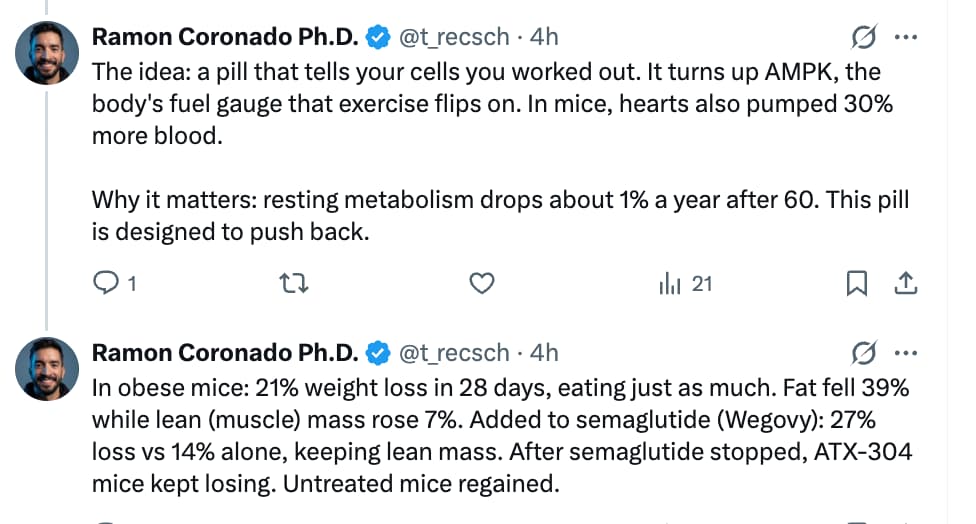
Amplifier Therapeutics and its parent Cambrian BioPharma report that ATX-304, an oral compound described as an AMPK and mitochondrial activator, produced 21 percent weight loss on its own in diet-induced obese mice over 28 days. Combined with semaglutide it reached 27 percent in 15 days, all from fat with no measured loss of lean mass. When semaglutide was reduced or withdrawn, mice on ATX-304 held their weight loss or kept losing despite overeating. The data come from 8 mice per group, were generated and presented by the company, and have not been through full peer review. The company’s own later human data showed minimal weight loss.
The GLP-1 drugs have two well-known weak points. A meaningful share of the weight lost is lean tissue, and most people regain weight when they stop. A conference abstract in the Journal of the Endocrine Society describes a mouse study aimed at both.
The compound is ATX-304, an oral small molecule from Amplifier Therapeutics, a Swedish company backed by Cambrian BioPharma. The company says it activates AMPK, the cell’s energy sensor, and mitochondria, and that it stays out of the brain. Instead of suppressing appetite, it raises energy expenditure. Mice eat the same and burn more.
Two experiments were run at the contract lab Gubra in mice fattened on a high-fat diet for 17 to 18 weeks. In the first, mice received semaglutide injections for three days, then had ATX-304 mixed into their food, with or without continued semaglutide. ATX-304 alone produced 21 percent weight loss by day 28. The combination reached 27 percent by day 15, against 14 and 19 percent for low and high dose semaglutide alone.
That combination result was large enough to hit the animal welfare ceiling, and the researchers cut every semaglutide dose to a tenth. What followed is the most interesting observation. Mice on semaglutide alone began overeating and returned to baseline weight within 17 days. Mice also receiving ATX-304 overate too, yet held their 27 percent loss. Body scans at day 32 attributed the loss to fat, with no reduction in lean mass.
The second experiment modelled stopping the drug. Mice lost 20 percent of body weight on 28 days of semaglutide, including some lean mass. Semaglutide was then withdrawn and ATX-304 started at three doses. Weight regain was prevented in a dose-dependent way, and at the top dose the animals kept losing, reaching 26 percent below baseline without further lean loss.
If this held in people, it would be a different kind of obesity drug: one that works on the expenditure side, pairs with appetite suppressants and could serve as an exit ramp from them.
There are reasons for caution. The abstract reports no error bars or statistical tests. The monotherapy and combination figures are quoted at different time points, so the size of the added benefit cannot be judged. The drug was given in food, so overeating mice consumed more of it. And mice at standard housing temperatures respond to energy-expenditure drugs far more than humans do.
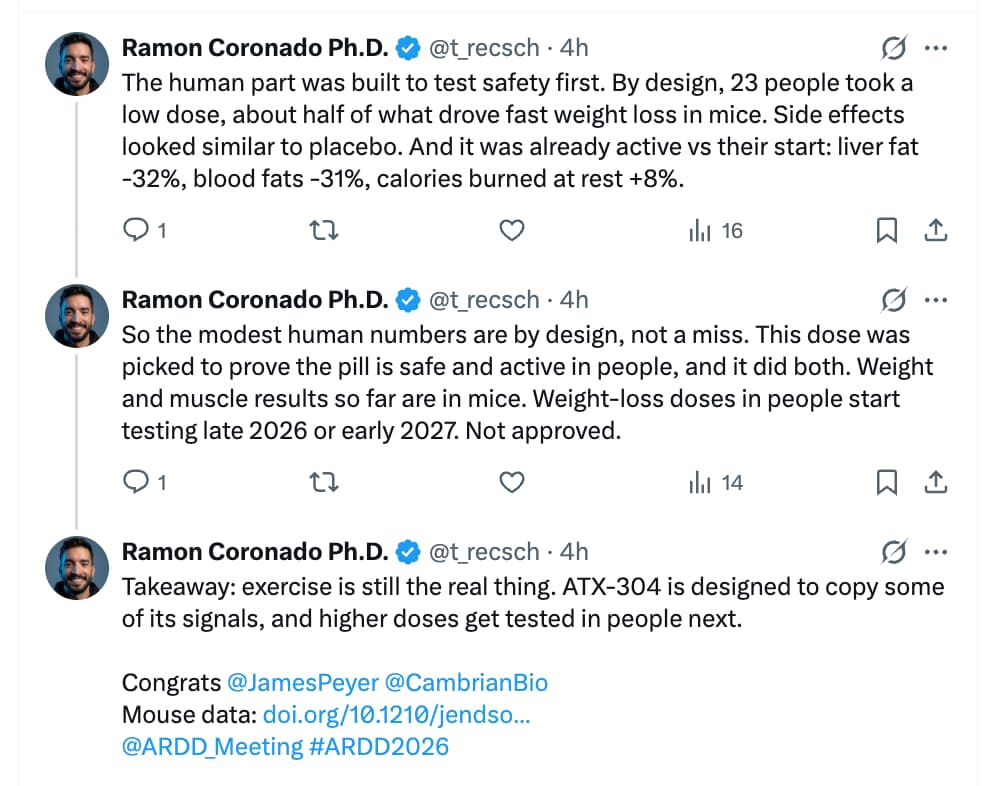
The company’s own human results underline that last point. In a Phase 1b trial reported in June 2026, 23 adults with obesity and prediabetes took 400 mg daily for eight weeks. Resting metabolic rate rose 8 percent and liver and visceral fat fell, but weight loss was described as minimal. An 8 percent rise in resting metabolism is roughly 130 extra calories a day, about one kilogram of fat over eight weeks at best.
Actionable Insights
ATX-304 is an investigational compound in early clinical trials and is not available.
What the numbers mean:
- ATX-304 alone: 21 percent weight loss in 28 days. For a typical 45 to 50 gram obese mouse (my assumption; weights are not given) that is about 10 grams.
- Combination with semaglutide: 27 percent in 15 days, versus 14 percent (low dose) and 19 percent (high dose) for semaglutide alone. That is 8 to 13 percentage points more, or 1.4 to 1.9 times the loss.
- After semaglutide was cut: semaglutide-only mice regained everything in 17 days. ATX-304 mice regained nothing.
- After full withdrawal: top-dose ATX-304 mice went from 20 to 26 percent below baseline in 14 days.
- Lean mass: no loss reported with ATX-304, while semaglutide alone reduced it.
The human reality check matters more than any of these. Eight weeks at 400 mg raised resting metabolism 8 percent with minimal weight change. Mouse weight-loss percentages routinely overstate human results several-fold.
For people on GLP-1 drugs now, the only supported take-home is the general one: weight regain after stopping is driven by rebound appetite, and lean mass is at risk during loss. Resistance training and adequate protein remain the tested countermeasures.
Context/Source
- Full title: Weight Loss and Change in Body Composition in a DIO Mouse Model by the Combined AMPK and Mitochondrial Activator, ATX-304, Alone, in Combination With Semaglutide, and After Semaglutide Withdrawal
- Type: Conference abstract OR22-05, presented 13 July 2025. Abstract citation ID bvaf149.080.
- Access: Open access.
- Institutions: Amplifier Therapeutics AB, Umeå, Sweden; Cambrian BioPharma, New York, USA; Gubra, Hørsholm, Denmark (contract research organization).
- Journal: Journal of the Endocrine Society, Volume 9, Supplement 1, October to November 2025 (Oxford University Press).
- Impact evaluation: The publisher’s page lists an Impact Factor of 4.4, a five-year figure of 4.2 and a CiteScore of 5.2. The impact score of this journal is 4.4, evaluated against a typical high-end range of 0 to 60+ for top general science, therefore this is a Medium impact journal.
1 Like
This one has been around for awhile. Mitochondrial uncoupler.
Patent:
Papers
https://pubmed.ncbi.nlm.nih.gov/39679375/
1 Like
New AMPK Activator ATX-304 Reverses Fatty Liver and Melts Body Fat in Preclinical MASLD Model
Researchers investigated the effects of a novel clinical stage compound, ATX-304, in a mouse model of severe progressive fatty liver disease. The drug acts as a direct activator of the cellular energy sensor AMPK and a mitochondrial uncoupler. Treatment led to near complete reversal of excess body fat, normalized blood cholesterol, and a significant reduction in liver lipid accumulation. The study also revealed unexpected spatial heterogeneity in how the liver heals, with distinct anatomical lobes showing different degrees of fibrosis reversal.
Metabolic dysfunction associated steatotic liver disease affects approximately a third of the global population. The condition progresses from simple fat accumulation to severe inflammation, tissue damage, and fibrosis. Despite its prevalence, only one drug is currently approved for treatment. Researchers have long viewed the cellular energy sensor AMPK as a prime therapeutic target. When activated, AMPK shifts cellular metabolism from storing energy to burning it. However, developing a direct AMPK activator that successfully treats fatty liver in living organisms has proven historically difficult.
This new study tests ATX-304, a novel drug that directly activates AMPK by suppressing its dephosphorylation. The researchers used a severe preclinical model, feeding mice a choline deficient high fat diet to rapidly induce liver disease. After the disease pathology was established, they introduced ATX-304 into the diet.
The results demonstrated a rapid reversal of metabolic dysfunction. Within two weeks, the treated mice lost their excess fat mass and returned to the body weight of healthy control mice. They maintained this lean body weight despite eating 20 to 30 percent more food than the untreated diseased group. This discrepancy indicates a massive increase in baseline energy expenditure, driven by mitochondrial uncoupling where energy is dissipated as heat.
Inside the liver, the drug initiated a complete metabolic reprogramming. It shut down genes responsible for synthesizing new fats and upregulated genes responsible for burning fats. The drug caused a physical relocation of lipid droplets within the liver lobules. Normally, fat droplets accumulate in the pericentral zone of the liver. After treatment with ATX-304, the remaining fat droplets migrated to the periportal zone. The periportal zone specializes in beta oxidation, meaning the drug essentially forces the liver to move its fat reserves directly into the cellular areas best equipped to burn them. This catabolic shift cleared harmful oxidized lipids and lowered circulating blood cholesterol by increasing its hepatic uptake and conversion into inert cholesteryl esters.
However, the study uncovered an unexplained spatial phenomenon. The liver did not heal evenly. The left lobe of the liver showed a near total reversal of fibrosis and fat accumulation. In contrast, the right median lobe retained significant fibrosis despite receiving the exact same concentration of the drug. This lobular heterogeneity complicates the narrative of a uniform cure and raises important questions about diagnosing and tracking liver disease via single point biopsies.
Overall, ATX-304 acts as a powerful tool for manipulating systemic metabolism. It successfully treats preclinical fatty liver disease by forcing the body to waste energy as heat and burn stored fat. Clinical trials in humans are necessary to confirm safety and efficacy.
Actionable Insights
While ATX-304 remains in preclinical development, the mechanisms it leverages provide clear lessons for human longevity. The primary insight is the sheer power of AMPK activation and mitochondrial uncoupling to reverse severe metabolic damage. You can naturally activate your AMPK pathways through vigorous exercise, fasting, and caloric restriction.
The magnitude of the benefit seen in this study is highly practically relevant. Treated subjects experienced a 32.5 percent relative reduction in circulating blood cholesterol, dropping from a disease state of 212 milligrams per deciliter down to 143 milligrams per deciliter. Furthermore, total liver triglycerides dropped by a relative 60 percent.
This massive clearance of fat occurred alongside a near 100 percent reduction in excess body fat gained from the unhealthy diet. Subjects achieved this weight loss even while eating 20 to 30 percent more food, demonstrating that increasing cellular energy expenditure can be as critical as restricting calorie intake.
Context/Source
- Full Title: AMPK activator ATX-304 reduces oxidative stress and improves MASLD via metabolic switching
- Institution: Umeå University and Maastricht University
- Country: Sweden and Netherlands
- Journal Name: JCI Insight
- Impact Evaluation: The impact score of this journal is 6.8, evaluated against a typical high-end range of 0 to 60 for top general science, therefore this is a Medium impact journal.
Exercise in a Pill? How a Novel Pan-AMPK Activator Reverses Metabolic Aging Without Breaking the Heart
The research paper evaluates O304, a novel pan-AMPK activator designed to replicate the physiological benefits of exercise and caloric restriction. In preclinical animal models, O304 improved insulin sensitivity, promoted weight loss, enhanced cardiovascular stroke volume, and cleared toxic amyloid proteins from pancreatic cells without causing the pathological heart enlargement observed with prior AMPK drugs. These vascular and metabolic benefits successfully translated to human subjects in a 28 day phase IIa clinical trial, where patients with Type 2 diabetes experienced improved fasting glucose, reduced blood pressure, and increased peripheral blood flow.
The quest to distill the systemic physiological benefits of exercise into a pharmacological intervention has remained a primary objective for longevity and metabolic disease researchers. At the center of this pursuit is AMP activated protein kinase, commonly known as AMPK. This enzyme serves as the master energy sensor within the cell. When cellular energy is depleted during physical exertion or caloric restriction, AMPK is activated, setting off a cascade of catabolic processes that improve insulin sensitivity, clear cellular debris, and burn stored fat. Historically, creating a drug that directly activates AMPK has proven exceptionally difficult. Previous candidates successfully lowered blood glucose but simultaneously caused dangerous structural side effects, most notably pathological enlargement of the heart muscle.
This research paper introduces O304, a novel pan-AMPK activator designed to bypass these structural toxicities while delivering the wide ranging metabolic benefits of physical exertion. O304 operates through a unique molecular mechanism. Rather than binding like AMP to force the enzyme active, O304 mimics the cellular signals of ADP binding. It actively prevents the dephosphorylation of the enzyme, locking AMPK in its activated state without overriding natural cellular limits.
In rigorous preclinical animal models, this compound induced profound physiological shifts. When administered to diet induced obese mice, O304 significantly increased glucose uptake in skeletal muscle independent of insulin signaling. Beyond mere glycemic control, the drug initiated systemic metabolic remodeling. The animals experienced measurable weight loss, their peripheral microvascular blood flow increased, and their cardiac stroke volume improved. Crucially, unlike earlier pharmacological attempts at AMPK activation, O304 achieved these cardiovascular improvements without inducing abnormal cardiac growth. The researchers also tested the drug on aged 14 month old lean mice, noting a significant improvement in physical endurance and time to exhaustion, effectively simulating the physiological adaptations of long term athletic training.
A critical discovery within this paper is the localized protective effect on pancreatic beta cells. In Type 2 diabetes, chronic high blood sugar leads to the accumulation of toxic amyloid proteins in the pancreas, which systematically destroy insulin producing cells. The data strongly suggests that O304 activates cellular recycling mechanisms that clear these toxic aggregates. This process reduces cellular stress and allows the beta cells to rest, potentially preserving long term organ function.
Translating these results from rodents to humans marks a pivotal milestone. In a 28 day phase IIa clinical trial involving 65 patients with Type 2 diabetes on Metformin therapy, O304 demonstrated early but definitive clinical activity. Patients receiving the active compound experienced reductions in fasting plasma glucose and measurable improvements in insulin resistance compared to placebo. Additionally, the treatment group saw significant reductions in both systolic and diastolic blood pressure, accompanied by enhanced microvascular perfusion in the extremities. These preliminary data confirm that systemic, pharmacologically induced energy deficit responses can be safely tolerated in humans, opening viable therapeutic avenues for addressing age related metabolic and vascular decline.
Actionable Insights
The practical takeaways from this research center on the physiological limits of pharmacological exercise mimetics. While AMPK activators like O304 demonstrate that science is moving closer to an exercise in a pill, the real world magnitude of these early interventions requires strict context. In the human trial, the active drug reduced fasting plasma glucose by a net absolute value of 0.50 millimolar, which translates to a drop of approximately 9 mg/dl compared to placebo. For a college educated individual managing their own longevity protocols, this is a clinically modest effect size [Confidence: High]. It does not replace the profound metabolic shifts achieved through rigorous physical training or nutritional discipline.
However, the cardiovascular implications are significantly more compelling for immediate risk reduction. The drug reduced systolic blood pressure by a net 7.0 mmHg and diastolic pressure by 4.7 mmHg relative to placebo. This magnitude of blood pressure reduction is highly relevant for lowering the risk of stroke and microvascular damage over a human lifespan [Confidence: High]. The overarching insight is that while future AMPK drugs may effectively mitigate arterial aging and clear amyloid debris from organs, foundational lifestyle interventions remain the most powerful and necessary tools for systemic metabolic biohacking.
Context / Source
- Open Access Paper: PAN-AMPK activator O304 improves glucose homeostasis and microvascular perfusion in mice and type 2 diabetes patients.
- Institution: Umeå Centre for Molecular Medicine, Umeå University, and Betagenon AB.
- Country: Sweden.
- Journal Name: JCI Insight.
- Impact Evaluation: The impact score of this journal is 8.5, evaluated against a typical high-end range of 0 to 60+ for top general science, therefore this is a Medium impact journal.
Novelty
Earlier allosteric AMPK activators, specifically MK-8722, caused severe cardiac hypertrophy and abnormal glycogen accumulation in the heart. This paper demonstrates that selectively preventing AMPK dephosphorylation delivers the systemic metabolic benefits of exercise without pathological heart enlargement. It also successfully brings a direct AMPK activator through preclinical toxicology into human efficacy testing, establishing proof of concept for hyperemic microvascular perfusion improvements in a clinical population.