Mouse Data, (2025): https://academic.oup.com/jes/article/9/Supplement_1/bvaf149.080/8298362?login=false
Fat-Burning Pill Keeps the Weight Off After Semaglutide Stops, at Least in Mice
Note on the source: this is a one-paragraph conference abstract (ENDO 2025, oral presentation OR22-05), not a full paper.
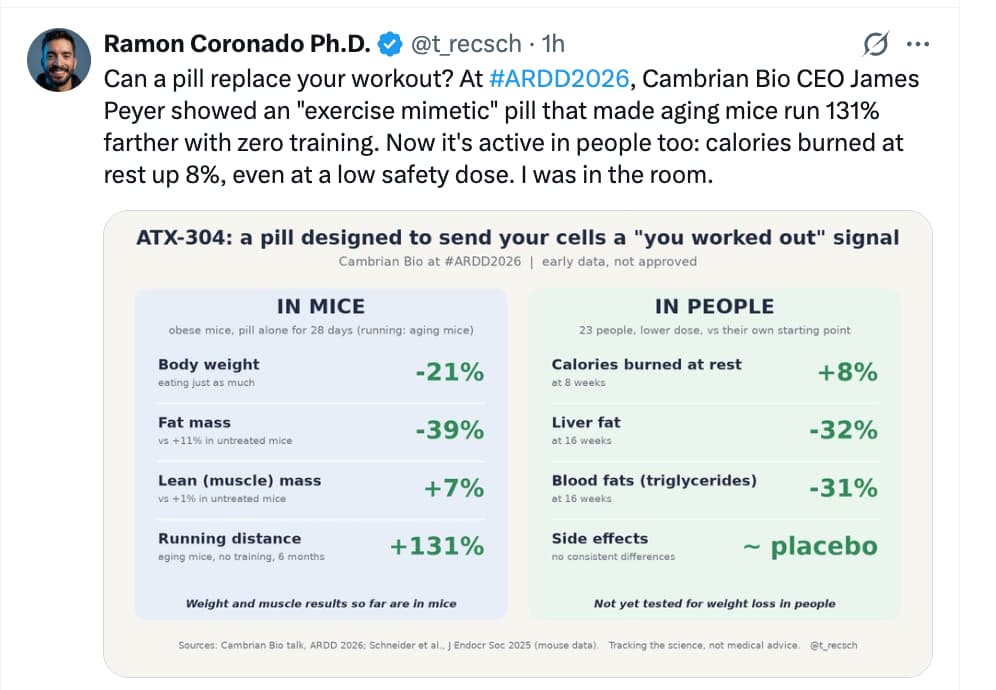
Amplifier Therapeutics and its parent Cambrian BioPharma report that ATX-304, an oral compound described as an AMPK and mitochondrial activator, produced 21 percent weight loss on its own in diet-induced obese mice over 28 days. Combined with semaglutide it reached 27 percent in 15 days, all from fat with no measured loss of lean mass. When semaglutide was reduced or withdrawn, mice on ATX-304 held their weight loss or kept losing despite overeating. The data come from 8 mice per group, were generated and presented by the company, and have not been through full peer review. The company’s own later human data showed minimal weight loss.
The GLP-1 drugs have two well-known weak points. A meaningful share of the weight lost is lean tissue, and most people regain weight when they stop. A conference abstract in the Journal of the Endocrine Society describes a mouse study aimed at both.
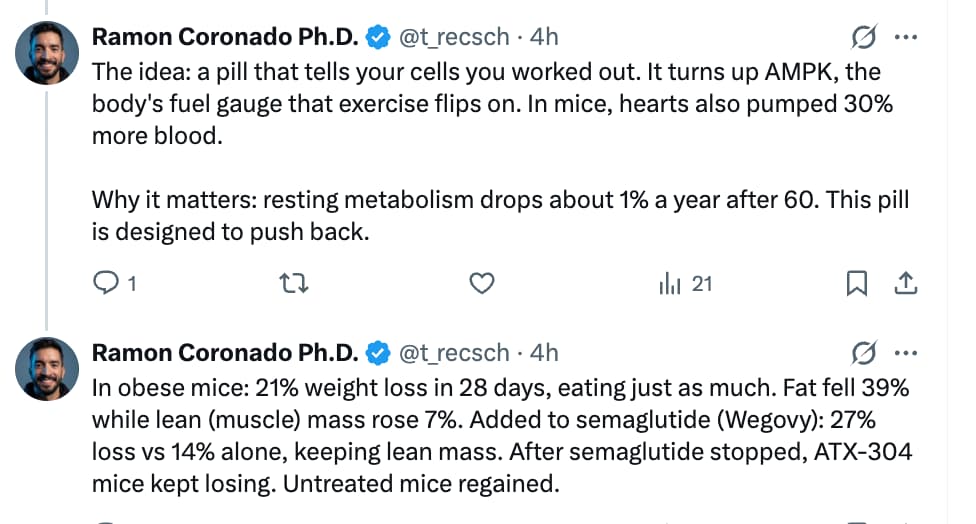
The compound is ATX-304, an oral small molecule from Amplifier Therapeutics, a Swedish company backed by Cambrian BioPharma. The company says it activates AMPK, the cell’s energy sensor, and mitochondria, and that it stays out of the brain. Instead of suppressing appetite, it raises energy expenditure. Mice eat the same and burn more.
Two experiments were run at the contract lab Gubra in mice fattened on a high-fat diet for 17 to 18 weeks. In the first, mice received semaglutide injections for three days, then had ATX-304 mixed into their food, with or without continued semaglutide. ATX-304 alone produced 21 percent weight loss by day 28. The combination reached 27 percent by day 15, against 14 and 19 percent for low and high dose semaglutide alone.
That combination result was large enough to hit the animal welfare ceiling, and the researchers cut every semaglutide dose to a tenth. What followed is the most interesting observation. Mice on semaglutide alone began overeating and returned to baseline weight within 17 days. Mice also receiving ATX-304 overate too, yet held their 27 percent loss. Body scans at day 32 attributed the loss to fat, with no reduction in lean mass.
The second experiment modelled stopping the drug. Mice lost 20 percent of body weight on 28 days of semaglutide, including some lean mass. Semaglutide was then withdrawn and ATX-304 started at three doses. Weight regain was prevented in a dose-dependent way, and at the top dose the animals kept losing, reaching 26 percent below baseline without further lean loss.
If this held in people, it would be a different kind of obesity drug: one that works on the expenditure side, pairs with appetite suppressants and could serve as an exit ramp from them.
There are reasons for caution. The abstract reports no error bars or statistical tests. The monotherapy and combination figures are quoted at different time points, so the size of the added benefit cannot be judged. The drug was given in food, so overeating mice consumed more of it. And mice at standard housing temperatures respond to energy-expenditure drugs far more than humans do.
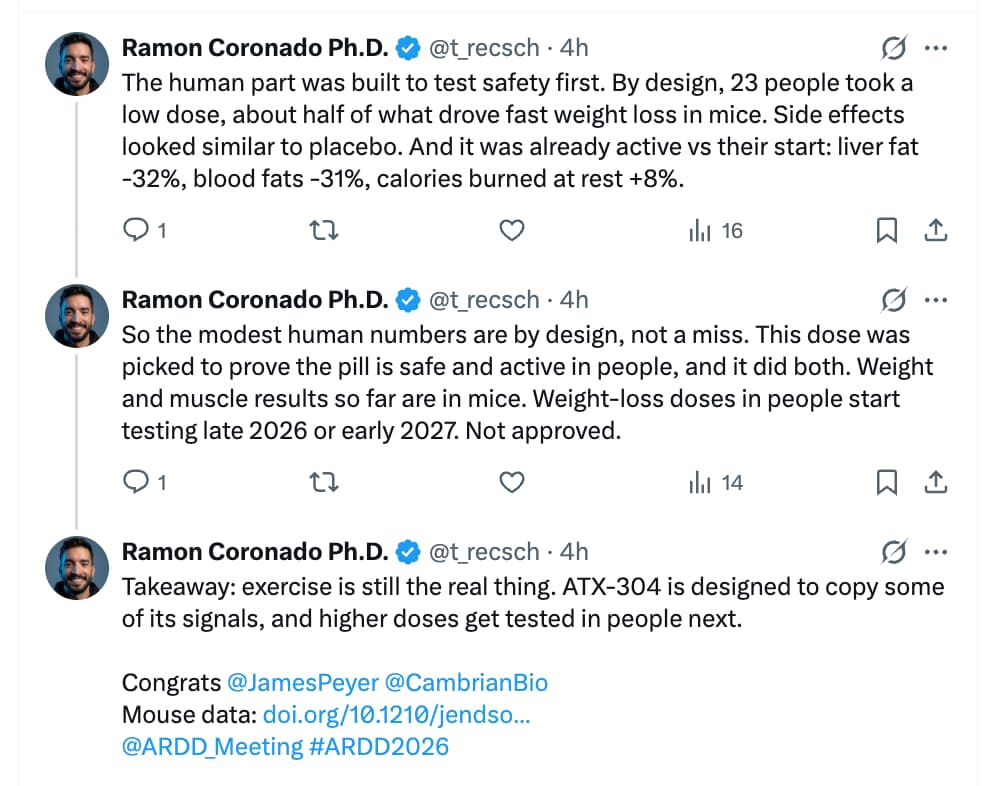
The company’s own human results underline that last point. In a Phase 1b trial reported in June 2026, 23 adults with obesity and prediabetes took 400 mg daily for eight weeks. Resting metabolic rate rose 8 percent and liver and visceral fat fell, but weight loss was described as minimal. An 8 percent rise in resting metabolism is roughly 130 extra calories a day, about one kilogram of fat over eight weeks at best.
Actionable Insights
ATX-304 is an investigational compound in early clinical trials and is not available.
What the numbers mean:
- ATX-304 alone: 21 percent weight loss in 28 days. For a typical 45 to 50 gram obese mouse (my assumption; weights are not given) that is about 10 grams.
- Combination with semaglutide: 27 percent in 15 days, versus 14 percent (low dose) and 19 percent (high dose) for semaglutide alone. That is 8 to 13 percentage points more, or 1.4 to 1.9 times the loss.
- After semaglutide was cut: semaglutide-only mice regained everything in 17 days. ATX-304 mice regained nothing.
- After full withdrawal: top-dose ATX-304 mice went from 20 to 26 percent below baseline in 14 days.
- Lean mass: no loss reported with ATX-304, while semaglutide alone reduced it.
The human reality check matters more than any of these. Eight weeks at 400 mg raised resting metabolism 8 percent with minimal weight change. Mouse weight-loss percentages routinely overstate human results several-fold.
For people on GLP-1 drugs now, the only supported take-home is the general one: weight regain after stopping is driven by rebound appetite, and lean mass is at risk during loss. Resistance training and adequate protein remain the tested countermeasures.
Context/Source
- Full title: Weight Loss and Change in Body Composition in a DIO Mouse Model by the Combined AMPK and Mitochondrial Activator, ATX-304, Alone, in Combination With Semaglutide, and After Semaglutide Withdrawal
- Type: Conference abstract OR22-05, presented 13 July 2025. Abstract citation ID bvaf149.080.
- Access: Open access.
- Institutions: Amplifier Therapeutics AB, Umeå, Sweden; Cambrian BioPharma, New York, USA; Gubra, Hørsholm, Denmark (contract research organization).
- Journal: Journal of the Endocrine Society, Volume 9, Supplement 1, October to November 2025 (Oxford University Press).
- Impact evaluation: The publisher’s page lists an Impact Factor of 4.4, a five-year figure of 4.2 and a CiteScore of 5.2. The impact score of this journal is 4.4, evaluated against a typical high-end range of 0 to 60+ for top general science, therefore this is a Medium impact journal.
1 Like
This one has been around for awhile. Mitochondrial uncoupler.
Patent:
Papers
https://pubmed.ncbi.nlm.nih.gov/39679375/