Collagen-amino-acid “cocktail” appears to turn back biological age, improves skin, in worms, mice, and humans

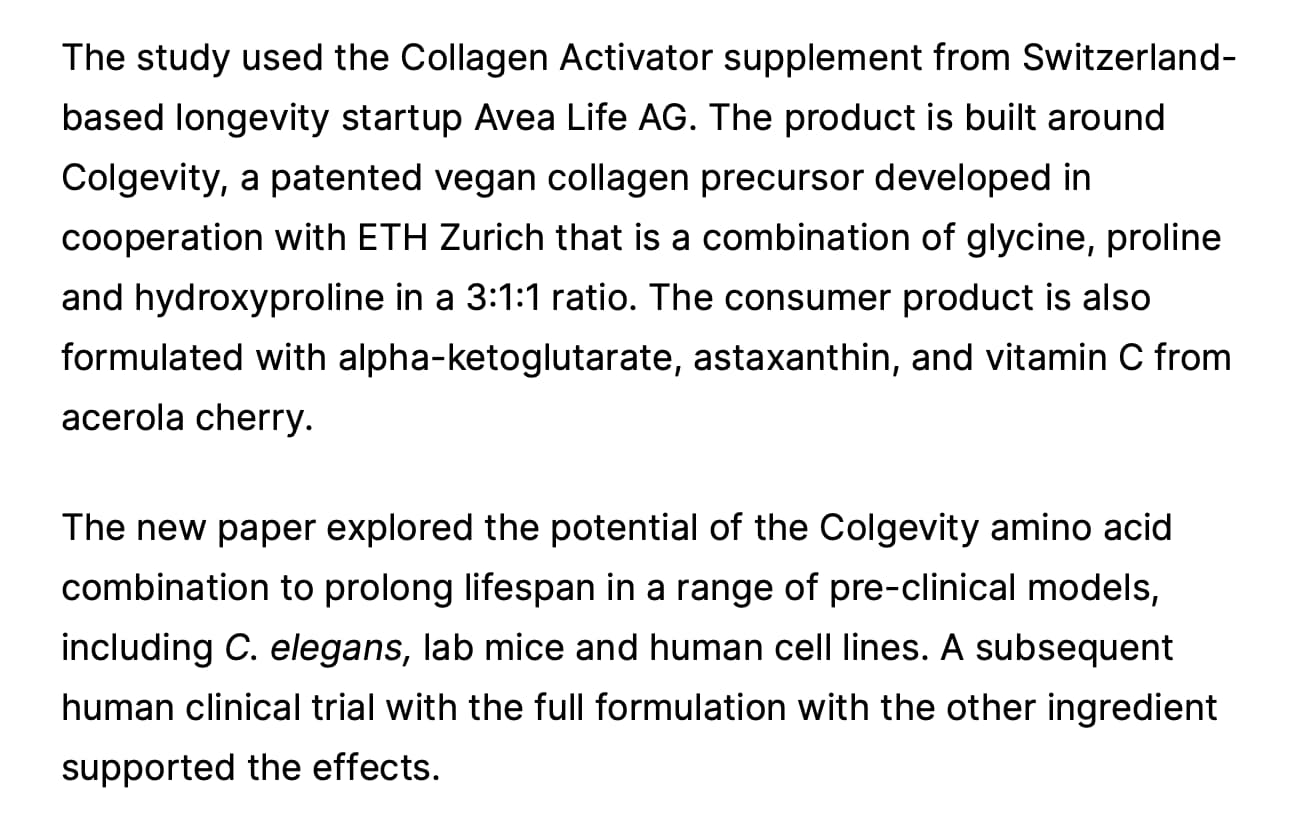
Researchers report that a targeted mixture of three amino acids — glycine, proline, hydroxyproline — in a 3:1:1 ratio, the minimal “building block” of collagen, may drive conserved longevity and rejuvenation signals across species, from nematodes to humans.

In the new study published in npj Aging (November 2025) , investigators combined this amino-acid triplet with known collagen-supportive cofactors — namely α-ketoglutarate (AKG), vitamin C, and in some formulations the antioxidant astaxanthin — and tested effects stepwise: first in worms, then human skin cells, old mice, and finally a small human observational cohort.

Key preclinical findings

  • In C. elegans, the 3:1:1 glycine:proline:hydroxyproline (Gly:Pro:Hyp) mix extended mean lifespan by **6–27%**across five independent trials, outperforming bulk collagen extract. Worms retained collagen-reporter expression and better “healthspan” (swimming/thrashing) late in life.
  • When AKG — a known geroscience metabolite that modulates epigenetics and metabolism — was added, lifespan extension further increased. This suggests the two act via partly independent but synergistic longevity-promoting pathways.
  • In human dermal fibroblasts, Gly:Pro:Hyp triggered robust up-regulation of extracellular-matrix (ECM) and collagen-related genes within hours, indicating stimulated ECM synthesis and remodeling.
  • In a small cohort of 20-month old mice (analogous to elderly humans), the amino-acid supplementation improved grip strength and reduced age-related fat accumulation — two functional proxies of healthy aging — while appearing safe (no overt organ toxicity).

Altogether, these preclinical data suggest that collagen homeostasis — long recognized as central to tissue integrity — may be a tractable longevity axis, and that simple amino-acid supplementation might nevertheless exert systemic, cross-tissue benefits.

Human observational data: preliminary but provocative

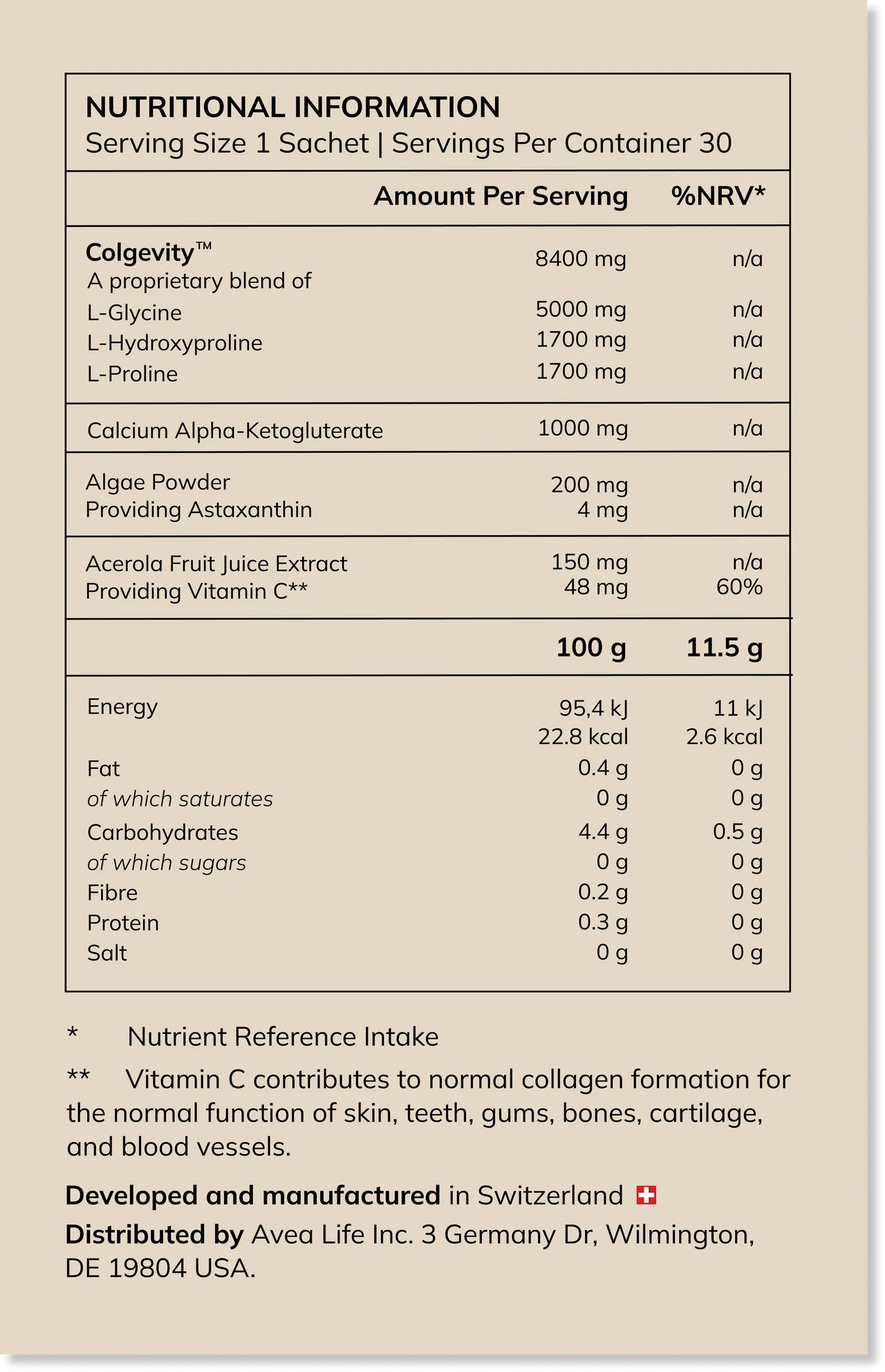
The study’s human arm administered a commercially marketed formulation (“Collagen Activator” / Colgevity™) daily for 6 months to 66 generally healthy adults (mean age ~47). The product combined the 3:1:1 amino-acid mix with vitamin C, AKG, and astaxanthin. Skin hydration, elasticity, and dermatological appearance improved significantly within 1–3 months.

More strikingly — at least for anti-aging enthusiasts — participants exhibited a mean reduction of 1.4 years in “biological age” (as measured by a commercial saliva DNA methylation clock) over six months (p = 0.04).

The authors interpret this as proof-of-concept that collagen-substrate supplementation can exert “rejuvenating” effects at molecular (epigenetic), cellular (skin ECM), and functional (strength, fat mass) levels — consistent with the cross-species data.


Why this matters for longevity and healthy-aging strategies

  • ECM/collagen maintenance as a pillar of healthy aging: Collagen and ECM stability are essential to tissue integrity, elasticity, and repair. Age-related loss or dysfunction of ECM underlies skin sagging, bone fractures, tendon weakness, vascular stiffening, and overall frailty. By demonstrating that simple amino-acid building blocks trigger ECM synthesis and systemic benefits, this work elevates ECM support from cosmetic or structural maintenance to a bona fide geroscience intervention axis.
  • A potentially low-risk, accessible “longevity tool”: Because glycine, proline, and hydroxyproline are food-derived amino acids — part of the normal collagen breakdown/absorption pool — and because AKG and vitamin C are already studied as safe nutritional/metabolic factors, this strategy may be more scalable and lower risk than many novel geroprotective drugs.
  • Synergy matters: The combination with AKG (a metabolic and epigenetic regulator), plus vitamin C (collagen hydroxylation cofactor) and antioxidants (astaxanthin), suggests a multi-layered support strategy: substrate supply, enzymatic co-factors, and oxidative-stress mitigation. This aligns with the emerging view that healthy aging likely requires multi-modal interventions rather than single “silver-bullet” compounds.
  • Rejuvenation rather than just disease prevention: The observed epigenetic age reversal, improved skin metrics, and functional gains in muscle/fat suggest that such an intervention could contribute not just to delaying pathology, but to restoring aspects of youthful physiology — a core goal for longevity-minded individuals.

Important caveats & what remains to be demonstrated

  • The human trial was uncontrolled and observational, so the biological-age drop could reflect placebo effect, lifestyle drift, measurement variability, or regression-to-the-mean.
  • The formulation combined several active components — you cannot attribute the effect solely to Gly:Pro:Hyp.
  • The epigenetic clock used is commercial and its predictive value for long-term healthspan or lifespan remains debated.
  • The mouse data — while promising — did not include survival/lifespan curves.

Bottom line (for longevity-oriented individuals)

This study marks a compelling advance in geroscience: a minimalist, diet-derived amino-acid ratio — supplemented with metabolic cofactors — appears to exert conserved, cross-species benefits for ECM maintenance, tissue function, and markers of biological age. If validated in rigorous placebo-controlled human trials, this “collagen-building block + co-factors” paradigm could become a foundational pillar in healthy-aging regimens — a low-friction, broadly accessible intervention aimed not just at disease prevention but at restoring youthful tissue quality and function. Until then, it should be viewed as a well-reasoned, promising hypothesis rather than a proven “rejuvenation therapy.”

Full, Open Access Paper:

A collagen amino acid composition supplementation reduces biological age in humans and increases health and lifespan in vivo

Related News Coverage:

6 Likes

Was thinking you could just add some extra glycine to gelatine and it’d get you close to what they are suggesting.

Gelatin’s amino acid profile is dominated by glycine (27–35%), hydroxyproline (20–24%), and proline (10–18%).

6 Likes

Why not the full cocktail?

investigators combined this amino-acid triplet with known collagen-supportive cofactors — namely α-ketoglutarate (AKG), vitamin C, and in some formulations the antioxidant astaxanthin

3 Likes

Kinda similar to what Novo’s does with some of it’s products such as glycine, AKG, vitamin c.
Don’t think they use the other 2 aminos used: proline & hydroxyproline.
Though they do use some other antioxidants instead of Astaxanthin.

Would be interesting to learn what results would be had with whey protein mixed with collagen powder along with taurine, AKG, creatine, multi vitamin & mineral, various antioxidants, and possibly other supplement products.
If there is a certain amount(weight) of amino acids/protein one can use at a single serving until it becomes problematic.

2 Likes

Drives me a little crazy when I see an interesting conclusion with the word “may” in front of it.

6 Likes

Of the three of those amino acids, hydroxyproline is the one that’s hardest to get in diet. It is present in skin (like chicken skin and probably pork rinds) and organ meats – like liver – in decent amounts, but is present only in low amounts in skinless chicken breast and beef steak, say. It’s present in fruits and vegetables only in very low amounts (there might be exceptions, but I haven’t found any).

The body can produce it from proline, but becomes less capable of doing so with age.

Interestingly, hydroxyproline was mentioned in this paper (which is now in Cell Metabolism):

https://www.biorxiv.org/content/10.1101/2024.05.04.592445v1

In this study, we describe how metabolism changes in 12 organs in male and female mice at 5 different ages. Organs show distinct patterns of metabolic aging that are affected by sex differently. Hydroxyproline shows the most consistent change across the dataset, decreasing with age in 11 out of 12 organs investigated.

Also, worth mentioning that the collagen paper was discussed in this thread:

1 Like

Collagen Activator reduces biological age

At 6 months, 45 participants (33 females, 12 males) completed the saliva epigenetic test61 to compare it to the beginning (time point 0), before taking the Collagen Activator (Fig. 6a).

As the natural progression of time, the chronological age increased by 0.5 years from the mean chronological age of 47.46 ± 8.33 years at baseline to 47.88 ± 8.33 years at 6 months. By contrast, the mean biological age at baseline was 47.07 ± 7.21 years, while the mean biological age at 6 months was 45.70 ± 7.57 years (mean difference: −1.37), demonstrating a statistically significant reduction (p = 0.040, paired t -test, two-tailed). When stratified by gender, the average decrease in biological age was similar between females (−1.33 years) and males (−1.48 years), with no statistically significant differences in the extent of biological age reduction between genders observed (Fig. 7b, c). The maximum decrease in biological age observed after 6 months of collagen supplementation was 8.9 years for males and 12.1 years for females (Fig. 7c).

That is a reduction after six months. Would there be a greater reduction after six months? Would more participants reach the maximum age reduction if they took the cocktail longer?

Note, males do better on average. But females do better on the max age reduction.

1 Like

Starpawn shared the link to see more discussion on this topic in another thread, but I’ll share this here…

One can buy hydroxyproline if you live in Europe (@cl-user found a link), but I could not find it available in the US.

I found a product that contains VC-H1 hibiscus extract (cl user and relaxed meatball both agreed the studies on VC H1 looked better than on collagen activator).

I first found it in veggimins, but then I found a better product on amazon

@RapAdmin I’m not linking to the other thread because I can only rarely get the copy and past link function to work… normally clicking on it does not do anything when I try …no big deal but fyi…

2 Likes

@Tilmitt: This certainly makes for an easy hack removing the problem of sourcing hydroxyproline. Besides gelatine, toss in more glycine, some vitamin C and also AKG for good measure.

2 Likes

One thing about hydroxyproline worth mentioning is this that I saw by doing a Google search:

Unlike proline, which can be post-translationally hydroxylated to form new collagen, ingested free hydroxyproline cannot be reutilized for protein synthesis. Instead, the majority is broken down, mainly in the liver and kidneys.

Still, if it has some kind of effect on the body’s aging – assuming what that paper says is real – it may be through other mechanisms besides direct protein synthesis. e.g. the liver produces glyoxylate and pyruvate using it.

There may be other ways of boosting it in the body besides just taking hydroxyproline or proline supplements.

3 Likes

I asked Gemini 3 about how to boost hydroxyproline, and it says:

Therefore, to boost hydroxyproline, you must boost the activity of the P4H enzyme.

The P4H enzyme has an absolute requirement for four specific ingredients to work. If any one of these is low—which often happens in aging—the conversion stops, and you end up with weak, unstable collagen (low hydroxyproline).

and it mentions AKG, iron, vitamin C, and oxygen.

Also, regarding proline, it writes:

Simply eating more proline (the raw material) is generally inefficient if the P4H enzyme is the bottleneck. It is like delivering more bricks to a construction site where the masons are on strike.

Better Strategy: Consuming Hydrolyzed Collagen Peptides.

Unlike pure proline, collagen peptides often contain Prolyl-Hydroxyproline (Pro-Hyp) dipeptides.

These small peptides can be absorbed intact. They act as signaling molecules that tell fibroblasts (skin/connective tissue cells) to ramp up their P4H machinery and collagen synthesis.

1 Like

Is there a form of CA AKG that you (or anyone) feels is effective, other than the $$$ Rejuvant?

I’ve been taking Renue By Science due to thinking liposomal might be the best next affordable option… no idea if my thinking is correct.

In the other thread, I wondered out loud if you could add powdered CA AKG to your beverage and sip on it all day in order to have it be more steady. I ask this because Brian Kennedy says that is what makes Rejuvant superior. Thoughts?

1 Like

I just get it in Novos powders. I haven’t heard any reason to believe it is low quality.

They have clearly skin in the game:

“Administering our novel and patented combination of a more collagen-mimicking ratio [3 Gly : 1 Pro : 1 Hyp] as a tool compound in preclinical models and then optimization by adding supporting ingredients (alpha-ketoglutarate, astaxanthin, and vitamin C) showed improvements in skin features and reduced biological age…”

1 Like

Its interesting, this is the first time I’ve seen a company identify their suppliers on their website… The product is about $80/month, so about twice what I pay for rapamycin. Seems we should be able to duplicate it for about 1/10th the cost using other sources…

2 Likes

I could find food grade Hydroxyproline, but not from any source I would trust. Another possibility is to add glycine to a supplement with with Vollagen® is composed of 18 amino acids , with Hydroxyproline making up ~10.5% to 13.5% of the total mass.

However, there is a major catch you must be aware of: There are two versions of Vollagen.

1. The “Standard” Vollagen (The one you want)

This version is the true “biomimetic” copy of human collagen and contains the specific Hydroxyproline signal you need for your protocol.

  • Glycine: ~20 - 24%
  • Proline: ~11 - 15%
  • Hydroxyproline: ~10 - 13.5%
  • Glutamic Acid: ~8 - 11%
  • Alanine: ~8 - 11%
  • Arginine: ~7 - 9%
  • (Plus smaller amounts of Leucine, Lysine, Serine, Valine, etc.

Once source of it is Terranova capsules

1 Like

This just seems like more proof for the glycine - methionine ratio. You need a certain amount of glycine to reduce the over-consumption of methionine that occurs with animal-based diets. Methionine-restricted diets have shown big extensions in longevity in mice. But, with natural diets, it is difficult to restrict methionine (and the other sulfur amino acid, cysteine), so you need to add glycine to your diet to aid in the removal of excess methionine.

2 Likes

FWIW …

2 Likes

Correct compound your own, better for a fraction of the cost,

Thinking…
Make. “GlyNAC” add Proline, Hydroxyproline, Ca AKG and a few other items

1 Like

CL User found this in the other thread on this topic. I contacted the company and they won’t ship to the US… but it’s a great find for the non US people!

Incase you wanted to check out the other thread where this has been discussed, here is a link. (I could only link the entire thread and not the relevant post, so scroll down to 9 days ago).

1 Like