Collagen-amino-acid “cocktail” appears to turn back biological age, improves skin, in worms, mice, and humans

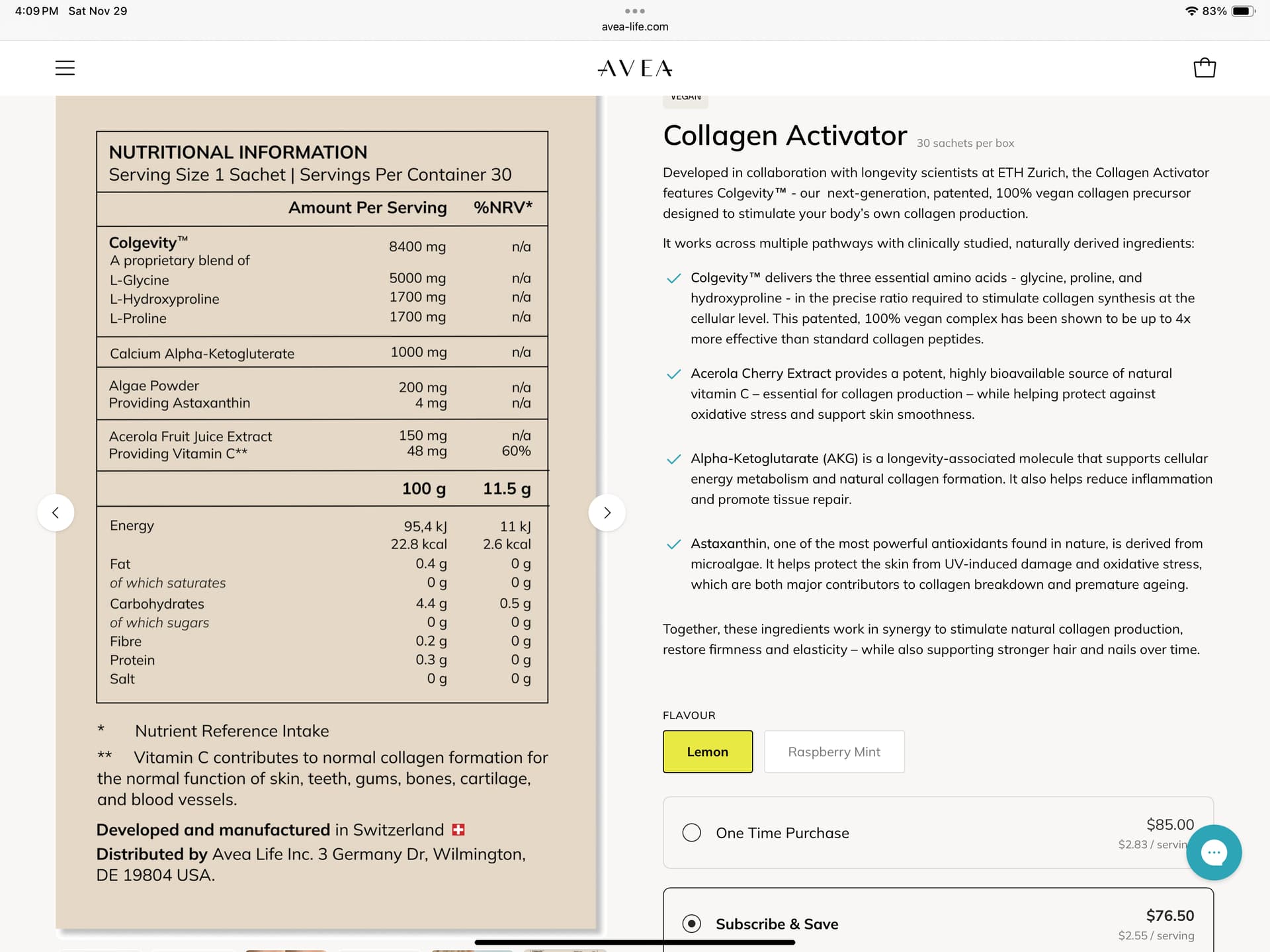
I found the product they used in the study

@RapAdmin posted the label already but I figured I would share the link. These are all products I take already (except the Ca-AKG at the moment since I stopped it). The dose of Astaxanthin seems low-ish but we really don’t know how much we need of it at the end of the day.

2 Likes

That title getting past peer review is absolutely egregious

2 Likes

I think you are correct - this seems like the easiest way to accomplish the goal in the US:

From Gemini:

If you are looking for a product that strictly falls within this exact percentage range, almost any standard, unflavored, and unsweetened gelatin powder (like those used for cooking and gelling) will fit the description, as this is the standard biochemical composition for the material.

Here are a few commercially available options that are explicitly sold as gelling fish gelatin powder:

  • O’creme Kosher Fish Gelatin: This is a high-quality, Kosher-certified gelatin powder sourced from Tilapia fish. It is unflavored and has a high bloom strength (250 Bloom), which is a measure of its gelling power, making it suitable for culinary and baking applications.
  • Pure Kosher Fish Gelatin: Another pure, unflavored, and uncolored kosher option that functions as a thickening/gelling agent for mousses, soufflés, and other desserts.
  • Mcgarrett Fish Gelatine Powder: This is marketed specifically as a food additive and gelling agent, perfect for making jelly, gummy candy, and marshmallows.
  • Sigma-Aldrich Gelatin from Cold Water Fish Skin: While often used for laboratory applications, this product is derived from cold water fish skin and is notable for its low gelling and melting points, a property important to consider when using any fish-based gelatin.
2 Likes

I purchased a 3 month supply of AVEA Cocktail but won’t take it until my face clears up after carac and I get baseline normal skin back.
If you are planning a trip to Europe you can bring hydroxyproline back in your suitcase but if shipped it’s considered food and the FDA requires a submission of documents and clearance. My ME-3 shipment from Europe was shipped but it was stopped and I had to do the paperwork myself to clear it through customs.

2 Likes

That’s weird. When I asked Gemini 3 Pro, it said that both collagen and gelatin were composed of 33% glycine, but only 10-15% proline and 10% Hydroxyproline. I also asked Claude Opus 4.5 and it gave similar ratios of Glycine 33% and Proline 10-12% and Hydroxyproline 10-12%. These numbers make sense in the context of the paper because that’s how they got the 3:1:1 ratios (by copying them from the ratios in collagen).

Also, I thought the main advantage of the supplement was that it was more easily digestible than collagen. If you’re taking collagen or gelatin you would lose that.

This is what Ai tried to explain to me regarding any differences between gelatin and Collagen peptids:

Collagen peptides are more extensively hydrolyzed → smaller peptides → slightly different ratios of di- and tri-peptides. There is no difference in the amino acid profile. Both are incredibly rich in Glycine, Proline, and Hydroxyproline. Collagen peptides are gelatin that has been processed one step further (hydrolyzed). Imagine gelatin as a long pearl necklace, and collagen peptides as that same necklace cut into tiny 2-3 pearl segments. The “pearls” (amino acids) are exactly the same; only the string length differs.

Absorption Collagen Peptides are superior for speed; Gelatin is “slow-release.” Collagen Peptides, Because they have been “pre-digested” into tiny chains (low molecular weight), they bypass much of the heavy lifting your digestion usually does. They cross the intestinal wall rapidly, spiking in your bloodstream within 30–60 minutes after ingestion They enter the blood intact as di- and tri-peptides (e.g., Proyline-Hydroxyproline), which acts as a “signal” to your cells to start repairing tissue.

Gelatin: Gelatin consists of longer, heavier protein chains. Your body must actively break these down using digestive enzymes before they can be absorbed. Much slower. It acts as a “slow-release” protein. Lower peak concentration in the blood compared to peptides, but it eventually provides the same total amino acids over a longer period

Because peptids flood the blood quickly, they reach “target sites” like the dermis (skin) and cartilage (joints) in high concentrations, triggering cell repair.The rapid spike of peptides in the blood mimics muscle/tissue breakdown, “tricking” your body into ramping up repair machinery in your skin and joints

Before gelatin is digested, gelatin absorbs water and coats the digestive tract. It lingers in the gut longer than peptides. Gelatin has unique gelling properties (gelling agents). It can physically coat the intestinal lining, potentially soothing inflammation and supporting the mucus barrier (often used for “Leaky Gut”).

Collagen peptids are best For Skin elasticity, joint pain, athletic recovery. (You want the signal to hit the bloodstream fast). Gelatin is best for gut health, digestion, coating the stomach. (You want the substance to linger and soothe).

1 Like

Not sure if the authors have an interest in the supplement used, but nowhere in the paper do they mention that they used hydrolyzed collagen in any of the experiments.

And in fact in the In the C. elegans (worm) experiments, the authors compared their 3:1:1 mix against “rat tail collagen” which is typically a native collagen (long, unbroken fibers) and is notoriously difficult to digest. In a laboratory setting (like a petri dish or worm media), it often stays as a large, insoluble molecule that cells or simple organisms cannot easily break down and absorb.

Hydrolyzed collagen is much easier to digest and using it would probably negate the advantage that the supplement had. I now think this experiment is a nothing burger.

1 Like

Yes, @AlbertN, as CL User pointed out in the other thread that starpawn started about this study, they do.

May as well use beef gelatin

A quick AI generated…

“Beef gelatin is composed of 98-99% protein by dry weight, with the remaining content being moisture and residual salts. The protein itself is made up of a specific profile of amino acids, predominantly glycine, proline, and hydroxyproline”

“General Composition”

Compound Percentage (Dry Weight)
Protein ~98–99%
Moisture & Salts ~1–2%
Fat, Fiber, Carbs Negligible (0%)

“Amino Acid Profile”

“The high protein content is characterized by a unique and consistent amino acid composition across different sources, which includes high levels of specific non-essential amino acids.”

Amino Acid Approximate Percentage Range
Glycine 27–35%
Proline & Hydroxyproline 20–24% (combined)
Glutamic Acid 10–12%
Alanine 8–11%
Arginine 8–9%
Aspartic Acid 6–7%
Lysine ~4%

“Gelatin is considered an incomplete protein because it lacks the essential amino acid tryptophan and is low in isoleucine, threonine, and methionine.”

2 Likes

I looked up Avea and ordered the collagen and I am in the United States.

1 Like

Thanks for the comment! It makes sense now the big differences in life extension between the rat tail collagen vs the 3:1:1. It seems crucial to have it in a highly digestible form. Also the 10:1:1 did better in the experiment, so i will add glycine either way.

2 Likes

@Schuler117 Let us know what you think! I ordered VC H1 in Plant (link above). At least the taste is pretty good.

Another good source of Hydroxyproline is bone broth…

The percentage of Hydroxyproline (Hyp) in bone broth depends entirely on whether you are analyzing the liquid broth (by total weight) or the protein fraction (amino acid profile).

In short:

  • In Liquid Bone Broth: Hydroxyproline is typically 0.2% of the total weight.
  • In Bone Broth Protein: Hydroxyproline is typically 8% – 10% of the total protein content.

Key Variables for Longevity Optimization

If you are using bone broth specifically for the glycine-proline-hydroxyproline triad (crucial for collagen synthesis and potentially lifespan extension via methionine restriction):

  1. Chicken vs. Beef: Chicken bone broth generally tests slightly higher in hydroxyproline (~2.16 mg/g) compared to beef broth (~1.97 mg/g) because chicken frames contain more connective tissue (cartilage/skin) relative to the dense mineral bone found in beef.
  2. Powdered Supplements: “Bone Broth Protein Powder” is dehydrated. It will typically mirror the protein fraction stats above (~9% Hyp), whereas “Hydrolyzed Collagen Peptides” will mirror the pure stats (~13% Hyp).

I’ve come across this product also, and it seems to be a reasonable source:

PROMPT:

Can you identify or estimate the amount of Hydroxyproline (Hyp) in this product: Anthony’s Collagen Peptide Powder, 1 lb, Pure Hydrolyzed, Gluten Free, Keto and Paleo Friendly, Grass Fed, Unflavored, Non GMO

Response:

Based on the product specifications and standard amino acid profiles for grass-fed bovine collagen, here is the estimated Hydroxyproline (Hyp) content for Anthony’s Collagen Peptide Powder.

Estimated Hydroxyproline Content

Metric Estimated Amount
Per Serving (approx. 1 scoop) 1.25 g (Range: 1.1 – 1.4 g)
Per 100 g of Powder ~11.4 g

The breakdown

Since Anthony’s does not publish a certificate of analysis (CoA) with a specific amino acid profile for every batch, this calculation is derived from the following confirmed data points:

  1. Protein Content: The product label lists 11g of protein per serving.
  2. Source Material: It is confirmed as Bovine Hide (Type I & III).
  3. Industry Standard: Hydroxyproline typically constitutes 11.4% to 13.5% of the amino acid residues in bovine collagen by weight.

Calculation Logic:
Using the industry benchmark from comparable grass-fed bovine collagen products (e.g., Vital Proteins, Peptan), which average ~11.4% Hydroxyproline relative to total protein:
$$11\text{g Protein} \times 0.114 = 1.254\text{g Hydroxyproline}$$

Why this matters for you (Longevity & Biotech)

1. Biomarker for Collagen Quality
Hydroxyproline is a non-essential amino acid found almost exclusively in collagen (and elastin). It is formed post-translationally via the enzyme prolyl 4-hydroxylase, a process requiring Vitamin C as a cofactor.

  • Actionable Insight: If you are taking this for longevity or tissue repair, ensure you have adequate Vitamin C intake (approx. 50-100mg) simultaneously to maximize the utilization of these peptides for your own collagen synthesis.

2. Stability & Thermostability
Hydroxyproline provides thermal stability to the collagen triple helix via hydrogen bonding.

  • Bovine vs. Marine: Bovine collagen generally contains higher levels of Hydroxyproline compared to marine collagen (which is lower due to the lower body temperature of fish). If your goal is structural integrity (joints/fascia) rather than just skin hydration, the higher Hyp content in this bovine product is advantageous.

3. Absorption (The Pro-Hyp Peptide)
Upon hydrolysis, collagen yields dipeptides like Pro-Hyp (Proline-Hydroxyproline). These dipeptides are resistant to digestion and can be detected in the blood, where they act as signaling molecules to stimulate fibroblasts.

  • Biotech Note: The high “pure hydrolyzed” nature of Anthony’s suggests a lower molecular weight (likely 2kDa - 5kDa), which optimizes the bioavailability of these specific Hyp-containing peptides.

Summary

You can reliably assume you are ingesting approximately 1.25g of Hydroxyproline for every standard serving of this product. This is a clinically significant dose for stimulating collagen synthesis pathways when paired with Vitamin C.


The following comparison analyzes Anthony’s Collagen Peptide Powder against a standard Marine Collagen source and its direct market competitor, Vital Proteins.

The Executive Summary

  • Best Value for Hydroxyproline: Anthony’s (and Bovine sources generally) offers the most consistent, biologically expected Hydroxyproline (Hyp) content per dollar.
  • The Marine Paradox: While evolutionary biology dictates that fish collagen (especially cold-water) should have lower Hyp content than bovine, some premium marine labels (like Vital Proteins) claim higher concentrations. This likely indicates specific sourcing (e.g., warm-water Snapper vs. cold-water Cod) or processing differences, but bovine remains the “gold standard” for structural homology to human collagen.

Comparative Analysis: Hydroxyproline Content

To ensure an accurate “apples-to-apples” comparison, the data below is standardized to a 10-gram serving of powder, as commercial serving sizes vary significantly (e.g., Vital Proteins uses 20g scoops, while Anthony’s uses ~12g scoops).

Product / Source Source Material Est. Hyp per 10g Powder Est. Hyp % (Relative to Protein)
Anthony’s Collagen Bovine Hide (Grass-Fed) ~1.04 g 11.4% (Standard Bovine Profile)
Vital Proteins Peptides Bovine Hide (Grass-Fed) ~1.03 g 11.4% (Label Claim)
Vital Proteins Marine Wild Caught Fish (Scales) ~1.30 g* ~14.1% (Label Claim)
Generic Marine Collagen Cold Water Fish Skin/Scales ~0.60 – 0.80 g 6.7% – 8.0% (Scientific Literature)

Note on the Data:

  • Anthony’s & Vital Proteins (Bovine): These are effectively identical in molecular composition. The numbers reflect the industry standard for bovine Type I & III collagen.
  • *The Vital Proteins Marine Anomaly: Standard marine collagen (especially from cold-water fish like Cod) typically contains 30% less Hydroxyproline than bovine collagen because fish live in lower temperatures and do not require the same thermal stability in their tissues. However, the Vital Proteins Marine label lists a surprisingly high Hyp count (1.56g per 12g serving). This suggests they may be sourcing from warm-water fish (e.g., Snapper, as occasionally listed on their older packaging) which have higher thermal stability, or the peptide concentration is processed differently. Do not assume all marine collagens have this high profile.

Biotech & Longevity Implications

1. The “Thermostability” Factor
From a biotech perspective, Hydroxyproline’s primary evolutionary role is to stabilize the collagen triple helix against heat.

  • Mammalian (Bovine): Evolutionarily adapted to 37°C (98.6°F). It naturally has a higher density of Proline and Hydroxyproline to prevent the helix from “melting” at body temperature.
  • Marine (Fish): Adapted to cold water. Their collagen “melts” at much lower temperatures. Consequently, generic marine collagen is usually less stable and has lower Hyp content.
  • Your Choice: Unless you have a specific reason to avoid beef (e.g., allergy, pescatarian diet), Bovine is generally the superior substrate for human tissue repair because its amino acid ratio is more homologous to your own body’s thermal requirements.

2. Peptide Bioavailability (The “Dalton” War)

  • Anthony’s: “Pure Hydrolyzed” typically implies a molecular weight of 3000–5000 Daltons.
  • Marine Sources: Often touted as having “lower molecular weight” (2000–3000 Daltons) due to the thinner nature of fish scales vs. cow hide.
  • Verdict: While marine peptides might theoretically absorb slightly faster due to size, the Pro-Hyp (Proline-Hydroxyproline) dipeptide content is the critical signaling molecule for longevity (fibroblast stimulation). Since bovine sources are naturally richer in Proline/Hydroxyproline (the precursors), they may ultimately yield a higher net concentration of these bioactive dipeptides in the blood, despite the marginal size difference.

Final Recommendation

If your goal is Longevity and Structural Integrity (Fascia, Joints, Bone density):
Stick with Anthony’s (or generic Bovine). It provides the structurally correct amino acid ratios for human tissue at a significantly lower cost per gram of Hydroxyproline. The “premium” you pay for Marine collagen is often for the “clean” sourcing (wild-caught) rather than a superior amino acid profile for human physiology.
1 Like

This paper along with all of the references cited are garbage studies designed to sell collagen supplements. Most collagen studies don’t have control groups. The few that do have control groups don’t use a protein equivalent placebo. Very few of the studies consider baseline protein intake. So you recruit a bunch of protein deficient subjects, give them collagen (which is nothing more than a form of protein) and magically they show some sort of improvement. Increased collagen sales achieved. If you want the benefits of a collagen supplement, just increase your dietary protein intake. If your dietary protein intake is already adequate, don’t expect any benefit.

4 Likes

fasterfour,

Yes, I agree. Before posting items like this I try to vet the quality of the research as well as who performed it and where it was performed. I also look at the number of participants and whether or not a specific product name is mentioned. A quick summary from chatGPT gave me the information. So, yes, though it meets statistical and practical significance I consider the study to be poorly done with an end purpose of promoting the product Avea Life AG (a Swiss longevity company).

1 Like