Isn’t this the answer for every single human trait? (intelligence, wealth, happiness, attractiveness, longevity, religiosity, etc.)
2 Likes
Yep, I believe so. They even say that in the paper, haha:
longevity appears to be about 50% heritable, similar to many other traits.
Such high heritability is similar to that of most other complex human traits and to life-span heritability in other species.
Still, a massive role of genetics IMO. More than most of us might be happy to believe 
4 Likes
No, all the rivers flow into the same ocean. When you find out where the genes have an effect it’s going to be many usual targets.
1 Like
Another N=1 datapoint on rapid progression of my Atherosclerosis:
3/26/24 (Age 64) : CAC score = 1 (25th percentile for my age)
2/10/26 (Age 66) : CAC score = 42 (39th percentile for my age).
This time I also got a CCTA with Heartflow (cheaper version of Clearly):
Total calcified coronary plaque : 27 mm3
Total soft coronary plaque : 406 mm3
Total coronary plaque : 433 mm3 (58th percentile for my age)
So for me the calcified plaque (CAC score) turned out to be the tip of the iceberg. The Heartflow (AI) also estimated the amount of coronary artery stenosis (1-24% for the LCAs and 1-68% for the RCAs) and flow reduction (none for the LCAs and up 11% flow reduction for the RCAs). Flow reduction typically only begins after 50% or more stenosis.
I have been on Praluent for the last 12 months with ApoB below 40 during that time. After seeing my CCTA, my primary care doctor increased my Lipitor dosage back to 10mg (she had reduced it to 2.5mg/day after putting me on Praluent a year ago because she was worried about lowering my brain cholesterol too low) and added a baby aspirin every other day.
On my own, I decided to increase my dosage of Nattokinase to 4000FU 3x/day and Boluoke Lumbrokinase 2 capsules (1.2 million IU) 3x/day on an empty stomach.
The CCTA had a radiation dosage of 216 mGycm (vs 79 mGycm just for the CAC score 2 years ago), which corresponds to roughly 5.7 mSv using the CCTA specific conversion factor (the average CCTA is estimated at 7 mSv, and the facility I used has below average exposure). This is estimated to increase cancer mortality by around 0.018% (This increases the estimated lifetime cancer mortality risk from 45% to 45.018% for a male at age 66), see calculator at XrayRisk.com. Annual background exposure is 3 mSv. Normally preventative CCTA is not recommended more than once every 3 years to keep radiation exposure down, but I figure I will recheck in 1 year to see what my trend is, then repeat every 3 years.
5 Likes
Eugene Braunwald I’ve heard brings his patients LDL-C down to the 10’s. You might want to research whether in your situation it might be worthwhile to decrease RW-ApoB further. I don’t know much about it. Not medical advice obviously.
Because CAC score above 0 is advanced cardiovascular disease I presume your other risk factors are all under control and in optimal ranges?
I think the brain cholesterol story is unlikely to be true, it was based on observational data and we have preliminary MR data showing reductions in all-cause dementia. Atorvastatin is even going to be studied if it reduces dementia risk in the STAREE and PREVENTABLE trials.
2 Likes
I find LDL-C and Apo-B numbers often don’t line up when they are low. In my case on 8-20-25:
Total Cholesterol = 103 mg/dL
HDL = 72 mg/dL
LDL = 13 mg/dL
TG = 94 mg/dL
Apo-B = 34 mg/dL
Apo-A = 181 mg/dL
Lp(a) < 7 nmol/L
3 Likes
Have you considered adding Bempedoic Acid and Ezetimibe? You can get them in a combo tablet very cheap from India.
2 Likes
Since you are concerned about and are tracking radiation exposure, keep in mind that both Astaxanthin and Melatonin are protective vs ionizing radiation. Astaxanthin 12mg daily is in my stack for this and other benefits. Melatonin 300mg an hour or 2 before radiation exposure is the suggested protective dosage.
Your lipid numbers are better than mine.
I’m 75 yo with CAC 287 (8/22) and 242 (6/24).
This summer I’ll redo either CAC or my 1st CTA.
What is your hsCRP ?
4 Likes
ApoB is 34 mg/dl. This is much better than many others in this situation. Plaque is normal at certain ages as we can see with the percentile.
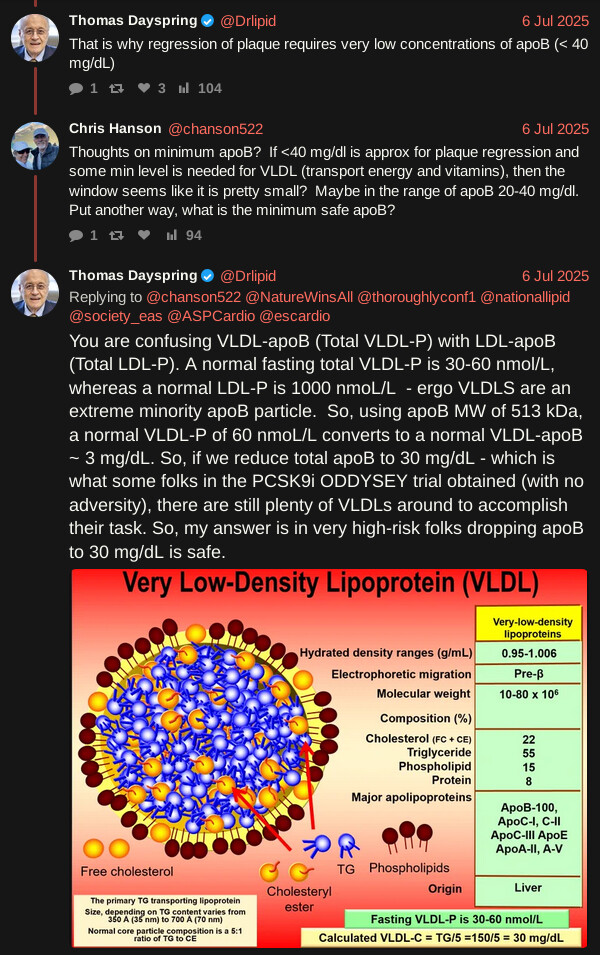
Question is if it’s worth decreasing further. I wonder how that affects fat soluble vitamin absorption. Thomas Dayspring is comfortable with 30 mg/dl apoB at least and believes regression requires <40 mg/dl.
2 Likes
Just remember that if you lose the war against plaque, you can pull out the big guns and put in stents. These push the plaque into tissue walls and effectively neutralizes their threat.
Of course it’s always best to prevent plaque in the first place, but you’ve done everything you can.
1 Like
They reduce the risk but not by 100%.
Continuing the discussion from Cardiovascular Health 2025:
1 Like
Yes, not by 100%due to the fact there’s probably other troublesome plaque somewhere else in your system that could cause trouble. However stents can neutralize the plaque in specific, high risk areas.
1 Like
Good idea. I do already use 5mg (half tablet) of Ezetimibe, along with Praluent (150mg, once a month) and now Lipitor 10mg/day and baby Aspirin every other day.
The main problem is I only started aggressively lowering my Cholesterol a year ago, after reading this thread. Prior to that I just took Lipitor 10mg/day for the previous 15 years (since age 50) as per my primary doctor which kept my LDL around 100 mg/dL.
2 Likes
My hsCRP fluctuates a bit, but are generally low. Here are my last 2 readings:
8-20-25 : 0.35 mg/L
10-21-25 : 1.05 mg/L
That is a great tip about taking 300mg melatonin, I will need to remember that the next time I get a CT scan.
1 Like
You could do a half dose of Bempedoic Acid too (90mg). The benefit will be small but I think it’s worth it in your case. Keep fighting it!
1 Like
Hi
I did a CCTA with Cleerly about 6 months ago. My calcium score about 15 years ago was 185 with 99% blockage of OM2. I just went about my life with statins, bempdoic acid, ezetimibe (sp), Nattokinase and Boluoke (thanks to you on this site). This time my om2 seems to be clear and no soft plaque!.
My question to you is about the reports with Heart flow. I was not at all happy with my reports with Cleerly. Dont get all the fancy graphics that the doctor has access to and shares the first time during debriefing. I got a two page written report outlining the various plaque burdens in the various vessels. How was your report just written material or some graphics showing the burdens. I may do Heart flow in 3 years. Let me know. Thank you Cheers
5 Likes
I admire the optimism in believing you can control everything, but I think this is a bit over-simplified, to be honest. There are a surprising number of ways to die, haha. You say you have no idea how you’d die of CVD. Let me give you some. It seems that you are really only talking about atherosclerotic diseases. And I agree, if you start early and look after lipoproteins and blood pressure, most of them are preventable, and soon Lp(a) will be too.
However, you could still have fatal arrhythmias, rheumatic heart diseases, cardiac amyloidosis, myocarditis (including from infections), valve dysfunctions, aortic aneurysms, aortic stenosis etc. And they are from no ‘fault’ of your own, and no diet, exercise or medications will prevent them.
And by the way, you can still have a myocardial infarction for reasons other than atherosclerosis. You can have coronary artery dissections (cause of almost half of MIs in women <50 actually), or artery spasms which choke off the blood supply. The latter can be induced by stress, trauma, etc.
The other thing is, bear in mind that you have something like 20,000 genes in your genome which code for proteins, plus a whole bunch of other regulatory regions (miRNAs, lncRNAs etc). We all have some risk factors for something, and we really don’t understand this stuff yet. For heart specifically you have a lot of options; whether it’s a particular variant of an ion channel (arrhythmia risk), lamin protein (cardiomyopathies), or susceptibility to various syndromes (broken heart syndrome, heart failure during/after pregnancy etc) which seem to hit people fairly randomly. And these are not simple genetic inheritances where if your parents lived to 90 then you’re fine. Oh, and let’s not forget the interactions between those variants, and the redundancies in the system, where you change one thing and a bunch of other things also change in response.
Anyway, I don’t want to be a massive downer, haha. And I think the positive attitude is great. But IMO, we still have a long way to go in making sure that everybody can reach 90 regardless of genes. I did run the numbers using UK data (Quantifying the low-hanging fruit of longevity - #22 by relaxedmeatball), and I reckoned that we could improve average male lifespan from current 78.6 years up to 87 years by addressing 7 simple risk factors (smoking, hypertension, exercise, lipids etc). If we all achieved optimal results, mathematically speaking the average could rise to 92.
6 Likes
A HUGE HAHAAHAAAAHAAAAAAAAAAAAAAAAAAAAAAAAAAAA and not in a sarcastic way though, but a real one. So you give me 1000 reasons why I could be (or am) wrong saying that everyone can live to 90, and then in last sentence you say that based on science and data we can all live to 92??? HUH, What???. Thank you for backing my opinion (wildly based on common sense) with actual data and science, so clearly now it is not just my opinion, but it is scientifically explained also. LOL btw not arguing whatsoever, and you absolutely make fair and right points but everything you say seems to lead to my oversimplified version of it LOL. and the other CVD issues you quote are very true and valid, but I consider them defects and most of them have nothing to do with genes. The son of an old friend of mine just passed (two weeks ago) on his sleep at 25. Never drank even coffee let alone alcohol or take any drugs btw. apparently, he was born with a birth defect in his heart, I forgot what the doctors said exactly. It just so happened that no one in his family has ever passed away under 80 years old, except two of his cousins that died in car accidents (know the whole family we lived in same block for over five generations back home, very common in some parts of old Europe)
Hang on - that would be average which is a hell of a long way from “everyone”…
1 Like
Heartflow included graphics in my report : see attached the pages with the graphics.
Thomas CCTA graphics.pdf (2.0 MB)
4 Likes