I ran the paper through my standard chatGPTAstraMax review. I copy the whole response below, but I extract part first
“The data therefore do not establish that high autophagy is harmful or that suppressing it would improve health.”
whole response
This paper provides useful human evidence that autophagy does not change uniformly with age. Its strongest contribution is showing different patterns across cell types and sexes. Its claims about physical decline and exercise are intriguing but remain preliminary.
Moreno et al. (2026). Autophagy Flux Is Remodeled Sex- and Cell Type-Specifically During Human Aging, and Is Linked to Reduced Physical Function in Older Adults. Aging Cell, 25:e70734. DOI
Summary. The researchers investigated three related questions: whether autophagy changes with human ageing, whether autophagy-related gene expression predicts actual activity, and whether that activity relates to physical function.
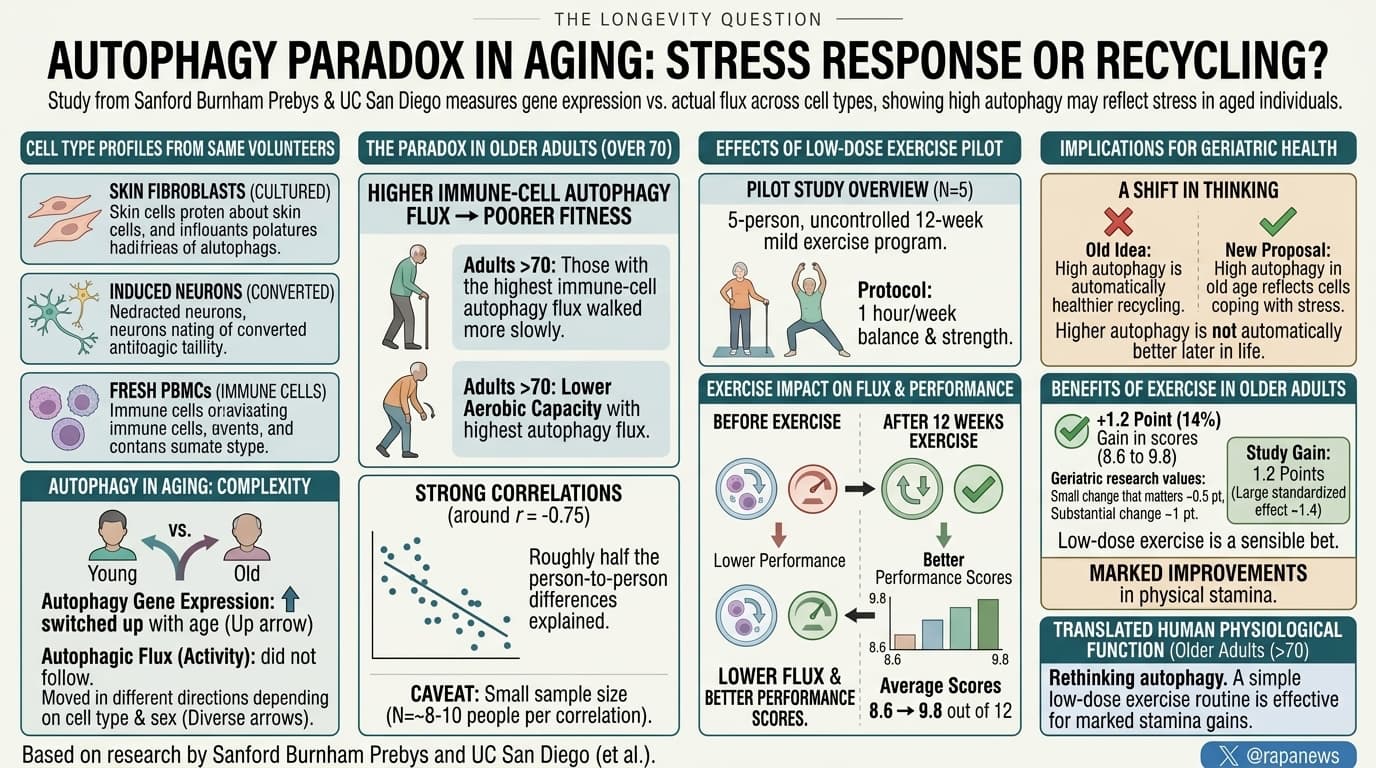
They studied skin fibroblasts, neurons directly converted from fibroblasts, and circulating immune cells called peripheral blood mononuclear cells, or PBMCs. Some samples were matched to the same donors, although the different experiments used overlapping subsets rather than an identical participant group.
A methodological strength is their measurement of autophagy flux. Counting autophagosomes alone cannot distinguish increased production from failed clearance. The researchers therefore measured the additional accumulation of the autophagosome marker LC3B after blocking lysosomal degradation with chloroquine. This estimates LC3B turnover under the assay conditions.
The main results were:
| Cell type |
Sample size for flux measurements |
Findings with increasing donor age |
| Male skin fibroblasts |
23 |
Flux declined, although the association was modest |
| Female skin fibroblasts |
21 |
No detectable age-related change |
| Male induced neurons |
14 |
No detectable age-related change |
| Female induced neurons |
8 |
Flux increased |
| PBMCs, both sexes |
23 |
Greater apparent variability in older participants, but no statistically significant overall association with age |
These findings challenge a simple model in which ageing produces the same decline in autophagy throughout the body.
RNA sequencing, conducted in nine fibroblast samples and thirteen induced-neuron samples, suggested increased expression of autophagy-related programmes with age. The pattern was stronger in fibroblasts and less coordinated in neurons.
However, increased gene expression did not correspond to a uniform increase in flux. For example, fibroblast autophagy-related expression generally increased, while measured flux declined in male fibroblasts. Baseline autophagosome abundance also failed to predict flux.
The physical-function findings were age dependent. Across the full adult sample, higher flux had mixed associations with health measures. Among participants aged 70 and above, higher flux was associated with several measures of poorer physical function.
For PBMCs, the reported associations included:
| Physical measure |
Association with higher PBMC flux |
Reported correlation |
| Maximum oxygen uptake, VO2max |
Lower aerobic capacity |
r = -0.75; p = 0.026 |
| Walking speed |
Slower walking |
r = -0.78; p = 0.01 |
| Chair-stand completion time |
Longer completion time |
r = 0.73; p = 0.02 |
Other associations included higher neuronal flux with weaker grip strength. These analyses involved very small older-age subgroups.
The researchers also examined five adults aged 77 to 88 before and after a 12-week mild exercise programme, consisting of weekly one-hour sessions focused on balance, strength and posture.
PBMC flux decreased in four participants and increased in one. Average Short Physical Performance Battery scores improved from 8.6 to 9.8 out of 12, with p = 0.03. Several other outcomes, including grip strength and blood pressure, did not significantly change.
The authors propose that elevated flux in some older people reflects an increased need to process damaged cellular material. Under that interpretation, lower flux following exercise could reflect reduced cellular stress and reduced demand for autophagy.
That explanation is plausible, but the study does not directly demonstrate it.
Novelty. The main advance is the integration of human cell models, functional autophagy measurements and donor physiology.
Three contributions stand out:
-
Comparing distinct cell types from overlapping, partly matched donors. This provides evidence that a person’s autophagy cannot necessarily be represented by one measurement from one tissue.
-
Identifying contrasting patterns involving age and sex. The increase in female-derived neuronal flux alongside the decline in male fibroblasts is particularly interesting.
-
Connecting flux to physical performance and an exercise intervention in older adults. This raises a useful question about whether high basal flux reflects effective maintenance, increased damage burden, or both.
However, increased blood-cell autophagy with age was already reported by Bensalem and colleagues in 2023, in a study analysing 114 adults at increased risk of type 2 diabetes. They also proposed a compensatory response to age-related damage. :chatgpt-content-reference{index=“0”}
Likewise, Dang and colleagues reported differences by immune-cell subtype, sex and age in 2025. The present paper therefore extends an emerging picture of heterogeneity rather than introducing that concept for the first time. :chatgpt-content-reference{index=“1”}
Critique. The study has several strengths: human samples, dynamic assays, donor matching where available, direct neuronal conversion intended to preserve ageing features, and physiological measurements beyond chronological age. The authors also acknowledge many of the mechanistic limitations.
The main concerns are as follows.
-
Several headline findings are statistically less secure than the narrative suggests.
The overall relationship between PBMC flux and age was not significant: p = 0.44. The apparent increase in variability and higher values among some older donors should therefore be treated as descriptive evidence, not a demonstrated general increase with age.
In fibroblasts, the formal age-by-sex interaction had p = 0.075. Finding a significant association in males and no significant association in females does not itself establish that the associations differ between sexes.
The neuronal age-by-sex interaction was stronger, at p = 0.001, but the female group contained only eight donors. Replication is essential.
-
The gene-expression results require an important qualification.
The Methods explicitly state that none of the curated gene-module comparisons survived correction for multiple testing at a false discovery rate below 0.05.
Consequently, descriptions of significantly increased modules refer to nominal significance. This does not invalidate the separate pathway-enrichment results, but it weakens the certainty of claims about coordinated upregulation of particular modules.
RNA sequencing also measures steady-state RNA abundance. It does not directly measure transcription rate, protein abundance or enzyme activity. The demonstrated mismatch is therefore between RNA abundance and measured flux; its underlying regulatory mechanism remains unresolved.
-
The physical-function correlations are vulnerable to small samples, multiple testing and confounding.
The age-70-plus analyses included at most ten PBMC donors, nine fibroblast donors and six neuronal donors. Large correlations from such small groups can be unstable.
Numerous physiological outcomes were examined across cell types and age groups, without a clearly described correction for this family of correlation tests.
The reported correlations also do not establish independence from age, sex, body size or other influences. This particularly matters for the neuronal association with grip strength: sex could influence both variables.
Moreover, the authors describe selecting the older-age analysis after observing the PBMC pattern around age 70. It should be regarded as exploratory.
-
Measured flux does not establish autophagic quality or reserve capacity.
The LC3B assays are more informative than static measurements, but they do not directly establish:
- How effectively damaged proteins or organelles are eliminated.
- Whether cargo selection is appropriate.
- How much additional activity the system can generate under stress.
- Whether mitochondrial clearance specifically is functioning well.
High basal flux can coexist with an inadequate response to an even greater damage burden. A cell may be processing more material while still falling behind.
Conversely, lower flux could reflect either lower demand or impaired machinery. The assay alone cannot distinguish these explanations.
The study therefore measures aspects of macroautophagy, rather than directly demonstrating effective mitophagy or comprehensive cellular repair.
-
The exercise experiment cannot establish causation.
Five participants, two measurement time points and no concurrent control group provide very limited evidence of an exercise effect on flux.
Natural variability, regression towards the mean, changes in health or behaviour, and sample handling could contribute. The decline in four participants is an observation, not proof of a reproducible treatment effect.
Improved physical performance alongside reduced flux also does not show that reducing flux caused the improvement. Both could be consequences of another change, such as reduced stress.
Descriptions such as exercise “reversing” elevated autophagy are stronger than this design supports.
-
Culture conditions and sampling limit generalisation to intact tissues.
Cultured fibroblasts experience artificial nutrient, oxygen and growth conditions. Directly converted neurons preserve useful donor features, but they do not reproduce an aged brain’s circuitry, tissue environment or lifelong exposures.
The neuronal assay quantified LC3B-positive structures in cell bodies. It therefore cannot fully characterise autophagy in axons and dendrites.
The PBMC measurements also combine immune-cell populations. Broad cell-count checks do not exclude changes in finer subtypes or activation states.
There is a further practical concern when comparing cohorts: SHOCK blood samples were processed within 45 minutes, whereas STRONG samples were processed within 2.5 hours. This difference could affect baseline comparisons between the healthy cohort and the exercise cohort, although it does not by itself explain the within-person exercise observations.
-
The compensatory-stress interpretation remains a hypothesis.
The researchers did not directly connect high flux to measured damage burden, impaired lysosomal reserve, or subsequent deterioration.
Higher flux could be a protective response in people with more damage. It could also arise from immune activation or other physiological differences. These possibilities have different implications for intervention.
The data therefore do not establish that high autophagy is harmful or that suppressing it would improve health. Similarly, senescence-related gene-expression enrichment does not establish which cells are senescent or whether senescence causes the observed flux patterns.
-
The discussion overstates the absence of dietary effects in earlier research.
The paper describes dietary interventions as not significantly modifying PBMC flux, citing Bensalem et al. 2025. However, that study reported a difference between intermittent fasting plus time-restricted eating and standard care at six months, with p = 0.04 in a post hoc analysis.
That result deserves caution, but it makes the dietary evidence mixed rather than uniformly negative. It also weakens the suggestion that dietary variability can readily be discounted when interpreting the exercise findings. :chatgpt-content-reference{index=“2”}
The most informative follow-up would combine a larger longitudinal cohort with a controlled exercise trial, repeated flux measurements, detailed immune-cell phenotyping, direct cargo-degradation assays and tests of lysosomal reserve. Measuring cellular damage alongside basal and stimulated flux would help distinguish increased repair demand from impaired repair capacity.