Did anyone save this page (that I wrote…) by any chance? The website disappeared and the page is not in the WebArchive. I spent hours writing it and it contained a good summary of the pros and cons of selegiline…
3 Likes
Out of all the maoi’s I’ve tried, I rate moclobemide my favorite for mood and energy.
Tranylcypromine, phenylzine, and selegiline were the other maoi’s tried.
Though they all have fairly high ratings online from what I’ve read.
Out of those 4, moclobemide is a reversible inhibitor and the other 3 are irreversible inhibitors.
There is a newer mao-b inhibitor that is reversible called safinamide.
https://en.wikipedia.org/wiki/Safinamide
https://en.wikipedia.org/wiki/Moclobemide
3 Likes
I rate moclobemide my favorite for mood and energy.
Have you used modafinil? If so, are you able to compare Modafinil to Moclobemide? Modafinil can be used intermittently at 1/4 doses and 1/2 doses of the standard 200 mg pill without much of a problem somewhat like the use of caffeine at doses of 50 mg, 100 mg, and the typical 200 mg capsule. I wonder whether or not Moclobemide can be used the same way?
2 Likes
Btw I never got any of these side effects with either drug. Max dose of Selegiline was 2.5mg and Wellbutrin was 225mg
2 Likes
Yes, and currently on modafinil. They are kinda comparable in regarding the dopamine, noradrenline style. Though a bit different in their mechanism of action and the “feeling” they produce as quite a few things are going on for each of them.
Modafinil seems kinda mild in effects after beening on it for 9 months, but still helps in avoiding day time naps which is good.
I don’t have any night time sleep issues with modafinil at 200mg/day.
My biggest problem with the maoi’s was sleep issues, such as waking up at around 2am to 5am, and cannot get back to sleep. I don’t use sleep medication, and would need one if I did decide to use various maoi’s.
If someone can get good effects with low dose (1/4, 1/2) modafinil or moclobemide, that’s amazing.
I did (and still do) take other products that might have boosted the effects of moclobemide such as a high protein diet, extra tyrosine & phenylalanine, and various plant extracts (caffeine, ginseng etc).
That seems to ramp things up 
Let us know if you try it out!
2 Likes
The problem in your calculations is that even the inventor of selegiline, dr. Knoll, thought that main mechanism of action for selegiline is not MAO-B inhibition, but CAE. And I found some info about 3rd plausible mechanism, PDI…
-
MAO-B inhibition
Reduces dopamine and phenethylamine degradation, opposes the age-related increase in MAO-B activity, and may reduce MAO-B-associated oxidative stress and neuroinflammation. -
CAE/TAAR1 enhancer activity
Enhances impulse-dependent monoamine release rather than causing non-physiological transmitter dumping. This is the Knoll “catecholaminergic activity enhancer” mechanism. -
PDI/ER–mitochondrial apoptosis modulation
May protect stressed neurons by limiting PDI-mediated mitochondrial membrane permeabilization, cytochrome-c release, and apoptosis.
And who knows, maybe these 2 more mechanisms may be compromised with pulse dosing? 3rd one definitely will, as it is not validated even in normal 5-10mg ED dosage. Its very likely it will diminish under less frequent and smaller doses.
About CAE (maybe, the main) mechanism of action - I’ve read an info that its potent under pico and femto concentrations.So, maybe it won’t be detrimental for it to take deprenyl EOD with 1,25 doses.
4 Likes
What do we think of Paul’s take on taladalfil?
He is a long time user of Selegiline and is doing incredibly well as a 72 yr old
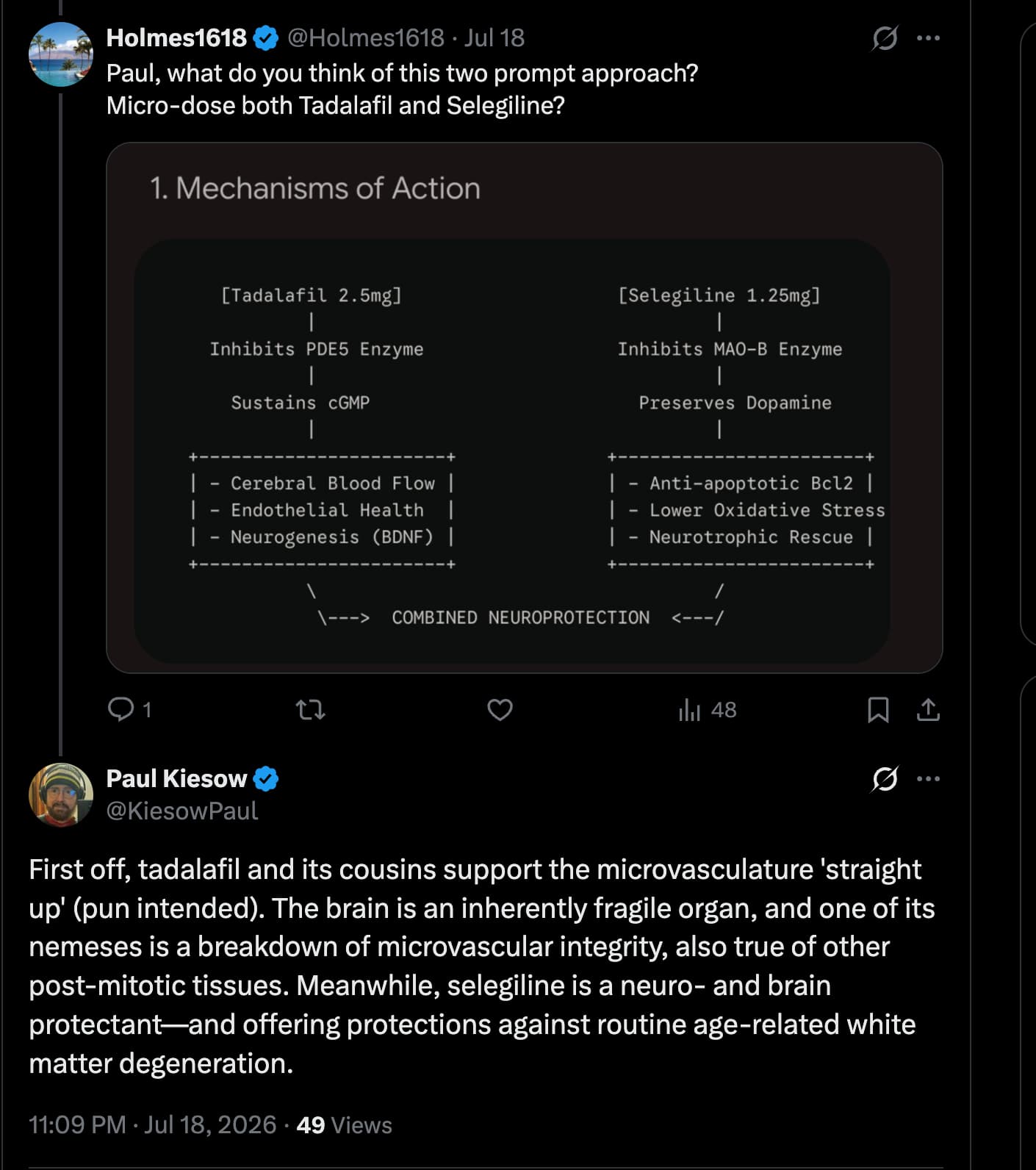
1 Like
We think its worth the try)
2 Likes
No, it’s not needed to avoid cheese with selegiline. It’s a very safe medication with mild side effects, if any in most cases. I am not certain it’s effective for life extension or as anti-aging.
3 Likes
I haven’t had side effects, bt I take 1 mg every other day.
2 Likes
Selegiline induces neuroprotection via PGC-1α/Nrf2 gene upregulation in H2O2 -treated hippocampal-derived neural stem/progenitor cells
https://pubmed.ncbi.nlm.nih.gov/42758107/
Study findings:
The researchers treated neural cells with varying concentrations of selegiline before exposing them to oxidative stress. At a concentration of 10 to the negative 7th molar, selegiline proved most effective, substantially reducing both apoptotic and necrotic cell death compared to untreated cells. The protective effects were accompanied by increased expression of key genes including PGC-1 alpha, Nrf2, and Bcl-2, which are known to support mitochondrial function and prevent cell death.
These findings suggest that selegiline works by activating the Nrf2 and PGC-1 alpha signaling pathways, which help cells defend themselves against oxidative damage. The results indicate that selegiline may have therapeutic potential for protecting neural cells in neurodegenerative diseases such as Alzheimer’s, Parkinson’s, and Huntington’s disease, where oxidative stress plays a significant role in neuronal damage and cell death.
Related scientific research:
Selegiline’s Protection of Brain Cells Through Cellular Defense Mechanisms
Selegiline demonstrates significant neuroprotective capacity against oxidative damage through the activation of multiple cellular defense pathways. Research consistently shows that this monoamine oxidase B inhibitor engages antioxidant and anti-apoptotic mechanisms independent of its primary enzymatic function.
One of the key mechanisms involves the Nrf2 signaling pathway. Deprenyl, the alternative name for selegiline, triggers the nuclear factor erythroid 2-related factor 2 (Nrf2)/antioxidant response element (ARE) pathway by increasing the nuclear translocation and DNA-binding activity of Nrf2 [1]
1
. This activation leads to upregulation of NAD(P)H: quinone oxidoreductase 1 (NQO1) expression, which protects cells from oxidative damage. The study demonstrated that both the antioxidant activity of deprenyl and its effect on NQO1 upregulation were greatly attenuated in Nrf2 siRNA transfected cells, confirming the critical role of this pathway [1]
1
. Additionally, the phosphorylation of extracellular regulating protein kinase (Erk) and Akt can be induced by deprenyl administration, with the ability to enhance NQO1 expression being partly attenuated by MEK inhibitor and almost completely attenuated by PI3K inhibitor [1]
1
.
Another crucial mechanism involves the induction of multiple antioxidative proteins through PI3K and Nrf2-mediated pathways. Deprenyl increased the expression of heme oxygenase-1 (HO-1), peroxiredoxin I (PrxI), thioredoxin I (TrxI), thioredoxin reductase (TrxRxI), gamma-glutamylcysteine synthetase (gammaGCS), and p62/A170 in neuronal cells [2]
2
. The Nrf2-mediated induction of these antioxidative molecules was controlled by PI3K, with neurotrophin receptor TrkB identified as an upstream signal for PI3K-Nrf2 activation by deprenyl [2]
2
.
The redox protein thioredoxin plays a particularly important role in selegiline’s cytoprotective mechanism. Selegiline at 1 microM or less induced Trx for protection against oxidative injury caused by MPP+, with this induction mediated by a PKA-sensitive phospho-activation of mitogen-activated protein kinase Erk1/2 and the transcription factor c-Myc [3]
3
. Selegiline-induced Trx and associated neuroprotection were blocked by antisense against Trx mRNA, demonstrating the essential role of this protein [3]
3
. Furthermore, Trx increased the expression of mitochondrial proteins MnSOD and Bcl-2, supporting cell survival [3]
3
.
In primary neural stem cells, selegiline demonstrated protective effects against hydrogen peroxide-induced oxidative stress. Treatment with selegiline significantly increased cell viability and upregulated the mRNA expression of B-cell lymphoma 2 (Bcl-2) and heat shock protein 4 (Hspa4), while suppressing oxidative stress-induced cell death through both apoptosis and necrosis [4]
4
. The optimal protective dose was 20 µM selegiline in this model [4]
4
.
Selegiline also protects neurons through mechanisms involving nitric oxide production and vascular protection. L-Deprenyl induced rapid increases in NO production in brain tissue and cerebral vessels, producing vasodilation through both endothelial NO-dependent and NO-independent mechanisms [5]
5
. The drug also protected the vascular endothelium from the toxic effects of amyloid-beta peptide [5]
5
.
Furthermore, selegiline can rescue neurons after they have sustained lethal damage through a mechanism independent of MAO-B inhibition. In delayed treatment models, selegiline rescued approximately 69% of dopaminergic substantia nigra neurons that had not died by the time treatment began but were found to die with saline treatment [6]
6
. This rescue capacity suggests that selegiline can partially compensate for the loss of target-derived trophic support [6]
6
.
Overall, selegiline protects brain cells from oxidative damage through multiple interconnected cellular defense mechanisms, including Nrf2/ARE pathway activation, induction of antioxidative proteins, thioredoxin-mediated protection, upregulation of anti-apoptotic factors, and neuronal rescue independent of its MAO-B inhibitory function.
Taking selegiline causes me to have trouble sleeping at night. I currently take 1 mg of rasagiline once a week because it takes several days for MAO-B enzymes to recover. Rasagiline is a more selective, irreversible MAO-B inhibitor.
My father is in his early sixties, and a brain CT scan showed mild physiological brain atrophy. The doctor said this is a normal phenomenon and a part of natural aging. I also had my father take 1 mg of rasagiline every week to delay the normal atrophy of his brain.
The main therapeutic advantage of rasagiline over the other selective irreversible monoamine oxidase-B inhibitor selegiline (l-deprenyl, Eldepryl) is that rasagiline does not have the presumed toxic amphetamine metabolic breakdown products of the structurally similar selegiline. Subjectively, rasagiline feels “cleaner”. Selegiline is metabolised to R(-)-methamphetamine and R(-)-amphetamine, whereas rasagiline is metabolised to R(+)-1-aminoindan. There is no evidence that these trace amphetamine metabolites contribute to selegiline’s neuroprotective action.
Reference:
1 Like
“sufferers from the fatal hereditary disorder we know as the aging process”
Yes, I suffer from that disorder. 
FWIW: Rasagiline is available from India. It is one of the cheap drugs.
Joseph Knoll (co-developer of Selegiline) famously took a low daily dose (1 mg) of Selegiline starting at age 64 and lived to 93.
Pharmacodynamic studies indicate that the in vivo MAO-B inhibition potency of Rasagiline is approximately 5 to 10 times that of Selegiline.
So, based on these, taking 1mg of Rasagiline weekly is probably equal to taking 1mg of Selegiline daily.
Plus, I can’t stand Selegiline which makes me sleeping badly, so I perfer Rasagiline.
Why the preference of selegiline in longevity discussions? Rasagiline doesn’t have amphetamine metabolites.
1 Like
Amphetamine metabolites give me a bad sleep.
Knoll believed the longevity benefit came from catecholaminergic activity enhancement, not the MAO-B inhibition. According to that theory Rasagiline would not be a replacement.
3 Likes
Source: https://desmolysium.com/selegiline/#:~:text=To%20avoid%20the,about%20a%20month.
@desmolysium Did you also take 1 mg of Rasagiline weekly? Thank you!
I took tiny doses daily. But way less than 1mg weekly. It was more like 0.25mg weekly.
1 Like
Given that Rasagiline is an irreversible MAO-B inhibitor and MAO-B recovery takes a long time, I feel that taking it once a week would be much more convenient and manageable than taking it once a day even though with tiny dose.
What do you think? Thanks. @desmolysium