Anyone takes NAC? Plus maybe Glycine? Extends mouse lifespan by 24%. Glycine extends mouse lifespan by 5% in ITP study

Here’s a good meta review and analysis of cysteine

https://onlinelibrary.wiley.com/doi/10.1111/acel.14392

4.1 On the mouse studies

In mice, supplementation with cysteine was found to significantly reduce the risk of death and extend survival time. Subgroup analysis revealed that these effects were independent of the dose, administration method, and genetic background (inbred vs. noninbred, transgenic vs. nontransgenic). It should be noted that, however, the AKR and C3H mice used in two studies develop spontaneous cancers and have shorter lifespans (Harman, 1957, 1961). Indeed, most included mouse studies utilized disease models, like amyotrophic lateral sclerosis (Andreassen et al., 2000; Kurano et al., 2022), lymphoma (Reliene & Schiestl, 2006), premature aging (Kondratov et al., 2009), Huntington’s disease (Paul et al., 2014), renal tubulointerstitial injury (Jin et al., 2014), senescence-associated vitamin D deficiency (Chen et al., 2019), diabetes (Frenkel et al., 2019), and pulmonary fibrosis (Chen et al., 2020). All these studies used NAC and found positive effects. In studies using wild-type animals, no consistently significant improvement was found. Cysteine hydrochloride did not increase the lifespan of male Swiss mice (Harman, 1961) but co-administration of glycine and NAC prolonged the lifespan of C57BL/6J mice (Kumar et al., 2022). To reduce the risk of inbreeding depression and overgeneralizing strain-specific findings, Flurkey et al. used the genetically heterogeneous HET3 mice and found that NAC did not affect the lifespan of female mice. The lifespan of male mice was extended but this might be due to diet restriction because reduced food uptake was observed (Flurkey et al., 2010). Using genetically heterogeneous animal models is important in aging studies.

The form of cysteine does affect the outcomes in mice. Cysteine hydrochloride and NAC are both commonly encountered derivatives of cysteine. Despite sharing certain chemical structural similarities, they diverge in terms of usage, as well as human absorption and utilization. Specifically, NAC is an acetylated form of cysteine. Upon oral administration, it is rapidly absorbed in the gut, delivered to the liver, and hydrolyzed to cysteine. This sequence of events ultimately results in a higher rate of oral absorption and utilization for NAC (Dilger & Baker, 2007; Pei et al., 2018) which may partly explain why only the administration of NAC, but not cysteine hydrochloride, impacted lifespan.
1 Like

In one of the studies posted at the beginning of the thread, there was no glutathione regeneration effect when taking 1.2g of each NAC and glycine but there was at 2.4g of each and 3.6g of each in healthy older adults (average age 65). I think 2.4g of each is probably the lowest effective dose for glutathione restoration and more is better.

4 Likes

yes that makes sense cus we ingest 1-2g of cysteine from our diet daily. so conceivably to raise glutathione beyond what our normal diet provide, 2-3g of NAC is likely needed.

but then there are also the studies on high dose beta carotene (20mg daily, super high, like 30k IU of vitamin A), vit e and NAC (high dose of 7g each humans equivalent) on smokers and wild type mouse models that show increased lung cancer risk (10% for normal wild type mouse but the sample was super small and being wild type, some types are more prone to cancer naturally than others we dont know the breed of those mouse) as well as risks of making cancers spread.

there could be design issues or just flukes with those studies but they deserve thought.

The NAC and cancer link was disproven by recent studies. Vitamins A and E though do have a cancer link and should not be supplemented.

5 Likes

which study? can you share please?

This study shows taking NAC reduces the risk of lung cancer in humans. I trust human data over mouse data. This study is from 2025. I would discount the older mouse study on NAC.

6 Likes

Ah okay cool. This is copd human observational study by the taiwanese.

The other mouse model one was by the french.

Its common for studies to point to different things but the more studies there are the more evidence there is towards certain facts

1 Like

COPD patients have a higher risk of lung cancer. So if NAC caused lung cancer in humans, it should have shown up here. Vitamins A and E did show increased lung cancer in humans.

3 Likes

The Vitamins A and E only increased lung cancer rates in smokers at very high doses daily. At RDA doses, I think the evidence is it does not.

The Taiwan observational study could be flawed, so could the mouse NAC studies, like you said those are mice, of unknown breeds, not humans, with JunD knocked out, etc.

1 Like

I would say again that mice are not humans, and mice are extremely cancer-prone. So it’s a little difficult to believe that this would translate to humans.

I think the observational studies out of Taiwan, using a massive (1M+ patient) database have quite a lot amount of value. You can see that they normalised for other medications (statins, aspirin etc), as well as obvious risk factors like smoking, drinking, lots of co-morbidities etc. Taiwan has a very good, centralised national health insurance system where every appointment, scan, prescription etc is logged, so the data itself should be reliable.

However, for the all-cancer paper you posted, I asked ChatGPT Pro (the $200/month version) to critique it. It pointed out a lot of flaws, where the experimental design strongly biases the study towards finding an effect. A person has to have 3 years of NAC use to be included as an NAC user, and they excluded patients diagnosed with cancer within 3 years of starting NAC. (So, they basically excluded the riskiest people from the treatment group by default). Also, it’s notable the cancers most benefiting from NAC are the ones which are screened, like prostate, breast, colorectal, which could suggest that the people regularly taking prescribed NAC are simply interacting with the medical system more often. The paper is reporting a risk reduction of 30% from taking NAC, which is absolutely massive, and somehow just doesn’t “smell right” for an antioxidant/mucolytic.

The same authors have another paper here: Preparing to download ... about NAC and liver cancer, which is using the same database.

Interestingly, before they matched the NAC users vs non-users, in the raw data the NAC user group actually had higher risk factors. The ones prescribed NAC were older, more rural, more diabetic, had more heart disease etc than those who were not prescribed NAC. Yet, once they normalised the two groups, NAC use still correlated with a massive risk reduction (HR 0.38), which was dose dependent. I’m not an epidemiologist, but to me that sounds like the opposite of healthy user bias, and seems to make the evidence for NAC look even stronger. However, again ChatGPT Pro highlights several issues:

  1. A “immortal time bias” due to the way they assign users and non-users.
  2. Surveillance intensity. It isn’t mentioned in the paper, but it’s a reasonable assumption that the wealthier, more city-dwelling group would have better surveillance and thus more cancer diagnoses.
  3. It doesn’t report major risk factors for liver cancer, such as HepB viral load, fibrosis/cirrhosis. For context, use of antivirals to suppress HBV have a HR of around 0.3 to 0.4. So the paper is claiming that NAC is as effective as antivirals, which seems very hard to believe.

At the same time - NAC is super cheap, seems to be super safe… so why not? In my personal opinion, I reckon maybe there’s something here, but the effect size won’t be 30-60%.

11 Likes

U make some v gd points.

This forum is amazing for biology and longevity science, many knowledgeable ppl, can share opinions and studies freely, ppl are open to scientific discussions etc.

Learned a lot.

Even the thread on david sinclair, i also read many negative opinions abt him, and i am a fan, but after reading them, i realised many negative opinions are reasonable and logical.

3 Likes

NAC is more importantly one of the pre-cursors for Glutathione, the “master antioxidant” that the GlyNAC combo supports.

I’ve been taking 4gm NAC + 4gm Glycine for about 5 years now. Started when I read a couple of the early GlyNAC studies.

NAC effect on glutathione.pdf (573.1 KB)

6 Likes

I’m a high glycine user, would like to see some of these results from the ITP before introducing NAC, but nice post from relaxedmeatball

2 Likes

Some interesting points by the Baylor’s College scientists on excessive antioxidants being harmful and how glycine seems to lower lung cancer rates.

Caveats About GlyNAC Supplementation

(a) GlyNAC supplementation is physiological and does not induce reductive stress

Cells require minute amounts of ROS for cellular signaling and function (52). Excessive decrease of ROS results in cellular damage, a phenomenon known as “reductive stress” (RedS) (53). Cells have to maintain a delicate balance between lowering OxS and simultaneously avoiding RedS. This balance could be upset easily. Excess administration of NAC-alone or GSH-alone in the worm Caenorhabditis elegans (C elegans) results in accelerated aging. This is likely due to induction of RedS ([54](Supplementing Glycine and N-Acetylcysteine (GlyNAC) in Older Adults Improves Glutathione Deficiency, Oxidative Stress, Mitochondrial Dysfunction, Inflammation, Physical Function, and Aging Hallmarks: A Randomized Clinical Trial - PMC)), whereas GlyNAC supplementation in mice increases life span (55). Cellular generation of ROS is a dynamic process linked to mitochondrial energy generation. It fluctuates within organs (rest vs activity, fasting vs fed, waking vs sleeping), and is different in each organ. Dosing of exogenous antioxidants is a challenge as too much could induce RedS, and too little will not restrain OxS. This trial finds that GlyNAC supplementation in OA lowers OxS markers, but these do not decrease below levels in YA thus avoiding RedS. Therefore, GlyNAC supplementation is an ideal physiological supplement that acts by supporting the intrinsic cellular capacity for lowering OxS without inducing RedS.

(b) Why GlyNAC works: the “power of 3”

GlyNAC provides the precursor amino acids glycine and cysteine (from N-acetylcysteine) for GSH synthesis. Glycine, cysteine, and GSH make independent and important contributions toward cellular health and organ function (22,56,57). Their combination represents a “Power of 3” to indicate that benefits occur due to the combined effects of all three components. It is not just GSH alone. Glycine is a rate-limiting amino acid for GSH synthesis (57). It is an important donor of the 1-carbon methyl-group essential for multiple cellular reactions, including purines for deoxyribonucleic acid (DNA) synthesis. Glycine and GlyNAC supplementation in mice significantly increase life span (55,58). Glycine supplementation is shown to lower the incidence of pulmonary adenocarcinoma (58). NAC donates cysteine and which provides the critically essential thiol (SH) groups needed for multiple cellular reactions. This is especially true for mitochondrial energy metabolism. Thiol groups play important roles in cellular reactions, and are a component of peptides, proteins and lipids. GSH is considered a “master antioxidant” based on its abundant presence within cells, its ability to neutralize harmful OxS, support mitochondrial function, and detoxification via glutathionylation. The “power of 3” refers to the combined action of glycine, NAC, and GSH, and could explain the speed and magnitude of GlyNAC-mediated improvement of the age-associated decline in cellular function, reversal of aging hallmarks, and health improvement in aging.

(c) GlyNAC is not the same as NAC-alone or GSH-alone

Although NAC and GSH have antioxidant properties, the effect of their supplementation on age-associated defects are limited. We compared the effects of NAC-alone versus GlyNAC on cardiovascular function in old mice and found that only GlyNAC improved cardiac function and inflammation (leukocyte infiltration), and this was not achieved by NAC-alone (51). Human clinical trials supplementing NAC-alone did not find any improvements RBC-GSH concentrations, OxS, or inflammation (as TNFα) (59–61), GlyNAC supplementation improved/corrected these outcomes in this RCT. A trial supplementing NAC-alone in diabetic patients failed to improve RBC-GSH fractional-synthesis rates or GSH concentrations (62), whereas GlyNAC supplementation in diabetic patients improved both these defects (63), and also improved mitochondrial dysfunction and IR (64). These differing responses can be explained by understanding that GSH synthesis requires both glycine and cysteine, and both are provided by GlyNAC. Because NAC can only provide cysteine, its ability to support GSH synthesis is limited by glycine availability (57). Potentially, NAC supplementation, by sequestering glycine into GSH could further decrease glycine availability for critical pathways discussed earlier. GlyNAC differs from NAC by providing both cysteine and glycine, and this could explain the extent and magnitude of biological and physiological improvements seen in OA in this RCT, and as reported in our prior publications (17,23,25,51). Similarly, supplementing GSH-alone in a human RCT failed to improve OxS (F2-isoprostanes) or genomic damage (8-OHdG) (65), whereas GlyNAC supplementation in this RCT improved both these markers. Furthermore, excess administration of NAC-alone and GSH-alone result in accelerated aging in C elegans (54), while GlyNAC supplementation in mice reversed GSH deficiency and increased longevity (55). GlyNAC supplementation provides a wide range of health benefits not provided by NAC-alone or GSH-alone.

3 Likes

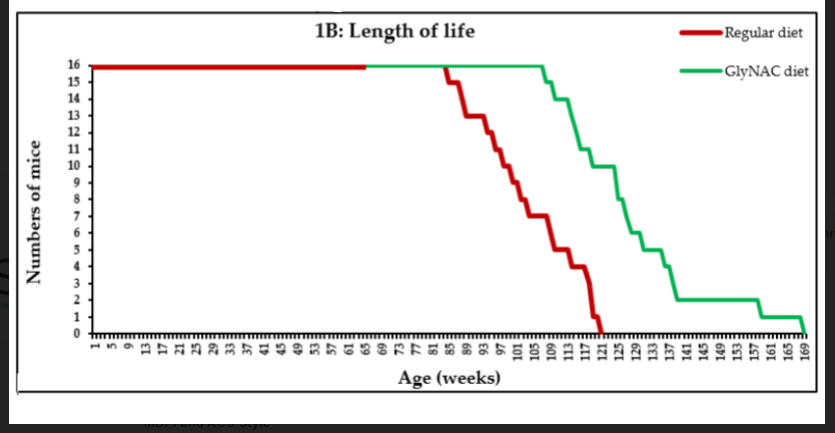
wow look at the lifespan extension in the 16 mice on glynac here. the last mouse lived until 169 weeks, twice the lifespan of the first normal mouse that died. the median glynac mouse outlived the longest lived normal mouse.

if replicated this is even more impressive than rapa.

only gene therapy can beat this.

6 Likes

The control mice fail the 900 days rule by a lot with a 707 days median. Even worse, the “long lived” mice don’t reach a 900 days median life either with 868 days.

GlyNAC is probably good but that study isn’t.

6 Likes

When solid human data exists, I give less weight to animal studies. When animal studies are all we have, they can still provide a useful signal—but they’re never the foundation. Ultimately, it’s the human findings that matter and should be replicated. That’s why the three Baylor studies impress me: they’re real human trials, in real clinical contexts—type 2 diabetes, HIV infection, and aging populations.

I posted them before in this topic.

6 Likes

At least i guess the data is real then

Here is a mouse study. While it comes with the usual caveats of being limited to mice, it still provides a very interesting early signal.

Full paper.
https://www.mdpi.com/2076-3921/12/5/1042

A mouse study on brain function can suggest a potential way to slow brain aging in humans, but only as an early indication, not as proof. Mouse studies are useful because they help researchers understand biological mechanisms and decide which treatments may be worth testing in humans. However, they do not demonstrate that a formulation will actually slow brain aging in people.

Mouse and human brains differ in lifespan, complexity, gene expression, disease progression, and drug metabolism. Because of these differences, more than 90 percent of compounds that show promising anti‑aging results in mice fail in human trials in areas such as neurology, oncology, and metabolic disease. This means that mouse studies create hypotheses but do not confirm them.

A mouse study can show that a biological mechanism might be relevant to human aging, that the formulation could be worth further testing, and that the study can offer early clues about dosage, delivery, and safety in animals.

In aged mice, GlyNAC improved several key processes linked to brain aging. It increased glutathione levels, reduced oxidative stress, improved mitochondrial function, reduced inflammation, improved glucose uptake in the brain, lowered genomic damage, and improved neurotrophic factors. These pathways are well‑known drivers of human brain aging and neurodegeneration. When a single intervention improves all of these mechanisms at the same time in older mice and also reverses age‑related cognitive decline, it represents a strong early signal of possible anti‑aging effects in the brain. This type of broad improvement is the kind of preclinical evidence that often motivates further therapeutic development.

So the GlyNAC mouse study is a very positive signal. But it is important to remember that even strong positive signals in mice often do not translate to humans. Both ideas are true at the same time: the study shows strong potential, but only future human trials can determine whether that potential becomes real.

2 Likes

They cant really do human trials to see if gly nac can extend lifespan can they?

Lol that would require like what 70y of followups from today.

So in humans the best they can do is more short term studies.

1 Like