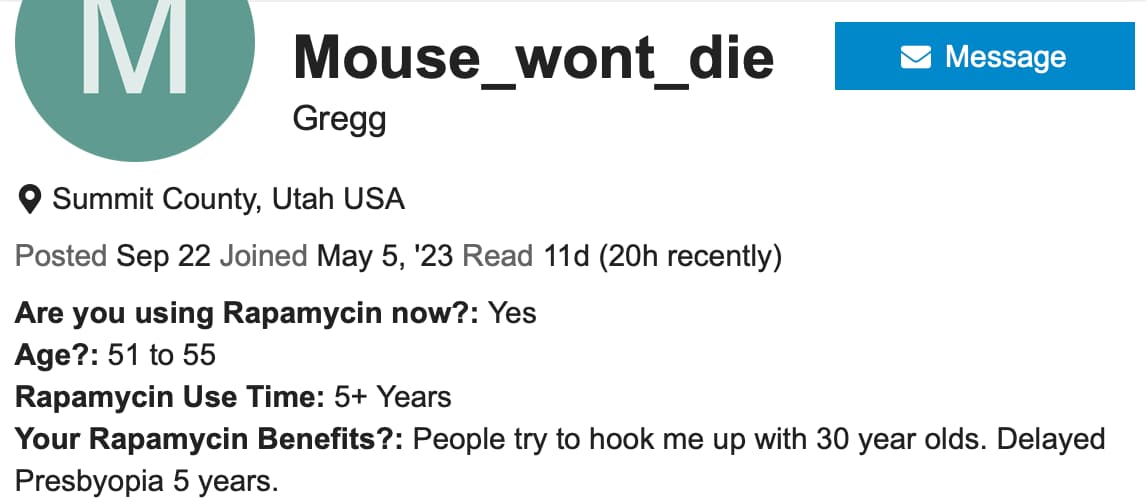
Not sure whether to put this in the humor thread, or here, but I was checking out new members and saw this on one profile… “People try to hook me up with 30 year olds”, is probably a benefit for a guy 51 to 55  @Mouse_wont_die
9 Likes
I’ll share a little of the story; A little over a year ago I was at a family function in Baltimore. While all the 13 year olds were running around and playing, the adult kids had a very nice cocktail hour. Over a blueberry Mojito I struck up a conversation with a local ER Doc and her friend (just colleague’s) a gentleman who worked in Public Health. We mostly spoke about skiing and, Rapa didn’t come up at all.
The next day my Cousin told me that she had a laugh when the lady who I was chatting with at the cocktail hour had approached her with a possible dating opportunity for me. When my Cousin asked her how old this woman was, she was told 36. When my cousin asked her friend how old she thought I was, she was told early 40’s. Maybe it was the Blueberry Mojitos? Or, maybe 6 years of Intermittent Rapamycin Therapy does have profound yet subtle effects.
5 Likes
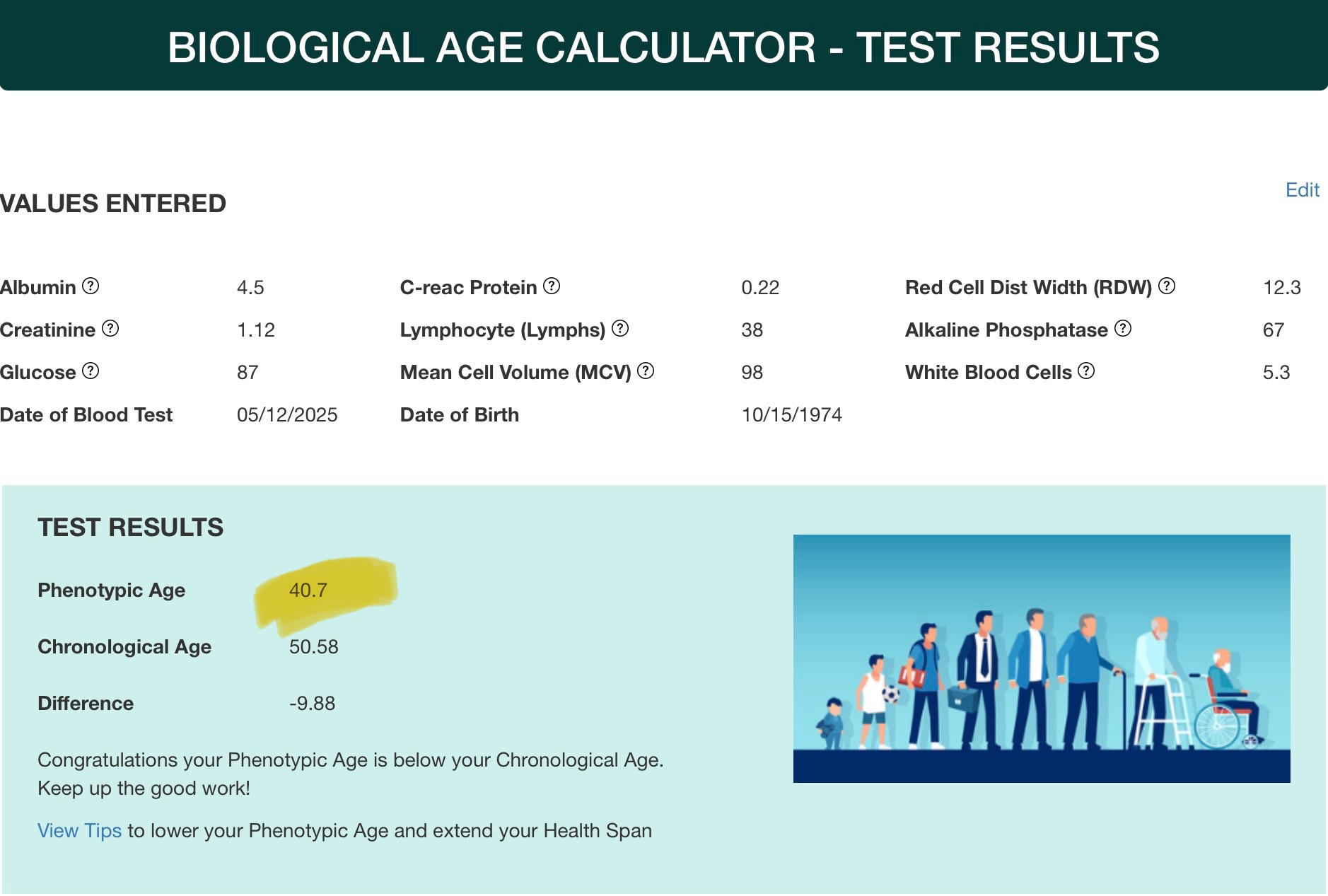
Here’s a slide from a recent Toastmasters speech I gave on Rapamycin. Those are my values. Rapamycin is the Real Deal! I was born in 72’ I always give out wrong birthdays.
9 Likes
Can you share how you’re dosing it along with the frequency of dose?
1 Like
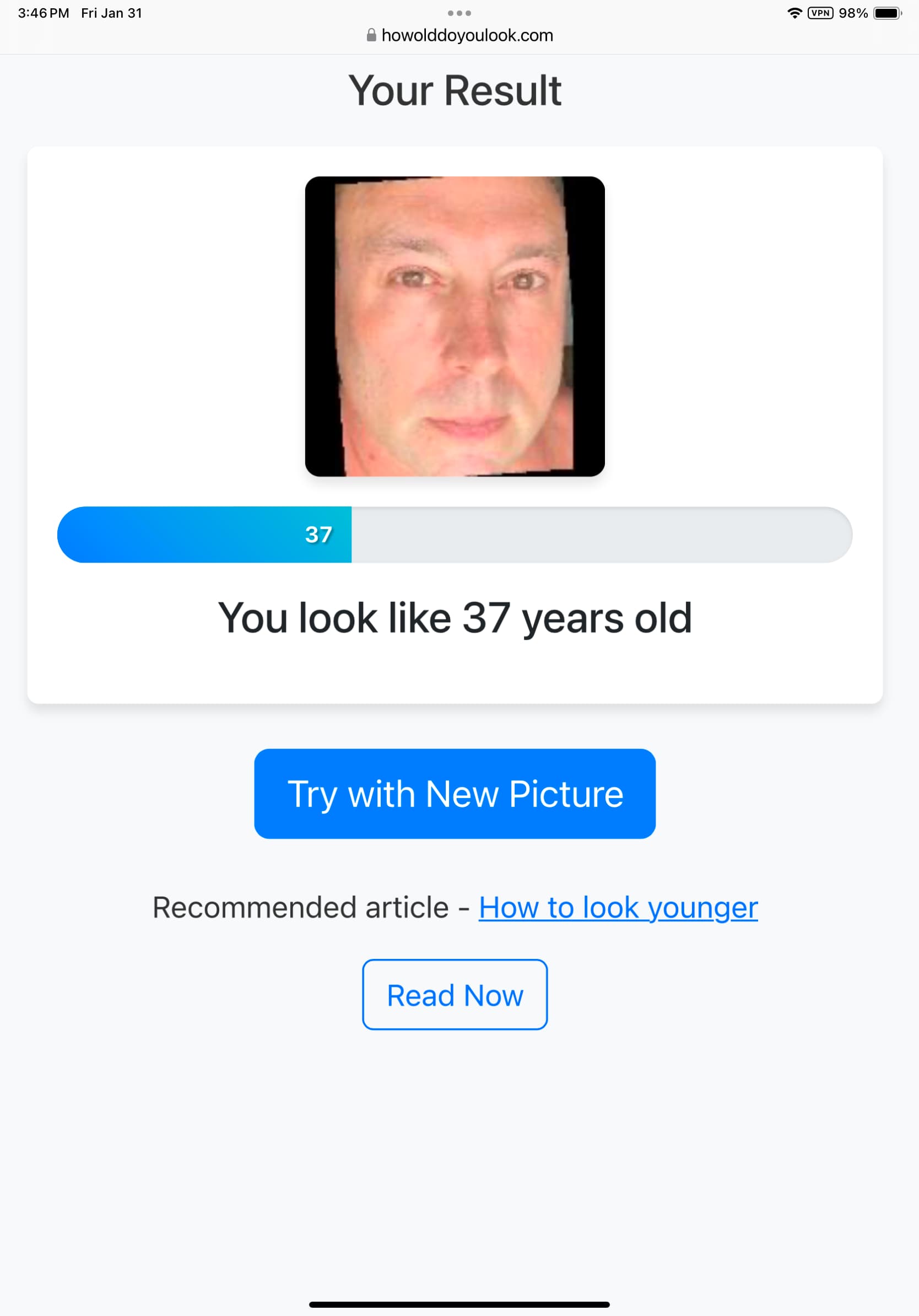
Here is a facial age pic taken in the morning with good sunlight and submitted to one of those “AI- How old am I” sites.
5 Likes
Hi Luke, GF, 4MG Biocon Rapamycin, Weekly.
3 Likes
Not a bad side effect
1 Like
Interesting. My lymphs and RCDW are much worse on Rapa which blunts my age reduction on the ML phenoage clock
1 Like
When I first started in the AgelessRX trial, the intention was to titrate me to 12 once a week. I switched sources within a couple months and have taken 4-5 per week since. Not sure if Ageless requires being in a medical trial these days, but yes that was the dose.
2 Likes
@RapAdmin , suggestion of a topic:
This topic people often vote on the months entering on the rapamycin.news community.
How about a topic to vote, updating the rapamycin effects, for people with more then a certain period on rapamycin? (more then a year, more then 2 years, more then 5 years… I don’t know, you suggest…) to see how people on our community, that is getting rapa for a long time, answer?
2 Likes
One new rapamycin user’s experiences… admittedly in an advertisement from Everest Health. Watch the video, he’s in amazingly good shape and improving even more now with rapamycin.
- Adopted father. Pan-Am Champion (3rd place).
GP dismissed his rapamycin questions.
Found a longevity clinic that didn’t.
Now racing at 90%+ max heart rate.
“You could be doing SO much better. It’s not rocket science. It’s available.”
Source:
https://x.com/goEverestHealth/status/2053867160393371794?s=20
4 Likes
I know it’s changed my life, so I’m a believer!
2 Likes
Continued muscle growth at 71 years of age, using rapamycin:
5 Likes
4 Likes
THANK YOU SO MUCH! I am almost entering 3-month point and you give me hope. I have APOE4 gene so rapa has been on my bucket list to try, given studies showing improvement with brain function and volume
3 Likes
Yeah… for me, and many people I read about before taking rapamycin… it was at 3 full months …90 days that the first hints of improvements started to show. Things like reduced arthritis, and allergies, dysphagia choking… improved memory and more strength.
And, protection from alzheimers and cancers.
Keep us posted!
5 Likes
Peter Attia has new thoughts about rapamycin. I don’t really see much to disagree with:
Summary Added by RapAdmin
I. Executive Summary
Dr. Peter Attia presents a critical appraisal of rapamycin (sirolimus) as a human longevity therapeutic, framing the current clinical adoption of off-label mTOR inhibitors around three unresolved translational questions: mechanistic plausibility,pharmacodynamic exposure optimization, and net clinical risk-benefit balance. Preclinical biogerontology unequivocally establishes mechanistic target of rapamycin (mTOR) inhibition as a robust lifespan-extending intervention across a billion years of eukaryotic evolution, demonstrating reproducible median and maximal lifespan extension across Saccharomyces cerevisiae , Caenorhabditis elegans , Drosophila melanogaster , and genetically heterogeneous mice within the National Institute on Aging Interventions Testing Program (Harrison et al., 2009). However, direct empirical validation that chronic mTOR attenuation confers geroprotection or extends healthspan in humans remains non-existent.
The second translational hurdle involves pharmacokinetics, biodistribution, and dosing architecture. Human longevity regimens routinely extrapolate off-label once-weekly dosing protocols from short-term immunological trials conducted by Mannick et al., 2014, wherein low-dose pulsed rapalogs (RAD001/everolimus) enhanced vaccine seroconversion titers without chronic immunosuppression. This intermittent paradigm directly conflicts with preclinical mammalian longevity models, in which rodents receive continuous, unpulsed rapamycin via dietary admix throughout adulthood. Critical translational parameters—optimal clinical dosing thresholds, weekly versus bi-weekly frequency, cumulative exposure duration, drug-holiday cycling schedules, and ideal chronological or biological age of initiation—remain entirely uncharacterized in clinical medicine. Ongoing trials in companion dogs, such as the Test of Rapamycin in Aging Dogs (TRIAD) directed by Matt Kaeberlein (Kaeberlein et al., 2024), utilize intermittent regimens in outbred companion animals sharing human environments to help bridge this gap.
Consequently, Attia highlights the final clinical impasse: current human safety and efficacy data fail to establish whether once-weekly off-label rapamycin provides an acceptable margin of safety to justify elective preventive use in asymptomatic individuals. Without longitudinal phase 3 randomized controlled trials evaluating hard clinical endpoints or validated surrogate biomarkers, the risk of off-target toxicities—including dyslipidemia, impaired glucose tolerance via disruption of mTOR complex 2 (mTORC2), stomatitis, and subclinical immunosuppression—precludes definitive medical endorsement.
II. Insight Bullets
- Longevity physician Dr. Peter Attia organizes the clinical evaluation of rapamycin into three unresolved questions:biological mechanism, optimal drug exposure, and overall risk-benefit safety margin.
- Pharmacological inhibition of mechanistic target of rapamycin (mTOR) unequivocally extends lifespan across all four primary eukaryotic model systems: yeast, flies, nematodes, and rodents.
- The conservation of mTOR signaling across approximately one billion years of evolutionary divergence provides a strong theoretical rationale for mammalian geroprotection.
- Despite universal preclinical efficacy in model organisms, empirical clinical evidence proving that mTOR inhibition extends human lifespan or delays multi-morbidity remains completely absent.
- Translation from non-human models to humans requires resolving fundamental pharmacokinetic uncertainties regarding optimal therapeutic dose, dosing frequency, and treatment duration.
- Clinical medicine currently possesses zero consensus data regarding whether human rapamycin protocols require intermittent cycling schedules, drug holidays, or indefinite administration.
- The optimal chronological or biological age for initiating preventative mTOR inhibition in humans is currently unknown and unsupported by prospective trials.
- Prevailing off-label human rapamycin protocols rely almost entirely on extrapolations from an exploratory clinical trial conducted by Mannick et al., 2014.
- The Mannick et al., 2014 trial evaluated the rapalog everolimus (RAD001) at low daily or weekly doses and demonstrated enhanced influenza vaccination antibody titers in older adults.
- A significant translational discordance exists between human protocols and preclinical rodent studies, as murine longevity data were generated through continuous daily dietary exposure rather than intermittent weekly pulses (Harrison et al., 2009).
- Continuous mammalian mTOR inhibition in animal feeds creates uninterrupted tissue exposure that cannot be directly mapped onto pulsatile human dosing models.
- Dr. Matt Kaeberlein is directing canine interventional trials through the Dog Aging Project to evaluate the healthspan and lifespan effects of rapamycin in outbred companion animals (Kaeberlein et al., 2024).
- The canine TRIAD clinical trial utilizes intermittent weekly rapamycin dosing regimens that closely model human off-label longevity protocols.
- Companion dogs serve as a critical translational model because they share human anthropogenic environments,genetic diversity, and age-related disease patterns on an accelerated timescale.
- A central clinical question for practitioners is whether the popular once-weekly rapamycin regimen provides sufficient biological benefit to justify elective administration in healthy individuals.
- The therapeutic margin of safety for off-label rapamycin in non-transplant, non-oncological populations remains uncharacterized over multi-year time horizons.
- Attia states that the lack of rigorous clinical data leaves him fundamentally undecided regarding whether to recommend off-label rapamycin for preventive longevity.
- The medical ambiguity surrounding rapamycin cannot be resolved without robust clinical trials testing hard healthspan endpoints rather than speculative biomarkers.
- Pulsatile once-weekly dosing is hypothesized to selectively suppress mTOR Complex 1 (mTORC1) while minimizing the disruption of mTOR Complex 2 (mTORC2).
- Chronic non-selective mTORC2 inhibition drives clinically significant adverse effects, including peripheral insulin resistance, hyperlipidemia, and immune dysfunction (Lamming et al., 2012).
- Clinical trials in healthy older adults, such as those by Kraig et al., 2018, confirm the general short-term tolerability of low-dose rapamycin but demonstrate limited baseline physiological improvements.
- Attia invites rigorous, objective scientific evidence and prospective randomized controlled trials to substantiate clinical decision-making surrounding human rapamycin use.
Short enough to watch, but he says he doesn’t know. I think tracking n=1 in detail is a solution.
1 Like
Hi doesn’t mention the success in monkeys, which is a lot closer to humans than mice… so much more compelling. I actually think, given what we know about the monkey trial, that we are much further along than Attia thinks. He obviously has not gone deep on the monkey data. We know dosing levels that work in primates, we know many of the things that Attia suggests we don’t know : Breaking: 15% Healthy Lifespan improvement via Rapamycin seen in Marmosets and Adam Salmon's Marmoset Longevity Study
Of course, it hasn’t been published yet (I’m talking with Adam Salmon and its still in process). I’ll feel more confident once its published, but the general lay of the land is much firmer than Attia suggests, I believe.
4 Likes
That’s true, and I thought that also, plus he didn’t mention preliminary data in dogs showing robust heart benefits (or cats vs HCM). However, if going by very strict criteria of peer reviewed studies, we are still not fully there.
The biggest issue right now is that we have no clear biomarkers we can follow in humans to assess impact of rapamycin (since lifespan RCTs in humans won’t ever happen). Even something on the negative side, like lipid or glucose dysregulation is not necessarily a signal to lower the dose or alter the protocol - it may be that it’s simply an undesirable(?) side effect, a necessary cost of bigger benefits (and therefore perhaps necessitating adding drugs to deal with such dysregulation - same as with a life saving cancer drug needing other drugs to deal with sides… you don’t quit the cancer drug). In marmosets we have - so far - seen arthritis issues as a side effect, so if we want to keep the 15% life extension we must find a way to deal with that (in a non-interfering way with rapa beneficial effects by for example using a drug that inadvertantly abolishes mTOR inhibition), without giving up the 15%. In other words, a negative side effect is not a surefire way of establishing that the dose is wrong (same for mouth sores, pimples, mild gastric effects etc.) - it might, or might not be a signal about the protocol.
Therefore PA is right - it is hard to establish an optimal, or even reasonable dosing protocol. Throw in another consideration - we are all different. Recall, that as is true of any drug, even if the majority benefit, there are some - as in the ITP - for whom it is the opposite effect, it shortens lifespan. So the dose must be adjusted individually. In the PEARL trial it was speculated that males experienced no observable benefits due to the dosage being too low - so should the dose be weight adjusted? I happen to be a slow metabolizer of drugs in general (genetical analysis of SNPs), which I have verified with rapamycin - the blood levels are quite high and come down slower, while Beth (and apparently Matt Kaeberlein) is the opposite. Presumably we should take that into account - our protocols will be different - and it is easy to imagine that there would be other criteria which should also be taken into account, not just how fast it’s metabolized. Hopefully the Arizona trials will get us some answers, but that’s years away and we are not getting any younger - waiting around for clarity is not an option for many of us (Charles is 85), therefore we have to guess and experiment, all in considerable fog. So yes, PA is right, but so what - as so very often in life, indeed most of the time, you are forced to make choices with incomplete or absent data, sux, but that’s reality. And we all may make different choices - PA his, I mine, and you yours. May luck be with us - being lucky beats being good every time. Spin that wheel!
5 Likes