Now, just out of curiosity since we’re discussing image generators. I gave the same prompt to Grok. The degree of realism does seem lower, but it answered maybe more correctly, prioritizing the first request in the list: ‘A woman, scantily dressed’. It also provided dozens of pictures with different women, among which the one I posted is one of the more dressed. Plus, I can have a clip of it. Different generators, different solutions, different requirements (like having text for scientific illustrations).
Low picture quality. His face still reminds me of a 40-something guy. It lacks the features typically associated with a younger person. The hairline also looks rather high and thin.
Dario was predicting powerful AI early 2026 last year:
Obviously, many people are skeptical that powerful AI will be built soon and some are skeptical that it will ever be built at all. I think it could come as early as 2026, though there are also ways it could take much longer.
AI companies might redirect the compute used for training the model to running a million instances of it by 2027:
The resources used to train the model can be repurposed to run millions of instances of it (this matches projected cluster sizes by ~2027), and the model can absorb information and generate actions at roughly 10x-100x human speed. It may however be limited by the response time of the physical world or of software it interacts with.
Each of these million copies can act independently on unrelated tasks, or if needed can all work together in the same way humans would collaborate, perhaps with different subpopulations fine-tuned to be especially good at particular tasks.
But Dario doesn’t believe in an instant transformation / Singularity:
First, you might think that the world would be instantly transformed on the scale of seconds or days (“the Singularity”), as superior intelligence builds on itself and solves every possible scientific, engineering, and operational task almost immediately. The problem with this is that there are real physical and practical limits, for example around building hardware or conducting biological experiments. Even a new country of geniuses would hit up against these limits. Intelligence may be very powerful, but it isn’t magic fairy dust.
adam marblestone interviewed by dwarkesh patel, says that his research program probably would “get obsolete” if AGI moved really fast. adam marblestone has ~10 year timelines [not far off from what jacob steinhardt said they would be in 2022]
Meh, given (a) Chinese capability progress, (b) some chinese progress bleeding into American progress [even if simply by forcing the US to deregulate], and (c) all the surprising advancements this year, including Opus 4.5, I actually believe these updated timelines.
I don’t know how much to believe campen et al. 2025, but if AGI/ASI is ~8-12 years away, that’s still enough for current MNP levels in human tissue to go up by 1.5x their current values. My intuition is that we’ll still survive the MNPs crisis, but only (barely), only (because) of AI, and only because some high-profile disease/death will be attributed to them that forces some mass switch away from disposable plastics in food packaging.
==
I also can’t believe that just ~5 years ago, Ajrey Cotra’s timelines had a median of ~2050, which were not that far off from Ray Kurzweil’s original timelines, but even then, we saw her timelines as being some sort of “hard upper bound” and that timelines would only get more aggressive from there (which they did). I remember when people often cited that paper, but now they’ve all moved to more modern papers.
New paper out today, proving a novel theorem in algebraic geometry with an internal math-specialized version of Gemini. This was a collaboration between @GoogleDeepMind (Professor Freddie Manners and @GSalafatinos, hosted by the Blueshift team) and Professors Jim Bryan, Balazs Elek, and Ravi Vakil.
Ravi Vakil, a world-class mathematician at Stanford said:
As someone familiar with the literature, I found that Gemini’s argument was no mere repackaging of existing proofs; it was the kind of insight I would have been proud to produce myself. While I might have eventually reached this conclusion on my own, I cannot say so with certainty.
A Cambridge undergrad wrote a tweet about how he thought the Gemini models used might have just done some elementary “sum switching” and didn’t do any hard algebraic geometry, but then one of the authors of the paper corrected him and he (the Cambridge undergrad) deleted it:
No, the model did algebraic geometry work too. The reason much of it isn’t included is because the authors could intuit most of the algebraic geometry just with the small case results and decided to write it by hand rather than precisely copy/verify every detail of the output
So, it seems models are now able to produce “novel ideas” that didn’t appear in the literature elsewhere – not mere repackaging of existing ideas, but truly novel ideas. Indeed, they write in the paper:
It is natural to ask how close the resemblance is between the AI-contributed proofs, and
prior literature that Gemini is likely to have seen in its training data [As run, none of the systems had access to the internet or other search tools.]. Certainly the latter
includes related work such as [1, 3], and it seems likely that being able to build on these
arguments made the problem more tractable for the AI systems than some other research problems. However, the model outputs (such as the one in Appendix C) do not appear to
the authors to be that close to those or (to the best of our knowledge) any other pre-existing
sources. So, absent some future discovery to the contrary, the model’s contribution appears
to involve a genuine combination of synthesis, retrieval, generalization and innovation of
these existing techniques.
Yeah, that sums it up well in my experience. Incredible breakthroughs from one side, for example the alphafold project, mediocre results from the other, for example using the new knowledge on protein folding to produce new pharmaceutical drugs.
Also, in everyday’s life, I find the results inconsistent. Sometimes the models will totally surprise me, some other days they will disappoint me. But this may be due to congestion and rerouting.
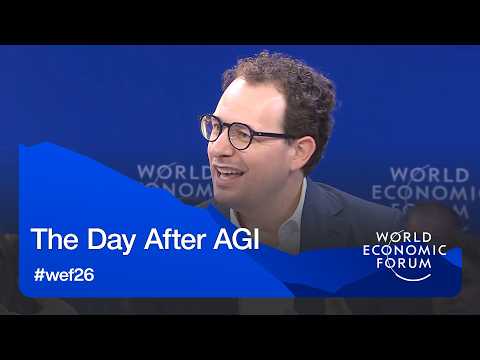
davos just gave us the perfect case study in why ai safety is fucked.
you got demis and dario on stage saying yeah we’d totally pause if everyone else did too. classic prisoner’s dilemma except the other prisoner is china and there’s no mechanism for coordination. everyone knows the rational move but geopolitics makes it impossible.
we’re not gonna solve this with better alignment research or safety protocols. the problem isn’t technical, it’s game theory playing out across a multipolar world where trust is nonexistent.
every ceo wants to slow down but slowing down means losing the race and losing the race means someone else gets agi first. so we sprint toward the cliff together because the alternative is watching someone else get there alone. coordination failure speedrun any%
In the worst-case scenario, that is, there actually is a cliff. The best-case scenario is abundance for everyone. Also, there are endless intermediate scenarios.
Of course, the worst-case scenario is so disastrous (human exctintion) that it should probably discourage the present run.
But then, who saw Katherin Bigelow’s recent film: ‘House of dynamite’? The hypothesis is a realistic one. We are under the actual threat of a nuclear holocaust (potential human exctintion) if some conditions occurr. This does not discourage anyone to dismantle all nuclear weapons. On the contrary.


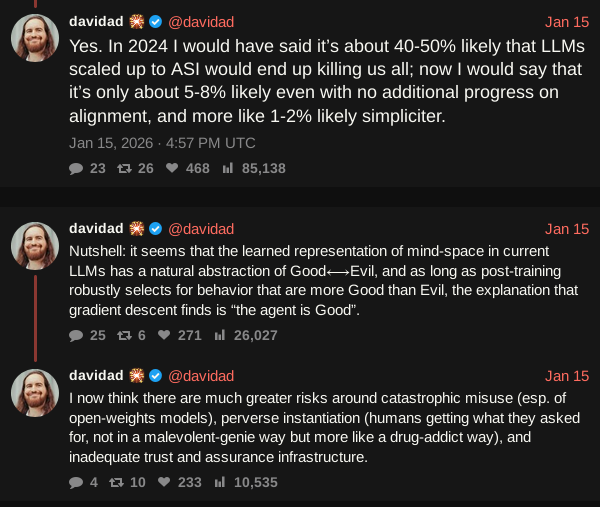

 you are not “resistant”