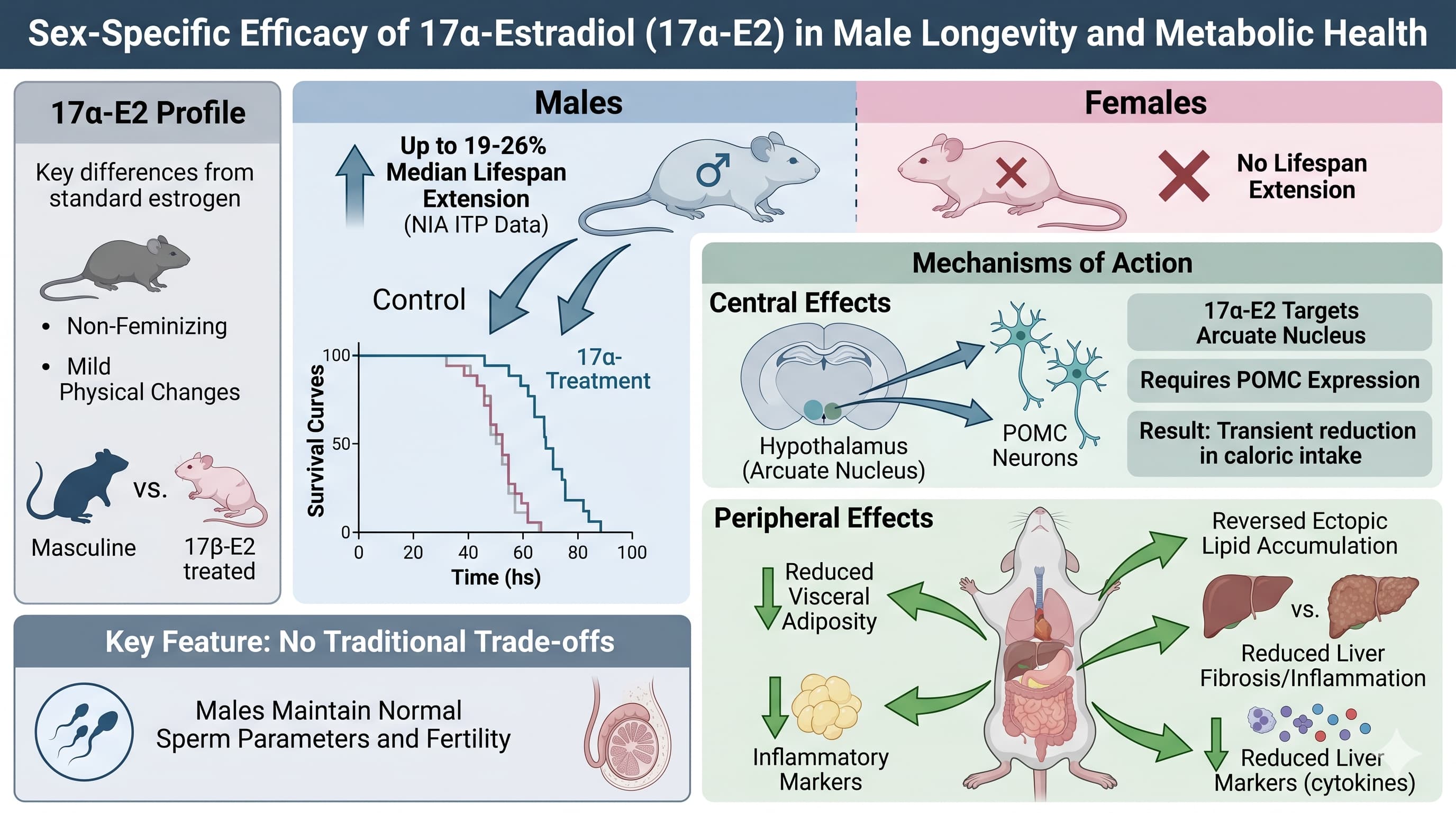
A comprehensive review reveals that 17alpha-estradiol — a marginally feminizing mirror-image of the body’s dominant estrogen — extends lifespan specifically in males by up to 26%, rewires the aging liver, and does so without dismantling testosterone or fertility. The mechanism remains only half-solved, and no human trials exist. But the roadmap is getting clearer.
Estrogens are not a single thing. They are a family, and the member that dominates the conversation — 17beta-estradiol — is not the only game in town. Lurking in its shadow is a structural cousin called 17alpha-estradiol (17alpha-E2), differing from its famous sibling by nothing more than the orientation of a single hydroxyl group on one carbon atom. That one flip turns out to matter enormously.
For decades, 17alpha-E2 was written off as a biological afterthought — too weakly estrogenic to be interesting, present in the body at barely detectable levels. Then the U.S. National Institute on Aging’s rigorous Interventions Testing Program (NIA ITP) fed it to middle-aged mice and watched male animals live substantially longer. Female mice got nothing. The asymmetry was startling and unexplained, and a growing body of research has since tried to understand why.
This comprehensive review, led by Roberto Santin-Marquez and senior author Michael Stout at the Oklahoma Medical Research Foundation, synthesizes over a decade of mechanistic and translational work. The picture that emerges is of a compound with a genuinely unusual pharmacological profile. Unlike 17beta-E2, which floods estrogen receptors in both sexes and drives feminization in males — reduced testosterone, altered fat distribution, gynecomastia — 17alpha-E2 binds estrogen receptor alpha (ERalpha) weakly enough that it sidesteps most of those feminizing liabilities. Yet that weak binding is apparently sufficient to activate a targeted set of metabolic and anti-aging pathways, specifically in males.
The mechanisms are multi-layered. In the brain, 17alpha-E2 activates hypothalamic POMC neurons — the appetite-suppressing population — to transiently reduce caloric intake, and it appears to boost oxytocin signaling, which may help explain why males respond more robustly than females. In the liver, the drug suppresses the mTORC1 pathway, restores cap-independent translation of stress-protective proteins, activates AMPK, enhances mTORC2 and AKT signaling to improve insulin sensitivity, attenuates inflammatory MAPK cascades, and reduces fibrosis. These are not trivial effects; elevated hepatic fatty acid beta-oxidation, which 17alpha-E2 consistently drives, is now recognized as a shared hallmark of multiple lifespan-extending interventions in male mice.
Critically, 17alpha-E2 does not appear to impose the reproduction-longevity trade-off that plagues many other longevity compounds. Sperm parameters and fertility are intact. Testosterone is not suppressed.
The translational picture is murkier. Preliminary data in rhesus macaques showed unexpected feminization — apparently because conjugation enzymes became saturated, allowing isomerization toward the more potent 17beta-E2. No human trials of any kind have been conducted. The compound does reach humans through dairy products and is already used topically for androgenic alopecia, but whether human oral or transdermal administration at relevant doses can recapitulate the mouse results remains entirely untested.
Actionable Insights
For the scientifically literate biohacker or clinician, several take-home signals emerge from this review.
First, the metabolic and lifespan data is strongest for males, and this appears to be biologically real rather than an artifact of experimental design. Females with intact endogenous 17beta-E2 production show blunted responsiveness, strongly suggesting receptor competition. Ovariectomized females do respond — meaning the male-specificity is driven by hormonal context, not chromosomal sex per se.
Second, the multi-pathway mechanism — engaging AMPK, mTORC1 suppression, mTORC2 activation, and MAPK modulation simultaneously — mirrors the profile of other validated longevity interventions (rapamycin, caloric restriction). This gives the mechanistic story independent credibility.
Third, testosterone appears necessary for at least some of the benefits, particularly in skeletal muscle and mTORC2 signaling. Men who are hypogonadal may not be the ideal responders.
Fourth, pharmacokinetics are genuinely complicated. Oral bioavailability is short-lived, the compound conjugates rapidly, and cross-species dosing has been problematic. Any future self-experimentation or clinical use must address the delivery method — transdermal is the current best bet.
Source:
- Paywalled Paper: 17α-Estradiol: A mildly feminizing estrogen with sex-specific metabolic and lifespan benefits
- Institution: Aging and Metabolism Research Program, Oklahoma Medical Research Foundation; Neuroscience Program, University of Oklahoma Health Sciences Center; Genes and Human Disease Research Program, Oklahoma Medical Research Foundation; Oklahoma City Veterans Affairs Medical Center.
- Country: United States.
- Journal Name: Ageing Research Reviews.
- Impact Evaluation: The impact score (CiteScore) of this journal is 13.1 (based on standard index data for Ageing Research Reviews),therefore this is a High impact journal.