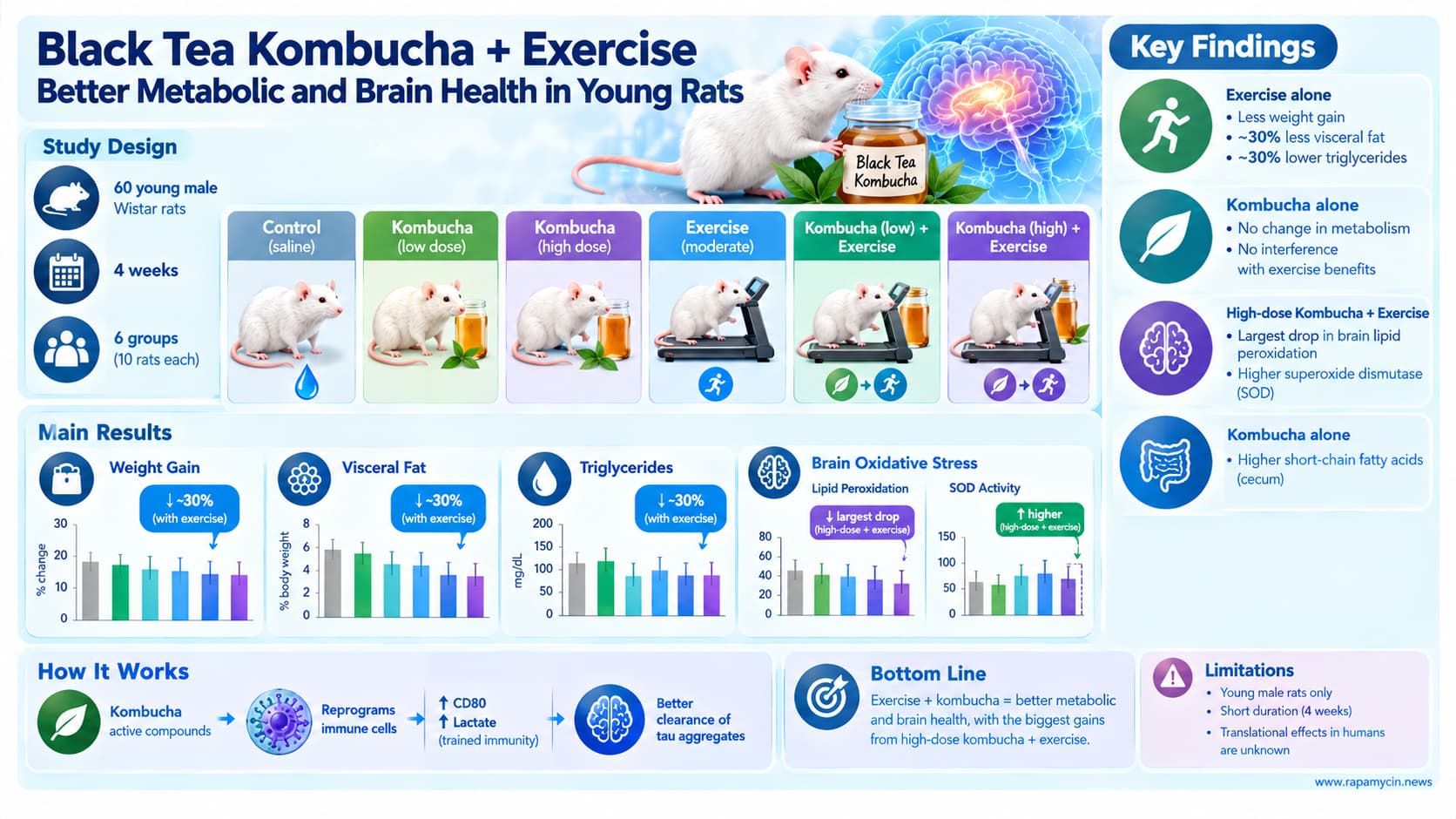
Brazilian researchers gave 60 young male Wistar rats saline, two doses of black tea kombucha, moderate treadmill exercise, or exercise combined with each kombucha dose for four weeks. Exercise alone produced the metabolic gains: less weight gain, about 30 percent less visceral fat and about 30 percent lower triglycerides. Kombucha alone changed none of these but did not interfere with them. Combining the higher kombucha dose with exercise produced the largest drop in brain lipid peroxidation and raised brain superoxide dismutase activity. Kombucha alone raised cecal short-chain fatty acids, but that effect disappeared when kombucha was paired with exercise.
Kombucha has collected a long list of wellness claims, most resting on thin human evidence. A new study from Brazil asks a more practical question: does the fizzy fermented tea add anything to a workout?
Researchers at the Federal University of Pampa assigned 60 young adult male rats to one of six regimens for four weeks: saline, a low or high dose of kombucha, moderate treadmill running, or running combined with either kombucha dose. Runners trained 30 minutes a day, five days a week, at about 60 to 70 percent of their estimated aerobic capacity. The kombucha, brewed in the lab from black tea and sugar for seven days, was given by stomach tube.
The metabolic results belonged to exercise. Running rats gained roughly half as much weight as sedentary controls, carried about 30 percent less fat around the kidneys, and had about 30 percent lower blood triglycerides. Kombucha alone moved none of these measures. It did not get in the way either: rats that ran and drank kombucha kept every metabolic benefit of exercise.
The more interesting signal came from the brain. Lipid peroxidation, a marker of oxidative damage to membrane fats, fell in every treated group. Exercise alone cut it by close to half. Running plus the high kombucha dose cut it by about two-thirds, a significantly bigger drop than running alone. Brain superoxide dismutase, a frontline antioxidant enzyme, rose 50 to 70 percent only in rats that both ran and drank kombucha.
The gut told a different story. Sedentary rats on kombucha had more short-chain fatty acids such as propionate and butyrate in their cecal contents. These compounds come from microbial fermentation and are widely linked to gut and metabolic health. That effect vanished in rats that also exercised, a point the paper’s own abstract misstates.
There is a twist for anyone who sips antioxidants around training. In leg muscle, running alone nearly tripled levels of non-protein thiols, mostly glutathione, a classic sign of adaptation to exercise stress. In rats that also drank kombucha, that rise was largely blunted. Similar blunting has been reported in people taking high-dose vitamins C and E, where it was tied to weaker training gains. Whether kombucha does the same in humans is unknown.
The caveats are substantial. The study ran for four weeks in young healthy males with ten animals per group. There was no unfermented sweet tea control, so the effects cannot be attributed to fermentation rather than tea polyphenols or sugar. Several published blood values are physiologically impossible as printed. No gut bacteria were sequenced.
What survives is a modest version of the big idea: exercise does the heavy lifting, kombucha does not undermine it, and the pairing may protect brain lipids. That last claim now needs a properly controlled test.
Actionable insights
Exercise is the active ingredient. In these rats, 30 minutes of moderate running five days a week cut visceral fat by about 33 percent and triglycerides by about 30 percent. Both are “large” effects by statistical convention: pick one exercised rat and one control at random, and the exercised rat had less visceral fat about 79 percent of the time and lower triglycerides about 82 percent of the time. Human effects are typically smaller, but the direction is well established.
Kombucha will not substitute for movement. It had zero effect on weight, fat, triglycerides or blood sugar.
If you already enjoy kombucha, it did not dull the metabolic benefits of exercise, and the high dose plus exercise lowered a brain oxidative damage marker by roughly 37 percent more than exercise alone. That rat dose scales to about 115 to 230 mL a day for a 70 kg adult using standard body-surface conversion, roughly one small bottle.
Two practical cautions. Kombucha blunted a muscle antioxidant adaptation to exercise, so separating it from your training window is a reasonable, low-cost hedge (speculative). And the brew started at 100 g of sugar per liter; choose lower-sugar products.
Context and source
- Open Access Paper: Combined effects of kombucha consumption and aerobic exercise on oxidative stress and metabolic parameters in Wistar rats
- Institutions: Federal University of Pampa (UNIPAMPA), Uruguaiana, with the Federal University of Santa Maria (UFSM), Santa Maria
- Country: Brazil
- Journal: Journal of the Science of Food and Agriculture (Wiley, on behalf of the Society of Chemical Industry),
- Impact evaluation: The impact score of this journal is 4.0, evaluated against a typical high-end range of 0 to 60+ for top general science (roughly 0 to 15 within food science), therefore this is a Medium impact journal.