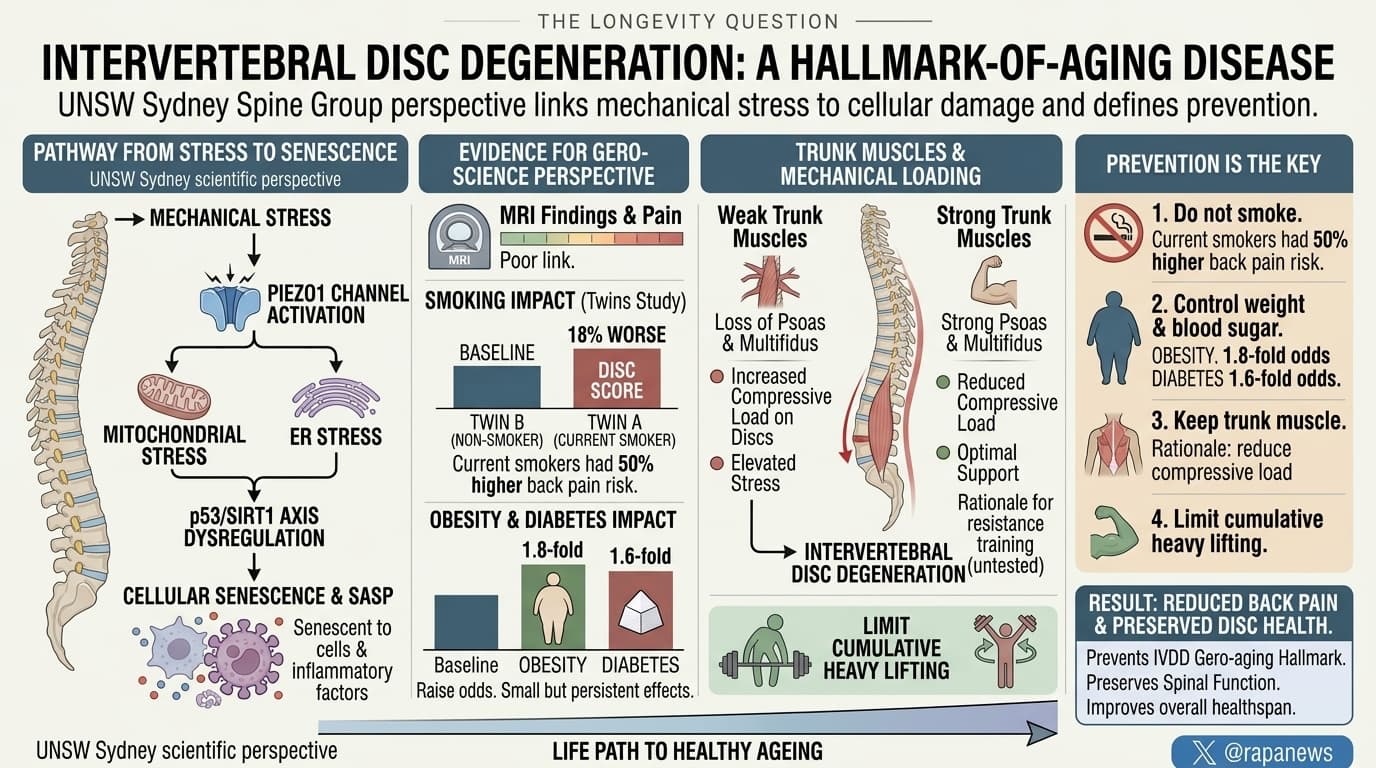
This GeroScience perspective from a UNSW Sydney spine group argues that intervertebral disc degeneration is a hallmark-of-aging disease, not simple mechanical wear. The authors link mechanical stress to cellular damage through a chain that runs from the PIEZO1 channel to mitochondrial and ER stress, the p53/SIRT1 axis, senescence and the SASP. They review the risk factors (sex and menopause, genetics, smoking, obesity, diabetes, occupational loading, gut microbiome), the poor link between MRI findings and pain, emerging imaging and blood biomarkers, and surgical evidence. Their conclusion is that surgery repairs the structural damage at the end of the cascade without touching the biology that drives it.
Most people picture a worn-out spine the way they picture worn-out tyres: too many miles, too much load. A new perspective in GeroScience from spine surgeons and researchers at the University of New South Wales argues that this picture is incomplete. They say the degenerating disc behaves like an aging organ, driven by the same cellular machinery that ages muscle, brain and blood vessels.
The disc starts aging very early. Cadaver studies show that cell density in the disc falls by up to a third between birth and age three, and keeps falling until about age 16. By age 50, more than 90 percent of adults show disc degeneration on imaging. The disc is the largest structure in the body without its own blood supply. Its cells depend on oxygen and glucose that diffuse in through thin cartilage endplates. As those endplates calcify with age, the disc slowly starves.
The authors assemble a self-reinforcing loop. Abnormal loading activates PIEZO1, a mechanosensitive ion channel, which floods disc cells with calcium. Mitochondria respond by producing excess reactive oxygen species, and the endoplasmic reticulum goes into stress. Chronic oxidative stress switches on p53, which suppresses SIRT1, a key regulator of mitochondrial quality control. Damaged mitochondria then stop being cleared, which produces more oxidants. Cells enter senescence and begin secreting inflammatory and matrix-degrading factors. The matrix stiffens and loses water, which makes loading worse and activates PIEZO1 even more.
Risk factors feed into this loop. In a Japanese cohort of 617 people, women had 41 percent higher odds of disc degeneration progressing, and years since menopause tracked with severity. Diabetes raised the odds of progression by about 60 percent, and obesity by about a third. Twin studies suggest genes outweigh most environmental exposures, and smokers’ discs scored 18 percent worse than those of their non-smoking identical twins. The review also highlights a contested “gut-disc axis,” in which microbial DNA has been recovered from degenerated discs and particular gut bacterial profiles have been linked to worse surgical recovery.
On the clinical side, the authors point to the gap between images and symptoms. Older patients often show moderate MRI changes that do not match how much pain they report. Several large trials found that fusion surgery for chronic back pain performs no better than intensive rehabilitation. Discectomy for a herniated disc relieves pain faster than conservative care, but the difference mostly disappears by one year. Only 17 to 37 percent of people with non-specific back pain ever fully recover.
The authors’ answer is to bring geroscience into the clinic. They propose quantitative MRI methods such as their own DeVa technique, blood and spinal fluid biomarkers, and pre-surgical microbiome profiling. They are candid that none of these tools has an established clinical role yet.
The underlying message holds up. Surgery treats the late consequences of degeneration and leaves the disease process untouched. Whether senolytics, mitochondrial interventions or metabolic control can change that process in humans has not been tested.
Actionable Insights
- Do not smoke. Current smokers had a 50 percent higher rate of developing new back pain over about 13 years, and risk climbed with each additional daily cigarette. Smokers’ discs scored 18 percent worse than their identical twins’.
- Control weight and blood sugar. Obesity raised the odds of disc degeneration about 1.8-fold, and diabetes raised the odds of progression about 1.6-fold. In standardized terms these are small effects (Cohen’s d around 0.2 to 0.3), but they persist for decades and can be changed.
- Keep trunk muscle. Loss of the psoas and multifidus muscles raises compressive load on the discs in computer models. This is a reasonable rationale for resistance training, though it has not been tested in trials.
- Limit cumulative heavy lifting. Heavy occupational loading raised the odds of degeneration 1.6 to 3.3-fold.
- For chronic back pain without nerve compression, choose rehabilitation before fusion. Outcomes were equivalent, and surgery carries more risk.
- Skip commercial “disc biomarker” tests. None is validated.
Context and Source
- Paper: The degenerating intervertebral disc leading to structural failure of the aging spine: from cellular pathways, risk factors, radiological diagnosis, to surgical management
- Institution: Spine Labs, St George and Sutherland Clinical School, University of New South Wales, with Royal Adelaide Hospital, Macquarie University Hospital and Xuanwu Hospital (Capital Medical University, Beijing)
- Country: Australia, with Chinese co-authors
- Journal: GeroScience (Springer)
- Impact evaluation: The impact score of this journal is 5.4, evaluated against a typical high-end range of 0 to 60+ for top general science, therefore this is a Medium impact journal.