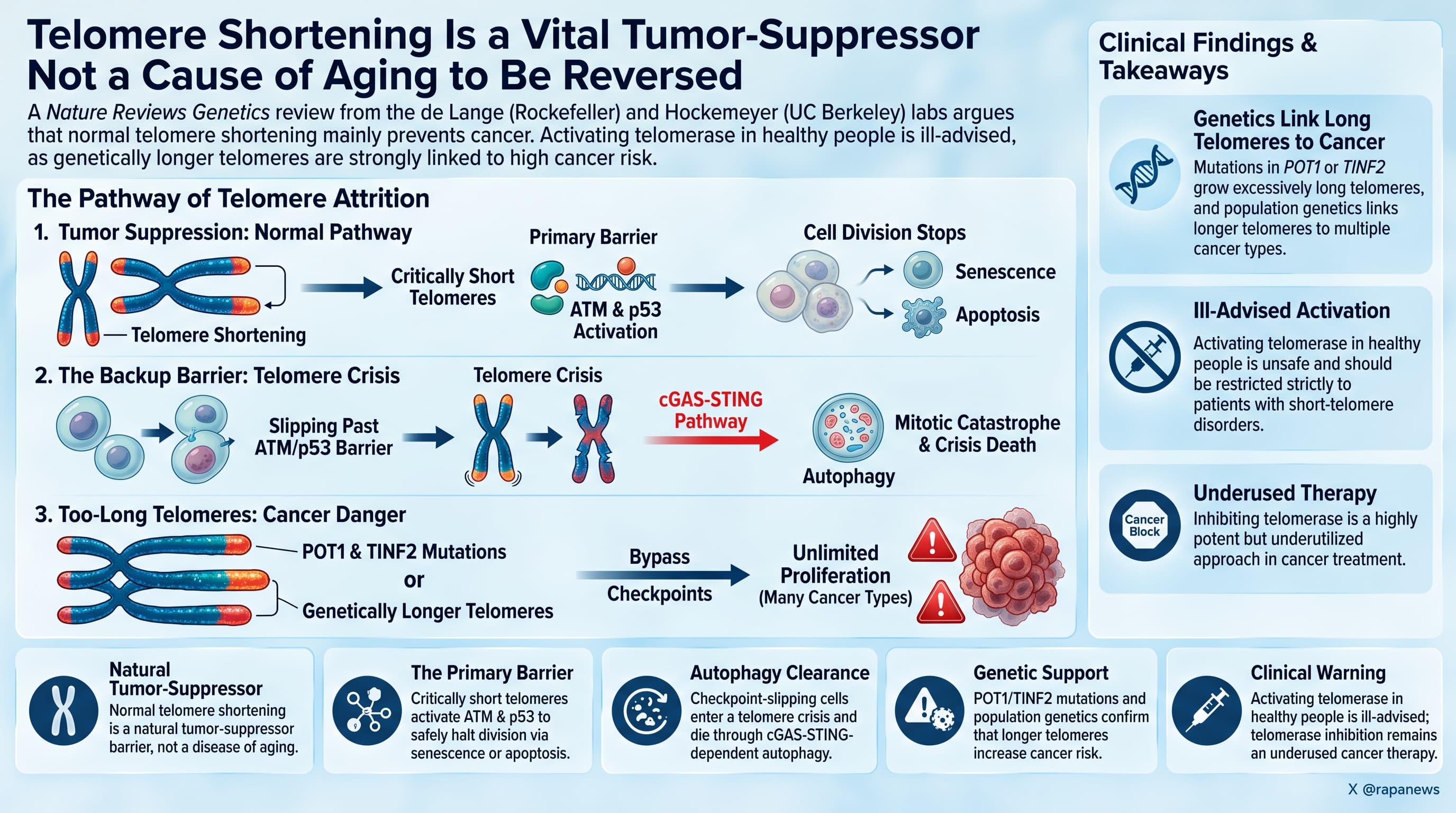
This Nature Reviews Genetics review from the de Lange (Rockefeller) and Hockemeyer (UC Berkeley) laboratories argues that normal telomere shortening is mainly a tumor-suppressor mechanism, not a cause of aging to be reversed. When a few telomeres become critically short, ATM and p53 stop cell division through senescence or apoptosis. Cells that slip past this barrier enter telomere crisis and die through cGAS-STING-dependent autophagy. The strongest new support comes from families with POT1 or TINF2 mutations, whose telomeres grow too long during development and who develop many cancer types, and from population genetics linking genetically longer telomeres to higher cancer risk. The authors conclude that activating telomerase in healthy people is ill-advised and should be limited to patients with short-telomere disorders. They also see telomerase inhibition as an underused cancer therapy.
For two decades the longevity world has treated telomeres like a fuel gauge: long is good, short is bad, and anything that tops up the tank must be a win. A new review from Titia de Lange at Rockefeller University and Dirk Hockemeyer at UC Berkeley argues that the gauge is wired the other way, at least for cancer.
Their core claim is that the steady loss of telomeric DNA in dividing cells is not a design flaw that causes aging. It is a cancer brake. Most adult human cells keep the telomerase gene, TERT, switched off. Each division trims the chromosome ends. When about five telomeres become critically short, the ATM damage sensor fires, p53 halts the cell, and the cell either senesces or dies. A would-be tumor cell that has already lost p53 keeps dividing until its chromosomes fuse and shatter. This state, called telomere crisis, kills most such cells through a cGAS-STING-driven form of autophagy. Cancer escapes only by switching telomerase back on, most often through mutations in the TERT promoter.
The strongest new evidence comes from families with inherited mutations in two shelterin genes, POT1 and TINF2. These people do not lack telomere protection, because one working copy of either gene protects chromosome ends normally. What they lose is the brake on telomere length. Their telomeres overgrow during embryonic development, so emerging tumor clones get many extra divisions before they hit the wall. The families develop melanoma, gliomas, sarcomas, lymphomas and other cancers at high rates. Population genetics points the same way: inherited variants for longer telomeres raise the risk of several cancers.
Long-read nanopore sequencing has also changed the numbers. Telomeres at birth appear to be 7.5 to 8.5 kilobases, not the 10 to 12 assumed for decades. They shrink by about 40 base pairs per division, slower than older estimates. On paper that margin looks too generous to stop cancer. The authors’ answer is that the shortest telomeres set the limit, not the average, and the same chromosome arms (17p, 20q, 12p) carry the shortest telomeres in nearly everyone.
There is a mitochondrial twist. Cells grown at the oxygen levels found in real tissue live longer in culture than cells grown in room air, but not because their telomeres shrink more slowly. Low oxygen paradoxically raises mitochondrial reactive oxygen species, which lock ATM into a crosslinked form that cannot respond to short telomeres. Oxygen tension therefore sets how short counts as “too short”, which may explain why the high-oxygen lung, esophagus and mouth suffer first in telomere disease.
The practical message is blunt. The authors argue that telomere-lengthening therapies belong only to patients with genuine short-telomere disorders, ideally applied briefly and outside the body. The other side is therapeutic: the telomerase inhibitor imetelstat is now approved for lower-risk myelodysplastic syndromes, and new atomic structures of telomerase could guide better drugs.
The case is persuasive, but much of the key human evidence rests on a small number of families and on genetic associations. Nobody has run a trial of adult telomerase activation and counted cancers.
Actionable Insights
- Reconsider telomerase activators. Supplements sold as telomerase activators (cycloastragenol, TA-65, astragalus extracts) and experimental TERT gene therapy aim to do what this review warns against. For long-term cancer outcomes in healthy adults: Safety Data Absent.
- A “long telomere” test result is not automatically good news. In a large Mendelian randomization study, each standard-deviation increase in genetically longer telomeres raised the odds of melanoma by 87% (odds ratio 1.87), lung adenocarcinoma about threefold (3.19) and glioma about fivefold (5.27). For a cancer with a 2% lifetime risk, an odds ratio of 1.87 moves you to roughly 3.7%. The same variants lowered coronary heart disease odds by 22% (0.78), so this is a trade-off, not a one-way verdict.
- Watch family history. Several relatives with melanoma, glioma, sarcoma or lymphoma, and no TP53 or BRCA explanation, warrants asking a genetic counselor about POT1 and TINF2.
- Telomerase inhibition works, modestly. Imetelstat produced 8-week transfusion independence in 39.8% of patients versus 15.0% on placebo. That means about 1 extra responder for every 4 patients treated.
Context and Source
- Open Access Paper: How telomere attrition protects against cancer
- Institutions: Rockefeller University (New York) and University of California, Berkeley; first author now at Boston Children’s Hospital
- Country: United States
- Journal: Nature Reviews Genetics
- Impact Evaluation: The impact score of this journal is 51.4 (Clarivate JIF, June 2026 release, 2025 citation data), evaluated against a typical high-end range of 0–60+ for top general science, therefore this is an Elite impact journal.